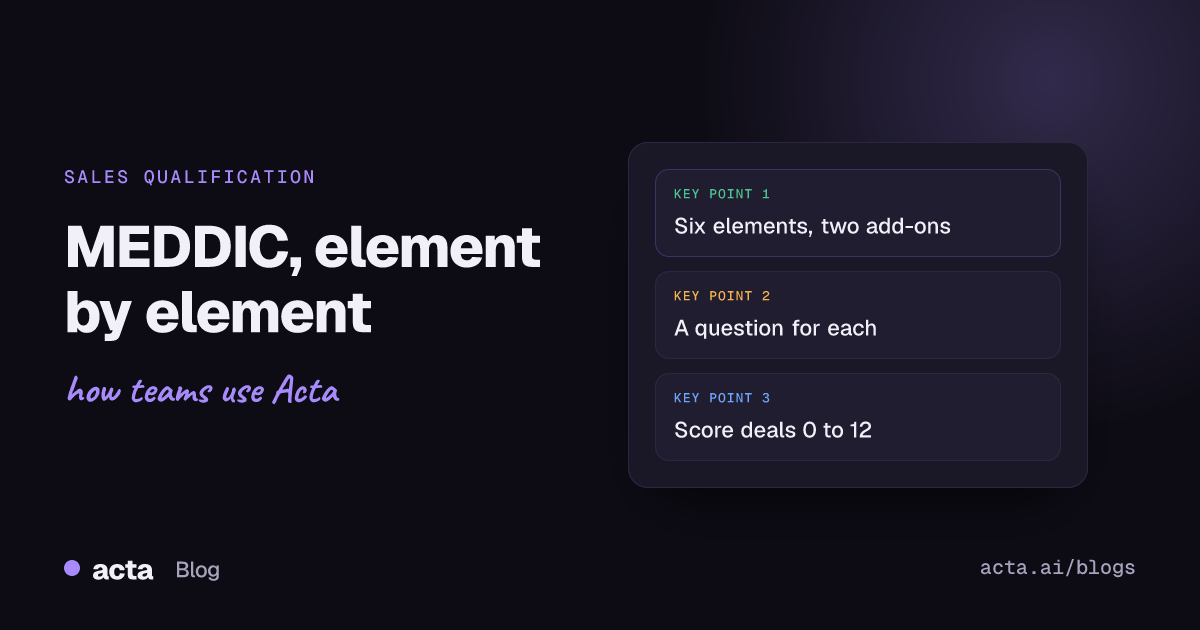
The MEDDIC sales methodology is a checklist for qualifying complex B2B deals. It has six elements: Metrics (the measurable gain), Economic buyer (who signs), Decision criteria (how they'll judge), Decision process (the steps to a yes), Identify pain (the problem worth paying to fix) and Champion (the insider selling for you). If you can't fill in all six with evidence, the deal is riskier than your forecast says.
This guide goes through each element one by one: what to capture, a question to ask and the red flag that should worry you. It then adds the two elements MEDDPICC brings, scores a fictional deal and compares MEDDIC with BANT and SPICED. It's for account executives, sales managers and founders selling to committees. If your deals close on one call with one person, MEDDIC is more process than you need.
Key takeaways
- MEDDIC has six elements; MEDDICC adds Competition, and MEDDPICC adds Paper process and Competition, for eight in total.
- Score each element 0 (unknown), 1 (assumed) or 2 (confirmed with evidence). A deal under 8 out of 12 shouldn't be in commit.
- Economic buyer and Champion are the elements reps most often mark green on hope. Ask for proof: a meeting held, an action taken.
- Spread the questions across three or four calls. Asking all six in a first discovery call feels like an audit.
- Write the evidence, not just the status. "Champion: Sara, set up the CFO meeting on 4 Nov" beats "Champion: yes".
Table of contents
- The MEDDIC sales methodology came from enterprise software selling
- Eight elements compared at a glance
- Metrics and the economic buyer prove the deal is worth funding
- Decision criteria and process show how the yes happens
- Pain and a champion give the deal a reason and a voice
- MEDDPICC adds paper process and competition
- A scored example shows MEDDIC in a real-looking deal
- MEDDIC works best alongside lighter methods
- Frequently asked questions
- Put MEDDIC into your next deal review
The MEDDIC sales methodology came from enterprise software selling
Most accounts trace MEDDIC to PTC (Parametric Technology Corporation) in the mid-1990s. The usual story, told in MEDDICC's history of the framework among others, is that Dick Dunkel and Jack Napoli looked at why PTC won, lost and slipped deals, working under sales leader John McMahon, and found the same handful of factors behind all three. Exact dates vary between sources, so treat the details as the commonly told version rather than settled history.
What matters more is what it was built for: long, expensive deals with several people involved. MEDDIC isn't a talk track. It's a list of things you must know before you can honestly forecast a deal. Salesforce's MEDDIC overview describes it the same way, as a sales qualification framework, and notes that the economic buyer and the champion can be the same person, though the champion is often lower in the hierarchy.
Since then it has picked up variants. MEDDICC adds Competition. MEDDPICC adds Paper process as well. The core six haven't changed.
Eight elements compared at a glance
The first six rows are classic MEDDIC; the last two come from MEDDPICC. Use the table as a cheat sheet in deal reviews.
| Element | What you need to know | Question to ask | Red flag |
|---|---|---|---|
| Metrics | The measurable gain they expect | "How would you measure success a year from now?" | No number, only "efficiency" |
| Economic buyer | Who can approve the spend | "Who signs off on a purchase this size?" | Nobody has met them |
| Decision criteria | How options will be judged | "What will you compare vendors on?" | Criteria written by a rival |
| Decision process | Steps, people and dates to a yes | "What happens after you pick a vendor?" | "We'll figure it out" |
| Identify pain | The problem and its cost | "What happens if you change nothing?" | Pain is nice-to-fix |
| Champion | An insider with influence who sells for you | "Can you get us time with the CFO?" | Friendly but no access |
| Paper process | Legal, security and procurement steps | "Who reviews contracts and how long does it take?" | First heard in the final week |
| Competition | Who else, including doing nothing | "What else are you considering?" | "Nobody", said too quickly |
Metrics and the economic buyer prove the deal is worth funding
Metrics
What to capture: The number the buyer expects to move, its current value and the target. Hours saved per month, cost per ticket, churn rate, days to close the books. Tie it to something the economic buyer already tracks.
Ask: "If this works, what changes in your numbers, and who would notice?"
Red flag: The metric is yours, not theirs. If your champion can't repeat the number in their own words, it won't survive the budget meeting.
Economic buyer
What to capture: The person who can say yes to the money and say no when everyone else says yes. Name, title, what they care about, whether you've met them.
Ask: "For a purchase of this size, who has the final say on budget?" Then: "What would they need to see?"
Red flag: Every attempt to meet them gets deflected. That's not a scheduling problem, it's a qualification problem.
Decision criteria and process show how the yes happens
Decision criteria
What to capture: The technical, financial and business criteria they'll use to compare options, ideally in writing. Integration with their CRM, security review, price per seat, time to roll out.
Ask: "When you compare vendors, what will you score them on, and which matters most?"
Red flag: The criteria look like a competitor's feature list. Someone got there first and shaped them.
Decision process
What to capture: Every step between today and a signature: evaluation, pilot, business case, approvals, with names and dates.
Ask: "Walk me through what happened the last time you bought software like this."
Red flag: The buyer can't describe it. Deals with no known process slip, usually past quarter end.
Pain and a champion give the deal a reason and a voice
Identify pain
What to capture: The business problem, who feels it, what it costs and why it matters now. Pain is what makes the Metrics urgent.
Ask: "What happens if you don't solve this this year?" For more ways in, see these discovery call questions that reveal buying intent.
Red flag: The pain is real but small. A problem nobody senior will spend political capital on is a nice-to-have.
Champion
What to capture: Someone inside who has influence, wants you to win and will act on it when you're not in the room.
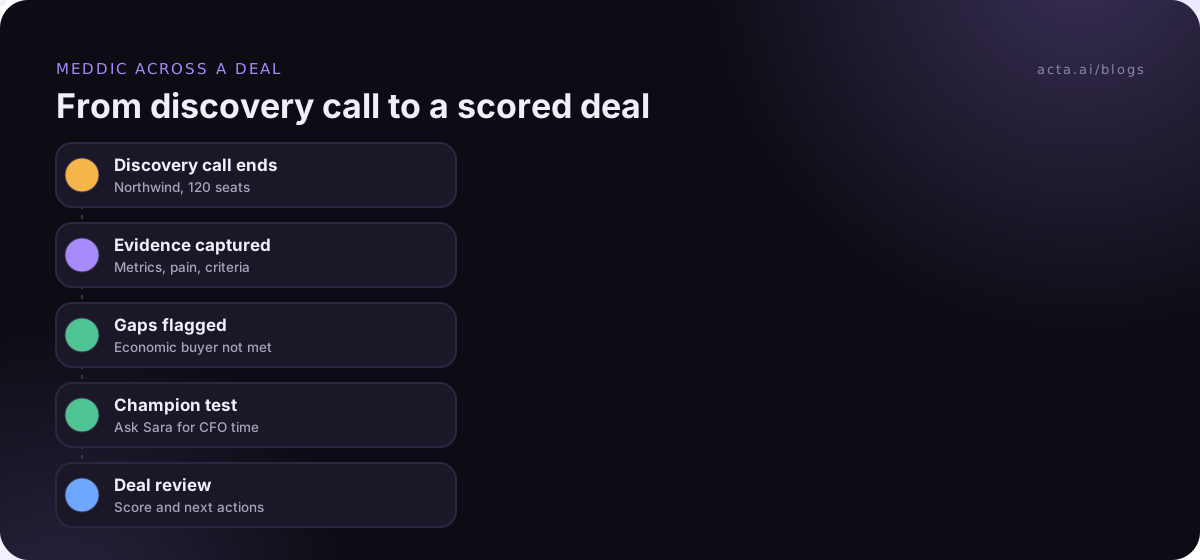
Ask: Test, don't ask. Request something only a champion would do: "Could you set up 20 minutes with your CFO next week?"
Red flag: A friendly contact who shares information but never opens a door. That's a coach, not a champion.
MEDDPICC adds paper process and competition
Paper process
What to capture: Legal review, security questionnaire, procurement, vendor onboarding, signature authority and how long each usually takes.
Ask: "Once you've chosen, what has to happen for a contract to be signed, and how long did it take last time?"
Red flag: You discover a four-week security review in the week you planned to close.
Competition
What to capture: Other vendors, internal builds and the option of doing nothing, plus how the buyer sees each.
Ask: "What else are you looking at, including fixing it in-house?"
Red flag: No competitors named in a big deal. Usually it means you haven't been told, not that there aren't any.
If your team wants the full eight, our post on MEDDPICC questions that don't slow the call has more phrasing for each.
A scored example shows MEDDIC in a real-looking deal
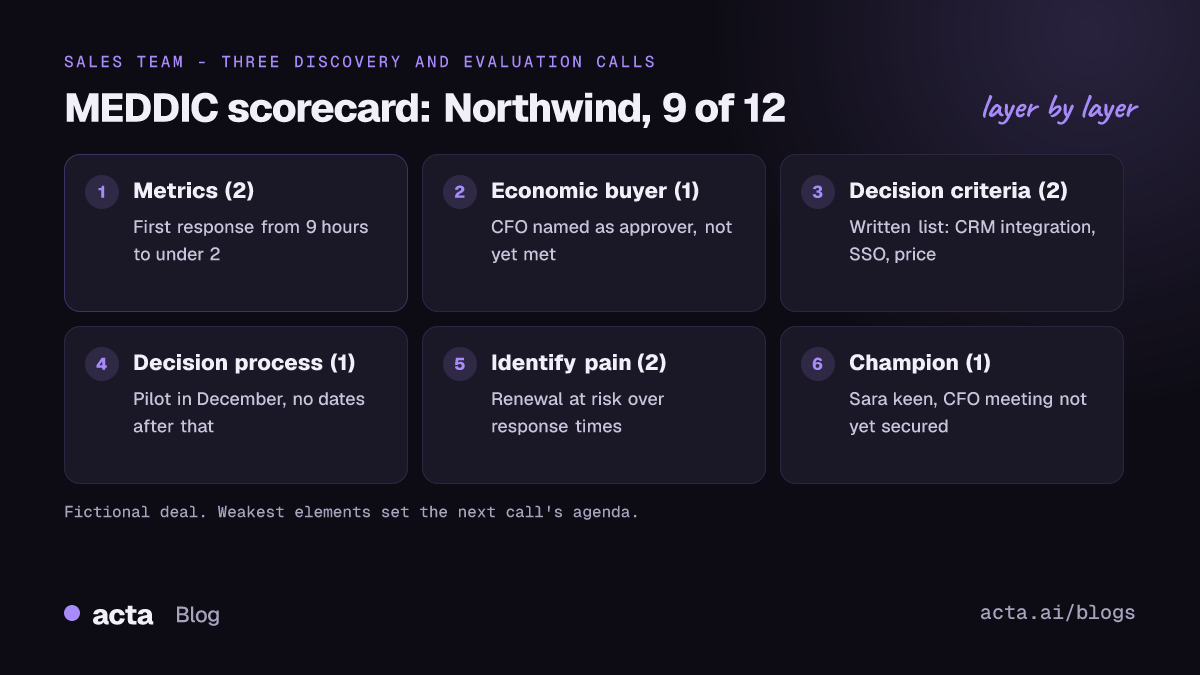
Here's a fictional mid-market deal after three calls, scored 0 to 2 per element.
Deal: Northwind Logistics, 120-seat rollout of a support platform. Rep: Priya. Stage: evaluation.
Metrics (2): Cut average first response time from 9 hours to under 2; Head of Support tracks it monthly.
Economic buyer (1): CFO Tom Hale named as approver; not yet met.
Decision criteria (2): Written list received: Salesforce integration, SSO, price per seat, rollout under 60 days.
Decision process (1): Pilot in December, then "a business case to finance". No dates after the pilot.
Identify pain (2): Two enterprise customers complained about response times in their QBRs; one renewal at risk.
Champion (1): Sara, Support Ops lead, enthusiastic and shares information, but hasn't yet secured the CFO meeting.
Score: 9 of 12. Next actions: Sara to request 20 minutes with Tom by 22 Nov (tests her as champion and covers the economic buyer); Priya to map dates for the post-pilot steps.
Nine out of twelve looks healthy, but both weak spots are the ones that kill deals late. That's the value of scoring: it points the next call at the gaps, not the comfortable topics.
MEDDIC works best alongside lighter methods
MEDDIC is thorough and slow to fill in. Other frameworks trade depth for speed.
- BANT (Budget, Authority, Need, Timeline) is a quick first filter for inbound leads. It's lighter than MEDDIC and says little about how the decision gets made. See our BANT sales methodology explainer.
- SPICED (Situation, Pain, Impact, Critical event, Decision) focuses on the customer's story and urgency, which suits recurring-revenue sales. Our SPICED comparison lines it up with others.
- MEDDPICC is MEDDIC plus Paper process and Competition, worth the extra two fields once deals involve procurement and security reviews.
A common setup is BANT or SPICED for early qualification and MEDDIC or MEDDPICC once an opportunity enters the forecast, often alongside a messaging method like Command of the Message. For a call agenda that blends both, see our discovery call template with BANT and MEDDIC questions.
Learning the framework takes an afternoon. Keeping the fields current after every call is the part teams struggle with. Acta writes notes from sales calls and has a MEDDPICC deal report among its report templates, so the evidence for each element comes from what the buyer said. If a bot in the call feels wrong for a senior buyer, the desktop app captures it from your own computer; either way, follow this guide on telling people before recording.
Frequently asked questions
What does MEDDIC stand for?
MEDDIC stands for Metrics, Economic buyer, Decision criteria, Decision process, Identify pain and Champion. Some teams use MEDDICC, adding Competition, or MEDDPICC, which adds Paper process and Competition. All versions share the same idea: list what you must know about a complex deal before you can forecast it with confidence.
Is MEDDIC a sales methodology or a qualification framework?
Strictly, it's a qualification framework: it tells you what to find out, not how to pitch. People call it the MEDDIC sales methodology because teams build their deal reviews, CRM fields and forecasting around it. Many pair it with a selling approach such as Challenger or SPIN for how to run the conversation itself.
When should you not use MEDDIC?
Skip full MEDDIC for small, fast deals: self-serve upgrades, single-buyer purchases, or anything that closes in one or two calls. The effort of filling in six elements outweighs the forecast benefit. Use BANT or a short checklist there, and save MEDDIC for deals with several stakeholders, a formal evaluation and a long cycle.
How do you tell a champion from a coach?
A coach gives you information. A champion takes action for you when you're not there: books the meeting with the economic buyer, pushes back on a rival's criteria, shares the internal business case. Test by asking for one specific action. If it doesn't happen, keep them as a coach and keep looking for a champion.
How do you track MEDDIC in a CRM?
Add one field per element with a status (unknown, assumed, confirmed) and a short evidence note, then review the weakest fields in pipeline meetings. The challenge is keeping the fields updated after every call, which is why many teams pull them from call notes rather than memory. Our guide to updating the CRM after sales calls covers the options.
Put MEDDIC into your next deal review
You don't need a rollout program to start. Try this on your three biggest open deals this week.
- Score every element: 0, 1 or 2, with a one-line piece of evidence for each.
- Find the two weakest: Those become the agenda for the next call, not a recap of what you already know.
- Test the champion: Ask for one concrete action, such as a meeting with the economic buyer.
- Map the paper process: Even if you use plain MEDDIC, ask about legal and security before the final month.
- Write it where the team can see it: CRM fields or a shared deal note, updated after each call.
To keep the evidence for each element without typing during calls, try the Acta desktop app with a 15-day free trial from the pricing page.