The Sandler sales methodology is a seven-step selling system that treats the buyer and seller as equals and puts qualification ahead of presentation. You agree an up-front contract for each conversation, dig into the buyer's real pain with a funnel of questions, settle budget and the decision process, and only then present a solution. If any step is missing, you don't move on, and "no" is an acceptable outcome.
This guide explains where the Sandler sales methodology came from, what each step involves, the questions reps actually use, and a filled-in example from a fictional deal. It also compares Sandler with SPIN, MEDDIC and Challenger. It's written for sales reps and managers deciding whether to train on it. If your deals are mostly self-serve or transactional, Sandler's slow, question-heavy discovery will feel like overkill.
Key takeaways
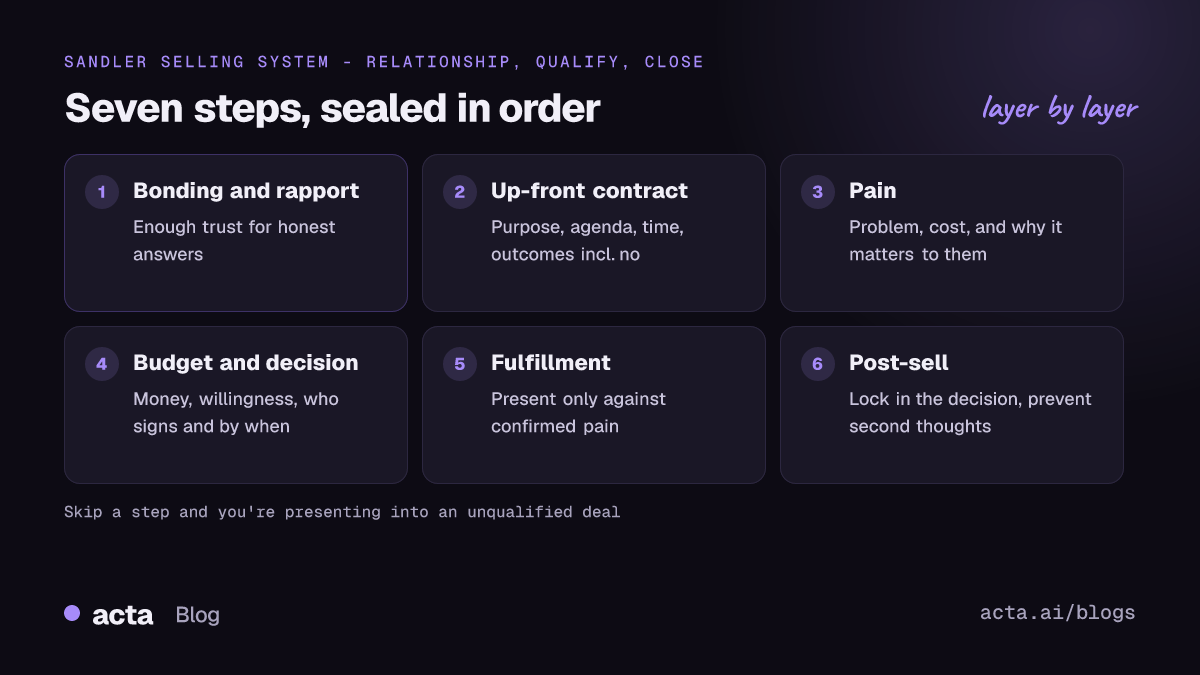
- Sandler has seven steps: bonding and rapport, up-front contract, pain, budget, decision, fulfillment and post-sell.
- The up-front contract sets the purpose, agenda, time and possible outcomes of a call, including the buyer's right to say no.
- The pain funnel moves from broad questions ("Tell me more about that") to cost and personal impact, so the buyer states the problem in their own words.
- Budget and decision come before any demo or proposal; presenting early is the most common way reps break the system.
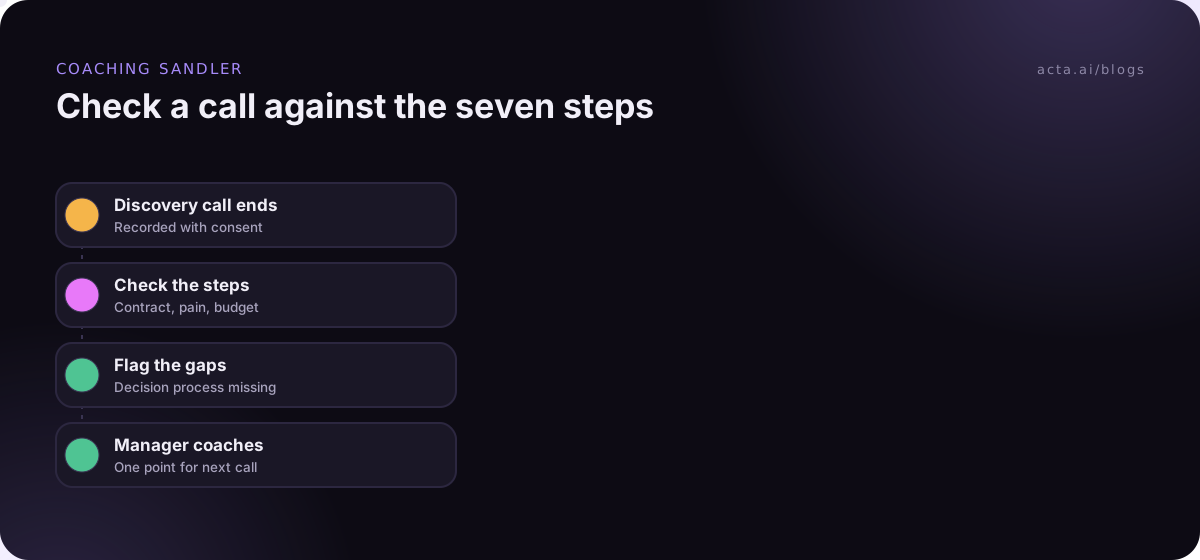
- Recorded calls make Sandler coachable: a manager can check in minutes whether the up-front contract was set and how deep the pain questions went.
Table of contents
- Sandler started as a reaction to high-pressure selling
- The Sandler sales methodology runs in seven steps
- The up-front contract sets the rules of each call
- The pain funnel moves from surface problem to impact
- A filled-in Sandler example from a fictional deal
- Sandler compared with SPIN, MEDDIC and Challenger
- Run Sandler on real calls, then coach from the recording
- Where Acta fits
- Frequently asked questions
- Decide whether Sandler fits your team
Sandler started as a reaction to high-pressure selling
The system is named after David Sandler. Sandler's own corporate story describes him as the creator of the methodology and founder of the organization, and Sandler-affiliated pages date the company to 1967 in the Baltimore area. Accounts of the founding story vary between sources, so I'd treat the colourful details with some caution.
The idea that has lasted is simpler than the history. Traditional selling, as Sandler saw it, had the seller chasing, pitching and pushing for a close while the buyer held all the cards and withheld information. Sandler flipped that. The seller asks more than they tell, agrees the rules of each conversation in advance, and is willing to walk away from a deal that doesn't qualify.
Sandler often explained the process with a submarine: a series of compartments, where you seal each one before moving to the next. A missing compartment sinks the boat, and a skipped step sinks the deal.
The Sandler sales methodology runs in seven steps
The seven steps are usually grouped in three parts: building the relationship, qualifying, and closing. HubSpot's Sandler beginner's guide walks through them in order and makes a point many reps miss: budget is a qualification topic, discussed early, not a late-stage negotiation.
- Bonding and rapport. Enough trust that the buyer will speak honestly. Not small talk for its own sake.
- Up-front contract. Agreement on what this call is for, how long it runs and what happens at the end.
- Pain. The business problem, its cost and why it matters to this person. No pain, no deal.
- Budget. Whether there's money, and whether the buyer is willing to spend it on this problem.
- Decision. Who decides, how, by when, and what could stop it.
- Fulfillment. Presenting your solution, but only against the pains, budget and decision process you've confirmed.
- Post-sell. Locking in the decision, heading off second thoughts and competitor counter-offers, and setting up the next stage of the relationship.
The order is the point. Most reps are tempted to jump from step 3 straight to step 6, because the demo is the fun part. In Sandler terms, that's presenting into a deal you haven't qualified.
The up-front contract sets the rules of each call
An up-front contract is a short, spoken agreement at the start of a conversation. It covers four things: the purpose, the agenda, the time, and the possible outcomes. The outcomes part is the one that feels uncomfortable the first few times, because you invite the buyer to say no.
A typical version on a first discovery call:
"Thanks for the time. We've got 30 minutes, does that still work? I'd like to ask about how you schedule drivers today and where it hurts, and you'll probably want to ask how we're different. At the end, one of three things happens: it's clearly not a fit and you tell me so, it might be a fit and we book a second call with whoever else should be involved, or we need more information first. Is that fair?"
Two rules make it work. Get an actual "yes" before you continue. And set a new contract at the start of every call, not just the first one. A rep without an up-front contract has no agreed basis for asking "so what happens next?" when the call ends.
The pain funnel moves from surface problem to impact
The pain funnel is a sequence of open questions that starts broad and narrows to the cost and personal impact of the problem. Sandler's own pain funnel starts with "Tell me more about that", and guides from HubSpot and Pipedrive each lay out their own version of the full progression. Here's a typical run, in my wording:
- "Tell me more about that."
- "Can you be more specific? Give me an example."
- "How long has this been going on?"
- "What have you tried to do about that?"
- "Did that work?"
- "What does this cost the business, roughly?"
- "How do you feel about that?"
- "Have you given up trying to fix it?"
The early questions surface the problem. The middle ones test whether it's real and recurring. The last ones get to why this person cares, which is what moves a deal when the budget conversation comes. Don't fire them like a checklist. Use the buyer's last answer to pick the next question, and stay quiet long enough for a real reply.
A filled-in Sandler example from a fictional deal
Here's how one deal might look after the first two calls. The seller is Dana, an account executive at a fleet-scheduling software company. The buyer is Marco, operations director at Northfield Logistics, a fictional regional delivery firm with about 80 drivers.
- Bonding and rapport: Both previously worked in warehouse ops; Marco was candid from minute five.
- Up-front contract: 30 minutes, agreed outcomes of no-fit, second call with finance, or more info needed. Marco chose the second call.
- Pain: Schedules built in spreadsheets every evening by two supervisors. About 10 hours a week of overtime between them. Missed delivery windows on Mondays. Marco: "I'm the one who gets the angry calls."
- Budget: No line item yet. Marco can approve tools under a set limit; above that goes to the CFO. He'd fund it from the overtime it removes.
- Decision: Marco recommends, CFO Priya signs off, IT checks the data connection. Target: live before the busy season in nine weeks.
- Fulfillment: Demo booked for the second call, covering only Monday routing and the evening scheduling job. No feature tour.
- Post-sell: Not reached. Dana's note to self: ask Priya on the next call what would make her change her mind after signing.
Notice what's absent: no proposal, no pricing deck, no "let me show you everything". If Priya had said on the second call that budget was frozen until next year, Dana would have stopped, agreed a date to revisit, and moved on. That's the system working.
Sandler compared with SPIN, MEDDIC and Challenger
Sandler isn't the only way to run discovery, and Sandler vs SPIN is a comparison reps often ask about. Here's how it lines up with the methods most teams consider.
| Method | Core idea | Best for | Watch out for |
|---|---|---|---|
| Sandler | Equal footing, qualify hard, buyer may say no | Reps who chase and over-present | Can feel scripted if rehearsed badly |
| SPIN | Situation, Problem, Implication, Need-payoff questions | Complex needs discovery | Says little about deal process |
| MEDDIC / MEDDPICC | Checklist of what a qualified enterprise deal needs | Forecasting larger deals | Tells you what to find, not how to ask |
| Challenger | Teach the buyer something, tailor it, take control | Buyers who think they know the answer | Hard for junior reps to pull off |
In practice many teams mix them: Sandler's up-front contract and pain funnel for how to run the call, MEDDPICC for what the deal record must contain. If that's your setup, our guides to MEDDPICC deal reports and SPIN selling deal reports show how to capture the fields from each call. For other frameworks, see the Miller Heiman sales methodology, the BANT sales methodology and the Challenger sales methodology explainers.
Run Sandler on real calls, then coach from the recording
Sandler is easy to agree with and hard to do under pressure. The fix is short, specific review after real calls.
- Write your up-front contract down and say it in the first two minutes of every call.
- Keep a pain funnel card next to your screen with five or six questions. Go at least three levels deep before you change topic.
- Ask about budget and decision on the first or second call, before any demo.
- Record the call, with consent, and check it against the seven steps afterwards. Our post on coaching from call recordings has a review routine, and this guide to recording consent covers what to tell the buyer.
- Coach one thing at a time. "Your up-front contract had no outcomes" is coachable. "Be more Sandler" isn't.
Listening back is uncomfortable the first time. You'll hear yourself answer your own questions and present ten minutes too early. That's the point of doing it. For more discovery questions that pair well with the funnel, see discovery call questions that uncover buying intent.
Where Acta fits
Acta records sales calls on Zoom, Google Meet and Teams, writes the transcript with speaker names, and fills deal reports from its report templates, including MEDDPICC, SPIN and BANT, which you can push to Salesforce, HubSpot or Zoho. There's no dedicated Sandler template, so teams usually pair a deal report with a quick manual check of the up-front contract and pain questions. More on the sales page.
Frequently asked questions
What are the 7 steps of the Sandler selling system?
Bonding and rapport, up-front contract, pain, budget, decision, fulfillment and post-sell. The first two build an equal relationship, the middle three qualify the deal, and the last two cover presenting the solution and keeping the decision firm. You complete each step before moving to the next, which is the submarine idea behind the system.
What is an up-front contract in sales?
It's a short agreement at the start of a call on purpose, agenda, time and possible outcomes. The outcomes include the buyer saying "this isn't a fit". Getting an explicit yes to the contract gives both sides permission to be direct, and gives the seller a fair basis for asking about next steps at the end.
Is the Sandler sales methodology still relevant?
Its core habits are: agree the purpose of each call, understand the buyer's problem before presenting, and qualify money and decision early. Buyers today often research before talking to sales, so the bonding and pain steps may be shorter. Many teams keep Sandler's call technique and add a framework like MEDDPICC for deal tracking.
What is the difference between Sandler and SPIN selling?
SPIN is a questioning model: situation, problem, implication and need-payoff questions. Sandler is a whole sales process with steps for rapport, contracts, budget, decision and post-sale. The pain funnel and SPIN's implication questions do similar work. You can use SPIN-style questions inside Sandler's pain step without any conflict.
How long does it take to learn Sandler?
The concepts take an afternoon. Doing it on live calls takes weeks of practice and review, mainly to stop presenting early and to say the up-front contract naturally. Recording calls and reviewing one step per week speeds this up more than reading another book does.
Decide whether Sandler fits your team
Sandler suits teams whose reps chase, over-present or accept vague next steps. Check these before you commit to training.
- Check your deal type: considered B2B purchases with real discovery benefit most.
- Listen to five calls: count how many had an agreed agenda and outcome at the start.
- Find where deals stall: if it's after the demo, budget and decision are probably being skipped.
- Pick a tracking framework: Sandler for running the call, MEDDPICC or BANT for the deal record.
- Plan the coaching: one step per week, reviewed on recorded calls.
To review your own calls without a bot in the room, record them with Acta's desktop app or Chrome extension and try it free for 15 days on the pricing page.