The SPICED sales methodology is Winning by Design's discovery framework: Situation, Pain, Impact, Critical Event and Decision. It's built to understand a customer's problem well enough to sell, and later renew, against it. Below, SPICED sits next to seven other common sales methodologies (BANT, CHAMP, GPCTBA/C&I, MEDDIC, SPIN, Gap Selling and Challenger) so you can see what each covers and when it beats SPICED.
This is a comparison of methods, not software. Every framework here is free to use; what costs money is training, certification and coaching. If you already know SPICED and want it written up from your calls automatically, our post on SPICED deal reports from sales calls covers that side.
Key takeaways
- SPICED is a discovery structure; BANT and MEDDIC are qualification checklists. They answer different questions and often work best together.
- Impact and Critical Event are the letters reps tend to rush. Without them you have a nice problem description and no reason to buy this quarter.
- Pick SPICED for subscription and SaaS sales where renewal depends on delivering the promised impact.
- Add MEDDIC's Economic Buyer and Champion checks once deals involve a buying committee and procurement.
- Challenger is a selling style, not a checklist, and pairs with any of the others.
Table of contents
- The SPICED sales methodology covers five things in order
- SPICED and seven other methods compared side by side
- Discovery-led methods sit closest to SPICED
- Qualification checklists inspect the deal rather than run the call
- Challenger changes how you sell, not what you check
- A SPICED example shows how the parts connect
- Pair SPICED with a checklist when deals get complex
- Frequently asked questions
- Choose your discovery framework with this checklist
The SPICED sales methodology covers five things in order
Winning by Design's SPICED framework page defines the five parts roughly like this. Situation is the facts and background about the customer. Pain is the challenge that brought them to you. Impact is how solving it affects their business. Critical Event is the deadline by which they need that impact. Decision is the process, people and criteria for buying. They also say SPICED can come out in a single qualification call or over several discovery meetings.
Here are SPICED discovery questions I'd use for each part. Keep Situation short; buyers hate repeating what's on their website.
- Situation: "How is the team set up today, and what are you using for this?"
- Pain: "What's not working? When did you first notice it?"
- Impact: "If that's fixed, what changes? What's it costing you now in time, money or customers?"
- Critical Event: "Is there a date this has to be solved by? What happens on that date?"
- Decision: "Who else gets involved, and how did you choose the last tool like this?"
The order matters. Pain without Impact is a complaint. Impact without a Critical Event is a nice-to-have. A real critical event is something like a contract renewal, a launch, an audit or a new team starting, not "we'd like it by Q2".
SPICED and seven other methods compared side by side
| Method | Main focus | Best for | Cost to adopt |
|---|---|---|---|
| SPICED | Pain, impact and urgency | SaaS and subscription sales | Free; paid training |
| BANT | Can and will they buy | Inbound leads, short cycles | Free |
| CHAMP | BANT, pain first | SDR qualification | Free |
| GPCTBA/C&I | Goals, plans, consequences | Consultative mid-market sales | Free |
| MEDDIC | Deal inspection | Complex enterprise deals | Free; paid training |
| SPIN Selling | Question sequence | Large, considered sales | Book; paid training |
| Gap Selling | Current vs future state | Problem-led discovery | Book; paid training |
| Challenger | Teach, tailor, take control | Buyers who need a new view | Book; paid training |
Checked on 12 November 2026; training prices aren't published by most providers, so confirm on each provider's site.
Discovery-led methods sit closest to SPICED
SPICED
Best for: SaaS and other recurring-revenue businesses, where the same Impact you sell on is what the customer checks at renewal. Pros: easy to teach, maps cleanly to CRM fields, and the Impact you capture carries through to onboarding and customer success. Cons: Decision is one letter for what is often the hardest part of an enterprise deal; it says less than MEDDIC about economic buyers and champions. Cost: the framework is published freely by Winning by Design, which sells training and consulting.
SPIN Selling
Best for: large, considered purchases where the buyer needs help seeing how big the problem is. Pros: Neil Rackham's 1988 book, based on research by his firm Huthwaite, gives a clear sequence of Situation, Problem, Implication and Need-payoff questions. Implication questions are the best training I know for getting reps past surface pain. Cons: it's a questioning method, not a qualification record; it doesn't tell you who decides or by when. Cost: the book, plus optional paid training. Our SPIN selling deal report post shows the structure filled in.
Gap Selling
Best for: teams that want discovery to centre on the gap between the customer's current state and the future state they want. Pros: Keenan's approach, taught by his firm A Sales Growth Company, forces reps to understand root causes before pitching anything. Cons: overlaps heavily with SPICED's Situation, Pain and Impact, and doesn't add much on deal process. Cost: the 2018 book, plus paid training.
Qualification checklists inspect the deal rather than run the call
BANT
Best for: inbound leads and short cycles where you need a fast yes or no. Pros: four facts (Budget, Authority, Need, Timeline) any new rep can learn in a day. Cons: budget-first thinking doesn't fit buyers who create budget once a problem is proven. Our explainer on the BANT sales methodology covers it in depth. Cost: free.
CHAMP
Best for: SDR teams that like BANT's simplicity but want to lead with the buyer's problem. Pros: Challenges, Authority, Money and Prioritisation is BANT reordered so pain comes first. Cons: still a filter, with little to say about how to run discovery. Cost: free.
GPCTBA/C&I
Best for: consultative mid-market selling. Pros: HubSpot's extension of BANT adds Goals, Plans, Challenges, and the Negative Consequences and Positive Implications of acting or not, which is close to SPICED's Impact. Cons: eight parts and an awkward acronym; reps rarely remember all of it on a live call. Cost: free.
MEDDIC
Best for: enterprise deals with buying committees, legal and procurement. Pros: Metrics, Economic buyer, Decision criteria, Decision process, Identify pain and Champion make forecasting more honest. MEDDICC's history page traces it to PTC in the 1990s. Cons: heavy for small deals; reps can treat it as form-filling. Cost: free framework, paid certification and training. SPICED vs MEDDIC is less either/or than people think; see the combination section below and our MEDDIC sales methodology guide.
Challenger changes how you sell, not what you check
Challenger
Best for: markets where buyers think they already know what they need, and the seller wins by reframing the problem. Pros: from Matthew Dixon and Brent Adamson's 2011 book, based on research at CEB (now part of Gartner). Its three skills, described on Challenger's own site as teach, tailor and take control, give reps a way to bring an insight rather than ask questions. Cons: done badly, "take control" turns pushy; it also needs real market insight to teach, which junior reps rarely have. Cost: the book, plus paid training.
Challenger works well on top of SPICED. Use a Challenger insight to open the conversation, then SPICED to capture what the buyer tells you in response.
A SPICED example shows how the parts connect
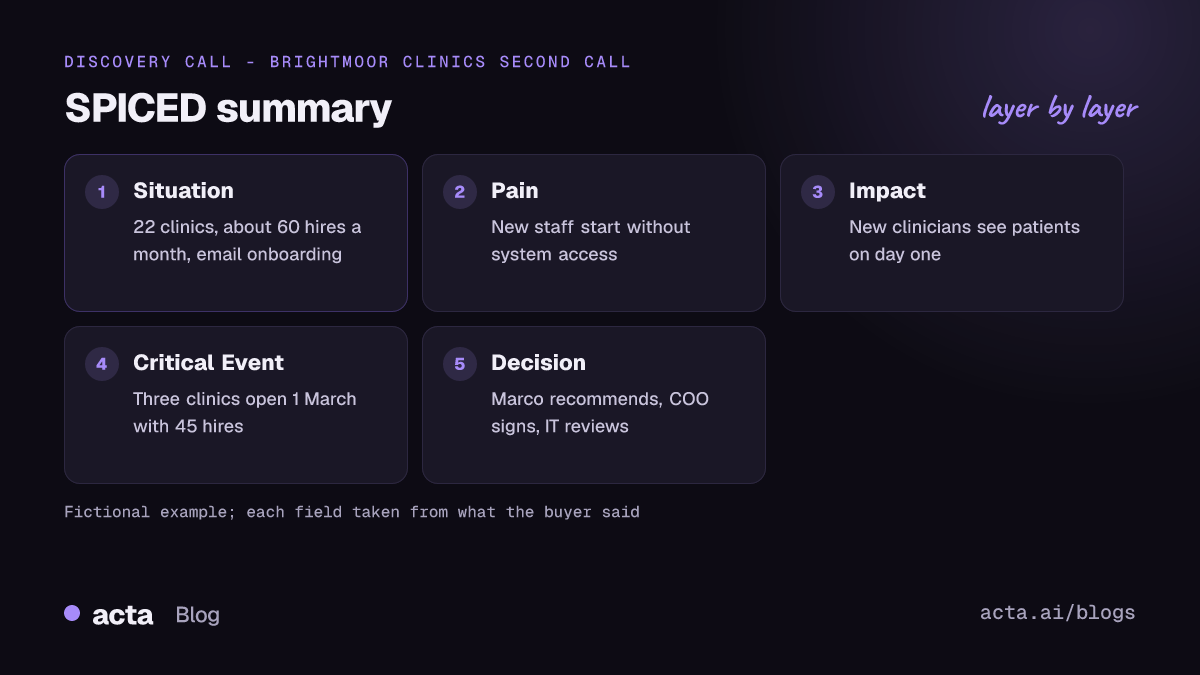
Here's a filled-in example from a fictional deal. Dana sells onboarding software. The prospect is Brightmoor Clinics' people team, and she's on her second call with Marco, their HR operations lead.
- Situation: 22 clinics, about 60 new hires a month, onboarding run from email and a shared drive.
- Pain: new staff often start without system access; clinic managers spend their first morning chasing IT.
- Impact: Marco estimates each delayed start costs a clinic half a day of a manager's time and a cancelled appointment slot. Solving it would let new clinicians see patients on day one.
- Critical Event: three new clinics open on 1 March with 45 hires between them. Onboarding must work by mid-February.
- Decision: Marco recommends, the COO signs, IT reviews integrations. Criteria: works with their HR system and needs no new logins for clinic managers.
Look at how the parts depend on each other. The 1 March opening turns a known annoyance into a dated project, and the cancelled appointments give Marco a number to take to his COO. Dana's next step is a short call with the COO built around that Impact, not another demo. The figures here are invented for the example.
Pair SPICED with a checklist when deals get complex
The most practical setup I've seen is SPICED for discovery plus two or three MEDDIC checks once a deal passes a size threshold: a named Economic Buyer, a Champion who has done something for you (not just said nice things), and a written Decision Process. That keeps calls conversational while making the forecast harder to fool.
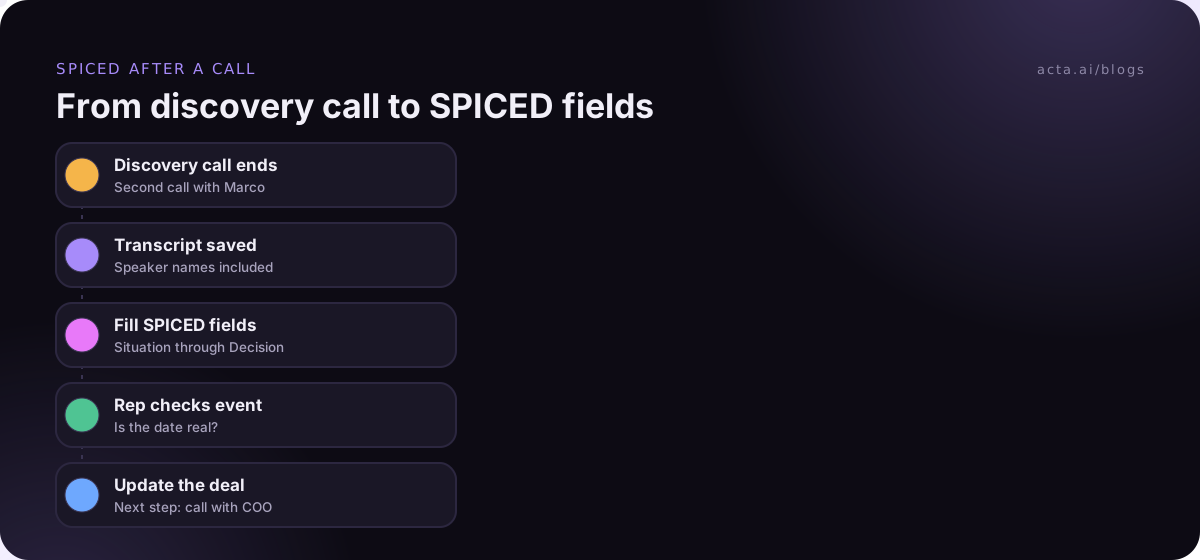
Whatever you combine, capture it from the call itself rather than from memory. Record discovery calls with consent (see what to tell participants before recording) and fill the fields from the transcript afterwards. If the buyer isn't keen on a bot joining, Acta's Chrome extension records Google Meet, Microsoft Teams in the browser and the Zoom web client from your own browser.
For what it's worth, Acta has a SPICED report among its report templates that fills the five fields from a recorded call, and notes can go to Salesforce, HubSpot or Zoho. You still decide whether the critical event is real.
Frequently asked questions
What does SPICED stand for in sales?
SPICED stands for Situation, Pain, Impact, Critical Event and Decision. It's a discovery framework from Winning by Design that helps sellers understand a customer's circumstances, the problem they want solved, what solving it is worth, the deadline that makes it urgent, and how the buying decision will be made.
Is the SPICED framework better than MEDDIC?
Neither is better overall. The SPICED framework is stronger for running discovery and capturing the customer's impact, which helps with renewals. MEDDIC is stronger for inspecting complex enterprise deals, especially economic buyers, champions and decision process. Many teams use SPICED in discovery and add MEDDIC checks as deals grow.
What is a critical event in SPICED?
A critical event is a dated deadline that forces the customer to act, such as a contract renewal, a product launch, an audit, a new office opening or a hiring wave. It's different from a preferred timeline. If nothing bad happens when the date passes, it isn't a critical event, and the deal is likely to slip.
Which sales methodology should a new team start with?
Start with whatever matches your deal type. For short, inbound-driven sales, BANT or CHAMP is enough. For SaaS with a few stakeholders, SPICED gives the best structure for discovery. For large enterprise deals, add MEDDIC. Pick one, train it properly, and avoid switching frameworks every quarter.
Can you use SPICED and Challenger together?
Yes, and they fit well. Challenger is about how you lead the conversation: bringing an insight, tailoring it to each stakeholder and guiding the decision. SPICED is about what you capture. A rep can open with a Challenger-style insight and then use SPICED questions to record the buyer's pain, impact and critical event.
Choose your discovery framework with this checklist
Before you roll out SPICED or any alternative, settle these five points with your sales leaders.
- Match the deal type: short cycles suit BANT or CHAMP; SaaS discovery suits SPICED; committee deals need MEDDIC checks.
- Define a real critical event: agree that a date only counts if something happens on it.
- Put Impact in numbers: ask reps to record at least one figure the buyer said out loud.
- Set CRM fields: one field per letter, plus a status of confirmed or assumed.
- Review from calls: coach from recorded discovery calls, not from what reps remember.
If you'd rather fill SPICED from the recording than from memory, Acta's desktop app captures calls without a bot, and the 15-day free trial is enough to test it on a few real deals.