The SOAP notes examples below show the same four-part structure, Subjective, Objective, Assessment and Plan, filled in for eight common visits: primary care, a chronic disease follow-up, telehealth, physical therapy, a counseling session, a nursing shift, a pediatric visit and a dental appointment. Each one is short enough to copy as a starting pattern, and each comes with a note on when that pattern fits.
Every patient here is fictional, and the clinical details are illustrative, not treatment guidance. This is general information about documentation, not clinical or legal advice; your organization's policies, payer rules and scope of practice come first.
Key takeaways
- Subjective is what the patient tells you; Objective is what you measure or observe. A symptom goes in S, the matching sign goes in O.
- The Assessment should connect S and O to a diagnosis or clinical impression, not repeat them.
- A usable Plan names who does what and when: tests, treatment, education, follow-up date and when to return sooner.
- Telehealth notes should say how the visit happened and mark findings that were self-reported or seen only on camera.
- AI drafts from a recorded visit can save typing, but only with patient consent and with the clinician reviewing every line.
Table of contents
- SOAP notes follow four sections in a fixed order
- Medical visit SOAP notes examples
- Therapy notes put function and progress first
- Nursing, pediatric and dental notes change the details
- What changes by setting, in one table
- Five mistakes make SOAP notes harder to use
- AI drafts from visit recordings still need clinician review
- Where Acta fits
- Frequently asked questions
- Choose a SOAP note pattern for your practice
SOAP notes follow four sections in a fixed order
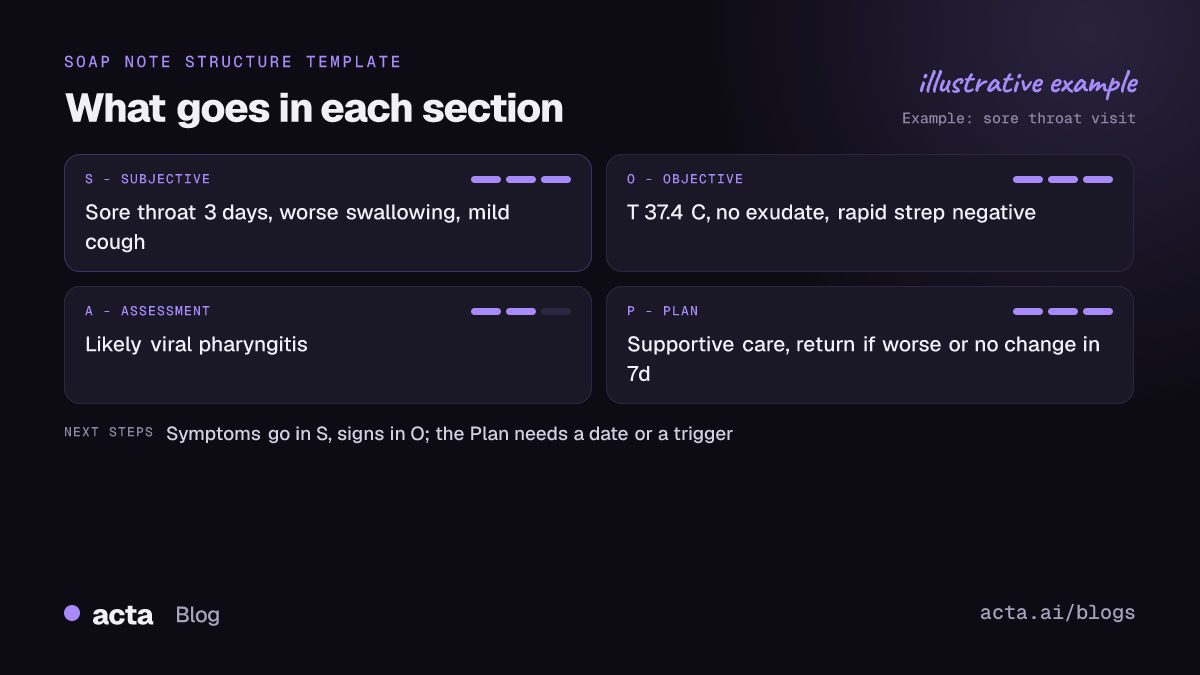
The StatPearls chapter on SOAP notes credits Larry Weed with developing the format almost 50 years ago and describes it as both a record of the patient's status and a way for clinicians to communicate with each other. The sections are:
- Subjective: the chief complaint and history in the patient's (or caregiver's) words: onset, duration, severity, what helps, what makes it worse, relevant history and current medications.
- Objective: vital signs, exam findings, test results, imaging and anything you directly observe.
- Assessment: your synthesis of S and O into a diagnosis or impression, with differentials when they matter.
- Plan: tests, treatment, patient education, referrals and follow-up.
Some clinics flip the order to APSO so the assessment and plan come first, which is faster for whoever reads the note next. StatPearls mentions research where that order helped physicians find information more quickly. The content stays the same; only the order changes.
Medical visit SOAP notes examples
These three cover the visits most people learn on: an acute problem, a chronic condition and a video visit.
Example 1: Primary care, acute sore throat
Use it when: a same-day visit for one new problem, where the note needs to show what you ruled out.
S: Jordan Lee, 29, reports sore throat for 3 days, worse on swallowing. Mild cough, runny nose, no fever at home. Roommate had a cold last week. No known allergies. No regular medications.
O: T 37.4 C, HR 78, BP 118/76, SpO2 99% on room air. Pharynx mildly red, no tonsillar exudate. No tender anterior cervical nodes. Lungs clear. Rapid strep test negative.
A: Sore throat most consistent with viral pharyngitis. Bacterial cause less likely given cough, no exudate and negative rapid test.
P: Supportive care: fluids, rest, over-the-counter pain relief per label. Return if unable to swallow fluids, fever above 39 C, or no improvement in 7 days. No follow-up needed otherwise.
Example 2: Chronic disease follow-up, type 2 diabetes
Use it when: a scheduled review where the point is trend, adherence and the next target.
S: Maria Santos, 58, here for 3-month diabetes review. Taking metformin as prescribed, misses evening dose about twice a week. Walking 20 minutes most days. No low-sugar episodes. Reports tingling in both feet at night for a month.
O: BP 134/82, weight 84 kg (86 kg last visit). HbA1c 7.6% (8.1% three months ago). Monofilament test: reduced sensation both soles. Feet: no ulcers, pulses present.
A: Type 2 diabetes, improving control. New reduced foot sensation, possible early peripheral neuropathy.
P: Continue current medication; discussed a phone reminder for the evening dose. Refer to podiatry. Daily foot checks explained. Repeat HbA1c and kidney function in 3 months. Follow-up visit in 3 months, sooner if any foot wound.
Example 3: Telehealth video visit, headache
Use it when: a video visit. A telehealth SOAP note must say what you could and couldn't examine.
S: Visit by video; patient at home, identity confirmed on camera. Sam Okafor, 41, reports dull, band-like headaches most afternoons for 2 weeks, 4/10, after long screen days. No vision change, weakness or vomiting. Sleeping about 5 hours a night.
O: Exam limited to video. Alert, speech clear, face symmetric, moves all limbs normally on request. Home BP reading reported by patient: 124/80. No other vitals available.
A: Probable tension-type headache related to sleep and workload. No red-flag features reported or observed on video.
P: Sleep and screen-break advice, over-the-counter pain relief no more than a few days a week. Headache diary for 2 weeks. In-person visit if pattern changes, any red-flag symptom appears, or no improvement in 4 weeks.
Therapy notes put function and progress first
Rehab and mental health notes lean on function and change over time. Physio-pedia's SOAP notes page is a good reference for physical therapy SOAP note wording, and WebPT's guide to physical therapy telehealth visits covers how the format shifts when the session is on video.
Example 4: Physical therapy, knee pain
Use it when: a treatment session where you need measurable progress to justify continuing care.
S: Alex Chen, 34, recreational runner, session 3 of 8 for right anterior knee pain. Pain 3/10 on stairs (was 6/10 at first visit). Completed home exercises 5 of 7 days. Goal: return to 5 km runs.
O: Right knee flexion 135 degrees (125 at first visit). Single-leg step-down: mild knee drift inward, pain 2/10. Hip abduction strength improved on manual testing. No swelling.
A: Patellofemoral pain improving with load management and hip strengthening. On track for goals.
P: Progress step-down and hip exercises; add walk-run intervals twice this week. Continue 2 sessions a week. Reassess running tolerance at session 5.
Example 5: Counseling session, anxiety follow-up
Use it when: a talk-therapy session where symptoms, risk and progress on goals all need a line.
S: Client, 26, attends session 6 for generalized anxiety. Reports fewer evening worry spirals since starting a set worry-time routine. Sleep improved to about 7 hours. Still avoids team meetings at work.
O: Alert, well groomed, good eye contact. Speech normal rate. Mood described as "better, still tense"; affect slightly anxious, appropriate. GAD-7 score 10 (14 at intake). Denies thoughts of self-harm.
A: Generalized anxiety, improving. Avoidance at work remains the main barrier.
P: Continue weekly CBT. Graded exposure plan: speak once in next team meeting. Review worry log next session. Safety plan reviewed and unchanged.
Nursing, pediatric and dental notes change the details
The structure holds, but who reports the Subjective and what goes in the Plan shifts. For a fuller walk-through of nursing practice, see our guide to SOAP notes for nurses.
Example 6: Nursing, post-op day 1
Use it when: a shift note on an inpatient, where the plan is nursing actions for the next hours.
S: Patient, 67, day 1 after right hip replacement. Reports pain 5/10 at the hip, worse when moving. Slept poorly. Passing urine, no nausea.
O: T 37.2 C, HR 88, BP 136/78, RR 16, SpO2 96% on room air. Dressing dry and intact. Right foot warm, pulses present, moves toes. Sat in chair 15 minutes with assistance of two.
A: Post-operative pain partly controlled, limiting mobility. No signs of bleeding or circulation problems.
P: Give analgesia as charted and reassess pain in 1 hour. Walk with physiotherapy this afternoon. Neurovascular checks every 4 hours. Tell surgical team if pain above 7/10 after analgesia.
Example 7: Pediatric visit, ear pain
Use it when: a child's visit, where the history comes from a parent and the plan includes what to watch at home.
S: Mia, 4, brought by her father. Pulling at right ear and crying at night for 2 days. Fever 38.5 C at home last night. Eating less, drinking normally. Recent cold. Immunizations up to date.
O: T 38.3 C, HR 112. Alert and playful between episodes. Right eardrum red and bulging; left normal. Throat mildly red. Chest clear.
A: Acute otitis media, right ear.
P: Treatment options discussed with father, including watchful waiting versus antibiotics per clinic guideline; plan agreed and documented. Fever and pain relief by weight. Return if fever lasts more than 48 hours, ear discharge, or child seems more unwell.
Example 8: Dental, tooth sensitivity
Use it when: a dental exam where findings are tied to a specific tooth and the plan is a procedure.
S: Patient, 45, reports sharp pain in lower right back tooth with cold drinks for 3 weeks, lasting a few seconds. No pain at night, no swelling.
O: Tooth 46 (FDI numbering): deep occlusal decay. Cold test brief, sharp, resolves in under 10 seconds. No tenderness to percussion. Bitewing radiograph: decay close to pulp, no periapical changes.
A: Deep caries tooth 46 with reversible pulpitis.
P: Restoration booked next week. Explained the chance of further treatment if symptoms persist. Desensitizing toothpaste in the meantime. Return sooner if pain lasts longer or wakes the patient at night.
What changes by setting, in one table
Looking across these SOAP notes examples, the pattern is the same and the emphasis moves. Use it when adapting a SOAP note template to your own setting.
| Setting | Subjective leans on | Objective leans on | Plan must include |
|---|---|---|---|
| Primary care | Symptom history | Vitals, exam, quick tests | Return precautions |
| Chronic care | Adherence, lifestyle | Trends in labs and vitals | Next target and recheck date |
| Telehealth | History, visit modality | What was seen on video | When to come in person |
| Therapy | Function and goals | Measures vs baseline | Session plan and reassessment |
| Nursing | Pain, comfort, needs | Vitals, wound, mobility | Actions this shift, escalation |
| Dental | Pain pattern | Tooth, tests, radiographs | Procedure and timing |
Five mistakes make SOAP notes harder to use
- Signs in the Subjective. "Throat looks red" is your observation. It goes in O.
- An Assessment that repeats the history. The reader wants your conclusion, not a second copy of S, and a vague assessment is exactly what a clinical documentation improvement specialist will query.
- A vague Plan. "Follow up as needed" tells the next clinician nothing. Give a date or a clear trigger.
- Copy-forward notes. Copying last visit's text saves a minute and creates contradictions. Update every section.
- Missing the patient's words. A short quote in S ("worse when I climb stairs") is often the most useful line in the note.
AI drafts from visit recordings still need clinician review
Some clinicians now draft SOAP notes from a recording of the visit instead of typing during it. The safeguards are not optional.
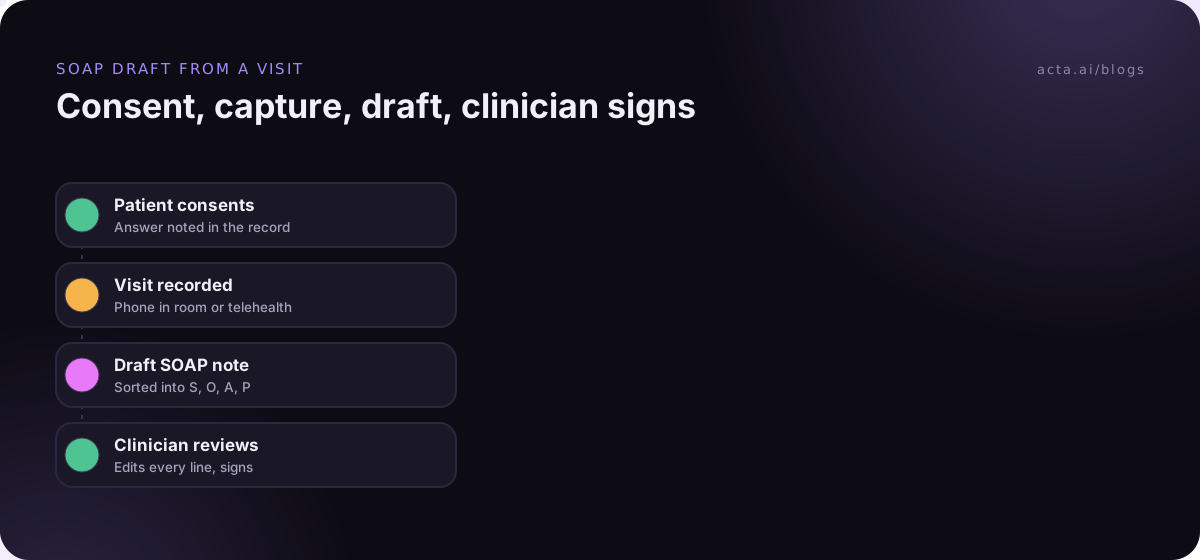
- Consent first: ask the patient before recording and note their answer. Our guide on recording consent and what to tell participants covers the basics, and your local rules come first.
- Capture the visit: on a phone in the room, or on your computer for telehealth.
- Draft: the tool sorts what was said into S, O, A and P.
- Review every line: the clinician corrects, adds exam findings the audio can't capture, and signs. Nothing goes into the record unchecked.
Our post on SOAP note drafts from patient visits walks through one template, and what clinicians should know about AI notetakers covers data agreements and where these tools fall short.
Where Acta fits
Acta can record a consented visit with its mobile app, or a telehealth call with its bot or desktop app, and produce a SOAP-format draft from one of its report templates for the clinician to edit. It is working towards HIPAA compliance and is not there yet, so check with your compliance team before using it with patient data. More on the healthcare page.
Frequently asked questions
What is a good SOAP note example for beginners?
Start with a single-problem visit like Example 1, the acute sore throat. It shows clearly how symptoms go in Subjective, measured findings in Objective, a reasoned conclusion in Assessment, and a Plan with return precautions.
How long should a SOAP note be?
As long as the visit needs and no longer. A routine follow-up may fit in eight to ten lines; a complex new patient takes more. Aim for every line to help the next clinician decide something. If a sentence wouldn't change anyone's decision, cut it or move it to the history.
Where do medications go in a SOAP note?
Current medications the patient reports usually go in Subjective, with name, dose, route and frequency. Medications given or measured during the visit can appear in Objective. New prescriptions or changes belong in the Plan. Follow your organization's template if it has a dedicated medication section.
Can I use these SOAP notes examples as templates?
Yes, as patterns for structure and wording. Replace every clinical detail with your own findings and follow your organization's documentation policy, payer requirements and scope of practice. The patients and values here are fictional and are not treatment recommendations.
What is the difference between SOAP and APSO notes?
Same four sections, different order. APSO puts the Assessment and Plan first, so the next reader sees your conclusion and next steps without scrolling. The content and rules for each section stay the same. Use whichever order your clinic or electronic record system expects.
Choose a SOAP note pattern for your practice
Pick the example closest to your most common visit and turn it into your own template.
- Match the setting: start from the example that looks most like your typical visit.
- Fix the Plan format: decide how you always write follow-up dates and return precautions.
- Add setting fields: outcome measures for therapy, tooth numbers for dental, modality for telehealth.
- Agree on order: SOAP or APSO, the same across the team.
- Set review rules: if you use AI drafts, consent first and clinician sign-off every time.
If you want to see how a recorded visit becomes a draft, try Acta's desktop app on a telehealth call during the 15-day free trial, with your compliance team's approval.