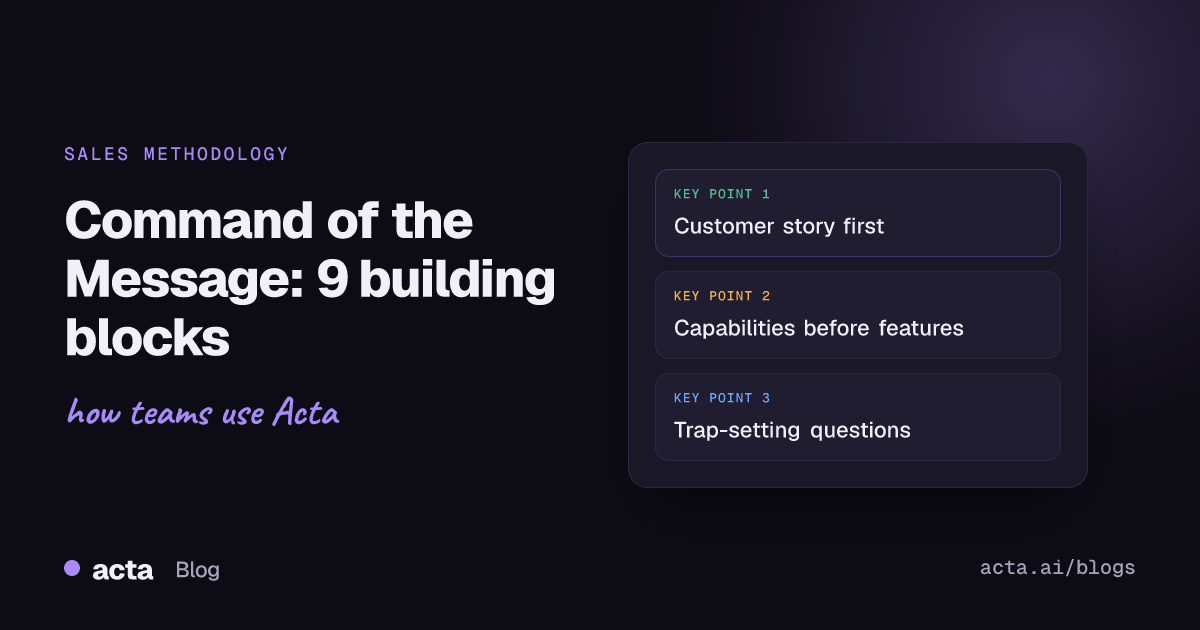
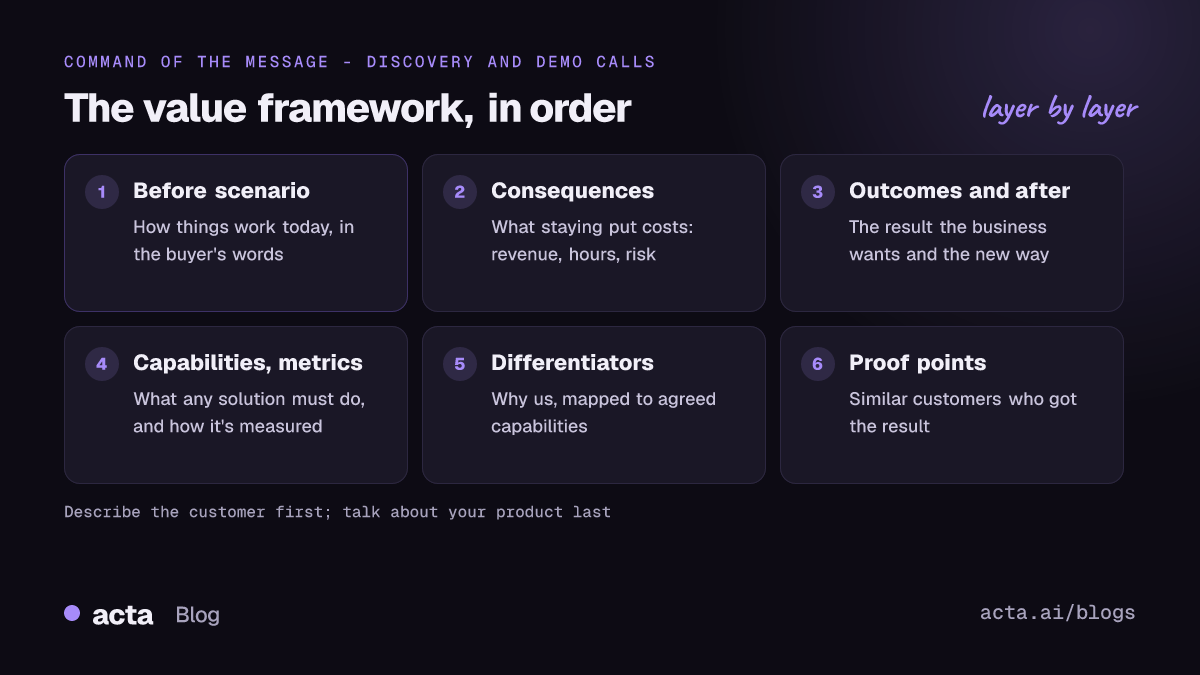
The Command of the Message sales methodology, from Force Management, is a value-messaging framework: it teaches sellers to describe the customer's current state, the cost of staying there, the outcomes they want and the capabilities needed to get there, and only then to show how their product delivers those capabilities better. Its nine building blocks are below, each with what it answers and a sample question.
This guide is for reps and managers who've heard the name and want the working parts without sitting through a workshop first. It isn't a replacement for Force Management's own training, which goes deeper and uses its own materials. If your sales are short, transactional and single-buyer, a lighter method will serve you better.
Key takeaways
- Build the customer's story in order: before scenario, negative consequences, positive outcomes, after scenario. Your product comes after that.
- Turn every pain into a required capability the buyer agrees to, then attach a metric they'll measure.
- Only use a differentiator if it maps to a required capability; otherwise it's noise.
- Prepare two or three trap-setting questions per competitive deal, so the buyer raises your strengths before you do.
- Run it alongside MEDDICC or MEDDPICC: the framework supplies the message, the qualification checklist tells you whether the deal is real.
Table of contents
- Command of the Message sales methodology is a value framework, not a script
- The nine building blocks compared at a glance
- The customer's story comes first
- Required capabilities and metrics turn pain into buying criteria
- Differentiators and proof points only count when they map
- Trap-setting questions connect discovery to your strengths
- A filled-in value framework makes it concrete
- MEDDICC qualifies the deal; the framework shapes the message
- Call notes show whether the framework is used
- Frequently asked questions
- Roll it out with this checklist
Command of the Message sales methodology is a value framework, not a script
Force Management describes its sales messaging work as enabling a buyer-focused conversation: sellers talk about business outcomes rather than product features. The core tool is a value framework, a one-page map of the problems you solve, what they cost, the results customers want and why you're the better route to them.
It's a messaging system, not a qualification checklist. MEDDICC asks whether you know enough about the deal; Command of the Message tells you what to say and ask so the buyer sees value. In practice, many teams run both.
One thing to know before you read summaries online: different sources package the components differently, with anywhere from six to nine parts. The substance is consistent. I've used nine blocks below because it keeps discovery questions and proof points visible as separate jobs.
The nine building blocks compared at a glance
Use this as a cheat sheet. The order matters: the first four describe the customer, the next two define what a solution must do, and the last three are about you.
| Building block | What it answers | Sample question |
|---|---|---|
| Before scenario | How do things work today? | Walk me through how this happens now. |
| Negative consequences | What does staying put cost? | What happens if nothing changes this year? |
| Positive business outcomes | What result does the business want? | What would success look like in numbers? |
| After scenario | How will things work once fixed? | Describe a good week after the change. |
| Required capabilities | What must any solution do? | What would a solution have to do to get you there? |
| Metrics | How will success be measured? | Which number would your CFO watch? |
| Differentiators | Why us, against these needs? | How do you handle X today? (trap-setting) |
| Proof points | Who else got the result? | Would a similar customer's story help? |
| Discovery questions | How do I uncover all of the above? | Prepared per block, per persona |
The customer's story comes first
The first four blocks are about the buyer's world. Skip them and every differentiator you mention floats free of anything the buyer cares about.
1. Before scenario
- Best for: Early discovery, with every new stakeholder.
- Why it matters: Establishes the current state in the buyer's own words, which is the baseline for everything else.
- Watch out for: Turning it into an interrogation about tools and headcount. Research what you can first.
- Sample question: Walk me through what happens today when a new customer signs.
2. Negative consequences
- Best for: Once the buyer has admitted a problem.
- Why it matters: Creates urgency. Lost revenue, wasted hours, missed targets and risk are what make a problem worth budget.
- Watch out for: Inventing consequences for the buyer. If they don't say it, it doesn't count.
- Sample question: If onboarding stays at six weeks, what does that do to first-year renewals?
3. Positive business outcomes
- Best for: When you're speaking to someone who owns a number.
- Why it matters: Moves the conversation from features to results the business tracks, like revenue, cost or risk.
- Watch out for: Vague outcomes such as 'better efficiency'. Push for something measurable.
- Sample question: If this worked, which business result would move, and by how much?
4. After scenario
- Best for: Mid-discovery, to test whether the buyer can picture the change.
- Why it matters: Gives the buyer a story to repeat internally, which your champion will need.
- Watch out for: Describing your product's screens instead of the buyer's new way of working.
- Sample question: Six months from now, how would a new customer's first month look?
Required capabilities and metrics turn pain into buying criteria
This is where the method earns its keep. A required capability is what any solution must do to reach the outcome. Get the buyer to agree to it, ideally in writing, and you've shaped the criteria every vendor will be judged on.
5. Required capabilities
- Best for: Before a demo or a formal evaluation starts.
- Why it matters: Agreed capabilities become the buyer's evaluation criteria, and you helped write them.
- Watch out for: Listing your own features and calling them requirements. Phrase each one vendor-neutrally.
- Sample question: To cut onboarding to two weeks, what would a solution need to do?
6. Metrics
- Best for: Any deal that needs a business case or finance sign-off.
- Why it matters: Gives the buyer a way to prove value after purchase, and gives you a number for the proposal.
- Watch out for: Picking a metric the buyer doesn't track. Use theirs, not yours.
- Sample question: How do you measure onboarding time today, and who reports it?
Once capabilities and metrics are agreed, a strong demo shows each capability in turn. Our guide to demo call structure covers how to order it.
Differentiators and proof points only count when they map
Most sellers start here, and that's the habit the framework is designed to break. A differentiator only matters if it lines up with a required capability the buyer already agreed to.
7. Differentiators
- Best for: After required capabilities are agreed, and in competitive deals.
- Why it matters: Shows why your way of meeting a capability is better, without rubbishing competitors.
- Watch out for: Leading with them. A differentiator before the buyer has a matching need sounds like a brochure.
- Sample question: When integrations break today, how quickly does your team find out?
8. Proof points
- Best for: Late discovery, business case and proposal stages.
- Why it matters: Customer stories and evidence reduce the buyer's risk of being the first to try.
- Watch out for: Generic logos. Match the story to the buyer's industry, size and outcome.
- Sample question: Would it help to hear how a similar firm measured onboarding before and after?
Trap-setting questions connect discovery to your strengths
9. Discovery and trap-setting questions
- Best for: Every call, prepared in advance for each persona.
- Why it matters: Discovery questions uncover the first six blocks; trap-setting questions steer the buyer towards the capabilities where you're strongest.
- Watch out for: Closed or leading questions. Keep them open, so the buyer reaches the conclusion.
- Sample question: How would you know if a sync failed overnight?
Force Management's own post on how to ask trap-setting questions describes them as the link between the value customers want and the differentiators you provide. Discovery questions find needs; trap questions make sure the needs you're best at come up. The "trap" is for the competition, not the customer: if a rival can't answer that capability well, the buyer will notice on their own.
A practical rule: for each differentiator, write one open question whose honest answer makes the buyer want that capability. If you can't write one, the differentiator probably doesn't matter to buyers.
A filled-in value framework makes it concrete
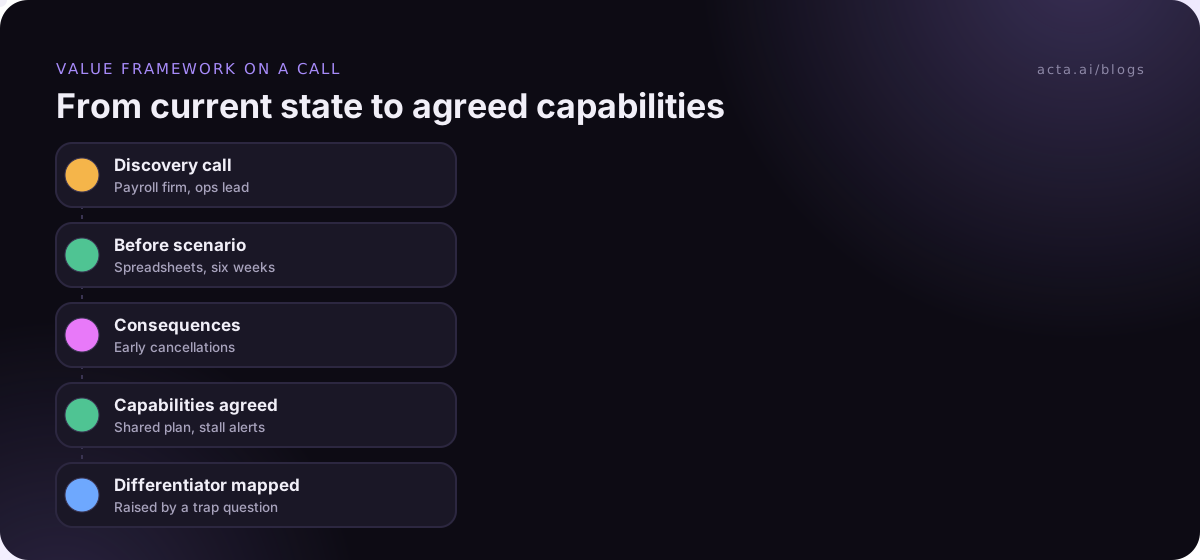
Here's a fictional deal. Priya sells customer onboarding software to a payroll company where new clients take six weeks to go live.
Before: Onboarding runs on spreadsheets and email; three teams hand off manually.
Negative consequences: Clients wait six weeks to see value; the CS lead says early cancellations cluster in the first quarter.
Positive outcomes: Faster time to first payroll; fewer first-year cancellations.
After: One shared plan per client, every team sees the next step, clients go live in two weeks.
Required capabilities: Shared onboarding plan across teams; automatic alerts when a step stalls; client-facing progress view.
Metrics: Days to first payroll; first-year cancellation rate.
Differentiator: Stall alerts based on each step's due date, which the incumbent tool lacks.
Proof point: A similar-sized payroll client's before-and-after onboarding time.
Notice that the differentiator only appears after the buyer agreed that stalled steps were the problem. Priya's trap-setting question was simply: "How do you find out today that a client's setup has stalled?"
MEDDICC qualifies the deal; the framework shapes the message
Force Management teaches MEDDICC as well, and its Opportunity Manager app supports both Command of the Message and MEDDPICC. The two fit together cleanly. Negative consequences and positive outcomes feed Identify Pain and Metrics; required capabilities shape Decision Criteria; proof points and differentiators help your Champion sell internally.
Many teams also sum it up as three questions every deal must answer: why change, why now and why us. The first four blocks answer why change and why now; differentiators and proof points answer why us. For the qualification side, see the MEDDIC sales methodology, and if your team prefers question-led discovery, the SPIN selling guide pairs well with the customer-story blocks.
Call notes show whether the framework is used
The hard part of any methodology is knowing whether reps actually ask the questions. Acta writes meeting notes and can produce a MEDDPICC deal report from each sales call using one of its report templates; the MEDDPICC deal report post shows the format. If you'd rather not bring a bot to customer calls, the Chrome extension or desktop app captures the call from your own computer. Check the rules on recording consent and tell the buyer first.
Frequently asked questions
What is Command of the Message?
Command of the Message is a sales methodology from Force Management that teaches sellers to sell on business value. It uses a value framework covering the customer's current state, the consequences of not changing, the outcomes they want, required capabilities, metrics, and the seller's differentiators and proof points. It shapes what reps say and ask, rather than how they qualify a deal.
What are the components of the Command of the Message value framework?
Commonly listed components are the before scenario, negative consequences, positive business outcomes, after scenario, required capabilities and metrics, with differentiators and proof points layered on top. Some summaries count six parts and others nine. Discovery and trap-setting questions are how sellers uncover each one during calls.
What is a trap-setting question?
It's an open discovery question designed to lead the buyer towards a capability where you're strong and competitors are weak. Instead of claiming "we alert you when syncs fail", you ask "how would you know if a sync failed overnight?" The buyer realises the need themselves, and competitors then have to answer it.
How is Command of the Message different from MEDDICC?
MEDDICC is a qualification framework: it checks whether you know the metrics, economic buyer, decision criteria, decision process, pain and champion. Command of the Message is a messaging framework: it tells you how to talk about value. Force Management teaches both, and teams usually use them together.
Is Command of the Message worth it for a small sales team?
The ideas are, especially building one value framework per main product and writing trap-setting questions. Whether formal training is worth the cost depends on deal size and team size. A small team selling complex deals can start by filling in the nine blocks for their top three customer problems.
Roll it out with this checklist
You don't need a big programme to start. Run these five steps over two or three weeks and review them on real calls.
- Build one framework: fill in the nine blocks for your most common customer problem, using real customer words.
- Write the questions: draft discovery questions for each block and one trap-setting question per differentiator.
- Map to qualification: link each block to the MEDDICC or MEDDPICC field it feeds.
- Review real calls: check which blocks reps covered and which they skipped.
- Update monthly: replace weak proof points and add consequences buyers actually mention.
Want to see which blocks your reps actually cover? Capture a few Google Meet calls with the Acta Chrome extension during the 15-day free trial and read them back against your framework.