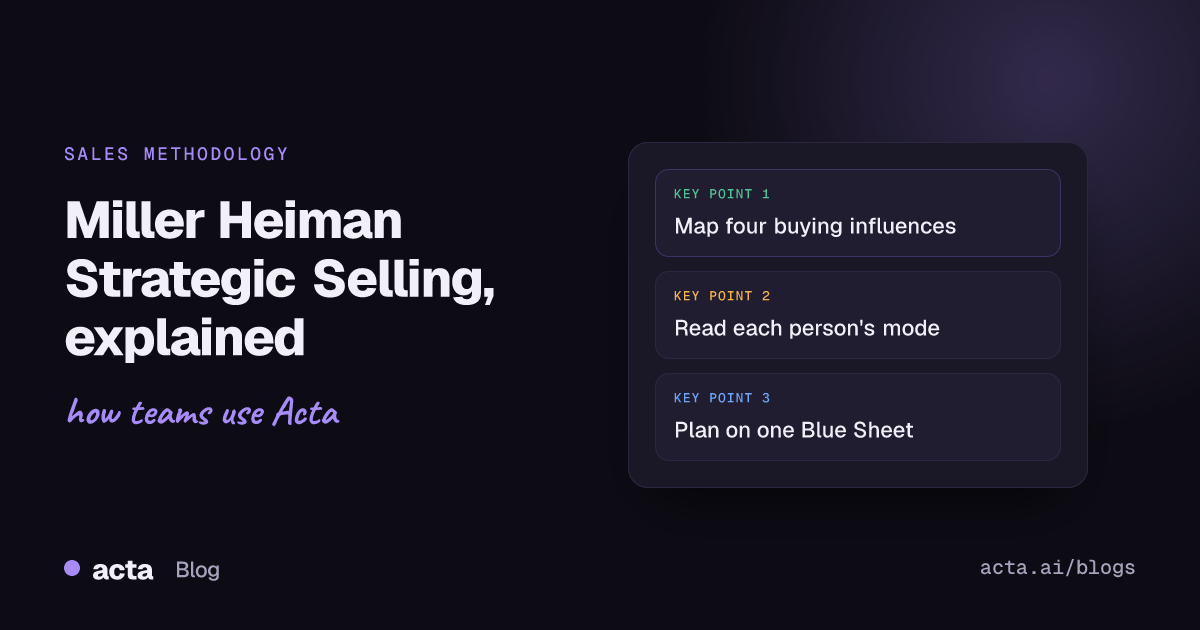
The Miller Heiman sales methodology, better known as Strategic Selling, is a way to plan complex B2B deals around the people who decide them. You map four buying influences (Economic, User, Technical and Coach), read how each one feels about change, list the red flags, and plan your next move on a one-page Blue Sheet. It fits long, multi-stakeholder deals far better than one-call transactional sales.
This guide covers where the method came from, each of its parts, the questions to ask, a filled-in Blue Sheet from a fictional deal, and how it sits next to SPIN, MEDDIC and Challenger. If you sell a $40 subscription on a single call, you can skip most of it. If your deals have five or more people on the buying side and a six-month cycle, read on.
Key takeaways
- Strategic Selling maps four buying influences per deal: one Economic Buyer, plus User Buyers, Technical Buyers and at least one Coach.
- Each influence sits in one of four response modes: Growth, Trouble, Even Keel or Overconfident. Only the first two are likely to buy.
- Every Blue Sheet starts with a single sales objective: one sentence saying what you sell, to whom, and by when.
- Red flags (missing information, an unknown influence, a reorganization) matter more than your strengths. Plan an action against each one.
- Update the Blue Sheet after every meeting, not once a quarter. Call notes that name who said what make that a 10-minute job.
Table of contents
- Miller Heiman started as a 1980s method for complex sales
- Four buying influences decide every complex deal
- Response modes tell you who actually wants change
- The Blue Sheet turns the method into a one-page plan
- A filled-in Blue Sheet from a fictional deal
- Miller Heiman sales methodology vs SPIN, MEDDIC and Challenger
- Run Strategic Selling on real calls, not just in reviews
- Frequently asked questions
- Decide whether Strategic Selling fits your team
Miller Heiman started as a 1980s method for complex sales
The method takes its name from Robert Miller and Stephen Heiman, and it reached most sellers through the book Strategic Selling, which secondary sources date to 1985 (a revised edition, The New Strategic Selling, followed later). The core idea hasn't changed since: in a complex sale, several people with different stakes all have a say, and the rep who knows only one of them is guessing.
The training company that grew around the book, Miller Heiman Group, is now part of Korn Ferry. Korn Ferry announced the acquisition in September 2019, along with AchieveForum and Strategy Execution. Today Korn Ferry teaches the method as Strategic Selling with Perspective and describes the Blue Sheet as its central tool. You'll still hear most people call it "Miller Heiman" or just "the Blue Sheet".
One caveat: the official course materials are proprietary. What follows is the widely published version of the framework. If your company has licensed the training, the workbook wording wins.
Four buying influences decide every complex deal
The center of the Miller Heiman sales methodology is a simple claim: every complex sale has four kinds of buying influence, and you need to know who fills each role. They're roles, not job titles. A CFO can be a Technical Buyer on one deal and the Economic Buyer on the next.
- Economic Buyer. The person who gives final approval and can release the money. There's one per sales objective. Be strict here: if three people each say "I'd have to run it by someone", none of them is it.
- User Buyers. The people who will use the product or manage those who do. They judge whether it makes their work better, and their verdict travels upward.
- Technical Buyers. IT, security, legal, procurement. They screen you against specifications. They usually can't say yes on their own, but they can say no.
- Coach. Someone inside the account (sometimes outside it) who wants your proposal to win and guides you to the other three. A real Coach has credibility with the Economic Buyer. A friendly User who likes your demo isn't automatically one.
Use one rule above all: don't confuse access with influence. The person who answers your emails fastest is rarely the one who signs.
Sample questions for each role:
- Economic Buyer: "When you approved the last purchase this size, what did you need to see?" or "What happens to this year's plan if nothing changes?"
- User Buyer: "Walk me through the last time this went wrong. Who fixed it and how long did it take?"
- Technical Buyer: "What would make you reject a vendor in the first week of review?"
- Coach: "Who else will weigh in that we haven't met?" and "How does the decision actually get made here, as opposed to how it's written down?"
Response modes tell you who actually wants change
Knowing who's involved isn't enough. Strategic Selling asks how each person sees their current situation, and sorts them into four response modes:
- Growth: things are fine, but they want more (more output, faster growth). Receptive.
- Trouble: something is broken and they feel it. The most receptive mode, provided you're fixing their trouble and not one you invented.
- Even Keel: things are fine and they see no reason to change. Unlikely to buy.
- Overconfident: they believe things are better than they are. Very unlikely to buy, and hard to move with facts alone.
The modes are per person and they shift. The VP who was in Trouble in March may be on Even Keel by June because a workaround landed. That's why you re-read them after every meeting. Korn Ferry's own red-flag guidance treats an influence in Even Keel or Overconfident mode as a red flag in itself.
The other personal piece is the win-result. A result is the business outcome your product delivers (fewer missed deliveries). A win is the personal gain someone gets from that result (the ops director stops getting called at 6am). The method asks you to find a win-result for every buying influence, because people sign for their own reasons, not the company's.
The Blue Sheet turns the method into a one-page plan
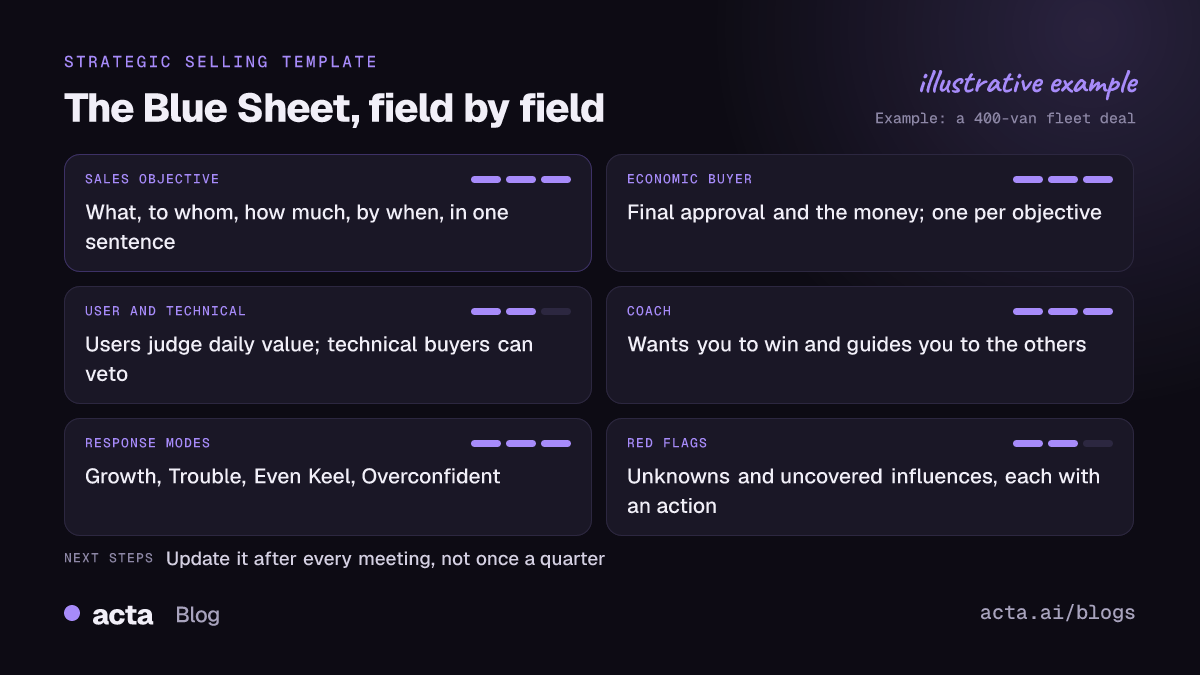
The Blue Sheet is where everything above gets written down for one opportunity. Commonly published versions include these fields:
- Single sales objective: one sentence with what, to whom, how much and by when. Not "win Halvorsen", but "sign Halvorsen to a 3-year fleet plan for 400 vehicles by 30 March".
- Buying influences: names for each role, their response mode, and how well you've covered them.
- Win-results: one per influence.
- Red flags: missing information, an influence you haven't met, someone new in a role, a reorganization, uncertainty about any of the above.
- Strengths: what you can build on.
- Competition: including "do nothing" and "build it ourselves".
- Possible actions and the best next action: specific, owned and dated.
Fill it in with your manager or deal team, not alone. The value is in someone asking "how do you know the CFO is in Growth mode?" and you not having a good answer.
A filled-in Blue Sheet from a fictional deal
Here's how it looks on a made-up deal. Priya sells fleet-tracking software. Her prospect, Halvorsen Logistics, runs 400 delivery vans. She's had three calls: a discovery call with the ops director, a demo for two dispatch managers, and a short security call with IT.
Single sales objective: Halvorsen signs a 3-year plan for 400 vans by 30 March, starting with the Oslo depot.
Economic Buyer: Dana Whitfield, COO. Mode: Growth (wants a second region next year). Win-result: expansion plan she can defend to the board. Coverage: not met. RED FLAG.
User Buyers: Two dispatch managers, Erik and Sofia. Mode: Trouble (late deliveries, phone-based tracking). Win-result: fewer driver calls, earlier warning of delays. Coverage: good.
Technical Buyer: Marco Lind, IT security lead. Mode: Even Keel. Win-result: no new security review backlog. Coverage: one call. RED FLAG: data-retention questions unanswered.
Coach: Jonas, ops director. Credible with Dana? Probably. Test it.
Competition: incumbent spreadsheet process; one rival vendor in early talks.
Best next actions: Jonas to brief Dana and propose a 30-minute meeting (Priya to send a one-page summary by Friday). Priya to send Marco written answers on retention and access by Wednesday.
Notice what the sheet exposes. Priya felt great after the demo, because the users loved it. But the person who signs hasn't met her, and the person who can block it is unmoved. Without the Blue Sheet, this deal sits in "Commit" until the quarter ends.
Miller Heiman sales methodology vs SPIN, MEDDIC and Challenger
These methods answer different questions, and plenty of teams combine them. Strategic Selling answers "who is involved and what's our plan?". The others are mostly about what happens inside a conversation, such as Sandler's pain funnel, or whether the deal is qualified.
| Method | Main question | Best used for |
|---|---|---|
| Miller Heiman Strategic Selling | Who decides, and how does each feel? | Account and deal planning |
| SPIN Selling | Which questions build the need? | Running discovery calls |
| MEDDIC / MEDDPICC | Is this deal qualified? | Forecasting and deal reviews |
| Challenger | What should the buyer rethink? | Shaping the buyer's view |
A common setup: SPIN for the questions on the call, Strategic Selling for the account plan, MEDDPICC for the forecast. MEDDIC's Economic Buyer and Champion map closely onto Miller Heiman's Economic Buyer and Coach, so the two don't fight. If you want the question side, read our explainer on SPIN Selling questions and examples, and for qualification see the MEDDIC sales methodology guide.
Where Strategic Selling is weaker: it says little about how to run the call itself, and it's heavy for small deals. Don't make reps fill a Blue Sheet for a two-week sale with one decision-maker.
Run Strategic Selling on real calls, not just in reviews
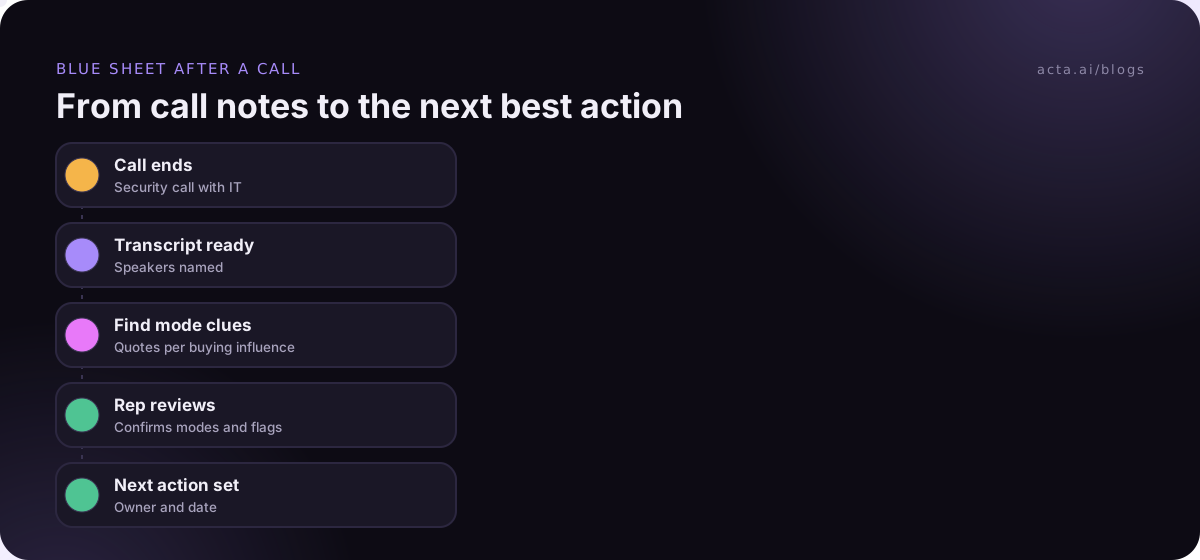
The method fails quietly when the Blue Sheet is filled from memory on Friday afternoon. Response modes and win-results come from what people actually said, so tie the sheet to your calls:
- Plan each call around a gap. Before a call, pick one red flag to close. "Find out who else signs off on vendors" is a call objective.
- Listen for mode clues. "We're managing fine" is Even Keel. "We lost two customers over this" is Trouble. Write the quote down, not your interpretation.
- Record and review. With consent, record the call so you can check exact words later. If bots aren't welcome, a desktop recorder or a browser extension captures it from your own computer. Check the consent rules for recording meetings first.
- Update the sheet within a day. New names, changed modes, new red flags, one dated next action.
- Review weekly with your manager. Spend the time on red flags and uncovered influences, not on the parts that look good.
Acta records sales calls with a bot, the desktop app or the Chrome extension, and writes transcripts with speaker names plus summaries, decisions and action items. Its report templates and MEDDPICC call notes cover qualification. A Blue Sheet isn't one of them, but you can ask OneChat across a deal's calls who raised security concerns and what was said, then fill the sheet yourself. The MEDDPICC deal report post shows what an automated version looks like for a related framework.
Frequently asked questions
Is the Miller Heiman sales methodology still used?
Yes. Korn Ferry, which acquired Miller Heiman Group in 2019, still teaches it as Strategic Selling with Perspective and builds the Blue Sheet into its Korn Ferry Sell software. Many teams also use the ideas informally, mapping buying influences in their CRM without the official training.
What are the four buying influences in Strategic Selling?
The Economic Buyer gives final approval and controls the money. User Buyers judge the product's effect on daily work. Technical Buyers screen it against specifications and can veto. The Coach guides you to the others and wants you to win. One person can hold more than one role.
What is a Miller Heiman Blue Sheet?
It's a one-page plan for a single opportunity. It records the single sales objective, each buying influence with their response mode and win-result, red flags, strengths, competition and the next actions. Teams update it after each meeting and use it in deal reviews to spot gaps early.
Can you use Miller Heiman and MEDDIC together?
Yes, and many teams do. MEDDIC tells you whether a deal is qualified; Strategic Selling tells you who to work on next and how. Their Economic Buyer is the same idea, and a MEDDIC Champion is close to a Miller Heiman Coach, so one set of call notes can feed both.
How long does it take to fill in a Blue Sheet?
The first one for a deal usually takes 30 to 60 minutes with your manager, mostly because it shows what you don't know. After that, updates take 10 to 15 minutes per meeting if you have good call notes to work from.
Decide whether Strategic Selling fits your team
The method earns its overhead on long, multi-person deals. Use this checklist before rolling it out:
- Check deal shape: adopt it where three or more people influence the decision and cycles run longer than a couple of months.
- Start with one sheet per strategic deal: skip it for small, fast deals so reps don't treat it as paperwork.
- Pair it with a call method: SPIN or a discovery template for the conversation, Strategic Selling for the plan.
- Review red flags weekly: make uncovered Economic Buyers and Even Keel influences the first agenda item.
- Feed it from call notes: base modes and win-results on what people actually said, not on memory.
To capture those calls without a bot in the room, try the Acta desktop app during the 15-day free trial.