The BANT sales methodology qualifies a deal by checking four things: whether the buyer has Budget, who has the Authority to sign, how real the Need is, and what Timeline they're working to. It's the oldest and simplest qualification checklist in B2B sales, which is exactly why it still works for inbound leads and short cycles, and why it breaks down on big committee deals.
This guide covers where BANT came from, what each letter really asks, the questions I'd use, a filled-in example from a made-up deal, and how it stacks up against MEDDIC, SPICED and CHAMP. If you sell six-figure contracts to buying committees, read the comparison section first: BANT alone probably isn't enough for you.
Key takeaways
- BANT stands for Budget, Authority, Need and Timeline. Treat it as four facts to confirm, not four questions to fire off in a row.
- Start with Need. A buyer with real pain will find budget; a buyer with budget and no pain stalls.
- Spread BANT across the first one or two calls. Trying to fill all four boxes in a 20-minute intro call makes it feel like a credit check.
- Mark each letter as confirmed, assumed or unknown. An "assumed" budget is the most common reason a forecast slips.
- Move to MEDDIC or SPICED once deals involve more than three or four stakeholders or a formal procurement process.
Table of contents
- BANT started as IBM's lead-qualification shorthand
- The BANT sales methodology checks four things
- Good BANT questions sound like discovery, not an audit
- A filled-in BANT example from a fictional deal
- BANT is the lightest of the common qualification frameworks
- Run BANT over two calls and write it down while it's fresh
- Most BANT mistakes come from treating it as a script
- Frequently asked questions
- Decide whether BANT fits your pipeline
BANT started as IBM's lead-qualification shorthand
Almost every account credits IBM's sales organisation with BANT. The dates are fuzzier than the attribution: some write-ups place it in the 1950s, others in the 1960s, and I haven't seen an IBM document that settles it. Built In's overview of BANT describes it the same way most sources do, as an IBM-born way to sort out which leads deserve a salesperson's time.
The context matters more than the year. BANT was built for a world where the seller held most of the information and the buyer came to them. A rep needed a fast filter: can this company pay, is this the right person, do they actually need it, and when? That logic still holds for inbound leads, SMB deals and anything with a short cycle.
What changed is how companies buy. Purchases now involve more people, buyers do more research before they talk to anyone, and budget often gets created after a problem is proven rather than sitting in a line item. That's why newer frameworks like HubSpot's GPCT and Winning by Design's SPICED start from goals or pain instead of money.
The BANT sales methodology checks four things
Each letter is a fact you want to confirm before you invest serious time, a demo team or a custom proposal. Here's what each one should mean in practice, which is a bit wider than the label suggests.
Budget
Not "do you have $40,000 sitting in a cost centre" but "is there a realistic path to paying for this?" That could be an approved budget, money being moved from a tool they're replacing, or a business case they're willing to build. Pipedrive's guide on whether BANT still works makes the same point: budget is often flexible when the need is strong.
Authority
Who signs, and who can say no? In a 30-person company that might be the founder. In a 3,000-person company it's usually a manager who champions it, a director who approves it, and someone in procurement or security who can block it. Authority means mapping that path, not finding one magic person.
Need
The problem, in the buyer's words, and what happens if they don't fix it. A vague need ("we're looking at tools in this space") is the weakest signal in the whole framework. A specific one ("our reps lose half a day a week rewriting call notes into Salesforce") is the strongest.
Timeline
When they need it working, and why that date. A timeline tied to an event, such as a contract renewal, a new hire class or a board review, is real. "Sometime this year" usually means no timeline at all.
Good BANT questions sound like discovery, not an audit
The fastest way to make a buyer defensive is to open with "What's your budget?" These BANT questions get the same facts while keeping the conversation about their problem. Use two or three per letter, not all of them.
Need
- "What made you look at this now rather than six months ago?"
- "Walk me through how it works today. Where does it break?"
- "If nothing changes, what does that cost you by the end of the quarter?"
Timeline
- "Is there a date you're working back from?"
- "What happens if this lands in March instead of January?"
Authority
- "Besides you, who'll want a say in this?"
- "How did the last tool like this get approved? Who signed off?"
- "Does security or IT review new vendors, and how long does that usually take?"
Budget
- "Is this something you've already set money aside for, or would it need a business case?"
- "What are you spending on the current approach, including people's time?"
Notice the order: Need and Timeline first, Budget last. Sandler puts budget earlier, as a qualification step; our Sandler sales methodology explainer covers that approach. By the time you ask about money, the buyer has already told you why the problem is expensive, so the budget answer is more honest. I've had far fewer awkward silences since switching to this order.
A filled-in BANT example from a fictional deal
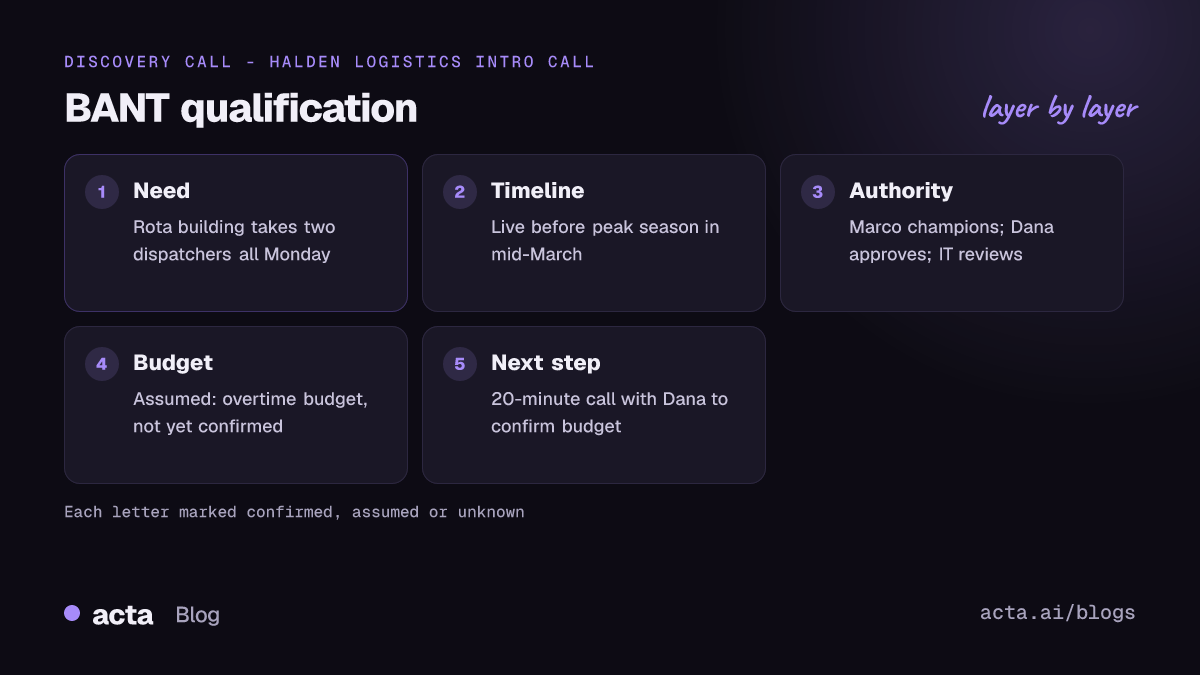
Here's a BANT example from an invented deal. The seller, Priya, sells scheduling software. The prospect is Halden Logistics, a 400-person freight company, and she's had one 30-minute discovery call with Marco, their operations manager.
- Need (confirmed): Dispatchers build weekly driver rotas in spreadsheets. Marco says it takes two dispatchers most of Monday and they missed a rest-period rule twice last quarter. He used the word "audit" twice.
- Timeline (confirmed): Their peak season starts in mid-March. Marco wants something running by the end of February so dispatchers aren't learning a new tool during peak.
- Authority (partly known): Marco champions it. Dana, Head of Operations, approves spend in this range. IT reviews any vendor that touches driver data. Priya hasn't spoken to Dana or IT yet.
- Budget (assumed): No line item. Marco thinks the cost could come from the overtime budget for dispatchers, but that's his guess, not Dana's decision.
Verdict: qualified to continue, not qualified to forecast. Priya's next step isn't a demo; it's a 20-minute call with Dana to confirm the budget route, plus an early security questionnaire for IT so it doesn't block the February date. That's what BANT qualification is for: telling you what to do next, not producing a yes/no score.
BANT is the lightest of the common qualification frameworks
BANT vs MEDDIC is the comparison people search most, but CHAMP and SPICED come up too. The short version: BANT is a quick filter, MEDDIC is a deal-inspection tool, SPICED is a discovery structure, and CHAMP is BANT with the order flipped.
| Framework | What it checks | Best for |
|---|---|---|
| BANT | Budget, Authority, Need, Timeline | Inbound leads, SMB, short cycles |
| CHAMP | Challenges, Authority, Money, Prioritisation | Teams that want BANT but pain-first |
| MEDDIC | Metrics, Economic buyer, Decision criteria and process, Pain, Champion | Complex enterprise deals |
| SPICED | Situation, Pain, Impact, Critical event, Decision | SaaS and recurring revenue |
MEDDIC was developed at PTC in the 1990s; MEDDICC's history page credits Dick Dunkel, working with Jack Napoli. It asks for everything BANT does plus metrics, decision criteria and a named champion, which is why it suits long, multi-stakeholder deals and feels heavy on a $3,000 deal. SPICED comes from Winning by Design and puts Impact and a Critical Event at the centre; their SPICED page lays it out. If you want the deeper version of either, our posts on MEDDPICC questions that don't slow the call and the SPICED sales methodology compared with other methods go further.
My rule of thumb: use BANT to decide whether a deal deserves attention, then switch to MEDDIC or SPICED for the deals that do. Plenty of teams run both, with BANT at the SDR stage and MEDDIC from first demo onward.
Run BANT over two calls and write it down while it's fresh
On the first call, aim for Need and Timeline. You'll often get hints on Authority without asking. Leave Budget for the end of call one or the start of call two, once the problem is clear. On the second call, confirm Authority by asking to meet the approver, and confirm Budget with that person, not your champion.
The catch is note-taking. If you're typing BANT fields during the call, you're not listening for the follow-up question. Record instead, with consent; our guide to what to tell participants before recording covers the basics. If the prospect doesn't want a bot in the call, a recorder on your own machine, like Acta's desktop app or the Chrome extension (Google Meet, Microsoft Teams in the browser and the Zoom web client), captures the conversation without one joining.
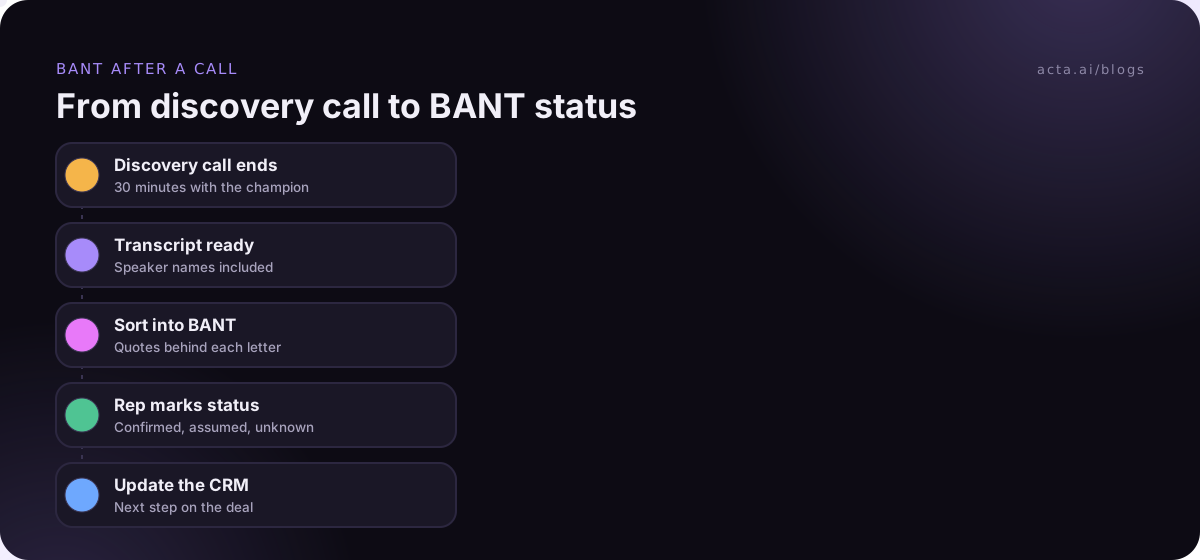
Then fill the four fields from the transcript right after the call, marking each one confirmed, assumed or unknown, and push them into the CRM. Our post on a discovery call template with BANT and MEDDIC questions has an agenda you can reuse.
This is where Acta fits, if you want it to. It records the call, and its BANT report template pulls budget, authority, need and timeline out of the transcript; BANT qualification reports from discovery calls shows what that looks like. Notes can go to Salesforce, HubSpot or Zoho, and you still decide what counts as confirmed.
Most BANT mistakes come from treating it as a script
- Asking budget first. You get a defensive number or "we don't have one yet", and the call goes cold.
- Disqualifying on "no budget". Many good deals start without a line item. No budget plus strong need and a real date is a business case, not a dead lead.
- Accepting the champion's word on authority. "I make the call" from a manager in a 2,000-person company deserves a polite follow-up about who else signs.
- Writing "Q1" as a timeline. Ask what event drives the date. No event usually means no urgency.
- Never updating it. BANT on day one is a snapshot. Revisit it after every call, or it drifts from reality and your forecast with it.
Frequently asked questions
What does BANT stand for in sales?
BANT stands for Budget, Authority, Need and Timeline. It's a lead qualification framework that helps a salesperson decide whether a prospect is worth pursuing now: can they pay, who decides, how real the problem is, and when they need it solved. Most accounts credit IBM with creating it, though sources disagree on the exact decade.
Is the BANT framework still useful?
Yes, for the right deals. The BANT framework is fast to learn and works well for inbound leads, SMB sales and short cycles. It's weaker for enterprise deals with large buying committees, where frameworks like MEDDIC or SPICED capture decision process, metrics and champions that BANT leaves out.
BANT vs MEDDIC: what is the difference?
BANT is a four-point filter for whether a lead is worth pursuing. MEDDIC is a six-point inspection of a deal already in play: Metrics, Economic buyer, Decision criteria, Decision process, Identify pain and Champion. Many teams use BANT at the SDR stage and MEDDIC once an account executive takes over.
Which BANT letter should you ask about first?
Start with Need. When the buyer has explained the problem and what it costs them, questions about timeline, authority and budget feel like a natural next step rather than an interrogation. Asking budget first is the most common way to make a prospect guarded in the first ten minutes of a discovery call.
Can a deal be qualified without budget?
Often, yes. If the need is clear, the timeline is tied to a real event and you can reach the person who approves spend, a missing budget usually means you'll help build a business case. Treat it as "budget unknown" and set a next step to confirm it, rather than disqualifying the lead.
Decide whether BANT fits your pipeline
BANT is the right starting point for most teams that need a shared definition of a qualified lead. Use this checklist before you roll it out.
- Check your deal size: if most deals close in under 60 days with one or two decision makers, BANT alone is enough.
- Set the order: teach reps to cover Need and Timeline before Budget.
- Define the statuses: confirmed, assumed or unknown for each letter, and agree what each means for the forecast.
- Pick a handoff point: decide when a deal moves from BANT to MEDDIC or SPICED, if it ever does.
- Capture it from the call: fill BANT from the transcript after the call, not from memory two days later.
To capture discovery calls without a bot in the room, try Acta's desktop app during the 15-day free trial.