Privacy & Security 5 min read
Is It Legal to Record Meetings With AI? Consent, Privacy and What to Tell Participants
When is it legal to record a meeting with an AI note taker? A plain-English guide to consent rules, privacy laws, a simple team recording policy and vendor questions.
Quick answer: In most places it's legal to record a meeting with an AI note taker as long as participants know about it, and in many places they must agree to it. The safest rule everywhere: announce at the start that the meeting is being recorded and transcribed, explain why, and let people object. Privacy laws such as GDPR and India's DPDP Act also expect a clear purpose and secure storage.
AI note takers have made recording meetings so easy that many teams now record almost everything. That's great for productivity. It also raises a fair question from the person on the other end of the call: "Wait, is this being recorded?"
Getting this right isn't only about avoiding legal trouble. It's about trust. A customer who discovers they were recorded without being told is unlikely to forget it. This article is general information, not legal advice.
Which laws apply when you record a meeting?
Two different kinds of law can apply when you record a meeting:
- Recording and wiretapping laws, which decide whether you can record a conversation at all, and whose permission you need.
- Data protection and privacy laws, which govern what you do with the recording afterwards: why you keep it, who sees it, how long you keep it and how you protect it.
You need to think about both.
Do you need one-party or all-party consent?
Recording laws usually follow one of two models:
- One-party consent: it's legal to record if at least one person in the conversation (which can be you) agrees.
- All-party consent: everyone in the conversation must agree.
In the United States, for example, federal law follows one-party consent, but several states require all parties to consent. Many other countries have their own rules, and when people join from different places, the stricter rule is usually the safer one to follow. Meeting platforms help here too: Zoom, for instance, can ask participants to consent to being recorded when they join.
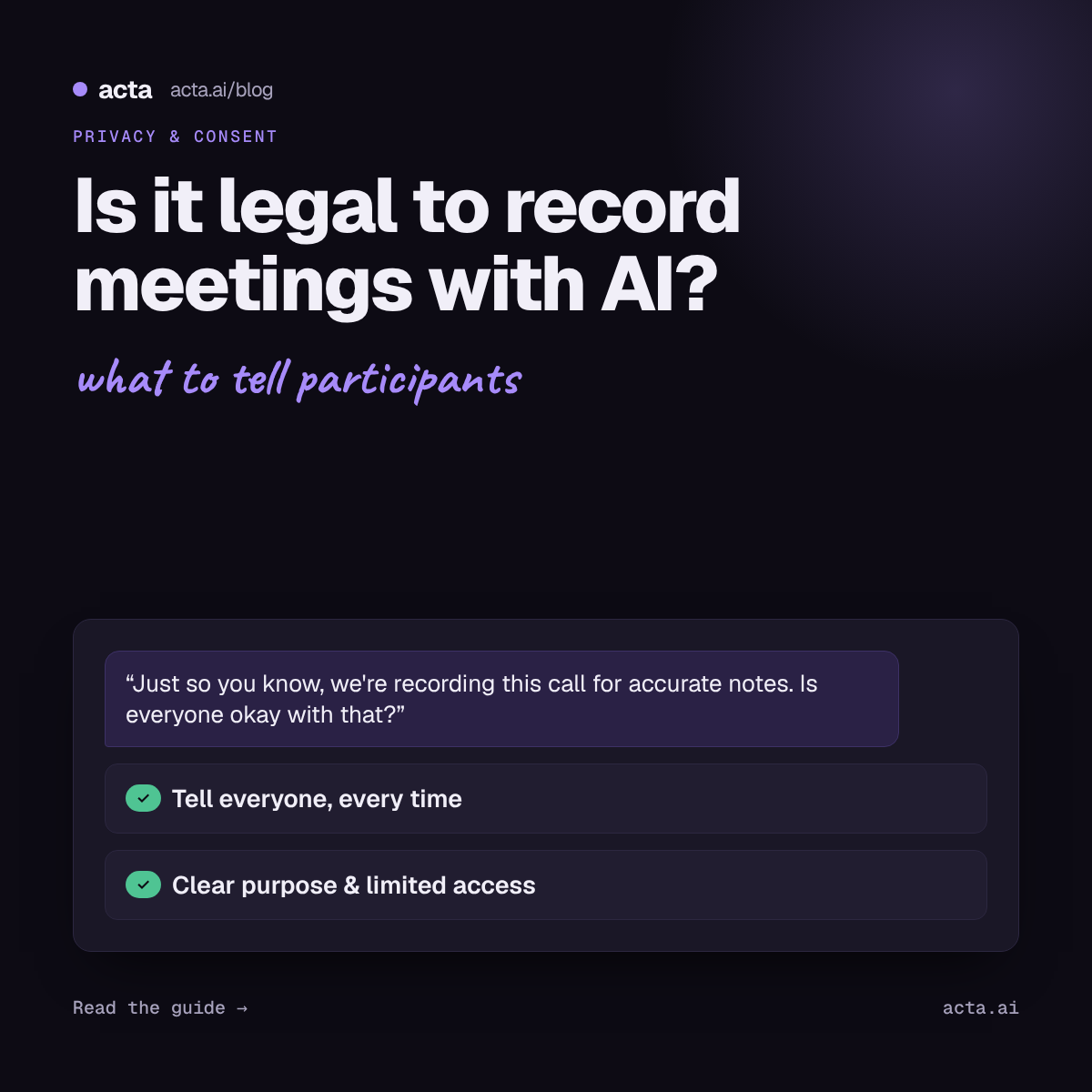
The practical takeaway: don't try to work out the minimum. Tell everyone, every time.
What do privacy laws expect from meeting recordings?
If your recordings include personal information (names, voices, opinions, anything about identifiable people), data protection laws come into play. The details differ, but they share common ideas:
- A clear purpose. Know why you're recording ("to produce meeting notes and action items") and don't use recordings for unrelated things.
- Transparency. Tell people what's recorded, why, and who will see it.
- Consent or another lawful reason. India's DPDP Act is built largely around notice and consent for processing digital personal data. The EU's GDPR allows several lawful bases, consent being one of them.
- Data minimisation and retention. Keep only what you need, for only as long as you need it.
- Security and access control. Only the right people should be able to see a recording.
- Rights for individuals. People may have the right to ask what you hold about them, and to have it corrected or deleted.
India's DPDP Act and its rules are being phased in, so check the current requirements with your legal team if you operate in India.
Which meetings need extra care?
- Job interviews. Always tell candidates, use recordings only for the hiring decision and keep them for a limited time. Our hiring and recruiting page shows how interview notes fit into that process.
- Customer and sales calls. Mention it at the start. Many customers are fine with it if you explain it's for accurate notes.
- Healthcare, finance and legal conversations. These often carry extra rules. Check before recording.
- Internal 1:1s and HR conversations. Even where it's legal, recording sensitive conversations can damage trust. Many teams exclude these by default.
What should a simple meeting recording policy say?
You don't need a 20-page document. Start with this:
- We announce recording at the start of every recorded meeting, including with external guests.
- The calendar invite says the meeting may be recorded and transcribed by [tool name].
- Anyone can ask us to stop recording, and we will.
- We record for notes, decisions and action items, not for monitoring people.
- Only attendees and people they share with can access a recording.
- We don't record sensitive HR conversations, medical discussions, or meetings where a participant has objected.
- We delete recordings after [X] months unless there's a reason to keep them.
Here's a line you can use at the start of a call:
"Just so you know, we're using Acta to record and transcribe this call so we have accurate notes and action items. Is everyone okay with that?"
What should you ask an AI meeting assistant vendor?
Before choosing a tool, get clear answers to these:
- Who in my organisation can see a recording?
- Where is our data stored, and is it encrypted?
- Is our data used to train AI models? (Here is why Acta doesn't use customer data for training.)
- Can we delete recordings, and set how long they're kept?
- How does the tool help us tell participants they're being recorded?
How does Acta handle recorded meetings?
Acta is designed so recordings are useful without being exposed:
- Access follows the user. You only see the meetings you have access to in your own Acta account, and the same applies when you search with OneChat or ask about meetings from Claude or ChatGPT through Acta's connector.
- Answers link to the source. OneChat answers point back to the meetings they came from, so people can check the context instead of relying on second-hand summaries.
- Purpose-built output. Acta turns meetings into summaries, decisions and action items, which supports the "clear purpose" principle above.
For details on storage, retention and data handling, see our privacy policy and security page, and talk to us about your organisation's requirements.
Frequently asked questions
Is it legal to record a Zoom, Teams or Google Meet call?
Usually yes, if participants are told and, where required, agree. Rules differ by country and region, so the safest approach is to announce recording at the start of every call.
Do I need consent to use an AI note taker?
In many places, yes, and it's always good practice. Tell participants the meeting is being recorded and transcribed, and why.
Can I record a meeting without telling the other person?
In some places one-party consent makes this legal, but it can damage trust and may break other rules. It's best not to.
Does India's DPDP Act apply to meeting recordings?
Meeting recordings can contain digital personal data, so the DPDP Act can apply. It emphasises notice, consent, purpose limitation and security, so check the current rules with your legal advisor.
How long should we keep meeting recordings?
Only as long as you need them. Many teams set a retention period, such as a few months, and keep recordings longer only when there's a clear reason.
This article is general information, not legal advice. Laws change and depend on where you and your participants are. Talk to a qualified lawyer about your situation. Record responsibly and get more out of every meeting: try Acta free for 15 days.