Quick answer: To run MEDDPICC without slowing the call, don't try to cover all eight letters in one conversation. Spread them across the deal, ask MEDDPICC questions in the buyer's own words, pick questions that answer two letters at once, and never say the acronym out loud. Fill in the framework after the call from your notes or transcript, then plan the next call around the gaps.
I've watched a lot of reps learn MEDDPICC and then get worse at calls for a month. They walk in with eight boxes to fill and it shows: the buyer starts a story about last quarter's mess, the rep interrupts to ask who signs contracts. The framework is good. Using it as a live script is the mistake.
This post is about the in-call part: which questions to ask, when, and how to make them sound like curiosity instead of a form. If you're after the written output, we've covered MEDDPICC deal reports separately.
What is the MEDDPICC framework, briefly?
The MEDDPICC framework is a qualification checklist for complex B2B deals. The letters stand for Metrics, Economic buyer, Decision criteria, Decision process, Paper process, Identify (or Implicate) pain, Champion and Competition. It grew out of MEDDIC, which came from PTC in the 1990s. Most accounts credit Dick Dunkel and Jack Napoli, with John McMahon as the sales leader who rolled it out; the MEDDICC team's own history tells the story. MEDDPICC adds Paper process and Competition to the original six.
The point of it is honesty. Each letter is a question you should be able to answer about the deal before you forecast it. HubSpot's roundup from reps who use MEDDPICC is a decent read on how teams apply it day to day. What none of it says is that you should ask all eight things in the first 30 minutes.
Why does MEDDPICC slow calls down?
Three habits cause most of it.
- Checklist order. Reps ask in acronym order, M then E then D. Buyers don't think in that order. They start with the pain, so start there.
- Too early for some letters. Asking about the paper process on a first call, before the buyer has decided they have a problem worth solving, is like asking about the wedding venue on a first date.
- Filling boxes live. If you're typing into eight CRM fields while they talk, you're not listening. You'll miss the follow-up that mattered.
Fix those three and most of the friction goes away.
Which MEDDPICC questions belong on which call?
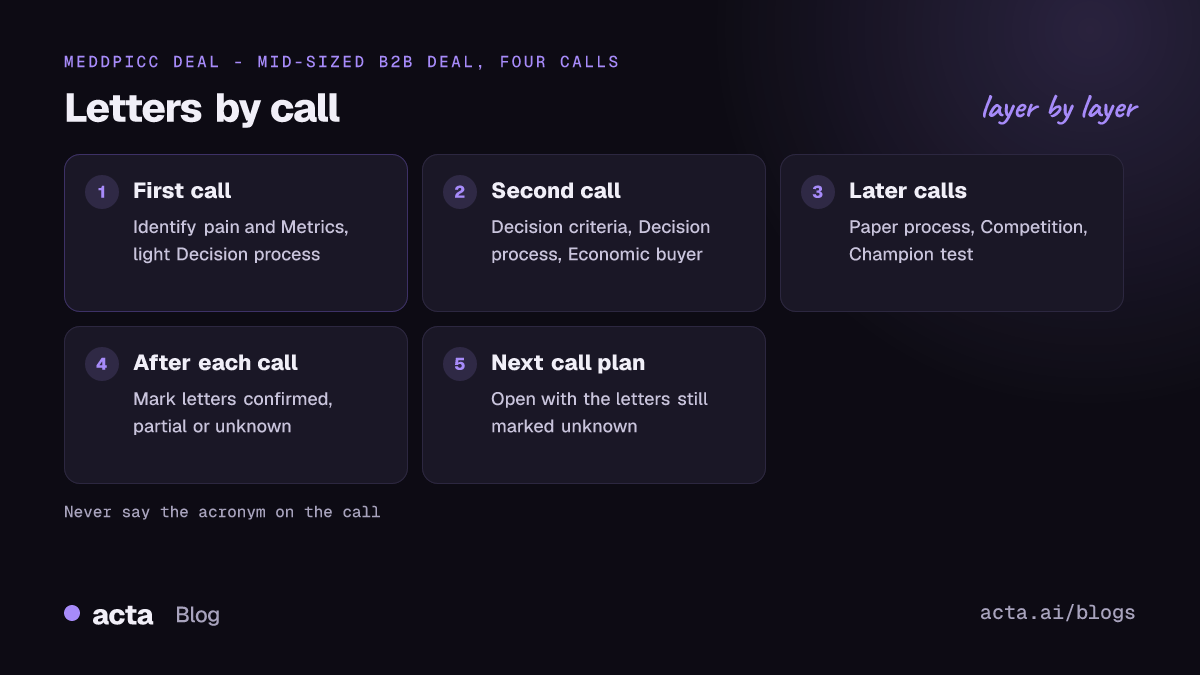
Think of MEDDPICC as something you complete over the deal, not on a call. Here's the rough split I'd use for a mid-sized B2B deal with a few calls before a proposal.
First call: pain and metrics
Spend most of the time on Identify pain and Metrics, with a light touch on how decisions get made.
- "Tell me about the last time this caused a problem. What happened?"
- "How do you measure it today? Is anyone reporting on it?"
- "If it were fixed, what number would move?"
- "Who else is feeling this?"
That last one starts your Champion and Economic buyer work without anyone noticing.
Second call: criteria, process and the economic buyer
Now they've told you the problem matters, you can ask how they'll choose.
- "When you compare options, what will you look at first?" (Decision criteria)
- "What happens between now and a decision? Who's involved at each step?" (Decision process)
- "Whose budget does this come out of?" (Economic buyer)
- "Would it be useful to get them on a short call before you put together your recommendation?"
Later calls: paper process, champion and competition
Once there's a real evaluation going, ask the uncomfortable ones.
- "Once you've picked a vendor, what happens on your side? Legal, security review, procurement?" (Paper process)
- "Who else are you looking at, and what do you like about them?" (Competition)
- "Could you walk me through how you'd present this internally?" (Champion test)
How do you ask MEDDPICC questions so they sound natural?
A few rules that make the biggest difference.
Never say the acronym. "I just need to confirm your decision criteria" sounds like you're filling in a form, because you are. "What will matter most when you compare options?" asks the same thing like a person.
Use their words. If the buyer calls the problem "the month-end scramble", you call it that too. Then "What does the month-end scramble cost you in overtime?" is a Metrics question that doesn't feel like one.
Ask questions that cover two letters. "Who'd be most relieved if this got fixed, and who'd need to sign off on it?" gets you champion candidates and the economic buyer in one go. "What happened last time you bought a tool like this?" gets decision process, paper process and sometimes competition.
Follow the story, then steer. Let the buyer finish. Then pick one thing they said and go one level deeper. You'll get more MEDDPICC answers from good follow-ups than from your planned list.
How do you find the economic buyer without going over your contact's head?
This is the letter reps fumble most, because asking "who's the economic buyer?" feels like saying "you're not important enough". Don't frame it as getting past them. Frame it as helping them win.
"When you take this to whoever owns the budget, what will they ask you first?"
"Would it help if we built the numbers together, so you're not defending them alone?"
The answers tell you who the economic buyer is, what they care about, and whether your contact can get you in front of them. If they say "I'll handle that part", that's fine for now. Write it down as a gap and come back to it on the next call.
How do you test a champion during the call?
A friendly contact isn't a champion. A champion has influence and will spend it for you. The only real test is to ask them to do something.
- "Could you get Marco from IT on the next call?"
- "Would you be willing to share how decisions like this were made last year?"
- "What pushback do you expect, and from whom?"
If they do the thing, you have a champion. If they keep agreeing and nothing happens, you have a coach at best. I'd mark that honestly in the CRM, even when it hurts the forecast. Messy fields are rarely laziness; our piece on why reps don’t update the CRM looks at the real reasons.
What should you do with MEDDPICC after the call?
This is where the framework really earns its keep. Spend five minutes right after the call going letter by letter and marking each one as confirmed, partial or unknown. Only mark confirmed if the buyer said it plainly. "I think the CFO signs" is partial.
Then plan the next call around the unknowns. If Paper process and Competition are blank three calls in, those are the first two topics next time.
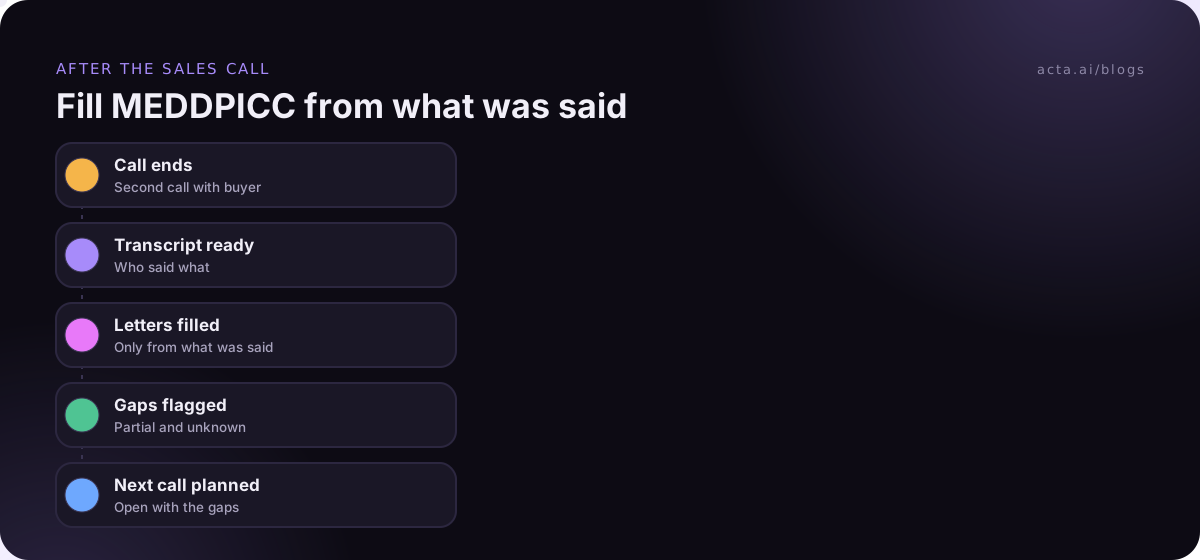
Doing this from memory is where things slip. You're sure they mentioned procurement; they actually said "we'll see". If you record your calls (after checking what the law and your buyer expect on consent), you can reread the exact words. If the buyer's IT blocks notetaker bots, a desktop recorder on your own computer gets the same transcript without anyone joining the call.
Don't let the CRM fields drive the conversation
Managers sometimes make every MEDDPICC field mandatory before a deal can move stage. The intent is good. The side effect is reps asking robotic questions on calls just to unblock a dropdown. Better to require the fields at forecast review and let reps fill them from the transcript.
Common MEDDPICC mistakes worth avoiding
- Treating decision criteria as yours to write. If you hand the buyer a list of criteria that happen to match your product, they'll know. Ask what matters to them first, then add what they've missed.
- Skipping competition because "they're not looking at anyone". The status quo is always a competitor. So is a spreadsheet, and so is an internal team that thinks it can build it.
- Leaving the paper process to the end. Security reviews and procurement can add weeks. If you ever run a lost deal analysis on old sales calls, watch for deals where this came up late. Ask about them before you commit to a close date.
- Filling letters with guesses. A MEDDPICC sheet full of assumptions is worse than an empty one, because it looks finished.
If you're also running discovery from scratch, our discovery call template pairs well with this, and the SPIN selling report covers a different questioning style if MEDDPICC feels too heavy for smaller deals.
Where Acta fits
Acta records sales calls on Zoom, Google Meet and Teams, with a bot or bot-free, and writes the transcript, summary and action items. One of its 40 report templates is a MEDDPICC deal report that fills the letters from what was said, so you can see gaps before the next call. You can also ask OneChat something like "what did they say about procurement?" across all calls on the deal and get answers with sources.
Frequently asked questions
What are the most important MEDDPICC questions?
Questions about pain and metrics come first, because without a measurable problem nothing else matters. After that, the economic buyer and paper process questions are the ones that most often change a close date.
Should I cover every MEDDPICC letter on the first call?
No. Focus on pain and metrics on the first call, and start on decision process lightly. Cover the rest over the next calls as the buyer's interest grows.
What is the difference between MEDDIC and MEDDPICC?
MEDDPICC adds Paper process and Competition to MEDDIC's six elements. Some teams use MEDDICC, which adds only Competition.
How do I know if my contact is a real champion?
Ask them to do something that costs them a little: bring a colleague to the next call, share how past decisions were made, or tell you who will push back. Champions act. Friendly contacts just agree.
Is MEDDPICC worth it for small deals?
For short, low-value sales it's usually too much. A lighter check, such as BANT, often does the job. MEDDPICC pays off when several people decide and the cycle runs for months.
Want MEDDPICC filled from your calls instead of from memory? See how it works on the 15-day free trial.