Quick answer: The discovery call questions that reveal real buying intent ask about consequences and commitments, not features: what the problem costs today, what happens if nothing changes, why now, who else has to agree, what they tried before, and what their next step is. Buyers with intent answer with numbers, names and dates. Vague answers usually mean you're still early.
Most reps leave a discovery call with a page of notes and no real idea whether the deal is alive. The prospect was friendly, nodded along, said "this looks really interesting". Then they went quiet for three weeks. The problem usually isn't the number of questions you asked. It's that the questions measured interest, and interest is cheap.
What follows are the questions I'd actually use to test intent, grouped by what each one tells you, plus how to read the answers. If you want a full call agenda with BANT and MEDDIC checklists, our discovery call template already covers that. This post is narrower: the questions that separate a curious prospect from one who's going to buy something this quarter, from you or someone else.
What does buying intent sound like on a discovery call?
Buying intent shows up as specifics. Our guide to buying signals in sales conversations lists the ones worth writing down. A buyer who means to act has already done some of the work in their own head. They know roughly what the problem costs. Someone above them has asked for it to be fixed. There's a date they care about. So when you ask, they answer with numbers, names and deadlines.
Someone who's browsing answers in generalities: "we're just exploring", "it'd be nice to have", "probably sometime next year". None of that is bad, and some of those people become customers later. But you shouldn't forecast them.
Here's a quick test I use. After each answer, ask yourself whether you could repeat it to your manager as a fact. "Our onboarding team spends about two days per new customer re-keying data from the contract" is a fact. "Onboarding is a bit painful" is a mood. Your job on the call is to turn moods into facts, or to find out there aren't any.
One more thing to keep in mind: buyers don't move in a straight line. Gartner's research on B2B buying found that most buyers revisit nearly every buying job at least once before they purchase. So intent isn't a switch that flips. Some of that research now starts with an AI assistant; we looked at how ChatGPT picks which tools to recommend. Good discovery call questions tell you where in that loop the buyer is right now.
Which discovery call questions test whether the pain is real?
Start with the problem, but don't accept the first answer. The first answer is the tidy version they've already said in three internal meetings. You want the story underneath it.
- "Walk me through the last time this went wrong. What happened?" A real story with a date and a customer name beats any summary.
- "Who noticed?" If nobody outside their own team felt it, the pain may not have a budget behind it.
- "How are you handling it today?" Every problem has a workaround. That spreadsheet or that one heroic coordinator is your real competitor.
- "If this were fixed next month, what would you do with the time?" If they can't answer, the value is fuzzy to them too.
Notice these are all open-ended questions. "Is onboarding slow?" gets a yes and nothing else. "Tell me about the last onboarding that slipped" gets five minutes of detail you can actually use, and usually a number or two you didn't have to ask for.
How do you ask about the cost of inaction without sounding pushy?
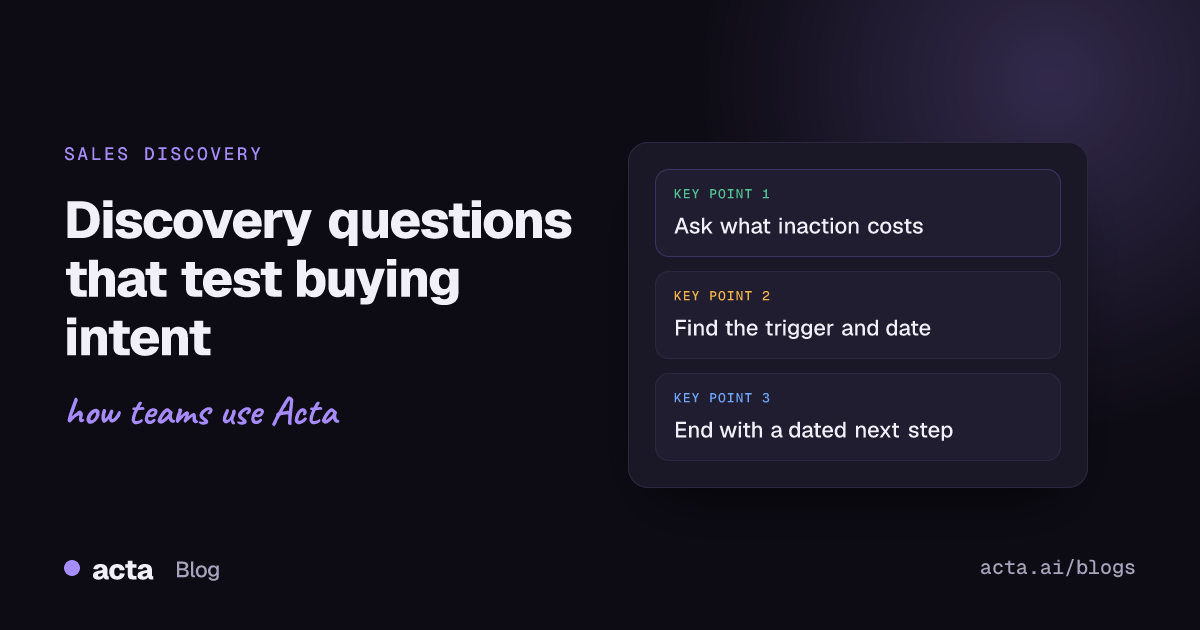
If I could only ask one question, it would be some version of "what happens if you don't change anything?" The answer to the cost of inaction question tells you more about buying intent than anything else on the call. If the honest answer is "nothing much, we'll live with it", you've learned something worth more than an optimistic close date.
The trick is to make it about their situation, not your deal. Compare these two:
"What would it cost you to not buy this?"
"Say you park this until next year. What does that look like for your team?"
The first one sounds like a sales tactic because it is one. The second is a real question, and people answer it honestly. Follow up on whatever they say: "Is that something your VP is tracking?" or "Has that shown up in a number anyone reports on?"
When the cost is real but nobody has measured it
Often the buyer feels the pain but has never put a figure on it. Don't invent one for them. Ask how they'd estimate it: hours per week, deals delayed, tickets reopened. If they're willing to work it out with you, that willingness is itself a signal. If they push back with "we don't really need a business case", be careful. Someone, somewhere, will need one.
Why now? Questions that find the trigger
Problems sit around for years. Something usually happens that turns an old annoyance into a project. Find that something.
- "What made this a priority now, and not six months ago?"
- "Is there a date that matters here? A launch, a renewal, an audit, a new team starting?"
- "What happens on that date if nothing is in place?"
A trigger plus a date is about as close to intent as you'll get on a first call. A new head of operations who starts in January and wants the mess cleaned up before then is a deal. "We've always wanted to sort this out" is a nurture sequence.
Who else is involved, and have they agreed?
The person on the call rarely signs alone. A prospect with intent has usually started thinking about who they'll need to convince. A browser hasn't.
- "Who else will want a say in this?"
- "Last time you bought something like this, how did it go from 'yes' to signed?"
- "Is there anyone who'd rather keep things as they are?"
- "What would your manager need to see to back it?"
The strongest signal here isn't an answer, it's an offer. When a prospect says "I should get our finance lead on the next call", they're spending their own credibility on the deal. Take them up on it before the call ends.
Did they try to fix it before?
This is the question reps skip most, and it's one of the most useful. "Have you tried to solve this before? What happened?" A failed project from two years ago tells you the objection you'll hit, who was burned by it, and what the buyer will need to see this time. A buyer who's already tried twice and is still trying has real intent. They're just nervous.
Ask about alternatives too: "Who else are you talking to?" and "What would make you stick with what you have?" Most people will tell you if you ask plainly. The answer "nobody, we only just started looking" is fine, but it moves the timeline out.
What commitment should you ask for at the end of the call?
The best intent test is a small request. Something like: "Would it make sense to get Dana from finance on a 30-minute call next Tuesday, so we can check the numbers together?" A buyer with intent picks a time. A browser says "I'll circle back".
Ask for something specific, with a name and a date. Then, after the call, check what you actually got. This is where a lot of deals quietly die: the rep remembers a warm conversation and forgets that nobody agreed to anything.
How many questions should you ask on a discovery call?
People ask how many questions to ask on a discovery call as if there's a right number. There isn't. For a 30-minute first call I'd plan around eight to twelve and expect to get through fewer, because the good ones lead to follow-ups. Six strong questions with three follow-ups each beats twenty questions read off a list.
The risk is the interrogation feeling: the prospect answers, you say "great" and move to the next line on your sheet. Fix that by reacting to what they said before asking the next thing. "Two days per customer, across how many customers a month?" is a follow-up and a calculation at once. Gong's guide to discovery questions has a longer list if you want more to pick from, but pick, don't recite.
What to cut
Drop anything you could have found on their website or LinkedIn. "So what does your company do?" spends their goodwill on your homework. Drop yes/no questions unless you're confirming something specific. And drop "what keeps you up at night?". Everyone has heard it, and nobody answers it honestly.
How do you review discovery call notes for buying intent afterwards?
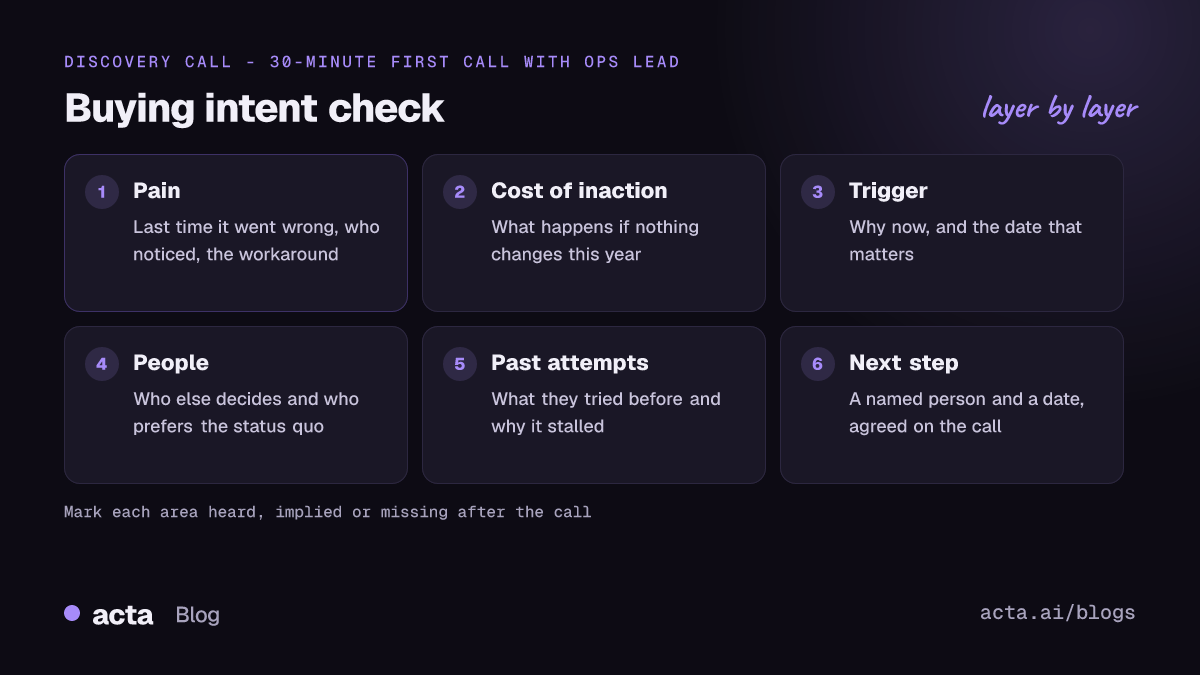
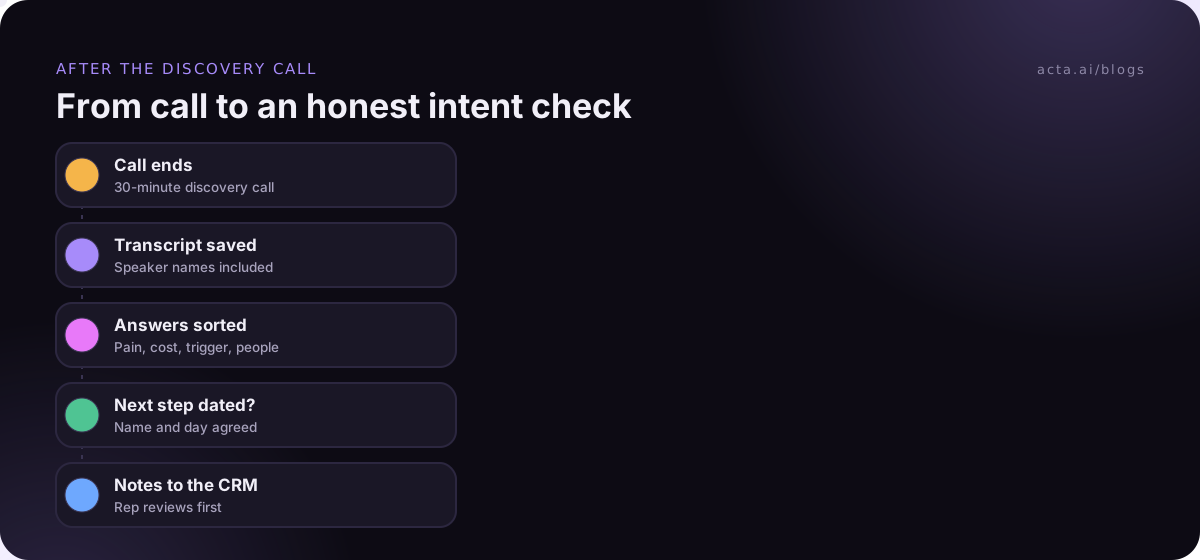
Right after the call, go through your discovery call notes and sort what you heard into six buckets: the pain, the cost of inaction, the trigger and date, the people involved, past attempts, and the next step. For each one, mark it as heard (they said it plainly), implied (you think so, but they didn't say it), or missing.
Be strict about "implied". It's where optimism hides. If the cost of inaction is implied and the next step is missing, that's an early-stage deal no matter how nice the call felt.
This is much easier if you can reread what was actually said instead of trusting memory. If you record calls (tell people first, and see our guide on consent and what to tell participants), you can check the exact words. When the buyer's company won't admit a notetaker bot, a desktop recorder or a Chrome extension can capture the call from your own computer instead. If you already qualify with BANT, the same transcript can feed a BANT qualification report.
Where Acta fits
Acta records sales calls on Zoom, Google Meet and Microsoft Teams, either with a meeting bot or bot-free from the desktop app or Chrome extension, and writes the transcript with speaker names, a summary and action items with owners. Its report templates include sales formats such as BANT and MEDDPICC deal reports, and the notes can go to Salesforce, HubSpot or Zoho. It won't ask better questions for you, but it makes it hard to pretend you heard an answer you didn't.
Frequently asked questions
What are the best discovery call questions to ask?
The ones that ask for specifics: the last time the problem happened, what it costs, what happens if nothing changes, why it matters now, who else decides, and what they tried before. Questions about features or your product can wait for the demo.
How do you know if a prospect has real buying intent?
They answer with numbers, names and dates, they can tell you why now, and they agree to a specific next step before the call ends. Friendliness and enthusiasm on their own aren't intent.
Should I use BANT or MEDDIC questions on a first call?
Use them as a checklist after the call, not as a script during it. The intent questions above cover most of the same ground in a more natural order, and you can map the answers to a framework afterwards.
What if the prospect won't answer the cost question?
Try asking how they'd estimate it instead of asking for a figure. If they still won't engage, it often means the problem isn't big enough yet, or they aren't the person who owns it. Ask who is.
How long should a discovery call be?
Thirty minutes is enough for a first call with one person. If more stakeholders join or the problem is complex, book 45 minutes rather than rushing the questions that matter.
If you'd like your next few discovery calls written up for you, try Acta with the 15-day free trial.