Quick answer: A discovery call template is a fixed plan for your first real sales conversation: a short agenda, a bank of discovery call questions about the buyer's situation, pain and impact, a qualification check such as BANT or MEDDIC, a notes format, and an agreed next step. Use it to learn whether the deal is real before you pitch anything.
Most discovery calls go wrong in the same way: the rep talks for twenty minutes, asks two questions, and leaves without a next meeting in the calendar. A template fixes that because it decides in advance what you need to learn and where you will write it down.
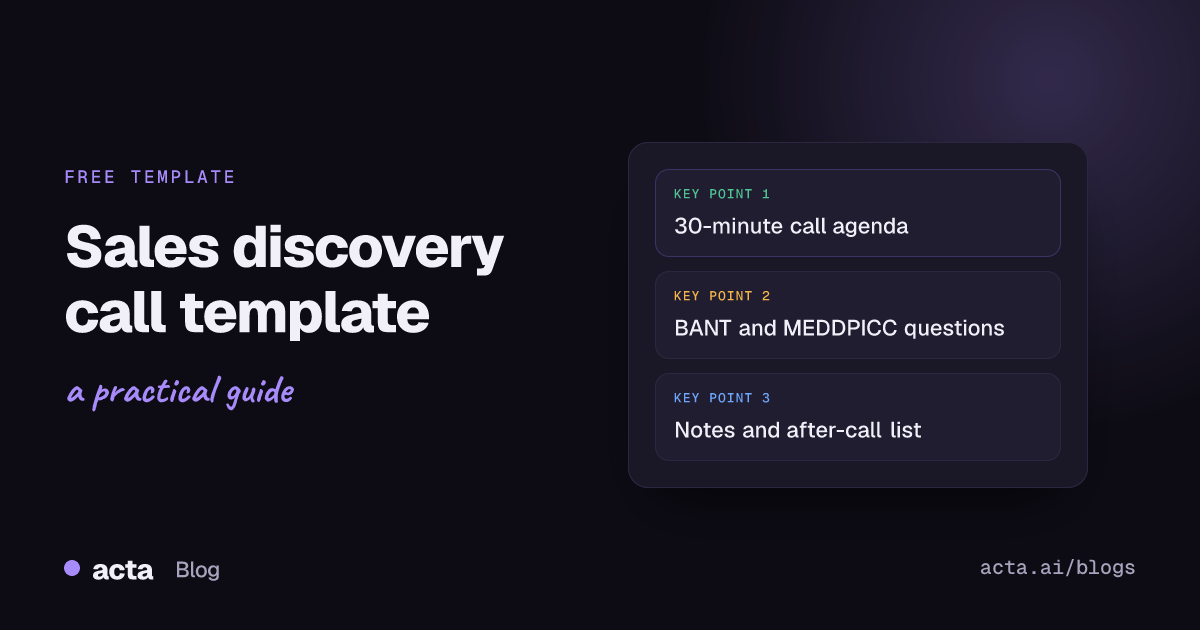
This guide gives you a 30-minute agenda you can copy, a question bank sorted by framework, a note-taking template, a filled-in example for two fictional companies (Northwind selling to Contoso), an after-call checklist, and the mistakes to avoid. At the end we show how Acta fills the same template from the conversation.
What is a sales discovery call?
A sales discovery call is the first proper conversation with a prospect after they have shown interest. Its job is to understand the buyer's situation and problem, and to decide together whether it is worth taking the next step. It is not a demo, and it is not a pitch.
By the end of a good call you should be able to answer four things:
- What problem the buyer has, and what it costs them.
- Who else is involved in the decision, and how they buy.
- Whether there is a reason to act now, and by when.
- What happens next, with a date both sides agreed to.
Qualification frameworks such as BANT and MEDDIC give you a checklist for the second and third points. The template below folds them into one call so you do not have to switch documents.
Discovery call template: a 30-minute agenda
Copy this agenda into your calendar invite and your notes. The timings assume a 30-minute call; stretch the middle sections for a 45-minute slot.
- Introductions (2 minutes): names, roles, and why each person is on the call.
- Agree the agenda (1 minute): "I'd like to understand how you handle X today, share a little about us if it is useful, and agree whether a next step makes sense. Anything you want to add?"
- Current situation (5 minutes): how they work today, which tools and teams are involved, and what triggered the conversation now.
- Pain and impact (8 minutes): what is not working, how often, and what it costs in time, money or risk.
- Qualification (7 minutes): budget, decision makers, decision process, timing and success criteria, using the BANT or MEDDIC questions below.
- Short relevance check (3 minutes): one or two sentences on how you have solved this problem for similar teams. No slides.
- Next step (4 minutes): agree a specific next meeting, who should attend, and what each side will prepare.
The rule that holds the agenda together: the buyer should talk for most of the call. If you notice you have been speaking for more than a minute or two, ask a question.
What discovery call questions should you ask?
You will not ask every question below in one call. Pick two or three per section, and save the rest for follow-ups. Open questions ("How...", "What...", "Walk me through...") get better answers than yes-or-no questions.
Situation questions
- Walk me through how your team handles this today, step by step.
- What prompted you to look at this now rather than six months ago?
- Which tools and teams touch this process?
- Have you tried to fix this before? What happened?
Pain and impact questions
- Where does the current process break down most often?
- When it breaks, what does it cost you: hours, missed revenue, customer complaints, risk?
- Who feels the problem most? Who notices when it goes wrong?
- What happens if nothing changes this year?
BANT questions
BANT stands for Budget, Authority, Need and Timeline. It is usually credited to IBM's sales organization, though published accounts disagree on the decade; HubSpot's guide simply says IBM developed BANT several decades ago to help reps qualify prospects. It is quick and works well for smaller, simpler deals.
- Budget: Is there budget set aside for this? If not, how do projects like this usually get funded?
- Authority: Who else will be involved in choosing a solution? Who signs off in the end?
- Need: If you solved this, what would change for your team? How would you measure it?
- Timeline: Is there a date driving this, such as a contract renewal, a launch or a new hire? When would you want something in place?
For a deeper BANT walkthrough and a scoring approach, see our guide to BANT qualification reports from discovery calls.
MEDDIC and MEDDPICC questions
MEDDIC was created at PTC in 1996. According to MEDDICC's own history, it was put together by Dick Dunkel while he worked under John McMahon, with Jack Napoli as a collaborator (who created MEDDIC). The letters are Metrics, Economic buyer, Decision criteria, Decision process, Identify pain and Champion. MEDDPICC adds Paper process and Competition. It suits larger deals with several stakeholders and a longer cycle.
- Metrics: What number would tell you this worked? What is it today?
- Economic buyer: Who owns the budget this would come from? Will they be involved before a decision?
- Decision criteria: What will you compare options on? What is a must-have versus a nice-to-have?
- Decision process: What are the steps from here to a signed agreement, and who is involved in each?
- Paper process: What do legal, procurement and security need to see, and how long does that usually take?
- Identify pain: What is the business impact if this stays as it is?
- Champion: Who internally wants this to happen, and will they help you reach the others?
- Competition: What else are you looking at, including building it yourselves or doing nothing?
Our post on MEDDPICC deal reports from sales calls shows how to keep each letter up to date as the deal moves.
BANT or MEDDIC: which should your discovery call template use?
Use BANT when deals are small, one or two people decide, and you need to sort many leads quickly. Use MEDDIC or MEDDPICC when deals are large, a buying committee is involved, and paperwork can stall a verbal yes for weeks. Salesforce makes a similar distinction in its comparison of BANT vs MEDDIC, and notes that BANT can be too rigid for complex purchases.
Many teams do both: BANT on the first call to decide whether to continue, then MEDDPICC from the second call on. If your team sells on problems and impact first, the SPICED deal report is another option.
Discovery call note-taking template (copy and paste)
Use one copy per call. Keep the headings even when a section is empty, because an empty heading is a gap you need to close.
- Account and call: [Company] - discovery call - [date] - [rep]
- Attendees: [Names, roles, and who invited whom]
- Trigger: [Why they are looking now]
- Current situation: [Process, tools, teams involved]
- Pain: [Problems in the buyer's own words]
- Impact: [Cost in time, money or risk, with numbers where the buyer gave them]
- BANT: Budget [known / unknown] - Authority [names] - Need [summary] - Timeline [date and reason]
- MEDDPICC gaps: [Letters with no evidence yet]
- Objections and concerns: [What worried them]
- Next step: [Meeting, date, attendees, what each side prepares]
- Action items: [Task] - Owner: [name] - Due: [date]
- Ask on the next call: [Questions you did not get to or answers that were vague]
Discovery call example: Northwind and Contoso
Here is the template filled in. Northwind and Contoso are fictional companies and everyone named is invented.
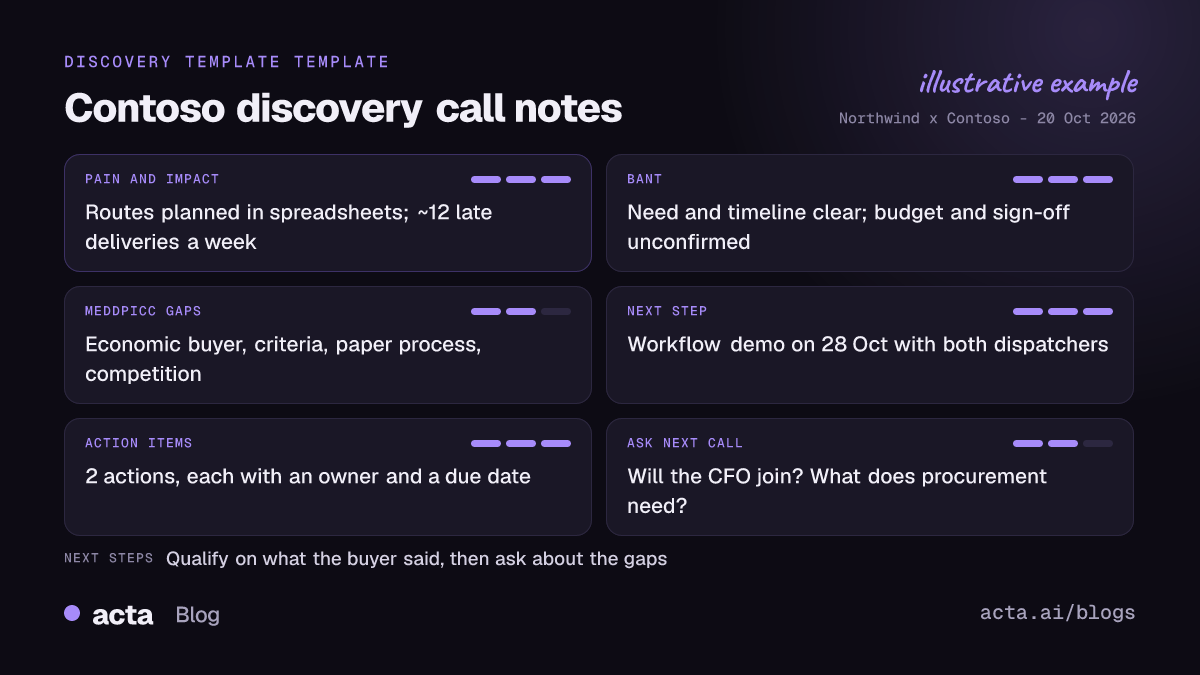
Contoso - discovery call - 20 October 2026 - Alex Rivera (Northwind)
Attendees: Jordan Patel, Operations Manager, Contoso; Alex Rivera, Account Executive, Northwind.
Trigger: Contoso opens a second warehouse in February and expects delivery routes to double.
Current situation: Two dispatchers plan routes each morning in spreadsheets. Drivers get printed sheets.
Pain: "Planning takes until 9:30, so the first trucks leave late." Route changes during the day are phoned through.
Impact: Jordan estimates about 12 late deliveries a week and around 15 hours of dispatcher time on planning.
BANT: Budget - not confirmed; Jordan thinks it would come from the operations budget. Authority - Jordan recommends, the CFO, Erin Walsh, signs. Need - clear. Timeline - live before the February opening.
MEDDPICC gaps: Economic buyer not met; decision criteria not written down; paper process unknown; competition unknown.
Next step: 30-minute workflow demo on 28 October with Jordan and both dispatchers.
Action items:
- Send recap and demo invite - Owner: Alex Rivera - Due: 21 October
- Share a sample week of routes - Owner: Jordan Patel - Due: 24 October
Ask on the next call: Will Erin join a later meeting? What does procurement need for a new vendor? Are you looking at other tools or extending the spreadsheets?
Notice that the notes use the buyer's numbers and words, not the rep's guesses, and that every unknown has turned into a question for the next call.
After-call checklist
Do this within an hour of the call, while it is fresh:
- Fill any blank headings in your notes, or move them to "Ask on the next call".
- Send a recap email: their problem in their words, the agreed next step, and who brings what.
- Update the opportunity in your CRM: stage, close date, next step, BANT or MEDDPICC fields.
- Send the calendar invite for the next meeting, with the right attendees.
- Note any risk: no economic buyer, no date, a competitor already in place.
- Decide honestly whether to continue. Disqualifying early saves both sides time.
What are the most common sales discovery mistakes?
- Pitching too early. If you are sharing your screen in the first ten minutes, you have stopped learning.
- Accepting vague answers. "Budget should be fine" is not a budget. Ask where the money comes from and who approves it.
- Talking only to your contact. A friendly user is not an economic buyer. Ask who else decides.
- Interrogating. Firing framework questions in order feels like a form. Follow up on what the buyer says instead.
- No next step. "Send me some information" is not a next step. Agree a meeting with a date.
- Notes that stay in your head. If it is not in the CRM, your manager, your SE and future you cannot use it.
How does Acta fill in the discovery call template?
Taking good notes while you also listen and ask follow-up questions is hard. Acta takes the notes so you can run the call.
- Capture the call. Acta records Zoom, Google Meet and Microsoft Teams through a meeting bot that joins from your calendar. If you would rather not have a bot in a first call with a prospect, use the bot-free AI notetaker options: the desktop app for Windows and Mac or the Chrome extension. Recording someone needs their consent where the law requires it, so tell the prospect at the start; our guide on whether it is legal to record meetings with AI covers what to say.
- Transcript and summary. Acta transcribes the call with speakers and writes a summary, plus action items with owners and due dates.
- BANT or MEDDPICC report. Acta has 40 report templates in 11 role groups, including BANT, MEDDPICC, SPICED and SPIN. Pick one, or let Acta choose from the conversation. The report fills each part of the framework from what the buyer actually said and includes an "Ask on the next call" list for anything still missing. See how it works for MEDDPICC notes from sales calls.
- Follow-up and CRM. Acta drafts the follow-up email from the call, and on a paid plan pushes the report to Salesforce, HubSpot or Zoho.
- Across the deal. Promises made on calls are tracked with owner, due date and how late they are, filterable by customer. Risks raised on calls, and warning signs such as overdue promises, are listed with a suggested mitigation. OneChat answers questions across all your meetings with sources, such as "What did Contoso say about procurement?"
You still own the judgement. Read the report, correct anything the buyer did not quite say, and decide whether the deal is qualified. More on how sales teams use this is on the Acta for sales page.
Frequently asked questions
How long should a discovery call be?
Thirty minutes is enough for most first calls. Book 45 minutes for complex deals where several people from the buyer's side will attend.
How many discovery call questions should I ask?
Plan eight to twelve and expect to use about half. Good follow-up questions on what the buyer says matter more than covering a list.
What is the difference between BANT and MEDDIC?
BANT checks four basics: budget, authority, need and timeline. MEDDIC goes further into metrics, the economic buyer, decision criteria and process, pain and a champion, which suits bigger deals with buying committees.
Should I demo on a discovery call?
Usually not. Use discovery to understand the problem, then tailor a demo to it on the next call. A short, relevant example is fine if the buyer asks.
What should a discovery call recap email include?
The buyer's problem and impact in their own words, what you agreed as the next step with a date, who will attend, and what each side will prepare.
Want your next discovery call template filled in for you? Try Acta free for 15 days.