The UAE working week has run Monday to Friday since 2022
The UAE working week is the pattern set for the federal government from 1 January 2022: four and a half working days, Monday to Friday, with Saturday and Sunday as the weekend. According to the government portal's page on public-sector working hours, federal employees work 7.30am to 3.30pm Monday to Thursday and 7.30am to 12pm on Friday. The same page notes that the Government of Sharjah works four days, Monday to Thursday, with a three-day weekend of Friday, Saturday and Sunday.
The private sector is a different story. The federal labour law caps normal hours, but it doesn't fix which days a company works. The u.ae page on private-sector working hours sets a maximum of 8 hours a day or 48 hours a week under Article 17 of Federal Decree-Law No. 33 of 2021, with at least one paid weekly rest day and a break after no more than five consecutive hours. Within that, employers choose. Some private firms copied the government's four-and-a-half-day week, some work a full Friday, and others in retail, hospitality or logistics run shifts across six or seven days.
So the first job before planning UAE working week meetings is simple: write down each party's actual working days and hours. A federal ministry, a Sharjah department, a free-zone tech company and a contractor on site can all be in the same project and keep four different weeks. (This is general information about the published rules, not legal advice on your contract.)
Friday is a short day built around the 12.45pm prayer
Friday in the UAE is a working day for most offices, but a short and quieter one. The General Authority of Islamic Affairs, Endowments and Zakat moved the Friday sermon and prayer to 12.45pm at all mosques across the country from 2 January 2026, as Gulf News reported. It replaced the 1.15pm time used since the 2022 weekend change. Many colleagues leave their desks well before the sermon starts, and federal offices close at noon anyway.
That shapes how a sensible team uses Friday:
- Morning: short internal check-ins, one-to-ones and anything that needs only UAE colleagues. Finish by about 11.30am.
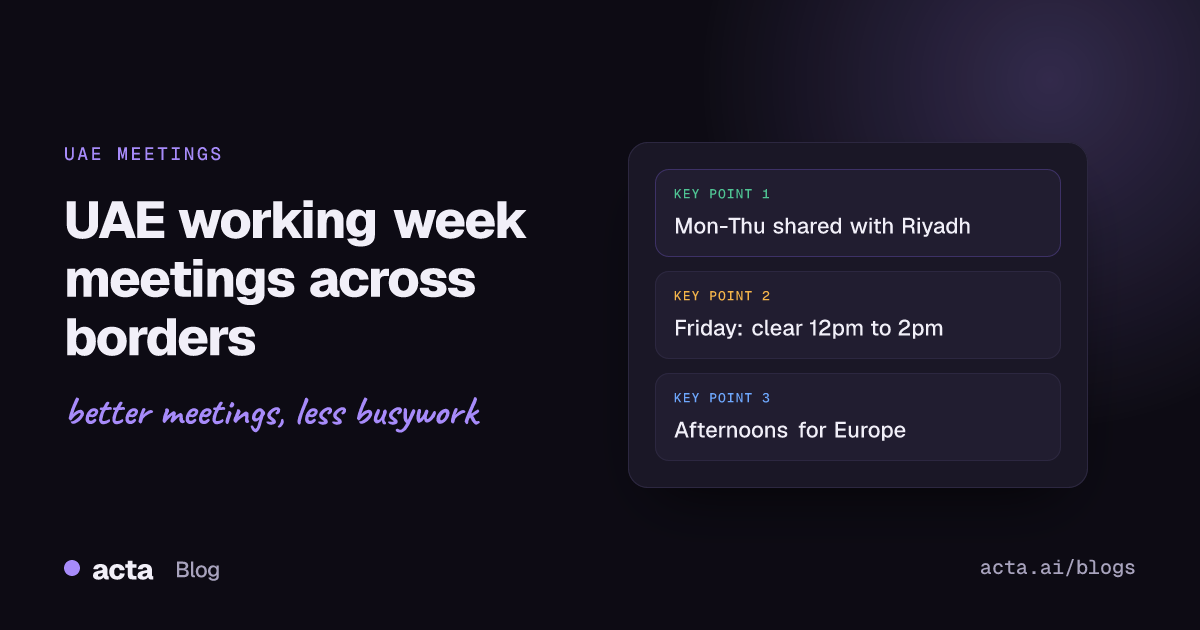
- 12pm to 2pm: no group calls. Don't book "quick syncs" in this slot, even with partners abroad.
- Afternoon: focus work, written updates and calls with Europe, if your company works a full Friday.
Friday is also a weekend day in Saudi Arabia, so it's a poor day for anything that needs Riyadh. Treat it as a UAE-and-the-rest-of-the-world day. During Ramadan the whole day shortens again; our guide to Ramadan working hours meetings covers that month separately.
Saudi Arabia's Sunday-to-Thursday week cuts shared days to four
Saudi Arabia moved its official weekend to Friday and Saturday in 2013; the Saudi Central Bank's statement at the time framed it as narrowing the gap in dealing with the rest of the world. Saudi government bodies work Sunday to Thursday. Private employers there set their own patterns, so ask your counterpart rather than assuming.
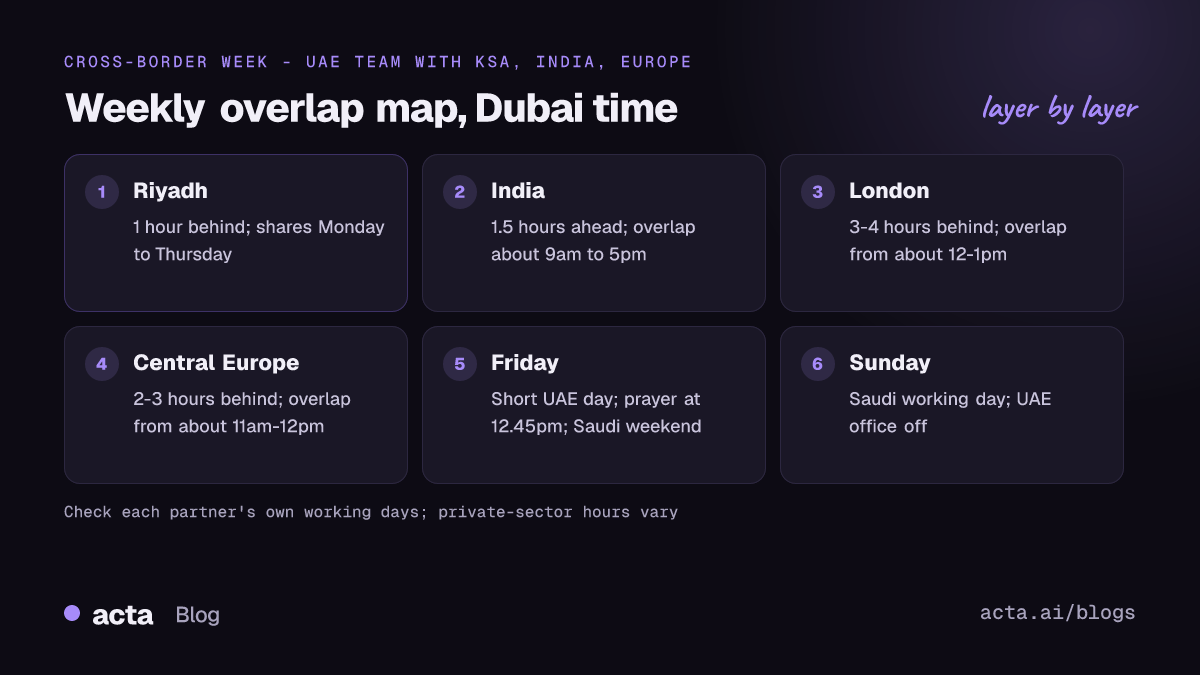
Put the two weeks side by side and the problem is obvious. A Monday-to-Friday UAE team and a Sunday-to-Thursday Saudi team share Monday, Tuesday, Wednesday and Thursday. On Sunday the Riyadh office is working while Dubai is off; on Friday it's the other way round. Riyadh also runs one hour behind the UAE (UTC+3 against UTC+4), and neither country changes its clocks, so the hour gap is stable all year.
Two practical rules follow. First, anything that needs a Saudi decision before the weekend has to land by Thursday afternoon Riyadh time. Second, Sunday work in Riyadh produces questions that sit unanswered until Monday in Dubai. A short written Sunday summary from the Saudi side, read first thing Monday, stops that becoming a lost day.
Time zones decide the daily overlap with India, Europe and the US
The UAE keeps Gulf Standard Time, UTC+4, with no daylight saving. India stays on UTC+5:30 all year, so Indian colleagues are always 1.5 hours ahead. The UK and EU are the moving parts: both put clocks forward on the last Sunday in March and back on the last Sunday in October, per the UK government and the Council of the EU. The US changes on different dates (second Sunday in March, first Sunday in November), which briefly creates odd gaps in spring and autumn.
Here's what the overlap looks like for a UAE office working 9am to 6pm against partners on a 9-to-5 or 9-to-6 day. Times are Dubai time; adjust for your own hours.
| Partner | Gap to UAE | Shared days | Overlap (Dubai time) |
|---|
| Riyadh | 1 hour behind | Mon to Thu | 10am to 6pm |
| India | 1.5 hours ahead | Mon to Fri (check) | 9am to 5pm |
| London | 4 hours behind (winter), 3 (summer) | Mon to Fri | 1pm to 6pm (winter), 12pm to 6pm (summer) |
| Central Europe | 3 hours behind (winter), 2 (summer) | Mon to Fri | 12pm to 6pm (winter), 11am to 6pm (summer) |
| New York | 9 hours behind (winter), 8 (summer) | Mon to Fri | None (winter), about 5pm to 6pm (summer) |
The pattern is clear enough to plan around. Mornings belong to the Gulf and India, early afternoon to everyone from Riyadh to Frankfurt, and the US mostly gets written handovers. For a deeper look at fair scheduling with far-flung teams, see our guides to scheduling across time zones and rotating meeting times.
A weekly rhythm for UAE working week meetings across three countries
A rhythm beats ad-hoc invites. Once people know which day carries which conversation, you stop negotiating calendars every week. This one suits a team split across the UAE, Saudi Arabia and India, with occasional European clients:
- Monday, 11am Dubai (10am Riyadh, 12.30pm India): weekly plan. 30 minutes. Read the Saudi Sunday summary first, then agree the week's priorities.
- Tuesday and Wednesday: working sessions. Small groups, booked between 10am and 1pm Dubai. Wednesday 1pm to 2pm is the Europe slot for client calls.
- Thursday, 11am Dubai: decisions and sign-offs. The last shared day with Riyadh. Anything that needs a Saudi approval goes here, not Friday.
- Friday: UAE-only morning. One-to-ones and admin before 11.30am; nothing across the prayer; written week-end update by mid-afternoon for India and the US.
- Sunday: Saudi-only day. Riyadh posts a short written summary of anything that came up, for Dubai to read on Monday.
If your Indian team doesn't work Fridays or works Saturdays, move the India-facing items to Thursday. The structure matters more than the exact slots. Our async standup template works well for the Friday and Sunday written updates.
A worked example: one regional team's week
Take an illustrative company: a Dubai-based IT services firm with a project team of nine. Khalid Al Mansoori leads delivery from Dubai Internet City. Noura Al Qahtani manages the client relationship from Riyadh. Arjun Iyer and Priya Nair run development in Bengaluru. The client's procurement lead, Sophie Laurent, sits in Paris.
Before they adopted a rhythm, Khalid's Monday started with a dozen unread Sunday messages from Riyadh, client approvals slipped into Friday when Noura was off, and Sophie kept getting invites at 9am Dubai, which was 6am in Paris in winter. After the change, Noura sends a five-line Sunday note. Monday's 11am plan covers it in the first five minutes. Arjun and Priya demo progress on Tuesday at 10am Dubai, 11.30am in Bengaluru. Sophie joins on Wednesday at 1pm Dubai, 10am Paris in winter. Thursday's 11am session closes approvals with Noura before the Saudi weekend.
The rhythm didn't remove meetings; it put each one where the right people are actually working. The Thursday decisions go out as written notes the same afternoon, which the Bengaluru team reads before their Friday and Noura reads on Sunday.

Recorded meetings and shared notes cover people outside the overlap
Some people will always fall outside the window: a US stakeholder, a Saudi colleague on Friday, an engineer in India on leave. Adding a second meeting for each of them doubles the load. A record of the first meeting is usually enough, if it says what was decided, who owns each action and by when.
When you record, say so at the start and give people the chance to object. Our article on recording consent and what to tell participants covers the general principles; for the UAE specifically, read our explainer on the PDPL and recording meetings. For a Teams or Zoom call on your laptop, the Acta desktop app records the meeting sound and your microphone without a bot joining, and it never records your screen.
Language is the other practical point for these teams. If the India-side discussion is in Hindi or a Hindi-English mix, Acta detects it automatically; for Arabic, choose Arabic (beta) in Settings, and set notes to English so everyone can read them. Urdu and Malayalam aren't supported yet. Our post on Hindi-speaking teams in the UAE shows how English records come out of Hinglish meetings. Details are in the meeting languages help article. Later, anyone can ask OneChat what was agreed across past meetings, with links back to the source, as described in the OneChat guide.
Common scheduling mistakes and what to do instead
- Booking Saudi approvals on Friday. It's the Saudi weekend. Move them to Thursday, or Wednesday if Thursday is busy.
- Assuming every UAE company works the government week. Ask partners for their days and hours; private firms vary.
- Forgetting the clock change. Your London call at 1pm Dubai becomes 9am in London in winter and 10am in summer. Recheck recurring invites in late March and late October.
- Using the Friday prayer slot for "quick" calls. Keep 12pm to 2pm clear, every Friday.
- Treating Sunday messages from Riyadh as urgent. Agree that Sunday items wait for Monday's plan unless someone flags a real emergency.
Compared with the alternatives, a fixed rhythm wins over rotating times when only one country is far away, and over "find a slot each week" when more than five people are involved. Rotation makes sense for truly global teams spanning the US and Asia, where no slot is fair to everyone.
How Acta helps cross-border teams
Acta joins Zoom, Google Meet or Teams as a bot, or records from your own computer with the desktop app or Chrome extension, and turns each call into a transcript, summary, decisions and action items with owners. For teams spread across the Gulf and India, that means the people who missed Thursday's call can read it on Sunday. See the Acta page for UAE teams; there's a 15-day free trial.
Frequently asked questions
What is the working week in the UAE?
The UAE federal government works Monday to Friday, 7.30am to 3.30pm Monday to Thursday and 7.30am to 12pm on Friday, with Saturday and Sunday off, a pattern in place since January 2022. Sharjah's government works Monday to Thursday. Private-sector companies choose their own days within the labour law's limit of 8 hours a day or 48 a week.
What time is Friday prayer in the UAE?
As of November 2026, the Friday sermon and prayer start at 12.45pm at all mosques in the UAE, a change that took effect on 2 January 2026 and replaced the earlier 1.15pm time. For meetings, keep 12pm to 2pm on Fridays free of group calls, since many colleagues leave their desks before the sermon begins.
What is the UAE-Saudi time difference?
The UAE is one hour ahead of Saudi Arabia all year: the UAE uses UTC+4 and Saudi Arabia UTC+3, and neither observes daylight saving. A 10am meeting in Riyadh is 11am in Dubai. The bigger gap is the working week: the UAE works Monday to Friday, Saudi Arabia Sunday to Thursday.
What is the best day for meetings between the UAE and Saudi Arabia?
Monday to Thursday are the only days both the UAE and Saudi Arabia work, so book joint meetings then. Use Monday for planning and Thursday for decisions, since Thursday is the last shared day before the Saudi Friday-Saturday weekend. Avoid Friday entirely for anything needing Riyadh, and ask Saudi colleagues to send a written Sunday summary.
When is the best time for UAE meetings with India and Europe?
For a UAE team, meetings with India fit between 9am and 5pm Dubai time, as India is 1.5 hours ahead. Meetings with London and Central Europe fit early afternoon Dubai time, roughly 12pm to 6pm in winter and an hour earlier in summer. One slot around 1pm Dubai usually works for the UAE, Saudi Arabia, India and Europe together.
Choose a meeting rhythm your partners can keep
A weekly pattern only works if the other side can keep it too. Agree it with each partner before you send the recurring invites:
- Map the weeks: list every party's working days and hours, including Friday and Sunday.
- Fix the anchor slots: Monday plan and Thursday decisions for Gulf teams, an early-afternoon slot for Europe.
- Protect Friday midday: no group calls from 12pm to 2pm.
- Set the written handovers: a Sunday note from Saudi Arabia, a Friday update for India and the US.
- Recheck twice a year: review recurring invites after the March and October clock changes in Europe and the US.
To get notes from every cross-border call without adding a bot, install the Acta Chrome extension for meetings in the browser.