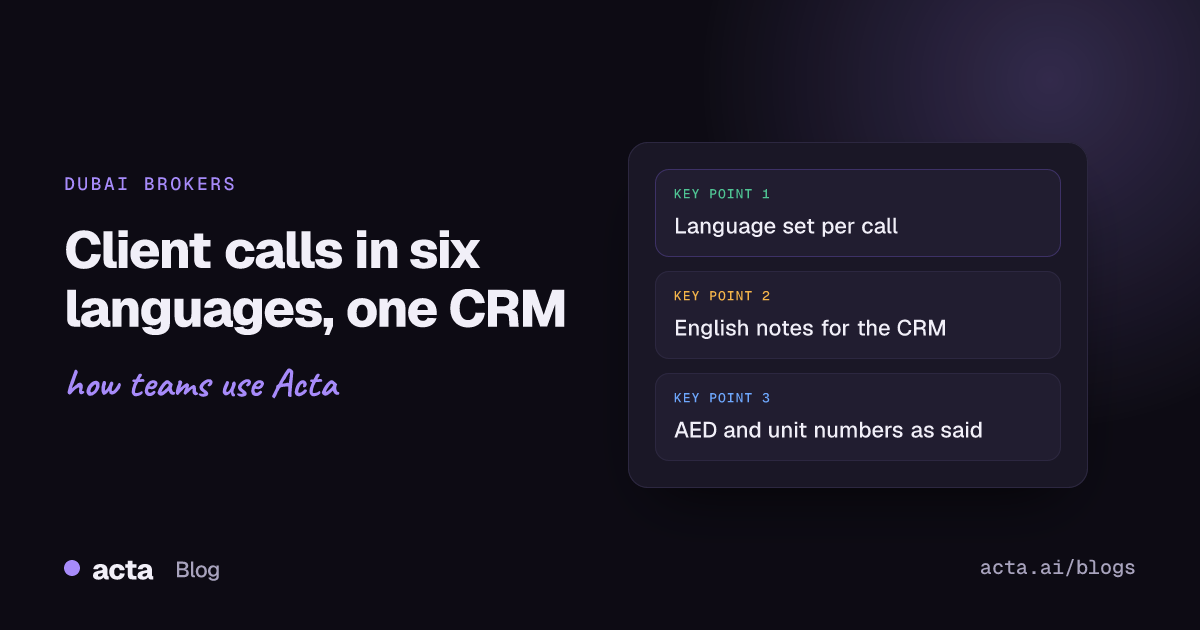
Hindi-speaking teams UAE-wide answer to English readers
The Indian business community in the Emirates is large and old. The Embassy of India's page on the Indian community in the UAE describes Indians as the largest expatriate group in the country. A lot of that community works inside companies founded by other Indians, and the internal language of those companies is often Hindi, or more accurately Hinglish: Hindi grammar with English business words dropped in every few seconds.
That's fine until someone outside the room needs the record. The bank's relationship manager wants to know what was agreed about the trade finance line. The external auditor asks why a supplier advance was approved. An Emirati partner or sponsor wants the minutes of the partners' meeting. None of them reads Devanagari, and few will accept "we discussed it in Hindi" as an answer. So Hindi-speaking teams UAE-wide end up doing double work: talk in Hindi, then someone rewrites it in English from memory, usually late at night and usually missing the numbers. Hindi meeting minutes rebuilt that way rarely survive the first question from an auditor.
The practical fix is to keep the meeting language people are comfortable in and generate the English record from the recording. That's what the rest of this guide sets up. It doesn't repeat the per-person office mapping covered in the Arabic-English meetings playbook for Dubai offices; this one is about Indian-run firms specifically, where Arabic meetings are the exception and Hindi is the default.
Auto covers Hindi and Hinglish without a setting change
Auto is the spoken-language option that listens and decides the language for you. In Acta it chooses between five languages: English, Hindi, French, Spanish and German. Hindi includes the Hindi-English mix, so a partners' meeting that slides from "achha, toh LC kab open hoga" to a full English sentence about shipping documents is handled as one Hindi meeting. Ten more languages exist, but they're in beta and have to be selected by name.
For most people in an Indian-run UAE firm, that means a single change: move "Language spoken in meetings" from the default English to Auto. After that, English calls with the bank come back in English and Hinglish team calls come back as Hindi, with English terms such as LC, PI, BL or VAT return kept as they were spoken. That is the whole trick to usable Hinglish meeting notes: one setting, no switching mid-call. The guide to Hinglish transcription goes deeper into how mixed sentences behave.
Here's an illustrative line from a finance huddle transcript, with a gloss:
बैंक को स्टेटमेंट सोमवार तक चाहिए।
Gloss: The bank needs the statement by Monday.
One thing to watch: Auto will never jump to Tamil, Telugu or Arabic. If the same person records a Hinglish huddle at 10 and an Arabic call with a landlord at 12, the second one needs Arabic selected first.
Tamil, Telugu and Bengali colleagues pick their language by name
Very few UAE trading houses are Hindi-only. The accounts team might be from Chennai, the warehouse supervisor from Hyderabad, the import desk from Kolkata. When they talk to each other in their own language, Acta can handle it, but only if they choose that language in Settings: Telugu, Tamil, Kannada, Marathi and Bengali are all in beta and are never picked by Auto. Beta means it works and accuracy is still improving. Clear audio and the exact language matter more here than with Hindi.
Short illustrative transcript lines, each with a gloss:
- Tamil: சரி, நான் பார்க்கிறேன். (Okay, I'll check.)
- Telugu: రేపు ఉదయం వస్తాను. (I'll come tomorrow morning.)
- Bengali: আমি কাল আসব। (I'll come tomorrow.)
In practice, most mixed meetings in these firms still run in Hindi or English, because that's the shared language between a Tamil accountant and a Gujarati owner. Use the regional setting for the meetings that really happen in that language: the Chennai-origin accounts team's own weekly close, a Telugu-speaking site supervisor's call with his foremen, a Bengali buyer call. For the team-level picture of how Tamil notes work, see Tamil meeting notes in Tamil or English.
The rule that trips people up is that the setting belongs to the person recording, not to the meeting. If the Telugu supervisor's call is recorded by someone set to Auto, it'll be processed as if it were one of the five auto languages, and the result will be wrong. Whoever presses Record has to own the language choice.
Malayalam and Urdu meetings still need a person taking notes
I'll be blunt, because this matters more in the UAE than almost anywhere: Malayalam and Urdu are not among Acta's 15 languages today. Gujarati and Punjabi aren't either. In many Indian-run Gulf firms, a large share of the drivers, storekeepers and site staff speak Malayalam, and Pakistani colleagues often speak Urdu. Don't record those conversations expecting a transcript, and don't pick Hindi as a stand-in for Urdu because they sound close. A transcript that's half right is worse than none, because someone will trust it.
What works instead:
- Keep a written log for Malayalam or Urdu briefings, with decisions and owners in English.
- Wrap up in Hindi or English. If the group can, restate the decisions at the end in a supported language and record just that part.
- Tell staff the list. One message saying "Hindi, English and these regional languages work; Malayalam and Urdu don't yet" saves a lot of confusion.
English notes give auditors and partners a record they can read
The second setting, "Language for my notes", has two choices: Same as the meeting, or English. Pick English and a Hinglish meeting still gets a Hindi transcript, but the summary, decisions, action items, report templates and follow-up email draft come out in English. Quotes stay as spoken. Acta doesn't translate notes into any third language, so there's no Arabic-notes-from-a-Hindi-meeting option.
What makes English notes trustworthy for outsiders is what doesn't change. Names, numbers, dates, AED amounts, invoice and PI numbers, product names and technical terms are kept as they were said, not converted. If the owner said "pachaas hazaar dirham", the record shows the amount as spoken rather than a reworked figure, and if someone quoted "PI 2291" it stays 2291. That's the detail an auditor checks first.
| Who reads the record | What they look for | Notes language |
|---|
| External auditor | Approvals, amounts, who signed off | English |
| Bank relationship manager | Facility terms, deadlines, documents promised | English |
| Emirati partner or sponsor | Decisions, risks, next steps | English |
| The team itself | Who does what by when | Same as the meeting or English |
My advice for most of these firms: English notes by default, transcript in the spoken language for anyone who wants to check a quote. A team that reads Hindi comfortably can switch notes back to Same as the meeting for purely internal meetings, but mixing the two on one shared drive gets messy fast.
The recording method follows where the conversation happens
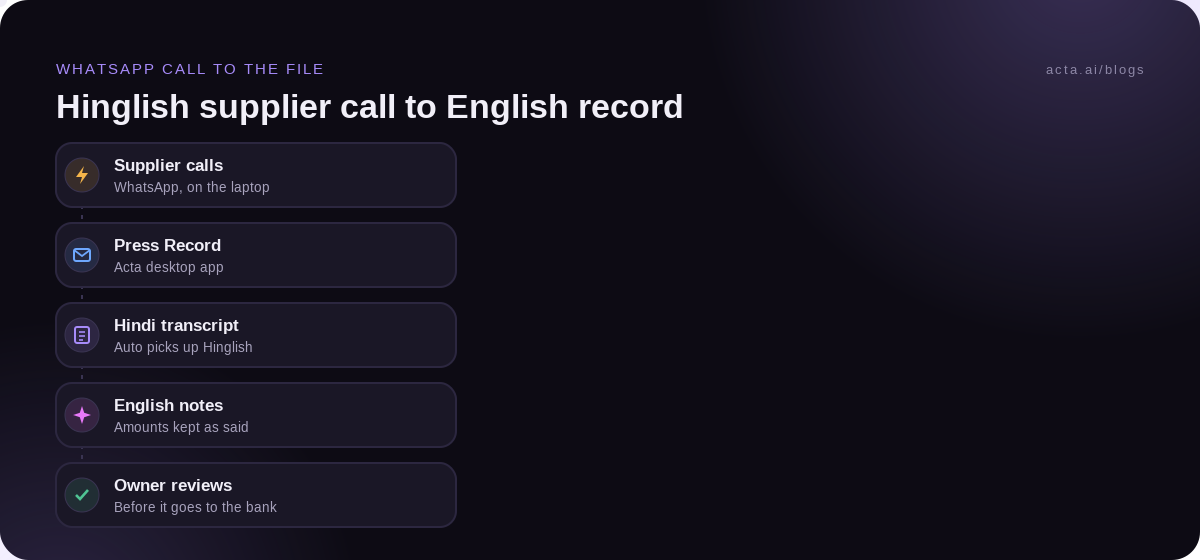
The language setting works the same however a meeting is captured, so pick the method by where people actually talk. In a Bur Dubai trading office, that's rarely a scheduled Zoom. It's a WhatsApp call from a supplier in Surat, a walk-in meeting in the owner's cabin, a Teams call with the bank.
| Where the conversation happens | Method that fits |
|---|
| WhatsApp or other call on a laptop | Desktop app: open it and press Record |
| Zoom or Teams desktop app | Desktop app, which detects the meeting |
| Google Meet or Teams in Chrome | Chrome extension, or the meeting bot |
| Owner's cabin, godown, site office | Mobile app on the table |
| An old recording someone already has | Upload the file |
The Acta desktop app records the call's sound and your microphone, never your screen, and it works with any calling app once you press Record; Zoom and Teams desktop meetings it spots by itself. The walkthrough on recording any call on your computer covers WhatsApp and Webex specifically. For the cabin and the godown, the Acta mobile app records in-person meetings from a phone. Older audio can be added through the upload guide.
Tell people before you record, in the language of the meeting. The desktop app has a Copy notice button that pastes a short recording notice into the chat. On the legal side, the UAE has a federal personal data protection law, Federal Decree-Law No. 45 of 2021; the government portal's data protection laws page is the official starting point. That's general information, not legal advice. For what to say to participants, read is it legal to record meetings with AI.
Worked example: a Deira trading house's Monday review
Take an illustrative family-run textiles trader near the Deira souks, eleven staff, three of them partners. Every Monday at 10, the partners, the accountant and the import coordinator sit in the owner's cabin for forty minutes. They talk in Hinglish. The accountant, Lakshmi, is from Coimbatore and switches to English when she presents the cash position. The coordinator, Rakesh, speaks Hindi.
Before Acta, Rakesh typed minutes in English on Tuesday morning. They were short, the AED figures were sometimes rounded, and the auditor once asked for evidence of an approval that wasn't in them. Now the owner's son puts his phone on the table, opens the mobile app and records. His account is on Auto with English notes.
What comes back, in the illustrative version:
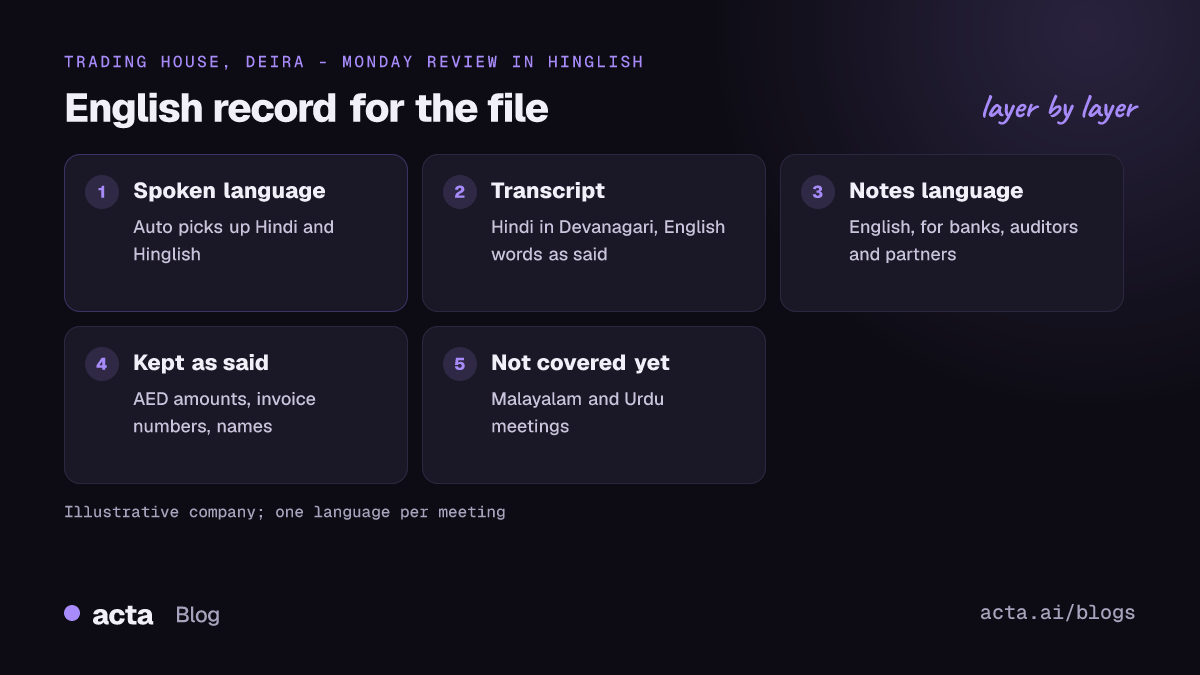
- Transcript: Hindi in Devanagari, with Lakshmi's English passages in English and terms such as LC, PI and container numbers as spoken.
- Summary (English): Two Pakistan-bound shipments delayed; partners approved a supplier advance; bank asked for updated stock statements.
- Decisions: Supplier advance of AED 40,000 approved by the two senior partners. Second shipment held until the LC amendment arrives.
- Action items: Lakshmi sends the stock statement to the bank by Thursday. Rakesh gets the revised PI from Surat by Sunday.
Lakshmi reads the decisions and amounts before the notes go into the audit folder. That check takes five minutes, and it's worth doing every week: the record is only as good as the last person who confirmed the figures.
The Tuesday call with Lakshmi's own accounts assistant, which runs in Tamil, is recorded by Lakshmi with Tamil selected. The Malayalam-speaking driver's briefing on delivery routes stays a written list on the whiteboard.
Set it up in Acta in five steps
- In the Acta dashboard, go to Settings, then Meetings, and find the Language card. It's just below "Add Acta Notetaker to my meeting invites".
- Under "Language spoken in meetings", choose Auto if you speak Hindi, Hinglish or English in your meetings. Choose Tamil (beta), Telugu (beta) or Bengali (beta) instead if that's the language of the meetings you record.
- Under "Language for my notes", choose English for records that leave the team, or Same as the meeting for internal notes.
- Record one short internal meeting. On its page, check the language chip next to the tabs; the "Change language" link takes you back to the card if it's wrong.
- Remember the setting applies to new meetings only. Past meetings keep the language they were processed in.
The meeting languages help article shows the card and lists all 15 languages.
Where Acta fits
Acta transcribes Hindi, Hinglish and English meetings on Auto and Tamil, Telugu, Bengali and other regional languages in beta, then writes notes in the meeting's language or English. It records through a meeting bot, the desktop app, the Chrome extension, the mobile apps or an uploaded file. It doesn't cover Malayalam or Urdu yet.
Frequently asked questions
Can AI meeting notes handle Hinglish for a UAE team?
Yes. In Acta, Hinglish is handled as Hindi, and Auto detects it, so a meeting that mixes Hindi and English needs no special setting. The transcript keeps Hindi in Devanagari and English words as spoken. Set the notes language to English if the summary and action items need to be read by people outside the team.
Can I get English minutes from a Hindi meeting for our auditor?
Yes. Choose English under "Language for my notes". The transcript stays in Hindi, while the summary, decisions, action items and report templates are written in English. AED amounts, invoice numbers, names and dates are kept as said, which is what an auditor checks. Have someone who attended read the decisions and figures before filing.
Does Acta transcribe Malayalam or Urdu?
Not yet. Acta supports 15 languages: five on Auto (English, Hindi, French, Spanish, German) and ten in beta, including Arabic, Tamil, Telugu, Kannada, Marathi and Bengali. Malayalam, Urdu, Gujarati and Punjabi are not on the list, so meetings in those languages need written notes for now.
How do I record a WhatsApp call with a supplier?
Take the call on your laptop and use the Acta desktop app: open it, choose Record on this device and press Start recording. It captures the call's sound and your microphone, not your screen. Tell the supplier you're recording first. The meeting language setting applies, so a Hinglish call on Auto comes back as Hindi.
Does everyone in the company need to change their settings?
Only the people who record. The language setting sits on each person's account and applies to the meetings they record. In a small firm that might be two or three people: set them to Auto with English notes, and set the one person who records Tamil or Telugu meetings to that language.
Write down your team's language rules this month
A one-page note in the team's WhatsApp group does more than any setting. Cover these points:
- Name the recorders: two or three people, each with Auto or a named regional language set on their account.
- Fix the notes language: English for anything an auditor, bank or partner may see.
- Pick a method per meeting: desktop app for laptop calls, mobile app for the cabin and the godown.
- List what isn't covered: Malayalam and Urdu meetings get a written log.
- Check the numbers: one attendee confirms amounts and approvals before notes are filed.
To try this on next Monday's review, install the Acta desktop app on the laptop that takes the most calls and set the language card before the meeting starts.