Ramadan working hours in the UAE are announced every year
There is no fixed Ramadan timetable that rolls over from one year to the next. The Ministry of Human Resources and Emiratisation (MOHRE) announces the private-sector rule, and the Federal Authority for Government Human Resources (FAHR) announces the federal government rule, usually shortly before the month starts. For Ramadan 2026, MOHRE announced on 12 February 2026 that private-sector working hours would be reduced by two hours a day, and that companies could use flexible or remote work as long as it stays within the reduced daily hours.
On the federal side, FAHR's Ramadan 1447 circular set official hours of 9am to 2.30pm from Monday to Thursday and 9am to 12pm on Friday, with flexible arrangements allowed and Friday remote work permitted for up to 70% of an entity's staff. Individual emirates announce their own local-government hours, so a Sharjah or Abu Dhabi government partner may keep a different day from a federal ministry.
What this means for your calendar: in a private company that normally works eight hours, the Ramadan day is about six. If your company also runs flexible start times, the shared window where everyone is online shrinks further. Check the year's MOHRE or FAHR announcement, then your own HR circular, before you build the schedule. The two-hour cut is set nationally, but your employer still decides the start and finish times inside the limit.
Dates move too. Ramadan 2026 began in the UAE on Wednesday 18 February, as WAM reported after the moon-sighting committee met. For 2027, astronomers expect the first day around 8 February, according to The National, but the official date depends on the sighting, so keep the first week of the plan flexible by a day.
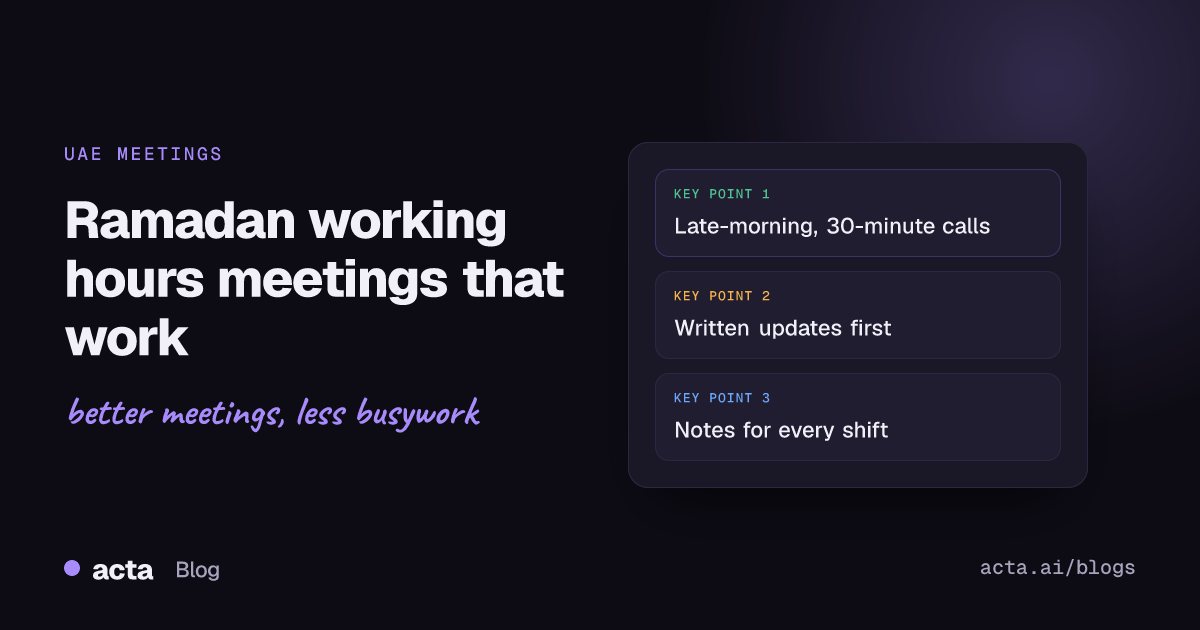
Ramadan working hours meetings fit best in the late morning
Most fasting colleagues have had a very early start for suhoor and Fajr prayer, and the last hour before iftar is when energy is lowest and people head home to break the fast with family. That leaves the late morning as the best window for anything that needs thinking. In practice, I'd book internal Ramadan working hours meetings between about 10am and 1pm, and leave the final hour of the shortened day free of calls.
Use these rules when you place a meeting:
- Start from the official day. Write the team's Ramadan start and end times at the top of the plan. Everything else fits inside that box.
- Protect the midday prayer. Dhuhr falls around midday in the UAE. Leave a gap of 20 to 30 minutes around it rather than booking back-to-back calls across it. Use the official Awqaf timetable for exact times in your emirate.
- Keep the last hour clear. Many people leave as soon as the reduced day ends. A 4pm call in a company that now finishes at 3pm is a meeting nobody can attend.
- Handle client calls by their calendar. A client in London or Mumbai may not be on Ramadan hours. Offer them your late-morning slots first, and record or summarise the call for colleagues who can't join.
- Don't schedule over iftar. Evening calls after iftar happen in some teams, but only when the people involved ask for them. Never make an evening slot the default.
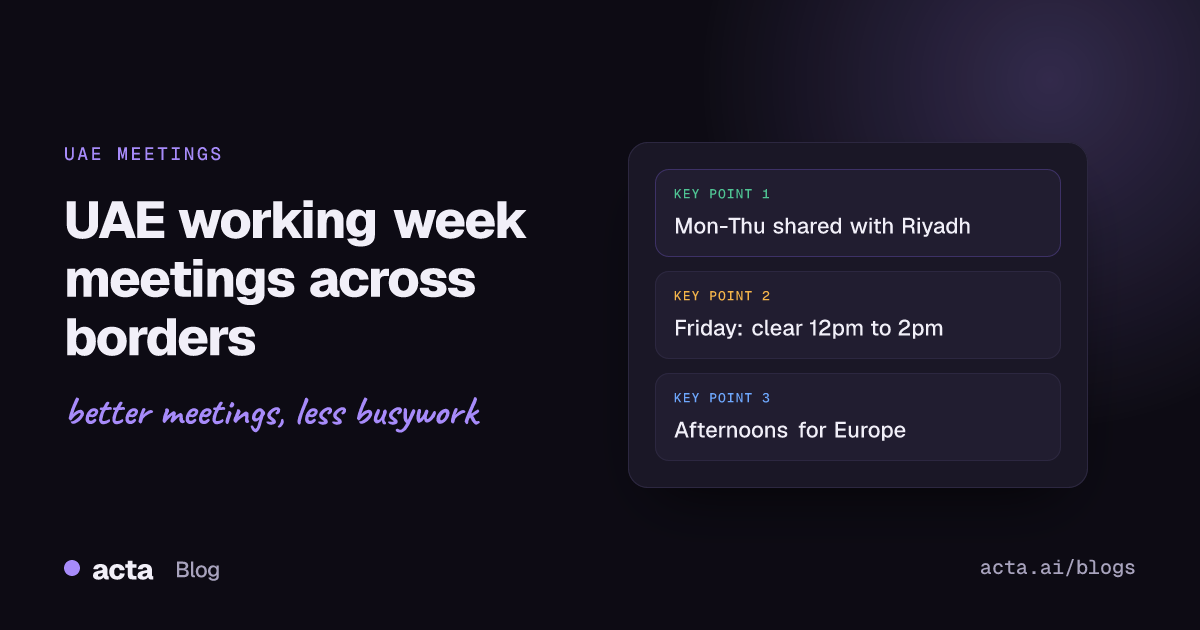
Friday needs its own thought. Federal entities finished at noon on Fridays during Ramadan 2026, and many private employers shorten Friday too. Treat Friday as a day for written updates and one-to-ones rather than group decisions. For how the normal week and Friday prayer shape cross-border calls the rest of the year, see our explainer on UAE working week meetings.
A 30-minute agenda replaces the hour-long meeting
A shorter day doesn't mean fewer decisions. It means each meeting has to carry more and waste less. The simplest change is to cut every recurring meeting to 30 minutes and move updates out of it. If a meeting regularly runs long, the advice in our guide to stopping meetings running over applies twice as much in Ramadan.
Here's a Ramadan meeting agenda you can paste into the calendar invite:
Weekly team sync (Ramadan) - 30 minutes, 10:30 to 11:00
Before the call (written, by 9:30): each person posts three lines - done, next, blocked.
1. Decisions needed today (10 min): list them in the invite; owner of each item presents in two minutes.
2. Blockers that need someone else (10 min): name the person who can unblock it.
3. Changes to deadlines this week (5 min): what moves, who tells the client.
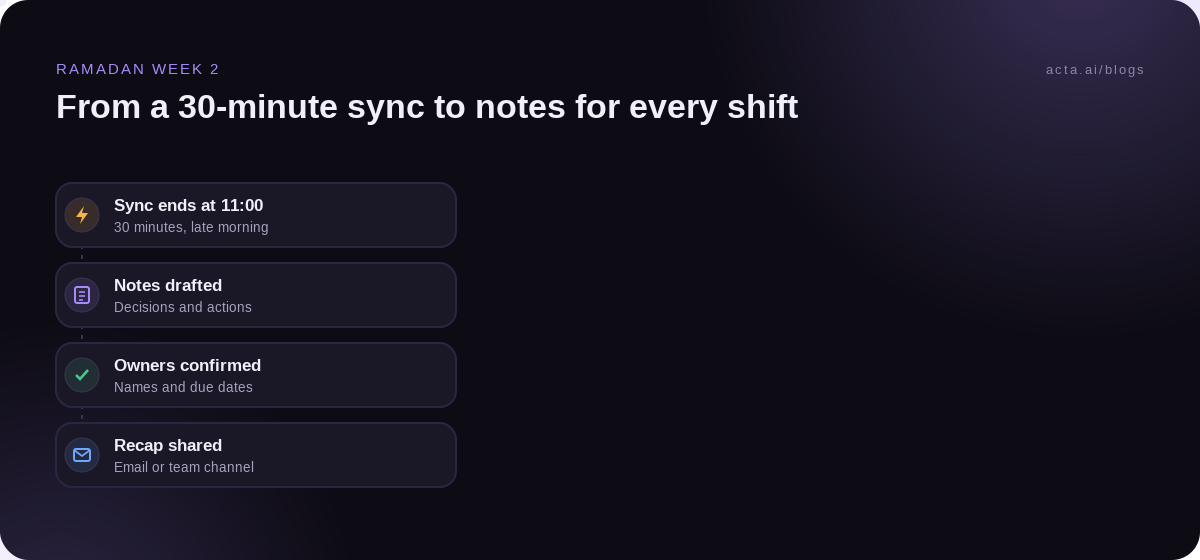
4. Read back actions (5 min): owner, task, due date. Notes go out within the hour.
Two details make this work. First, the written pre-read means the call starts with decisions, not a round of updates. Second, the read-back at the end stops the classic Ramadan problem of three people remembering three different deadlines. If you want ideas for the recap message itself, our meeting recap email examples include short formats that suit a phone screen.
Not every meeting should survive. Ask of each recurring slot: does it produce a decision, or only information? If it's information, move it to a written update for the month. Our guide to async meetings covers what to move and what to keep live.
Written notes keep split shifts and remote days in step
Ramadan often spreads a team across different hours. Retail, hospitality, healthcare and logistics teams may run split shifts or later evening shifts, and the 2026 announcements allowed flexible and remote arrangements within the reduced hours. The result is that some people miss the live call. A clear written record, sent the same day, is what keeps them aligned.
Good Ramadan notes are short and specific: the decisions made, each action with an owner and a date, and anything that changed since last week. Send them by email or post them in the team's usual channel. In many UAE teams that's a WhatsApp group; keep the message to a few lines and link to the full notes rather than pasting a wall of text into the chat.
Recording helps when the meeting has decisions people will need to check later. Ask first, every time: say at the start that you'd like to record for colleagues on the later shift, and stop if anyone objects. Our explainer on consent and what to tell participants covers the general principles, and our UAE PDPL guide to meeting recording explains consent, free zones and notices for UAE teams. If bots aren't welcome in the call, a desktop recorder such as Acta's desktop app captures Zoom, Teams or a WhatsApp call from your own computer, and its Copy notice button pastes a short recording notice into the meeting chat.
Language matters in mixed UAE teams. If the meeting is in Arabic, Acta can transcribe it when Arabic (a beta language) is chosen in Settings, and the notes can come out in English for the wider team; Hindi and Hindi-English are detected automatically. Urdu, Malayalam and Tagalog aren't supported yet, so for those conversations keep a person taking notes. Our Arabic meeting transcription setup guide walks through the Arabic settings step by step. The meeting languages guide shows where the setting lives.
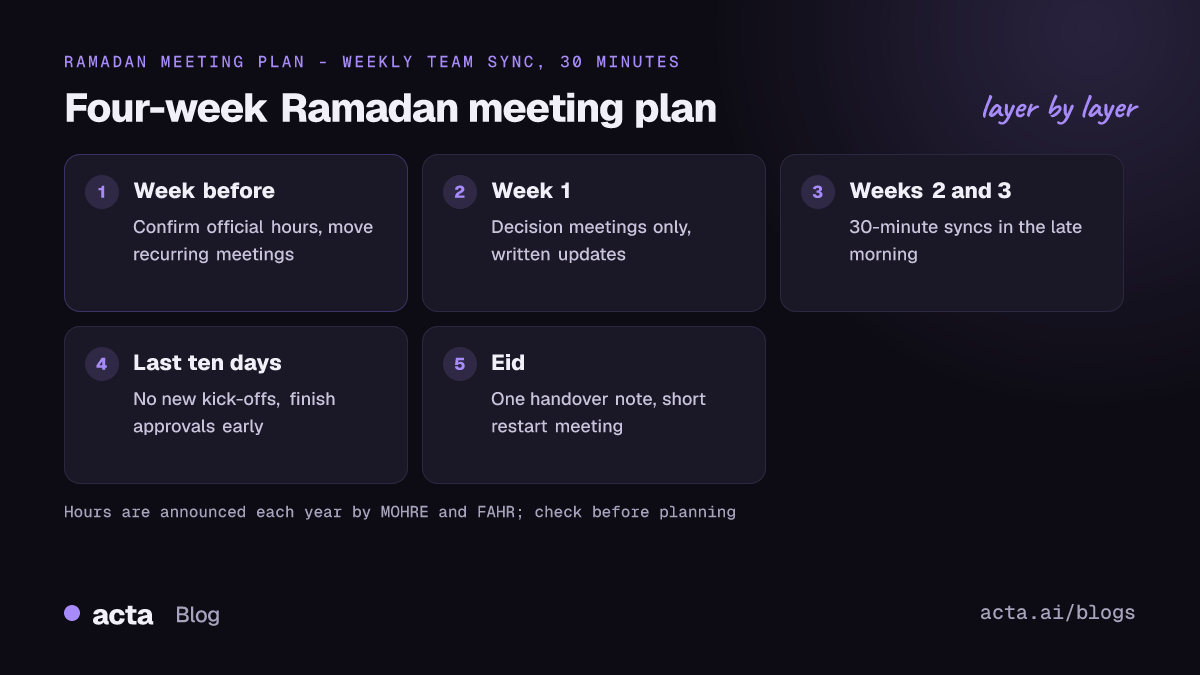
A four-week plan covers the month from preparation to Eid
Ramadan isn't the same in week one and week four. The first days are an adjustment, the middle weeks settle into a rhythm, and the last ten days are a time of extra worship for many Muslims, with Eid Al Fitr holidays at the end. Plan the meeting load to match.
| Week | Meeting load | What to do |
|---|
| Week before | Normal | Confirm the official hours, publish the team's Ramadan day, move recurring meetings, agree who covers which shift. |
| Week 1 | Light | Keep only decision meetings; send written updates; expect timings to shift as people adjust. |
| Weeks 2 and 3 | Steady | Run the 30-minute syncs; batch client calls into late mornings; keep notes going out the same day. |
| Week 4 (last ten days) | Lightest | Avoid new kick-offs; finish approvals early; prepare the Eid handover list and out-of-office cover. |
| Eid and return | Pause, then restart | Send one handover note before the break; hold a short restart meeting on the first day back. |
The handover note before Eid is the one document I'd never skip. List open decisions, who owns each, and what the client has been told. It's the difference between a calm first day back and a morning of "who promised what?".
A filled-in example shows a week-two sync in Dubai
Here's an illustrative example. A freight team in Dubai has eight people: two on an early warehouse shift, four in the office, and two working remotely on Fridays. During Ramadan the office day runs 8:30 to 2:30 under the company's own circular. Fatima Al Hammadi, the operations lead, moves the weekly sync to Tuesday at 10:30 and cuts it to 30 minutes.
The pre-read arrives in the team's channel by 9:30. In the call, three decisions get made, and the notes go out at 11:20:
Week 2 ops sync - Tuesday, 10:30 to 11:00
Decisions: approve the new trucking quote; move the client review to Monday 11:00; pause new onboarding until after Eid.
Actions: Fatima - send approval to the vendor by Wednesday. Rahul Menon - share warehouse photos with the client before 1pm Thursday. Maria Santos - confirm the Monday review with the client today.
Changed since last week: the customs clearance for one shipment now expects an extra day; client informed by Rahul.
The warehouse shift reads the notes at the start of their day. Nobody had to repeat the call, and the remote pair on Friday see exactly what changed.
Respect shows up in small scheduling choices
Most of what makes meetings during Ramadan go well is ordinary courtesy applied with a bit of thought. Not everyone in a UAE team fasts, and not everyone who fasts wants to discuss it. Don't ask people whether they're fasting; plan the calendar so it works either way.
- Keep food out of shared calls. If you're not fasting and need lunch, turn the camera off for a moment or step away. Most colleagues appreciate it.
- Don't push work onto non-fasting colleagues. It's tempting to give every late slot to whoever isn't fasting. Spread the load fairly instead.
- Accept iftar invitations when you can. Team iftars are a normal part of working life in the UAE. They aren't meetings; leave the laptop behind.
- Greet people. "Ramadan Kareem" or "Ramadan Mubarak" is a warm, common greeting from colleagues of any background.
- Give slack on response times. Replies may come later in the day or after iftar. Set expectations in writing rather than chasing.
Hybrid teams need one extra rule: if half the team is remote, run the meeting from the call, not the room, so people at home don't miss decisions said across a table.
Most Ramadan meeting problems come from five habits
When a Ramadan schedule goes wrong, it's usually one of these:
- Copying the normal calendar. A 9am to 6pm meeting pattern squeezed into a six-hour day leaves no time for actual work. Rebuild the week instead.
- Late-afternoon client calls. If a client insists on 3pm, check whether a colleague on a later shift can take it, or record it with consent and share notes.
- No written outcome. With people on different hours, a decision said aloud and never written down is lost by the next shift.
- Starting big projects in the last ten days. Kick-offs right before Eid tend to stall. Schedule them for the week after the holiday.
- Assuming last year's hours. The announcement is made each year. Check the new one before you publish the plan.
If attendance drops, don't add a reminder call. Check the slot against the official day and your team's shifts; the problem is nearly always the time, not the people.
Where Acta fits during Ramadan
Acta records your Zoom, Google Meet or Teams meetings with a bot, the desktop app or the Chrome extension, then writes the transcript, summary, decisions and action items with owners, plus a follow-up email draft. That makes it useful for a month when fewer people attend each call. It has a 15-day free trial, and our AI note taker page for the UAE explains how it handles Arabic and English meetings.
Frequently asked questions
What are Ramadan working hours in the UAE private sector?
For Ramadan 2026, MOHRE announced that UAE private-sector working hours are cut by two hours a day, with flexible or remote work allowed within the reduced daily hours. The ministry announces the rule each year, so check MOHRE's latest announcement and your employer's own circular for exact start and finish times. This is general information, not legal advice.
How long should meetings be during Ramadan?
In the UAE, keep most internal meetings during Ramadan to 30 minutes or less, held in the late morning. Send updates in writing beforehand so the call covers only decisions and blockers. Leave the last working hour before the end of the reduced day free, since many colleagues leave promptly to reach home for iftar.
Is it OK to schedule meetings after iftar in the UAE?
Only when the people involved suggest it. Some UAE teams, especially those working with clients in other time zones, choose a short call after iftar, but it shouldn't be the default. Evenings in Ramadan are family and worship time for many colleagues. Offer late-morning slots first and send notes to anyone who can't join.
What is a good Ramadan meeting agenda?
A good Ramadan meeting agenda in the UAE fits 30 minutes: a written pre-read of done, next and blocked; ten minutes of decisions; ten minutes of blockers; five minutes of deadline changes; and a five-minute read-back of actions with owners and dates. Send the notes the same day so colleagues on other shifts can act on them.
When does Ramadan 2027 start in the UAE?
As of November 2026, astronomers expect Ramadan 2027 to begin in the UAE around Monday 8 February 2027. The official first day depends on the moon-sighting committee, which announces it the evening before. Plan the first week of your meeting schedule with a one-day margin and confirm the hours once MOHRE and FAHR publish them.
Set up your Ramadan meeting rhythm before the first day
A good Ramadan calendar is decided in the week before the month starts, not on the first morning. Work through this list with your team:
- Confirm the hours: read the year's MOHRE or FAHR announcement and your HR circular, then publish the team's Ramadan day.
- Move the recurring meetings: shift them into the late-morning window and cut each to 30 minutes.
- Switch updates to writing: agree a three-line format and a daily posting time.
- Agree how notes are shared: who sends them, where, and by when, so every shift sees the same decisions.
- Plan the Eid handover: book the handover note and the restart meeting now.
If you'd like notes and action items written for you after each call, try the Acta desktop app on your next Ramadan sync.