Arabic meeting minutes share one standard structure
Minutes of meeting in Arabic are called محضر اجتماع, and most organisations in the region use a similar skeleton whether it's a ministry committee in Riyadh or a family business board in Sharjah. The headings below are standard Modern Standard Arabic. Treat the table as a basic Arabic minutes template and adjust it to your house style.
| Arabic heading | English equivalent | Usually drafted from |
|---|
| محضر اجتماع | Minutes of meeting | Meeting title |
| التاريخ والمكان | Date and place | Invite |
| الحضور | Attendees | Invite, then confirmed |
| المعتذرون عن الحضور | Apologies | Secretary |
| جدول الأعمال | Agenda | Invite or chair |
| ملخص النقاش | Summary of discussion | Transcript |
| القرارات | Decisions | Transcript, checked |
| المهام والمسؤوليات | Action items and owners | Transcript |
| ما يستجد من أعمال | Any other business | Transcript |
| موعد الاجتماع القادم | Next meeting date | Transcript or chair |
Two habits make any format better. Write decisions as complete sentences that make sense out of context, and give every action item a name and a date. "Follow up with the supplier" isn't an action; "Huda notifies the supplier by Thursday" is. The general advice in meeting minutes best practices applies in Arabic too.
These three are records someone may rely on later: a shareholder, an auditor, a regulator or a future chair. Keep them formal, keep the discussion summary short and make the decisions exact.
1. Board meeting minutes (محضر اجتماع مجلس الإدارة)
Use it for board and partners' meetings where resolutions are passed. Quorum and votes matter more than the discussion.
محضر اجتماع مجلس الإدارة (Board meeting minutes)
- رقم الاجتماع (Meeting number) and التاريخ والمكان (Date and place)
- رئيس الاجتماع (Chair) and أمين السر (Board secretary)
- الحضور (Attendees) and اكتمال النصاب (Quorum confirmed)
- اعتماد محضر الاجتماع السابق (Approval of the previous minutes)
- القرارات (Resolutions), each with نتيجة التصويت (Vote result)
- المهام والمسؤوليات (Actions and owners)
- التوقيع (Signature)
Check: the exact resolution wording, who voted how if your articles require it, and that amounts match the board papers. For a deeper look at resolutions and votes, see board meeting minutes from the recording.
2. Committee meeting minutes (محضر اجتماع اللجنة)
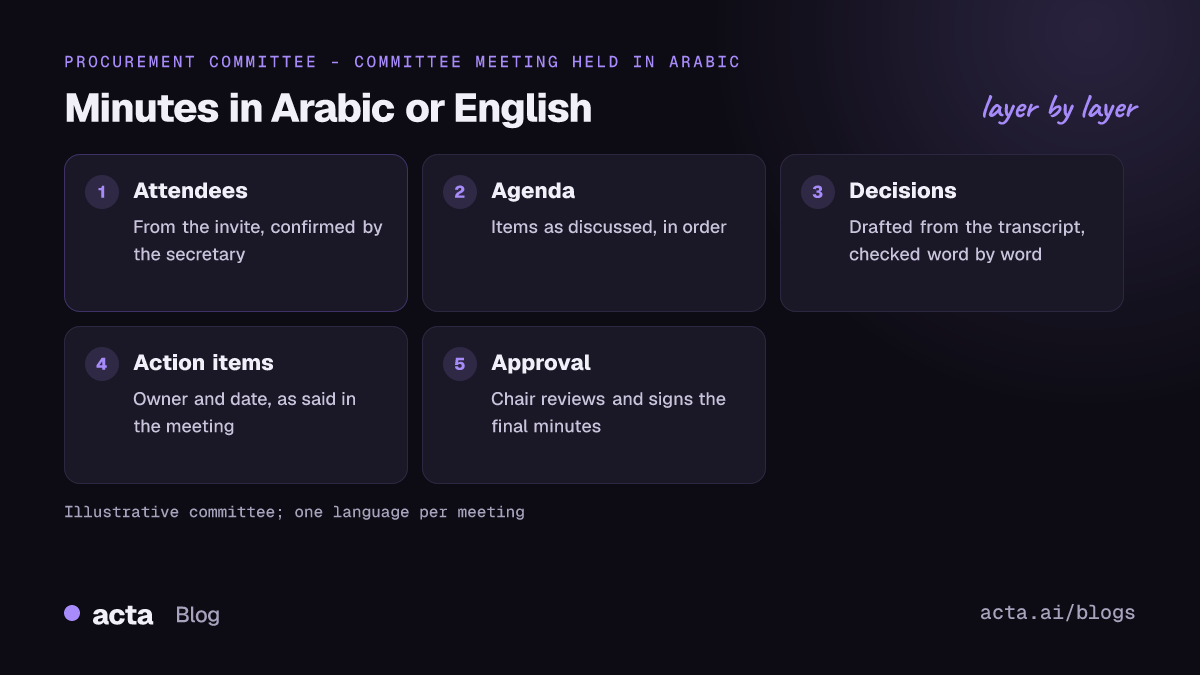
Use it for audit, procurement, tender, HR or steering committees, where the committee recommends or decides within a mandate.
- اسم اللجنة (Committee name) and رقم الاجتماع (Meeting number)
- الحضور (Members present) and المعتذرون عن الحضور (Apologies)
- جدول الأعمال (Agenda)
- التوصيات (Recommendations), kept separate from القرارات (Decisions)
- المهام والمسؤوليات (Actions, owner, deadline)
- موعد الاجتماع القادم (Next meeting)
Check: that recommendations aren't recorded as decisions. A procurement committee that "recommends" an award to the CEO hasn't awarded anything, and Arabic minutes should say توصية, not قرار. The steering committee minutes templates cover escalations in more detail.
3. Minutes of a meeting with a government entity (محضر اجتماع مع جهة حكومية)
Use it when you meet a ministry, municipality, free zone authority or regulator and want an internal record of what was asked and promised. These are your internal minutes, not an official record of the entity.
- الجهة (Entity) and رقم المرجع (Reference number, if any)
- ممثلو الجهة (Entity representatives) and ممثلو الشركة (Company representatives)
- الموضوع (Subject)
- المتطلبات المطلوبة (Requirements requested)
- الالتزامات (Commitments made by the company)
- المستندات المطلوبة والموعد النهائي (Documents due and deadline)
Check: reference numbers, document names and deadlines, all of which should be kept exactly as said. Record commitments as precisely as they were made; don't tidy a cautious "we'll try" into a promise.
These are lighter. People read them to know what happens next, so put actions near the top and keep the discussion to a few lines.
4. Client meeting minutes (محضر اجتماع مع العميل)
Use it after a client meeting where scope, prices or timing changed. Often sent to the client as a follow-up.
- العميل (Client) and الحضور (Attendees from both sides)
- طلبات العميل (Client requests)
- ما تم الاتفاق عليه (What was agreed)
- نقاط مفتوحة (Open points)
- الخطوات التالية (Next steps, owner, date)
Check: prices and quantities against the quote, and any wording the client might later quote back to you.
5. Internal operations meeting minutes (محضر اجتماع داخلي)
Use it for weekly operations, finance or sales reviews.
- المؤشرات الرئيسية (Key figures discussed)
- المشكلات (Issues)
- القرارات (Decisions)
- المهام والمسؤوليات (Actions and owners)
Check: that figures were recorded as said and not rounded, and that each issue has an owner.
6. Project progress meeting minutes (محضر اجتماع متابعة المشروع)
Use it for consultant-contractor-client progress meetings and IT project check-ins.
- نسبة الإنجاز (Progress against plan)
- المخاطر (Risks)
- طلبات التغيير (Change requests)
- المهام والمسؤوليات (Actions, owner, deadline)
- موعد الاجتماع القادم (Next meeting)
Check: dates, change request numbers and which party owns each risk.
The notetaker drafts the content and the secretary owns the record
An AI notetaker changes where the secretary spends time. Instead of writing every line from handwritten notes, you get a draft and review it. That's a real saving, but only if the review is done properly. Here's the split I'd use for Arabic meeting minutes drafted in Acta:
- Drafted for you: the transcript in Arabic script, a summary, decisions, action items with owners, and a follow-up email draft. Report templates and your own custom templates follow the notes language too.
- Kept as said: names, numbers, dates, dirham or riyal amounts, reference numbers and English technical terms. Nothing is converted.
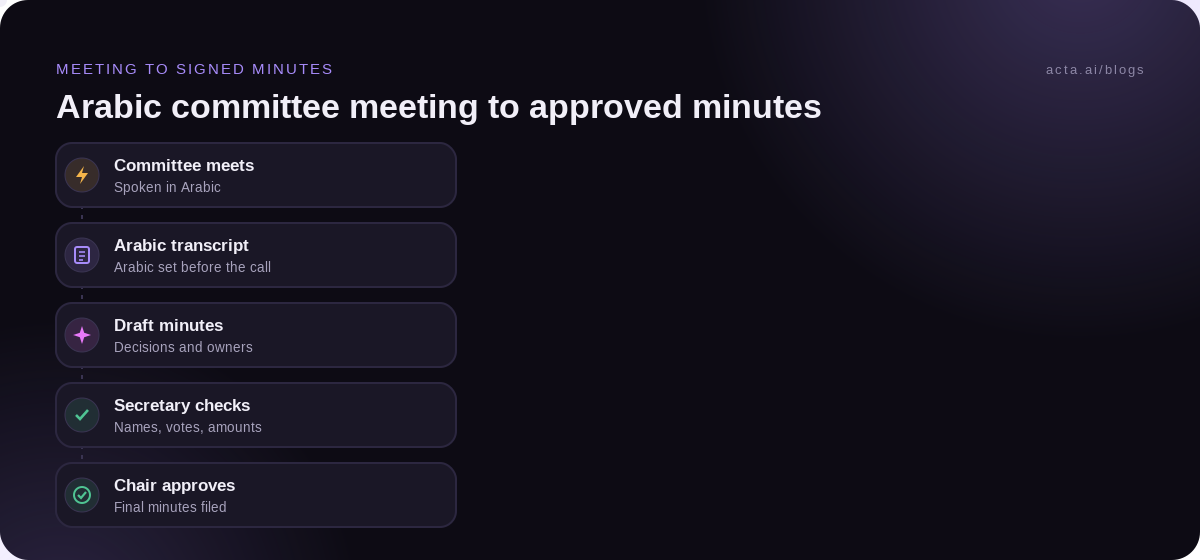
- Still the secretary's job: the official attendee list and apologies, quorum, the exact wording of resolutions and votes, anything said off the record, and the final layout with Arabic headings.
On that last point: Acta's own section headings, such as "In short" or "Key quotes", stay in English, as does the whole dashboard. The text under them is in the notes language. So for minutes in Arabic, copy the drafted content into your house format under the Arabic headings above. A custom template can make the draft follow the order of your format, which saves rearranging.
A sample decision block, illustrative, as it might read after review:
القرارات: تمت الموافقة على العرض الثاني.
Gloss: Decisions: the second offer was approved.
Arabic is in beta in Acta: it works and accuracy is still improving. Formal speech transcribes most cleanly; fast dialect and crosstalk are weaker. Read the decision passages in the transcript itself, not just the summary. The Arabic meeting transcription setup guide covers dialect and audio in detail.
The reader decides whether minutes are in Arabic or English
Acta writes notes either in the meeting's language or in English. There's no third option. For an Arabic meeting, that means the transcript is always Arabic, and the summary, decisions, action items and templates are either Arabic or English, depending on "Language for my notes".
Decide by who signs and who reads:
- Arabic minutes when an Arabic-speaking chair signs them, when they go to a government entity in Arabic, or when the client receives them.
- English minutes from an Arabic meeting when the record goes to a mixed management team, a parent company abroad, or an English-language project file.
Quotes stay as spoken either way. That's useful when English minutes need to show the exact Arabic wording of a commitment: the minutes say what was agreed in English, and the key quote stays in Arabic beside it.
The setting is per person and applies to new meetings. If the meeting secretary usually takes English notes but the board wants Arabic minutes this quarter, change it before the board meeting, not after. Past meetings keep the language they were processed in.
Arabic text shows left-aligned in Acta for now
One limit to know before you rely on the transcript: Arabic currently displays left-aligned in Acta. The text is in Arabic script; it just sits on the wrong side of the page. Right-to-left display is being fixed. Until then, long passages are harder to scan, so most secretaries copy what they need into a document set to right-to-left.
If your minutes end up on an intranet page or in an HTML email, the W3C's guidance on structural markup and right-to-left text recommends setting the direction on the document with the dir attribute, and its article on inline bidirectional markup explains how mixed Arabic and Latin text, such as a reference number inside an Arabic sentence, is ordered. In Word or Google Docs, the paragraph direction button does the same job.
Set it up in Acta before the meeting
- Open the Acta dashboard and go to Settings, then Meetings.
- Find the Language card below "Add Acta Notetaker to my meeting invites".
- Set "Language spoken in meetings" to Arabic (beta). English is the default, and Auto won't detect Arabic.
- Set "Language for my notes" to Same as the meeting for Arabic minutes, or English for English minutes.
- After the meeting, check the language chip on the meeting page, then review the draft against the format you use.
Boardroom meetings work with the meeting bot or the mobile app; for calls on a laptop where a bot isn't welcome, the desktop app or the Chrome extension records without one. Always announce the recording; read is it legal to record meetings with AI for what to say. In the UAE, the government portal's data protection laws page is the official starting point on Federal Decree-Law No. 45 of 2021; that's general information, not legal advice. The meeting languages help article lists all 15 supported languages.
Where Acta fits
Acta records Arabic meetings (in beta) and drafts the summary, decisions, action items and templates in Arabic or English, keeping names, amounts and dates as said. The secretary reviews the draft and produces the signed minutes.
Frequently asked questions
What are the standard headings for minutes of meeting in Arabic?
Most Arabic minutes use محضر اجتماع (minutes of meeting), التاريخ والمكان (date and place), الحضور (attendees), جدول الأعمال (agenda), ملخص النقاش (summary of discussion), القرارات (decisions), المهام والمسؤوليات (actions and owners) and موعد الاجتماع القادم (next meeting). Boards add quorum, approval of previous minutes and vote results.
Can AI write Arabic meeting minutes from a recording?
It can draft them. With Arabic selected in Acta, you get an Arabic transcript plus a summary, decisions and action items in Arabic or English. Arabic is in beta, so the secretary should confirm attendees, resolution wording, votes and amounts before the chair signs. The final minutes remain a human-approved record.
Can I get English minutes from an Arabic meeting?
Yes. Choose Arabic as the spoken language and English as the notes language. The transcript stays in Arabic, while decisions, action items, templates and the follow-up email are written in English. Quotes stay in Arabic, and names, amounts and dates are kept as said, which helps when the English minutes are questioned later.
Does Acta show Arabic right to left?
Not yet. Arabic transcripts currently display left-aligned, and right-to-left display is being fixed. The text itself is in Arabic script. For formal minutes, copy the content into a document set to right-to-left and apply your Arabic headings there.
Should committee recommendations and decisions be recorded separately?
Yes. A committee often recommends to a board or chief executive rather than deciding. Record those under التوصيات (recommendations), and keep القرارات (decisions) for things the committee was authorised to decide. Mixing them is one of the most common errors in committee minutes and causes trouble in audits.
Before the next meeting, settle five things:
- Choose the format: board, committee, government-facing, client, operations or project.
- Set the language: Arabic for the spoken language, and Arabic or English for the notes.
- Prepare the attendee list: from the invite, ready to confirm on the day.
- Agree the review: the meeting secretary checks decisions, votes and amounts within a day.
- Prepare the document: a right-to-left file with your Arabic headings, ready for the drafted content.
To draft your next set of minutes from the recording, try the Acta desktop app on a real meeting and compare the draft with your usual minutes.