Spanish meeting notes should follow the reader, not the speaker
The transcript language isn't really a choice. If the client spoke Spanish, the transcript is Spanish. The real decision is the second one: who reads the notes, and in which language do they work?
Three common cases. A Madrid account director talking to a Bogota retail client wants Spanish notes, because the follow-up email goes straight back to the client and nobody on either side needs English. A US software company's customer success manager in Houston, calling a distributor in Monterrey, might want English notes, because the renewal forecast is reviewed by a VP in Seattle who doesn't read Spanish. And a Barcelona startup selling into Latin America might switch back and forth: Spanish notes for client calls, English for investor updates.
Acta gives each person two settings for this. "Language spoken in meetings" tells it what to listen for; "Language for my notes" is either "Same as the meeting" or English. There's no third option. Acta doesn't translate Spanish notes into Portuguese or French, so if your Lisbon colleague needs the record, English is the shared language.
For the language picture as a whole: Acta detects English, Hindi, French, Spanish and German automatically, and ten more languages, from Italian and Portuguese to Japanese and Tamil, can be chosen in Settings as beta languages. Spanish is one of the automatic five, which is why there's so little to set up.
Before the call: Spanish is on Auto, so setup takes two minutes
New Acta accounts start on English, so do this once:
- From the dashboard, go to Settings and open Meetings.
- Find the Language card, just below "Add Acta Notetaker to my meeting invites".
- Set Language spoken in meetings to Auto if your calls are a mix of Spanish and English, or to Spanish if nearly all of them are in Spanish.
- Set Language for my notes to Same as the meeting for Spanish notes, or English if your notes feed an English-speaking team.
- After your first Spanish call, check the language chip next to the meeting's tabs. Change language takes you back to the card if something's off.
New settings apply from the next recorded meeting; earlier ones stay as they were. The meeting-notes email shows the language too. For the full option list, see the meeting languages help article.
Then decide how you'll record. If the client's company blocks meeting bots, the Acta Chrome extension records Google Meet, Microsoft Teams in the browser and the Zoom web client from your own browser, with no bot in the participant list. Either way, say at the start that you're recording and why. A simple "¿Les parece bien si grabo la llamada para las notas?" (Is it OK with you if I record the call for the notes?) does the job. The guide on recording consent and what to tell participants covers the rules in more detail.
Regional Spanish changes words and forms of address, not the setting
There's one Spanish setting, and it covers Spanish as spoken in Spain, Mexico, Colombia, Argentina and the US. What changes between them is vocabulary, forms of address and a few habits that matter when you read notes. Acta keeps all of it as spoken.
| Where | Typical address at work | A line you might hear | Watch for |
|---|
| Spain | tú, even with clients | "¿Os viene bien el jueves?" (Does Thursday suit you all?) | vosotros forms; decimal comma |
| Mexico | usted with clients | "¿Me lo puede mandar hoy?" (Could you send it to me today?) | decimal point, as in English |
| Colombia | usted, often even with colleagues | "¿Me regala el presupuesto?" (Could you send me the budget?) | "regalar" here is a polite request, not a gift |
| Argentina | vos | "¿Vos podés mandarlo hoy?" (Can you send it today?) | slang like "luca" for a thousand pesos |
| US teams | tú, with English mixed in | "Te mando el link." (I'll send you the link.) | Spanglish terms kept as said |
The Colombian "¿me regala...?" is a good example of why quotes should stay in the original. Translated word for word, "will you gift me the budget?" sounds odd; in Bogota it's simply a polite way to ask. If your notes are in English, the summary should read "Andrés asked for the budget", and the Spanish quote is there for anyone who wants the exact words.
Forms of address carry relationship information too. A Mexican procurement lead who uses usted with you for a year and then switches to tú has moved the relationship along. English notes can't show that; the transcript can.
Spanglish stays Spanglish in the transcript
US-based teams with Hispanic staff and clients often speak a Spanish that borrows English freely: "hacemos el follow-up el lunes", "te mando el deck", "el deadline es el viernes". These are Spanish sentences with English words in them, so set the meeting to Spanish (or Auto) and the transcript keeps the English loanwords as they were said.
That's a different situation from a call that genuinely switches language, where the first half is Spanish and the second half is English because a new person joined. Acta handles one language per meeting, and Hindi-English is the only mix it supports within a single call. For a full switch, pick the language that carries the decisions and capture the other part by hand, or split it into two recorded meetings.
The scale of Spanish in US business is easy to underestimate. The Census Bureau's 2017-2021 language-use release reports that more than one in five people aged five and over in the United States spoke a language other than English at home. A Census Bureau story on the languages Americans speak found Spanish was by far the most common of those languages in 2019, at 62% of people who spoke a non-English language at home. If your US team sells to small businesses in Texas, Florida or California, some of your calls are already in Spanish whether your tools know it or not.
Large numbers need a second look before notes go out
Acta keeps amounts, dates and numbers as they were said. That's what you want, but it means a reader in another country can still misread them. Three traps come up in Spanish client calls again and again.
Billón is not billion. The Real Academia Española's Diccionario panhispánico de dudas defines un billón as a million million (10 to the power of 12). It advises against using billón to mean a thousand million, though it notes that use is not unusual in US Spanish. The Spanish word for a thousand million is mil millones (or millardo). So "un billón de pesos" in a Mexican budget conversation means a million million, and "mil millones" is the English billion. If an English reader sees a number with "billón" in a quote, flag it.
Decimal marks differ. Spain writes 1.500,50 euros for one thousand five hundred euros and fifty cents. Mexico writes 1,500.50, as in English. A transcript reflects what was spoken, but when a client reads a figure off a spreadsheet, the separator they had in mind isn't always obvious. Check the unit and the magnitude against the proposal.
Slang and currency. An Argentine client might say "cincuenta lucas" for fifty thousand pesos. Colombian amounts often run into the millions of pesos. Keep the currency next to every figure in your notes (COP, MXN, EUR, USD) because "80 millones" with no currency is a guess waiting to go wrong.
A Bogota client call, from recording to follow-up email
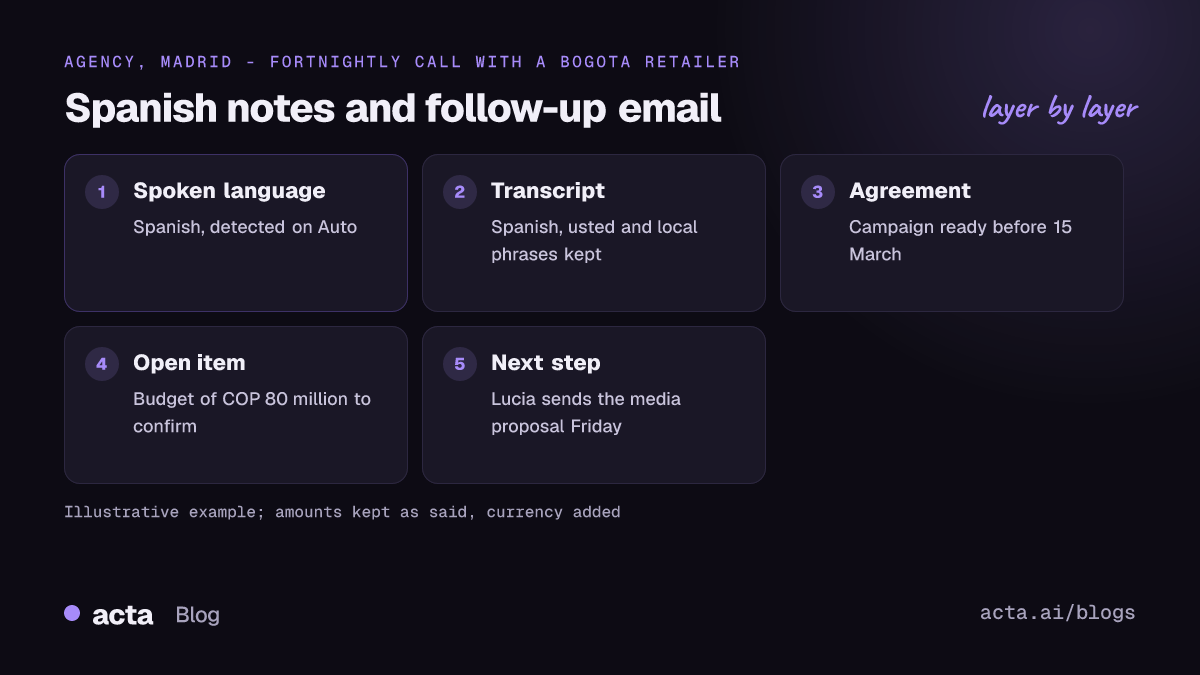
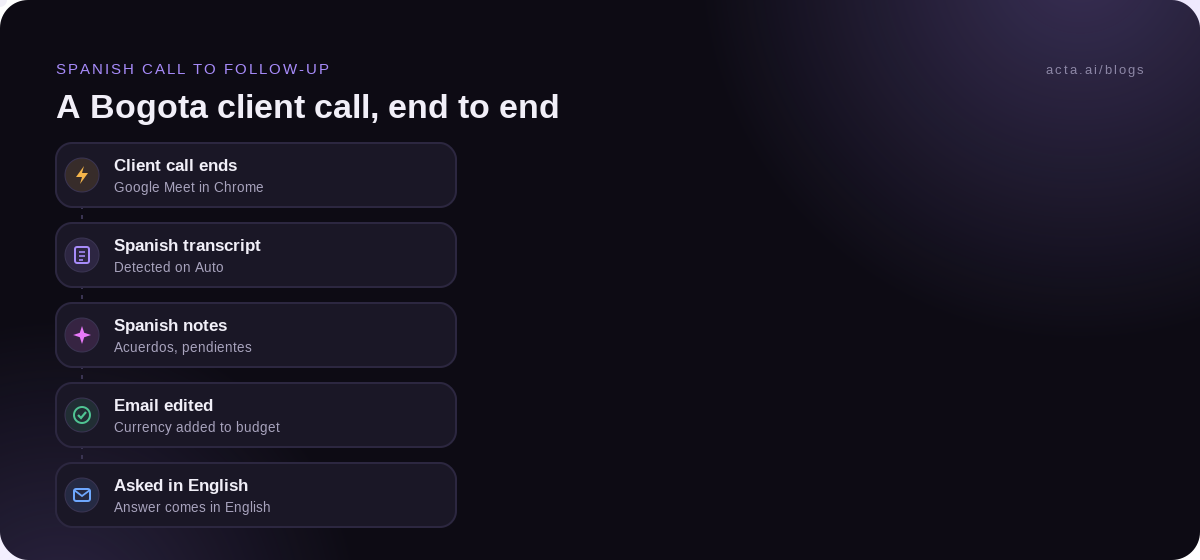
An illustrative example, not a customer story. Lucía runs accounts at a Madrid digital agency. Every two weeks she has a call with Andrés, marketing lead at a home-goods retailer in Bogota, on Google Meet. She records it with the Chrome extension, with Spanish as the meeting language and Spanish notes, since the follow-up goes back to Andrés.
A few lines from the transcript:
- Andrés: "Necesitamos la campaña lista antes del 15 de marzo." (We need the campaign ready before 15 March.)
- Andrés: "¿Me regala el presupuesto aprobado por correo?" (Could you send me the approved budget by email?)
- Lucía: "Quedamos en enviar la propuesta de medios el viernes." (We agreed to send the media proposal on Friday.)
The Spanish notes, with glosses:
- Acuerdos (agreements): campaña lista antes del 15 de marzo (campaign ready before 15 March).
- Pendientes (open items): presupuesto aprobado de 80 millones de pesos, pendiente de confirmación por correo (approved budget of 80 million pesos, to be confirmed by email).
- Próximos pasos (next steps): Lucía envía la propuesta de medios el viernes (Lucía sends the media proposal on Friday).
Acta also drafts the follow-up email in Spanish. Lucía edits two lines, adds COP next to the budget figure and sends it:
"Hola Andrés, gracias por la llamada. Te confirmo que enviamos la propuesta de medios el viernes. ¿Nos confirmas por correo el presupuesto aprobado de 80 millones de COP?" (Hi Andrés, thanks for the call. I'm confirming we'll send the media proposal on Friday. Could you confirm the approved budget of COP 80 million by email?)
Note the tú in Lucía's email: Spanish agencies tend to use it, and Andrés has been using it with her for months. If he hadn't, she'd write usted. Her managing partner in London doesn't read Spanish, so he asks Acta in English, "what did the Bogota client agree to this month?", and gets an English answer, since Ask Acta and OneChat reply in the language of the question. For more on writing these emails, see automating meeting follow-up emails.
Five habits that make Spanish notes less useful
- Leaving the setting on English. New accounts default to English. A Spanish call recorded that way comes back as nonsense, and the earlier meeting won't fix itself after you change the setting.
- Translating quotes by hand. If you need English, set English notes and keep the quotes in Spanish. A home-made translation of a client's promise is no longer the client's promise.
- Dropping the currency. Pesos, euros and dollars all appear in Spanish calls. Write the code next to the number.
- Mixing two languages in one recording. Split the call or choose the language of the decisions.
- Skipping the CRM step. Notes that stay in an inbox get lost. Acta can send meeting reports to Salesforce, HubSpot or Zoho, in the notes language you chose.
Audio quality matters as much as any setting. A client on a car speakerphone in Mexico City traffic will produce a worse transcript in any language. The guide on transcribing meetings in other languages has more practical tips that apply here.
Where Acta fits
Acta records the call by bot, desktop app, Chrome extension, phone or upload, writes the Spanish transcript and gives you notes, decisions, action items and a follow-up draft in Spanish or English. It keeps regional forms and figures as spoken. You still read the notes before they go to a client; that part doesn't change.
Frequently asked questions
Can AI take meeting notes in Spanish?
Yes. Acta can transcribe Spanish meetings and write the summary, decisions, action items and follow-up email draft in Spanish, or in English if you prefer. Spanish is one of five languages it detects automatically, with English, Hindi, French and German. Names, dates and amounts stay as they were spoken, so check currencies before forwarding.
Does Acta detect Spanish automatically?
Yes, with "Language spoken in meetings" set to Auto, Acta recognises Spanish among its five automatic languages. The default for new accounts is English, so switch to Auto or Spanish once in Settings, Meetings, Language. The change applies to new meetings, not ones already processed.
Can I get English notes from a Spanish meeting?
Yes. Set "Language for my notes" to English. The transcript stays in Spanish, while the summary, decisions, action items and email draft come in English. Quotes remain in Spanish, and figures such as 80 millones de pesos are kept as said, so an English reader can still check the original wording.
Does it handle Mexican, Colombian and Argentine Spanish?
There's a single Spanish setting covering all regional varieties, and Acta keeps what people said, including usted, tú, vos and local expressions such as the Colombian "¿me regala...?". Strong accents, poor connections and crosstalk affect any transcript, so a clear microphone on both ends helps more than anything else.
What happens with Spanglish on a call?
Spanish sentences with English words, such as "te mando el link", are transcribed as Spanish with the English words kept. A call that switches fully from Spanish to English is different: Acta takes one language per meeting, so choose the language of the decisions or record the two parts separately.
Choose a Spanish notes routine for your team
A routine that holds up after the first month:
- Set the language once: Auto or Spanish for anyone with regular Spanish calls.
- Match notes to readers: Spanish for client-facing staff, English for managers who don't speak it.
- Keep quotes original: never replace a client's words with your translation.
- Label every amount: currency code plus a check on billón and decimal marks.
- Log it: push the notes to your CRM the same day.
To start, record your next Spanish client call with the Acta desktop app or the Chrome extension, during the 15-day free trial.