The UAE PDPL is the federal law on personal data
The UAE PDPL is Federal Decree-Law No. 45 of 2021 regarding the protection of personal data. Its official English text sits on the UAE legislation portal, and the government's data protection laws page on u.ae summarises the UAE's data protection framework and notes that the law came into force on 2 January 2022. If you only read two pages before writing a recording policy, read those two.
The PDPL isn't a recording law in the narrow sense. It doesn't have a chapter on Zoom calls. It's a general law about processing personal data, and a meeting recording is a file full of it: voices, names, job titles, opinions, sometimes phone numbers and prices agreed with a named client. An AI notetaker then produces more of it, in the form of a transcript, a summary with names attached and action items assigned to people. So the useful question isn't "is recording allowed?" but "on what basis am I processing what's in this recording, and how will I handle it afterwards?"
A word on what this guide leaves out. Data protection is only one part of the picture. Other UAE laws touch on privacy and recording, and your sector regulator may have its own rules. This guide sticks to the PDPL and the two best-known free-zone regimes, because those are the texts most office teams run into first. For a wider look across countries, the guide to meeting recording laws by country is a useful companion.
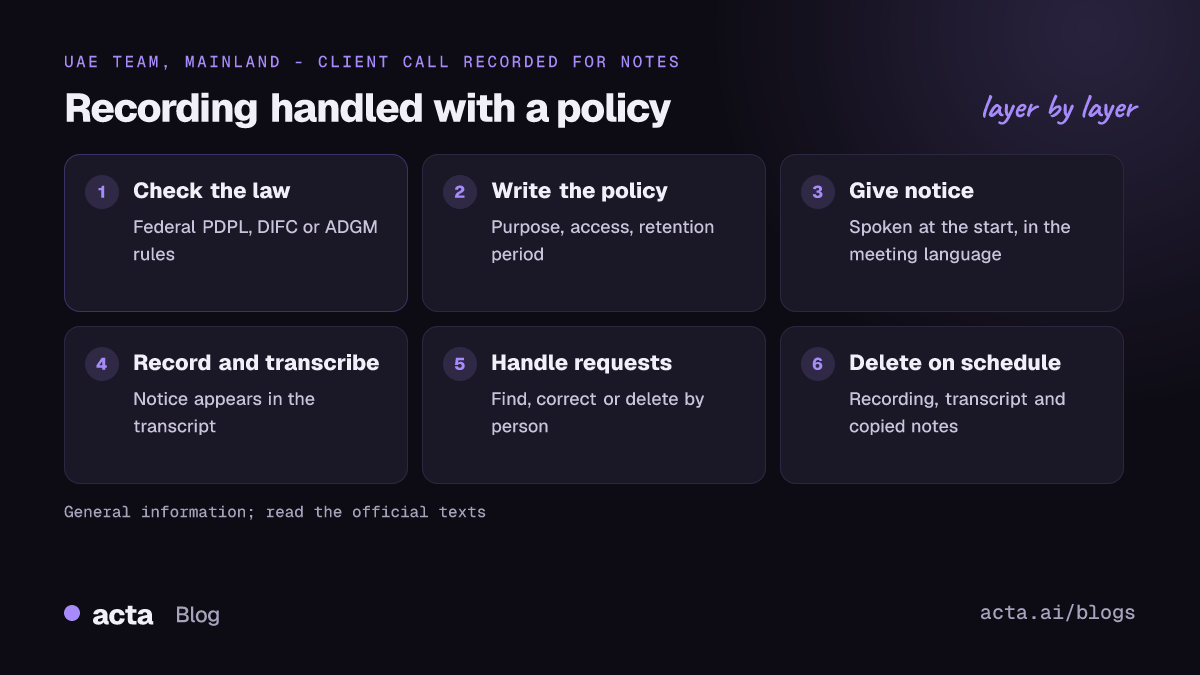
Consent is where UAE PDPL meeting recording starts
The law's text is direct: it is prohibited to process personal data without the consent of its owner, and it then lists the cases excluded from that prohibition. Which exception, if any, fits your situation is exactly the kind of question to take to a lawyer. For an ordinary internal meeting or client call recorded so someone can write notes, most teams find it simpler to ask and get agreement than to argue an exception.
Article 6 sets conditions for consent. Two parts matter most for meetings. First, the controller (your company, as the organiser of the recording) must be able to prove the data subject's consent. Second, the person can withdraw consent. That has practical consequences:
- Make the notice part of the recording. A spoken notice at the start, and the absence of objection or a clear "yes", is something you can point to later. A line buried in an email footer is much harder to show.
- Know what you'll do if someone says no. Pause the recording, take manual notes for that meeting, or record only the part after they leave. Decide this before the call, not during it.
- Know what you'll do if someone changes their mind later. You need to be able to find that meeting and act on the request.
Bot-free recording doesn't change any of this. A desktop app or browser extension records without a visible participant, which is why it's useful in meetings where bots are blocked, but people still need to know. If you use the Acta desktop app, its "Copy notice" button pastes a recording notice into the meeting chat. For a broader guide on telling participants, read is it legal to record meetings with AI.
People in a recording keep rights over it
Articles 13 to 18 of the PDPL set out the data subject's rights. They include the right to information about how their data is processed, the right to data portability, the right to correct inaccurate data and request erasure, the right to restrict processing, and rights to object to direct marketing and to decisions based on automated processing. You don't need to memorise the list. You need a process that can respond to it.
For meeting recordings, three questions test whether you're ready:
- Can you find every recording a given person appears in? Search by name across transcripts helps. So does a naming convention for meetings.
- Can you correct or delete a recording, its transcript and its notes? The notes are often copied into a CRM, a project tool or an email. Deleting the recording alone may not be enough.
- Do you know how long you keep recordings, and why? "Forever, because storage is cheap" is the answer that causes trouble. The recording retention policy examples give clauses you can adapt.
Automated processing deserves a sentence of its own. An AI summary of a meeting isn't usually a decision about a person. But if you start using recordings to score employees or candidates automatically, you're closer to the territory Article 18 covers, and you should get advice before you do.
DIFC and ADGM companies follow their own laws
The federal law states that it doesn't apply to companies and establishments in the UAE's free zones that have their own legislation on personal data protection. Two free zones are the usual examples, and each publishes its rules on its own official site.
In the Dubai International Financial Centre, the governing text is the DIFC Data Protection Law, DIFC Law No. 5 of 2020. The DIFC's Commissioner of Data Protection is responsible for supervising and enforcing it. In Abu Dhabi Global Market, ADGM enacted the Data Protection Regulations 2021, replacing its 2015 regulations, and its Office of Data Protection, headed by a Commissioner, publishes guidance on them.
| Where your company is set up | Main data protection text | Where to read it |
|---|
| Mainland UAE and free zones without their own data law | Federal Decree-Law No. 45 of 2021 | UAE legislation portal; u.ae |
| DIFC, Dubai | Data Protection Law, DIFC Law No. 5 of 2020 | DIFC Commissioner of Data Protection |
| ADGM, Abu Dhabi | ADGM Data Protection Regulations 2021 | ADGM Office of Data Protection |
Group structures make this messier than the table suggests. A holding company in DIFC with an operating company on the mainland may record a single board call that involves both. Work out which entity is organising the recording and which law applies to it, and get advice where it isn't obvious. Don't assume the free-zone rules mirror the federal ones; read them.
Worked example: a Dubai distributor's client calls
Take an illustrative mainland distributor of medical consumables in Al Quoz. The sales team holds weekly Arabic calls with hospital procurement teams, a Monday internal review in Hindi and English, and a monthly English call with a supplier in Germany. The sales head wants all of them recorded for notes.
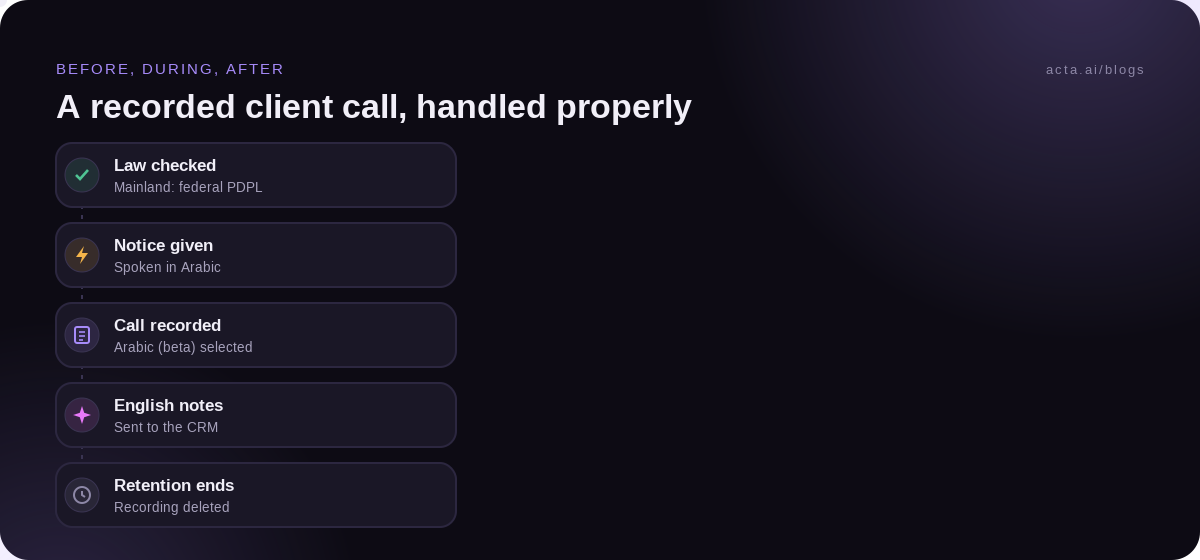
Before. The company writes a one-page recording policy: which meetings are recorded, why (accurate notes and follow-ups), who can see recordings, and how long they're kept (in this example, 90 days for recordings, longer for the written notes that go into the CRM). It adds a line to client meeting invites saying the call will be recorded for notes and that the client can ask for it not to be.
During. The account manager opens each Arabic call with a short spoken notice in Arabic and waits for an answer. When a hospital's procurement head says she'd rather not be recorded, the account manager stops and takes notes by hand. Nobody argues; it's in the policy.
After. The notes go into the CRM in English. The Arabic transcript stays in the meeting record for checking quotes, and the recording is deleted on schedule. When a former client asks what the company holds about him, the team searches meetings by his name, lists what it finds and acts on the request.
None of this is exotic. It's ordinary record-keeping, done before the first recording rather than after the first complaint.
Notice wording in Arabic, Hindi and English
The best notice is short, said at the start, and in the language the meeting is held in. If the room mixes languages, say it in two. Here are illustrative versions to adapt:
English: "Before we start: I'm recording this call so I can write accurate notes. The recording and notes stay within our team. If you'd prefer I don't record, tell me now and I'll take notes by hand."
Arabic: نسجّل هذا الاجتماع لكتابة المحضر.
Gloss: We're recording this meeting to write the minutes.
Hindi: यह मीटिंग रिकॉर्ड हो रही है।
Gloss: This meeting is being recorded.
Keep the native-language line short and follow it with the purpose in whatever words come naturally. Then pause. A notice that nobody has time to respond to isn't much of a notice. For invites, add one sentence: "This call will be recorded for meeting notes; reply if you'd prefer it isn't." For recurring internal meetings, a notice in the team channel at the start of the quarter plus a quick reminder at the top of each meeting is usually enough for staff, though your lawyer may want more for sensitive meetings. The guide to recording HR, legal and board calls covers those.
Set the meeting language so the notice is transcribed
A notice only helps you later if you can find it. If the meeting runs in Arabic but the recorder's account is set to English, the transcript of that Arabic notice will be unusable. Acta transcribes 15 languages. English, Hindi, French, Spanish and German are recognised on Auto; Arabic, Tamil, Telugu, Bengali, Kannada, Marathi, Japanese, Italian, Portuguese and Dutch are beta languages chosen by name. Set it up like this:
- In the Acta dashboard, open Settings, then Meetings, and find the Language card.
- Under Language spoken in meetings, choose Auto for English and Hindi meetings, or Arabic (beta) for Arabic ones.
- Under Language for my notes, choose Same as the meeting or English.
- After the meeting, check the language chip next to the tabs on the meeting page, and read the first lines of the transcript to confirm the notice is there.
The setting applies to new meetings only. Arabic transcripts currently display left-aligned while right-to-left display is being fixed, which doesn't affect searching for the notice. The meeting languages help article has the details. Urdu and Malayalam aren't supported yet, so for those meetings keep a written note that the notice was given.
Six mistakes teams make when they start recording
- Recording first, writing the policy later. The policy answers questions people will ask on the first day. Write it first.
- Treating bot-free as notice-free. No bot in the participant list means no automatic signal. You have to say it.
- Relying on a vendor summary of the law. Read the official text and the u.ae page. Vendor blogs (this one included) are a starting point.
- Assuming the federal law covers a DIFC or ADGM entity. Check which regime applies to the company that organises the recording.
- Keeping everything indefinitely. Set a retention period and delete on schedule. The guide on what to keep from meeting recordings helps decide.
- Not asking vendors the basic questions. Where is data processed, who can access it, is it used to train models, and how is it deleted? Get the answers in writing.
Teams with staff or clients in Europe face a second set of rules. The GDPR checklist for AI note takers covers the EU and UK side, and it's worth reading next to this one because the two regimes don't line up exactly.
What Acta does and doesn't do here
Acta records meetings, writes transcripts and notes, and gives you tools that help with the process side: a "Copy notice" button in the desktop app, search across meetings, and language settings so a notice in Arabic or Hindi is transcribed in that language. It doesn't decide your legal basis or make a recording lawful; your notice, purpose and retention do that. Acta does not use customer data to train AI models, and its security page and privacy policy describe how data is handled.
Frequently asked questions
Does the UAE PDPL apply to recording meetings?
The PDPL, Federal Decree-Law No. 45 of 2021, governs the processing of personal data, and a meeting recording contains people's voices, names and statements. Most mainland companies therefore handle recordings under it. Companies in free zones with their own data protection legislation, such as DIFC and ADGM, follow their zone's rules instead. Check the official texts for your entity.
Do I need consent to record a meeting in the UAE?
The PDPL's text prohibits processing personal data without the owner's consent and then lists exceptions. Article 6 requires the controller to be able to prove consent, and the person can withdraw it. For routine calls, most teams give a spoken notice at the start and offer to stop recording. Whether an exception fits your case is a question for a lawyer.
Does the PDPL apply in DIFC and ADGM?
The federal law says it doesn't apply to free-zone companies and establishments that have their own personal data protection legislation. DIFC has the Data Protection Law, DIFC Law No. 5 of 2020, overseen by its Commissioner of Data Protection. ADGM has its Data Protection Regulations 2021 and an Office of Data Protection. Read the rules on each zone's official site.
Do I still need to tell people if no bot joins the call?
Yes. A desktop app or browser extension records from your own computer, so nobody sees a notetaker join, but the people on the call are still being recorded. Say at the start that you're recording and why, and offer to stop. Acta's desktop app has a Copy notice button that pastes a recording notice into the meeting chat.
Can someone ask me to delete a meeting recording?
Articles 13 to 18 of the PDPL give people rights over their data, including correction, erasure and restricting processing, so you should be ready to act on such requests. In practice, that means being able to find every meeting a person appears in and remove the recording, transcript and any notes copied into other tools.
Write a one-page recording policy
A short written policy does more than any tool setting. Draft it this week and share it with the team before the next client call.
- Name the law: federal PDPL, DIFC or ADGM, depending on which entity organises the recordings.
- Define the purpose: accurate notes and follow-ups, and nothing broader without a fresh look.
- Fix the notice: spoken at the start, in the meeting's language, with an easy way to say no.
- Set retention: how long recordings, transcripts and notes are kept, and who deletes them.
- Plan for requests: who handles access, correction and deletion requests, and how meetings are found.
When the policy is ready, try it on real meetings with the Acta Chrome extension or desktop app during the 15-day free trial.