Quick answer: Good sales call coaching from recordings is a small weekly habit, not a big review. Pick two or three calls per rep, focus on one skill at a time, have the rep review the call first, mark two or three moments, and spend 20 minutes on what they'd do differently. Then check the same skill on next week's calls. Tell reps and buyers that calls are recorded.
Most sales managers coach from deal reviews. The rep says the call went well, the manager asks about next steps and close dates, and everyone moves on. That's pipeline management. It's useful, but it isn't coaching, because neither of you heard what actually happened on the call.
And managers tend to think they coach more, and better, than they do. HR Dive reported on research where managers rated themselves as good coaches but HR leaders disagreed. Recordings fix a big part of that gap: you're coaching on what was said, not on the rep's memory of it or yours.
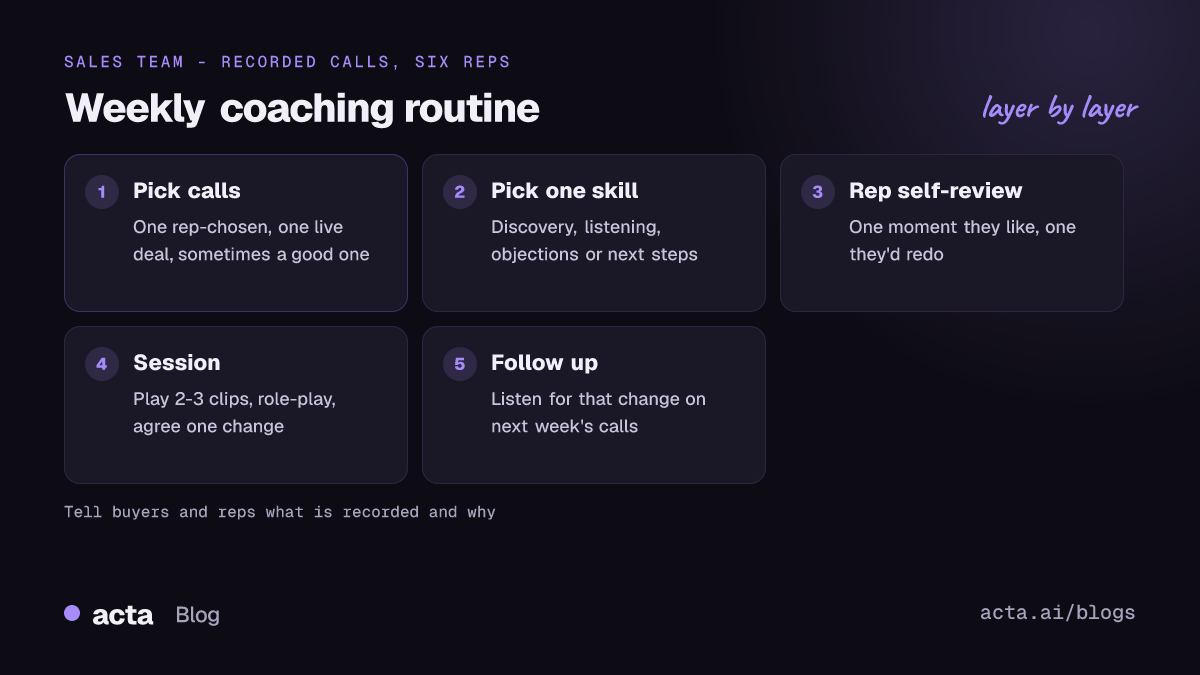
Here's the routine I'd use as a front-line manager with six to eight reps and not much spare time.
Why coach from call recordings instead of deal reviews?
Because deal reviews only see outcomes, and call recordings show behaviour. A rep can lose a deal after a great discovery call, or win one despite talking over the buyer for 40 minutes. If you only coach on the result, you'll end up praising luck and criticising bad timing.
Call recordings give you three things deal reviews can't:
- The exact words. "I asked about budget" becomes "I asked 'do you have budget for this?' and they said 'sort of'". Those are very different coaching conversations.
- The moments that mattered. The objection the rep rushed past, the follow-up they didn't ask, the point where the buyer went quiet.
- A shared reference. You and the rep can both listen to the same 90 seconds and talk about it, instead of arguing about two memories.
Which calls should you pick for sales call coaching?
Resist the urge to only pull lost deals. Those are better material for a separate lost deal analysis, where you look for patterns across a quarter. If every call you review is a loss, reps learn that being coached means being in trouble. I'd pick two or three calls per rep per week, mixed like this:
- One the rep chooses. Ask them for a call they're unsure about. People pick honestly when it's their choice.
- One from a live deal that matters. A second or third call in a deal you'll forecast, so the coaching can change the outcome.
- Now and then, a good one. A call that went well, so you can say exactly why and they can repeat it.
Skip internal calls and very short ones. A 12-minute check-in with an existing customer rarely has enough in it to coach on.
What should you listen for in a call review?
One skill at a time. A call review that covers discovery, objection handling, talk time, product knowledge and next steps all at once ends with a rep who remembers none of it. Pick the skill you're working on with that rep this month and listen for it. Here are the ones I'd usually rotate through.
Discovery depth
Did the rep ask follow-up questions, or move to the next line on their list after every answer? Listen for the moment the buyer said something interesting ("we tried this two years ago") and whether the rep went after it. Our guide to buying signals in sales conversations lists what to listen for.
Listening
Does the rep let the buyer finish? Do they summarise what they heard before answering? A rep who's always one sentence ahead of the buyer is usually pitching, not selling.
Objections
When the buyer pushed back, did the rep ask what was behind it, or jump to a rebuttal? "It's too expensive" can mean five different things. Good reps find out which.
The close of the call
Did the call end with a specific next step, a name and a date? Or with "I'll send over some info"? This one is the easiest to coach and changes results fastest.
If your team uses a qualification framework, the framework gives you a ready-made list. For MEDDPICC, for example, the MEDDPICC deal report shows which letters each call left empty, which is a useful starting point for what to coach.
How do you run a sales coaching session from a recording?
Twenty to thirty minutes, once a week, per rep. Here's the format I'd use.
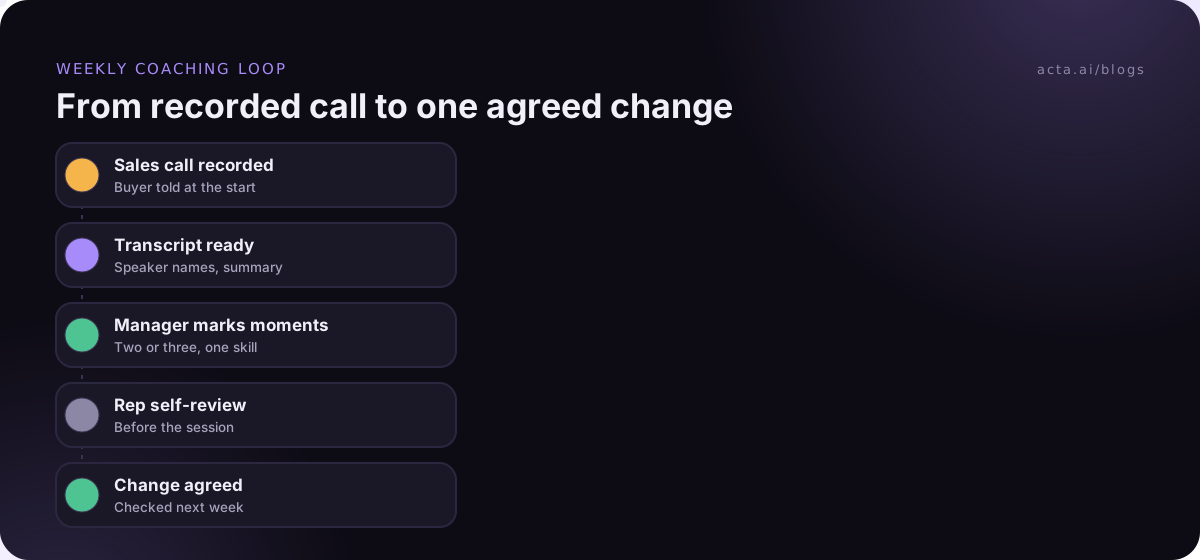
- Rep self-review first. Before the session, the rep listens to the call (or reads the transcript) and notes two moments: one they're happy with and one they'd redo. Self-review does half the coaching on its own.
- You mark your moments. Pick two or three timestamps that relate to the skill you're working on. Not ten.
- Start with theirs. Ask what they noticed. If they found the same moment you did, you don't need to point it out.
- Play the clip. Listen together. Then ask: "What was going on for the buyer there?" before "What would you do differently?"
- Practise it. Two minutes of role-play on that exact moment beats ten minutes of advice. You play the buyer and say what they said.
- Agree one thing to try. One. Write it down where you'll both see it next week.
Next week, start by listening for that one thing in their new calls. Coaching that never checks back is just a nice chat.
How do you give coaching feedback reps actually use?
Quote the call. "At 14 minutes she said the board meets in March and you moved on to pricing" is coaching feedback a rep can act on. "You need to listen more" isn't.
A few other habits that help:
- Ask before you tell. "What did you make of that answer?" often gets you further than your own view.
- Be specific about good moments too. "Great call" teaches nothing. "Asking who else felt the pain got you the finance lead's name" teaches a lot.
- Keep coaching separate from performance reviews. If reps think every recording might end up in their appraisal, they'll stop volunteering calls. That kills the whole routine.
- Coach the person, not the script. Two reps can handle the same objection in different ways and both be fine.
HubSpot Academy has a short sales coaching lesson for managers if you want a structured refresher on running sessions.
How much time does a weekly coaching routine take?
Less than most managers expect, if you don't listen to whole calls. With transcripts, you can skim a 45-minute call in five minutes, jump to the part where the buyer raised pricing, and listen only to that. For six reps at two calls each, that's about an hour of prep a week, plus the sessions themselves.
You can also search across calls rather than inside one. Asking "where did buyers push back on implementation time this month?" across the team's calls shows you a pattern worth a whole-team session rather than six separate one-to-ones. We wrote about asking questions across all your meetings if that's new to you.
Keep your coaching notes in the same place as the rest of your 1:1 notes, so you can see progress over time. Our post on one-on-one meeting notes covers a format that works for this.
What about consent and privacy when coaching from recordings?
This is general information, not legal advice, and the rules vary by country and state. Two groups need to know about recording: the buyers on the call and your own reps.
For buyers, the rules on recording calls depend on where everyone is. We've covered them in our guide on whether it's legal to record meetings with AI and what to tell participants. In practice, say it at the start of the call and put it in the invite.
For your reps, recording for coaching is a form of workplace monitoring. In the UK, for example, the ICO published guidance on monitoring workers in October 2023, which, as Hunton's summary explains, expects employers to have a lawful basis, tell workers about monitoring in plain terms and use the least intrusive approach. Whatever your location, be clear with the team about what's recorded, who can listen, how long it's kept and what it's used for.
If you record from your own computer instead of with a bot, the Acta desktop app has a Copy notice button that pastes a recording notice into the meeting chat, so the buyer sees it in writing.
Common sales call coaching mistakes
- Only reviewing losses. Reps start hiding calls. Mix in good ones and rep-chosen ones.
- Too many points per session. One skill, two or three moments. That's it.
- Coaching your own style. The question is whether it worked for the buyer, not whether it's how you'd have said it.
- Skipping the follow-up. If you don't listen for the agreed change next week, the rep learns it didn't matter.
- Letting it slip in busy weeks. End of quarter is exactly when a 20-minute review of a live deal call is most useful.
Where Acta fits
Acta records sales calls on Zoom, Google Meet and Microsoft Teams, with a meeting bot or bot-free from the desktop app or Chrome extension, and writes a transcript with speaker names, a summary and action items. Managers can ask OneChat questions across a rep's calls and get answers linked to the exact meetings, which makes picking coaching moments quicker. Acta doesn't use customer data to train AI models.
Frequently asked questions
How many calls should a sales manager review per rep?
Two or three a week is plenty for most teams. Consistency matters more than volume: two calls every week beats ten calls once a quarter.
Should reps review their own calls?
Yes. Self-review before the coaching session is one of the most useful habits you can build. Reps often spot the problem themselves, and they remember it better when they did.
What is the best skill to start sales call coaching on?
Ending calls with a specific next step. It's easy to hear on a recording, easy to practise and usually shows up in results within a few weeks.
Do I need to tell my reps their calls are recorded for coaching?
Yes. Be open about what's recorded, who can listen and what it's used for. Depending on where you are, data protection rules may also require it. This isn't legal advice, so check with your own counsel.
Can I coach from transcripts instead of audio?
For content, mostly yes: questions asked, follow-ups, next steps. For tone and pace you'll still want to listen to the clip. A transcript is the fastest way to find which part to play.
To try this routine with your team's calls, start Acta's 15-day free trial.