Use Cases 6 min read
SPIN Selling Deal Reports Written From Every Sales Call
How Acta turns a recorded discovery call into a SPIN deal report covering situation, problem, implication and need-payoff, with objections, procurement and next steps.

Quick answer: A SPIN deal report organizes a sales conversation around Neil Rackham's four question types: Situation, Problem, Implication and Need-payoff. Acta writes it from the recorded call, adding the objections raised, procurement details, upsell signals and agreed next steps, so a rep or sales leader can see how far the buyer's need has developed without replaying the recording.
A good discovery call does most of its work through questions. The rep learns how the buyer works today, finds what is going wrong, explores what that problem is costing, and gets the buyer to say out loud why fixing it matters. That sequence is valuable, but it rarely survives into the CRM, where it shrinks to "good call, sending proposal".
The gap shows up later. The manager reviewing the pipeline cannot tell whether the buyer ever put a cost on the problem, and the account executive preparing for the second call has to rely on memory. Acta's SPIN deal report keeps that structure on the page.
What is SPIN Selling?
SPIN Selling is a questioning method developed by Neil Rackham and the research team at Huthwaite, published in his 1988 book of the same name. It came from studying what successful salespeople actually did in larger, more complex sales, and it found that the best performers asked more and better questions rather than pitching early. Huthwaite's overview of the SPIN methodology describes it as a research-based way to uncover needs and build the buyer's own sense of value and urgency.
The acronym names four kinds of question, usually asked in this order:
- Situation: facts about the buyer's current setup, team, tools and processes. Necessary, but too many of them bore the buyer.
- Problem: difficulties, dissatisfactions and pain points with the way things work now.
- Implication: the knock-on effects of those problems, such as lost revenue, delays, risk or extra headcount. This is where a small irritation becomes a business case.
- Need-payoff: questions that get the buyer to describe the value of a solution in their own words, which tends to be more persuasive than any claim the seller makes.
Rackham also drew a distinction between implied needs (complaints) and explicit needs (a clear wish for a solution). Deals move when implied needs are developed into explicit ones, and implication and need-payoff questions are how that happens.
What does Acta's SPIN deal report include?
The report reads the transcript of a sales call and lays it out in the order a sales leader would want to review it:
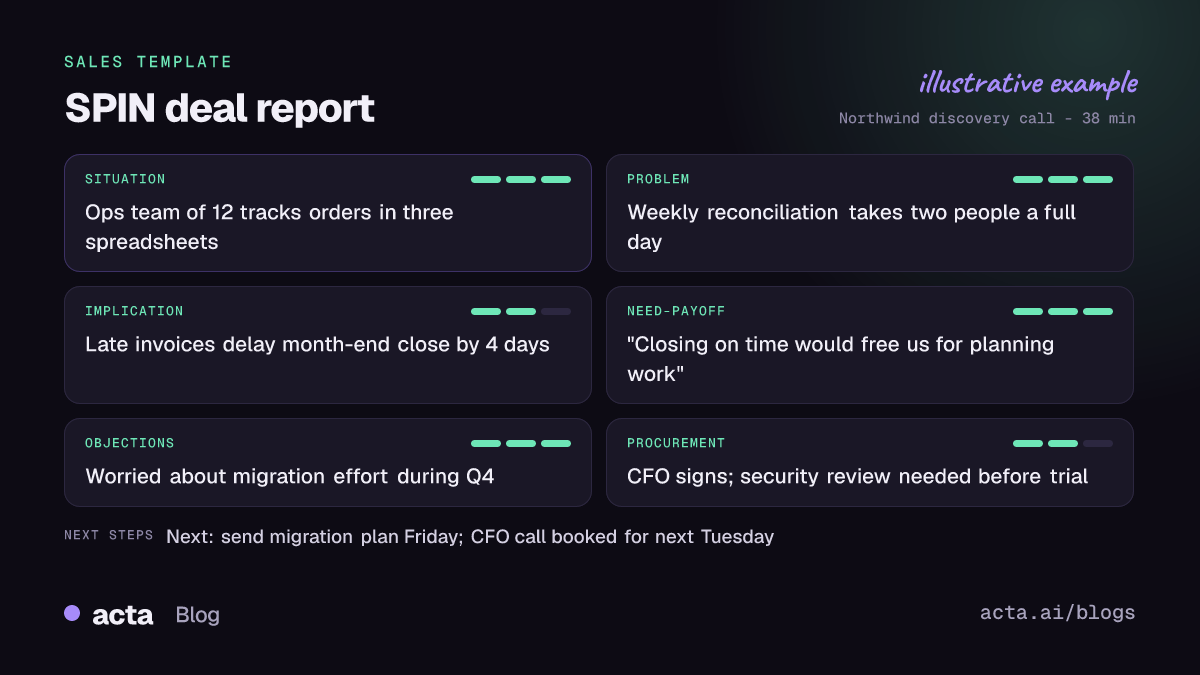
- SPIN elements: what the buyer said about their situation, the problems they named, the implications that came up and the payoffs they described, each tied back to the conversation.
- Objections: concerns about price, timing, fit or risk, and how they were answered, or whether they were left open.
- Procurement details: who signs, which approvals or security reviews are needed, and any purchasing steps or dates mentioned.
- Upsell opportunities: other teams, use cases or products the buyer hinted at.
- Next steps: what was agreed, by whom and by when.
- Sales-cycle insight: a view of how the deal is progressing, useful for leaders who track many opportunities at once.
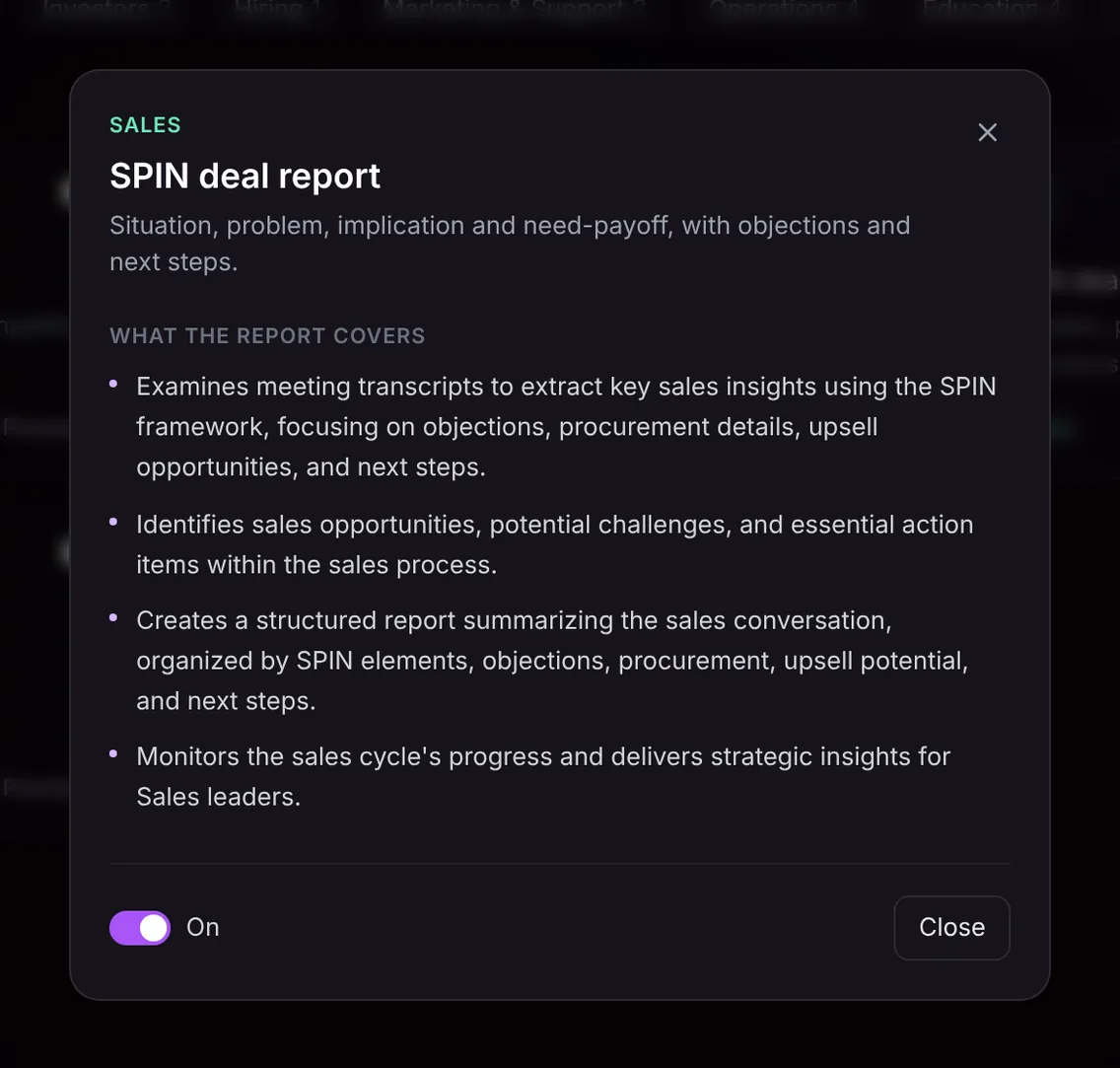
Like Acta's other sales reports, it can also carry an "In short" summary, a confidence level that notes what was missing, coverage of each SPIN element on a three-point scale, suggested "Ask on the next call" questions for the gaps, and key quotes with the speaker.
Here is the template in Acta's Templates page, with the preview of what the report covers:
And an illustrative example of a finished report:
Why is a SPIN report useful, and who is it for?
It is built for account executives, sales development reps and the managers who coach them. A few situations where it earns its place:
- Preparing the second call. The rep sees that the buyer described a reporting problem but never put a cost on it, so the next call opens with implication questions instead of a demo.
- Coaching. A manager reviewing a week of calls can spot a rep who asks plenty of situation questions but rarely reaches need-payoff, which is one of the patterns Rackham's research warned about.
- Forecast reviews. If the need-payoff section is empty, the deal probably is not as advanced as the stage in the CRM suggests.
- Handoffs. When an opportunity moves from an SDR to an AE, or from sales to onboarding, the buyer's own words about value travel with it.
Because the report is written from the transcript, it only contains what was said. If a SPIN element never came up, the report shows that gap rather than filling it in.
How does Acta pick the SPIN template automatically?
You do not have to remember to switch the template on before a call. Acta reads the conversation after the meeting and picks a fitting template even if you have not turned it on. For SPIN, the signals are a buyer and a seller working through the current setup, the pain points, what those problems are costing, and what a fix would be worth. The report is labelled "Auto", and Acta says why it chose it, for example that the call explored the buyer's problems and their business impact.
If you keep SPIN on and later record an internal pipeline review or a team standup, the relevance check stops it from producing a forced report. The template is listed under "Not relevant" with the reason, so you are not left with an empty SPIN analysis of a meeting that had no buyer in it.

How do you use the SPIN deal report?
- Record the call. Acta works with Zoom, Google Meet and Microsoft Teams through a meeting bot, or without one through the bot-free desktop app, the Chrome extension or the mobile apps. You can also upload a recording.
- Turn on the template. Open the Templates page at Acta Agents and Templates, preview what the SPIN report covers, and toggle it on. Or let Acta pick it when a call fits.
- Open the meeting's Templates tab. The SPIN report sits next to the summary, transcript, action items and decisions.
- Share it. Copy it, download it as PDF, Word or Markdown, or use Push to CRM to add it as a note on the contact in Salesforce, HubSpot or Zoho (paid plan, with that CRM connected).

Tips for a more complete SPIN report
- Keep situation questions short and move on; the report is more useful when most of the call is in problem and implication territory.
- Ask the buyer to quantify: "How many hours a week does that take?" gives the implication section something concrete.
- Let the buyer state the payoff. "What would it mean for your team if that went away?" produces the quotes that end up in the report.
- Close with explicit next steps and dates so the next-steps section is not vague.
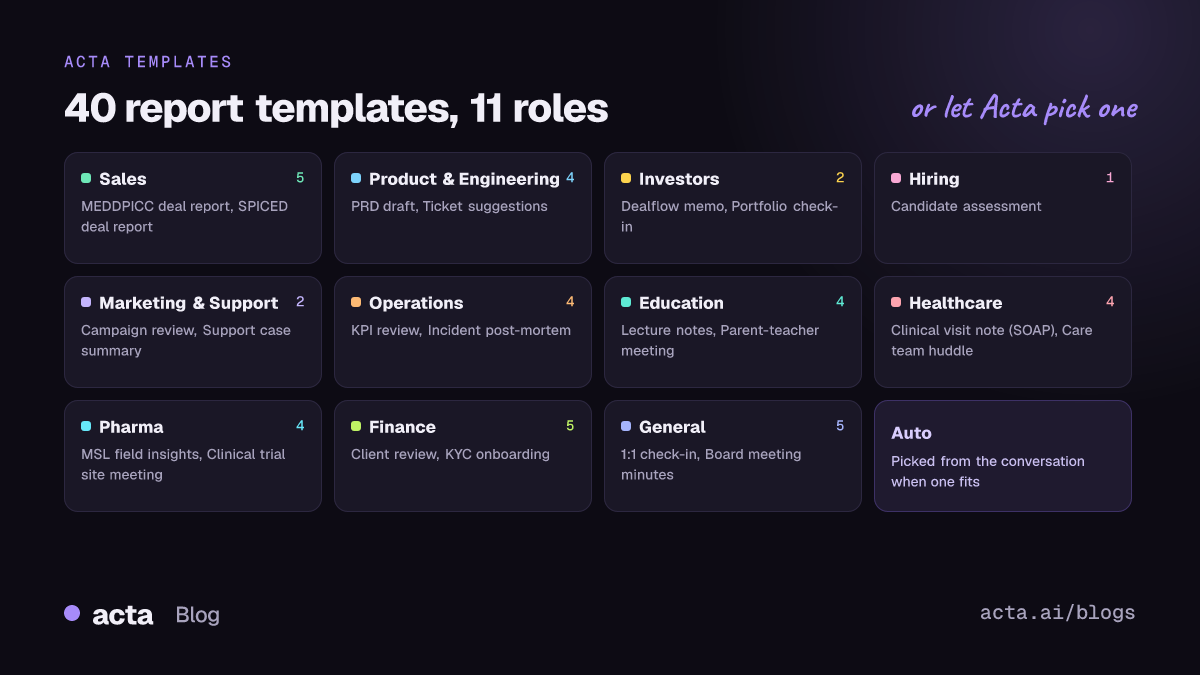
If your team qualifies with a different framework, Acta has sibling reports: the MEDDPICC deal report for complex enterprise deals, the SPICED deal report for recurring-revenue sales, and BANT qualification for quick early-stage screening. More on how sales teams use Acta is on the sales page.
Frequently asked questions
What does SPIN stand for in sales?
Situation, Problem, Implication and Need-payoff. They are four types of question that move a buyer from describing their current state to stating the value of a solution.
Can I use SPIN and MEDDPICC together?
Yes. SPIN describes how you question the buyer, while MEDDPICC describes what you need to know to qualify the deal. You can turn on both templates in Acta and get both reports from the same call.
What happens if I did not ask implication questions?
The report shows that the implication section is thin or missing and can suggest questions to ask on the next call. It does not invent implications that were not discussed.
Can I push the SPIN report to my CRM?
Yes. On a paid plan with Salesforce, HubSpot or Zoho connected, Push to CRM adds the report as a note on the customer's contact.
Try it on your next discovery call: start a free 15-day Acta trial.