SOAP notes for nurses are problem-focused entries split into four parts: Subjective (what the patient or family tells you), Objective (what you observe and measure), Assessment (your nursing judgment about what it means) and Plan (what you'll do next and when you'll check again). Many units add Intervention and Evaluation, making it SOAPIE. The format keeps one problem, its evidence and its follow-up together in a note any colleague can pick up.
This explainer is for nursing students, new graduates and nurses moving to a unit that charts in SOAP. It covers what goes in each section, a worked example, how SOAP compares with PIE and DAR, and the mistakes that weaken a note. It's general information, not clinical or legal advice: your facility's documentation policy always comes first.
Key takeaways
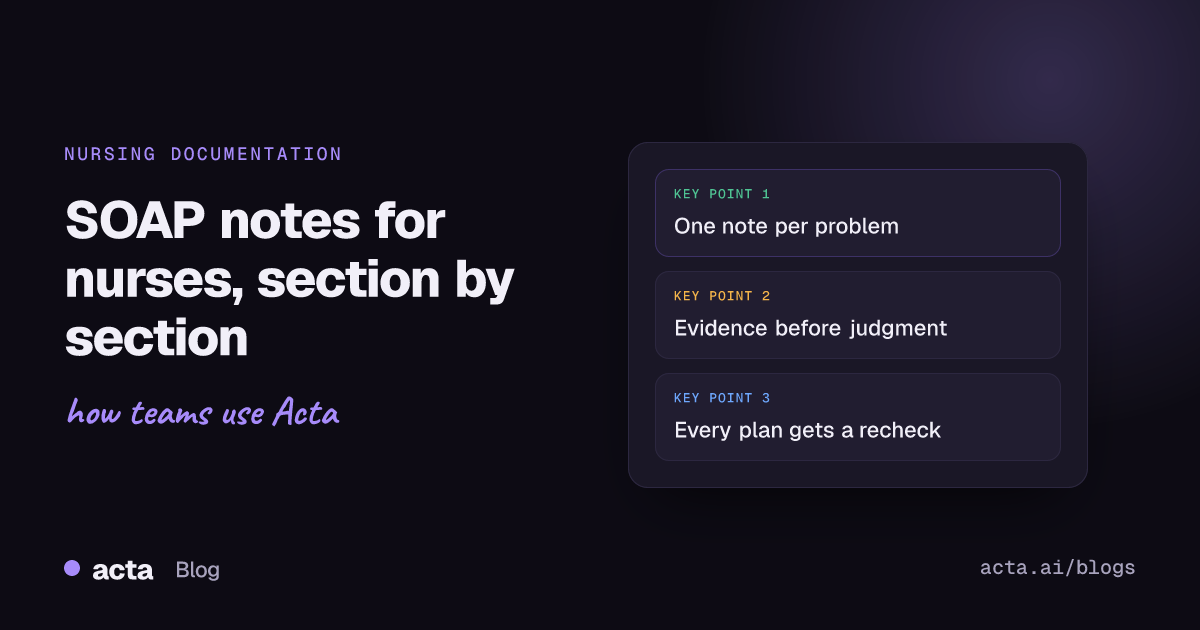
- Use one SOAP note per problem (pain, fall risk, wound, anxiety), not one per shift.
- Apply the reproducibility test: if another nurse could repeat the measurement or observation, it goes in Objective. If the patient said it, it goes in Subjective.
- Write the Assessment as a judgment backed by the S and O data, often as a nursing diagnosis, never as a copy of the vitals.
- Give every Plan item a time or trigger for reassessment, such as "recheck pain 30 minutes after analgesia".
- If an AI scribe drafts the note, get patient consent first and review every line before you sign.
Table of contents
- SOAP notes for nurses follow four sections in a fixed order
- Each section answers a different question
- A worked example shows a full nursing SOAP note
- SOAP is one of several nursing charting formats
- SOAP fits problem-focused notes better than routine entries
- Five common mistakes weaken a SOAP note
- AI can draft the note, but the nurse signs it
- Frequently asked questions
- Choose the right note format for your next shift
SOAP notes for nurses follow four sections in a fixed order
SOAP comes out of problem-oriented medical records. The StatPearls chapter on SOAP notes credits the structure to Dr. Larry Weed, and the four headings have stayed the same for decades: Subjective, Objective, Assessment, Plan. The order matters. You gather the evidence first and only then say what you think it means.
Physicians use SOAP for progress notes, but the nursing version reads differently. A doctor's Assessment usually names a medical diagnosis. A nurse's Assessment describes the patient's response to that condition: acute pain, risk for falls, impaired skin integrity, anxiety about discharge. As nurse.org's overview of SOAP notes in nursing puts it, this is where you interpret the subjective and objective findings, often as a nursing diagnosis.
That difference shapes every section. Your Plan lists nursing interventions and when you'll reassess, not the medication orders a prescriber would write.
Each section answers a different question
It helps to think of each heading as a question you're answering for the next nurse on shift.
Subjective: what does the patient say?
Record the patient's own words, or a family member's, in quotes where you can. Chief complaint, symptoms, how they rate their pain, what makes it better or worse. StatPearls suggests the OLDCARTS mnemonic (onset, location, duration, character, aggravating factors, radiation, timing, severity) for describing symptoms, and it works just as well at the bedside.
Objective: what can you measure or observe?
Vital signs, pain scores on a validated scale, wound appearance, intake and output, lab values, mobility, behavior you saw. This is where the subjective vs objective data line trips people up. "Patient appears anxious" is an interpretation. "Patient wringing hands, speaking quickly, HR 104" is objective.
Assessment: what does it mean?
Pull the S and O together into a judgment. Is the problem improving, stable or getting worse compared with the last note? Name it as a nursing diagnosis if your unit uses them. One or two sentences is normal.
Plan: what happens next?
List interventions, patient teaching, who you've escalated to, and when you'll reassess. Make each item specific enough that the next nurse knows whether it was done.
A worked example shows a full nursing SOAP note
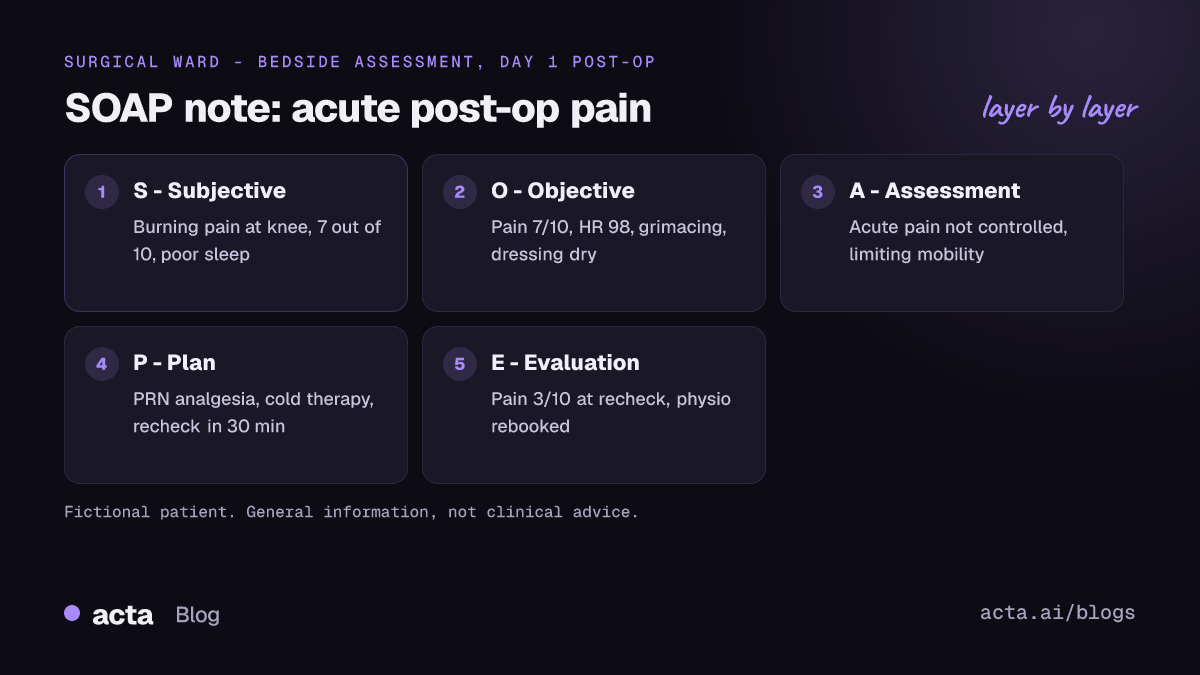
Here's a SOAP note example for nursing on a surgical ward; for other settings, see these SOAP notes examples. The patient is fictional and the details are illustrative only; follow your own orders, scales and policies.
Problem: Acute post-operative pain. Mr. Daniel Reyes (fictional), 68, day 1 after right total knee replacement. 14:00.
S: "It's a burning pain around the knee, worse when I bend it. About a 7 out of 10." States last pain relief "wore off an hour ago". Reports poor sleep overnight because of pain.
O: Pain 7/10 on numeric scale. BP 148/88, HR 98, RR 18, SpO2 96% on room air, temp 37.2°C. Grimacing on knee flexion. Dressing dry and intact, no new drainage. Pedal pulses present bilaterally, toes warm. Declined physiotherapy session at 13:00 due to pain.
A: Acute pain related to surgical incision, not controlled on current regimen and limiting mobility. Raised HR and BP consistent with pain. No signs of neurovascular compromise.
P: Gave PRN oral analgesic as prescribed at 14:05. Applied cold therapy and raised the leg on pillows. Reassess pain at 14:35. Taught patient to request analgesia before pain exceeds 4/10. If pain stays above 5/10 after reassessment, notify surgical team to review the regimen. Rebook physiotherapy for 15:30.
I (SOAPIE): As above, 14:05 to 14:15.
E (SOAPIE): 14:35 pain 3/10, HR 84. Patient able to flex knee with assistance. Physiotherapy confirmed for 15:30.
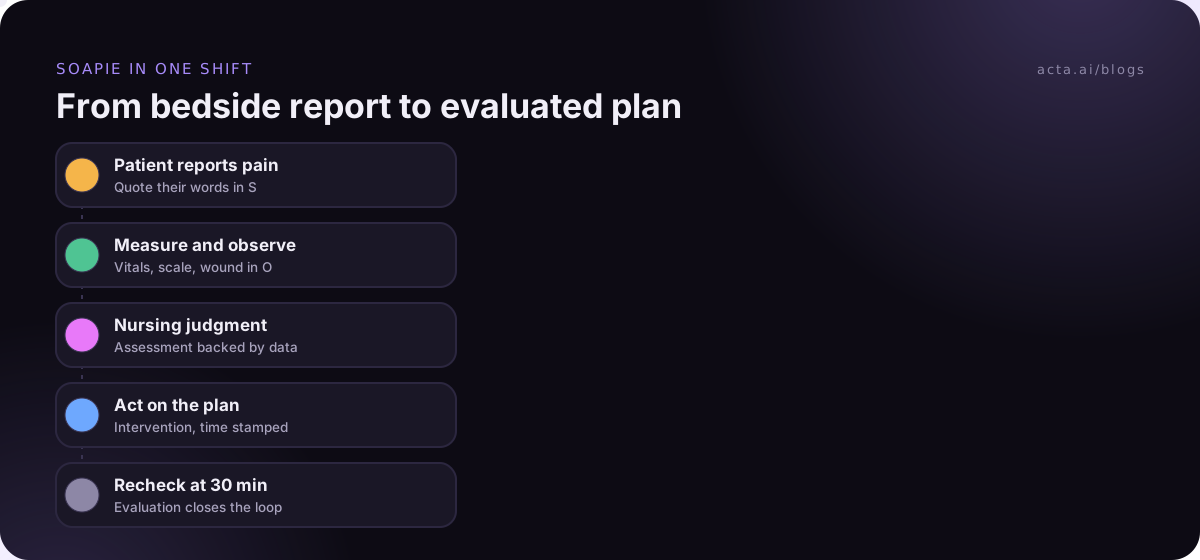
Two things make this note useful. Every claim in the Assessment points back to something in S or O, and the Plan includes a time to check whether it worked. The Evaluation line then closes the loop, which is the whole point of SOAPIE charting.
SOAP is one of several nursing charting formats
Your unit may not use SOAP at all, and nursing documentation formats vary a lot between hospitals. The open textbook Documentation in Nursing walks through several common structures, and sources generally agree that none is best in every setting. Which one you use usually comes down to facility policy and, in hospitals, what the clinical documentation improvement team needs from the chart.
| Format | Parts | Where it fits |
|---|---|---|
| SOAP | Subjective, Objective, Assessment, Plan | Problem-focused notes, outpatient and NP visits |
| SOAPIE / SOAPIER | SOAP plus Intervention, Evaluation (and Revision) | Inpatient nursing where you act and recheck in one shift |
| PIE | Problem, Intervention, Evaluation | Units built around nursing care plans |
| DAR / F-DAR | Focus, Data, Action, Response | A single event or change from baseline |
| Narrative | Free text in time order | Unusual events that don't fit a template |
PIE grew out of nursing practice, while SOAP came from medical records, which is why some nurses find PIE closer to how they think. DAR is quick for a focused event, such as a fall or a sudden change in mental status. A common critique of SOAP-based formats is that they center the illness rather than the person, so make room in Subjective for what matters to the patient.
SOAP fits problem-focused notes better than routine entries
Use SOAP when there's a specific problem to work through: new or uncontrolled pain, a wound that's changing, a patient who's newly confused, a teaching need before discharge. Nurse practitioners use it for most visit notes, because each visit is built around a complaint and a plan.
Skip it for routine observations that already live in flowsheets. Charting a full SOAP note for stable vitals every four hours duplicates data and buries the notes that matter. If your unit charts by exception, routine care stays in the flowsheet, with a SOAP or DAR note only when something deviates from normal.
For handover, SOAP notes are a good source but not a script. Pull the Assessment and the open Plan items into whatever handover tool your unit uses.
Five common mistakes weaken a SOAP note
- Interpretation in Objective. "Wound looks infected" belongs in Assessment. In Objective write what you saw: "2 cm erythema around incision, warm to touch, yellow drainage on dressing".
- An Assessment that repeats the data. "Pain 7/10, BP 148/88" is not an assessment. Say what it means and whether it's better or worse.
- A Plan with no reassessment time. "Monitor pain" can't be checked. "Reassess pain 30 minutes after analgesia" can.
- Copy-forward notes. Carrying yesterday's note into today's with small edits is how outdated information ends up in the chart. Write from today's assessment.
- Vague time stamps and late entries. Chart close to the event and label late entries as late, per your policy.
AI can draft the note, but the nurse signs it
Ambient AI scribes and meeting assistants can now turn a conversation into a draft SOAP note. Used carefully, that saves typing. Used carelessly, it puts words in the chart you didn't verify. Three rules hold regardless of the tool: get the patient's consent before anything is recorded, use only tools your organization has approved for patient information, and read and correct every line before you sign. Our guide to AI notetakers in healthcare goes through the questions to ask first, and the post on consent before recording covers what to tell people.
Acta is a meeting assistant, not a clinical system. It has a SOAP note draft template that turns a consented conversation into a draft for clinician review, and teams use it for non-patient meetings like care team huddles. Acta is working towards HIPAA compliance rather than claiming it today, so check with your compliance team before using it with patient data. See Acta for healthcare for details.
Frequently asked questions
What is the difference between SOAP and SOAPIE in nursing?
SOAPIE adds two sections to SOAP: Intervention, where you record what you actually did, and Evaluation, where you record how the patient responded and when. Some units add Revision too (SOAPIER) for changes to the care plan. SOAPIE suits inpatient nursing because you often act and recheck within the same shift, so the note closes its own loop.
Can a nurse write a nursing diagnosis in the Assessment?
Yes, and many units expect it. The nursing Assessment describes the patient's response to a health problem, such as acute pain, risk for falls or anxiety, rather than the medical diagnosis. Back it with the S and O data, for example "acute pain related to surgical incision as evidenced by 7/10 pain and grimacing on movement". Follow the terminology your facility uses.
How long should a nursing SOAP note be?
Long enough that another nurse can understand the problem, what you found, what you think and what happens next. For a single problem that's often five to ten lines. StatPearls advises clarity over excessive detail. If a note runs much longer, check whether routine data is being repeated that already lives in flowsheets or the MAR.
Is subjective data less important than objective data?
No. Pain, nausea, fear and fatigue are often only available as subjective data, and the patient's own words can be the earliest sign that something is changing. The point of separating them is clarity: the reader should know what the patient reported and what you measured, so they can weigh both. Quote the patient directly where you can.
Can I use AI to write SOAP notes for nurses?
You can use an approved AI tool to draft them, if your organization allows it, the patient has consented, and you review every line before signing. The signed note is your professional record, so you are responsible for its accuracy. Watch for invented details, missing negatives and assessments the AI guessed rather than took from what was said.
Choose the right note format for your next shift
Before you start charting, run through this quick checklist.
- Check your policy: Confirm whether your unit expects SOAP, SOAPIE, PIE or DAR, and which notes are charting by exception.
- Name the problem: Write one note per problem, with the problem stated at the top.
- Sort the evidence: Patient's words in S, anything reproducible in O, your judgment in A.
- Time the follow-up: Give every Plan item a reassessment time or trigger, then document the Evaluation.
- Review any AI draft: Consent first, approved tools only, and read every line before signing.
For team meetings off the ward, such as huddles, case reviews and handover planning, the Acta desktop app can take the notes so you can stay in the conversation; you can try it with a 15-day free trial on the pricing page.