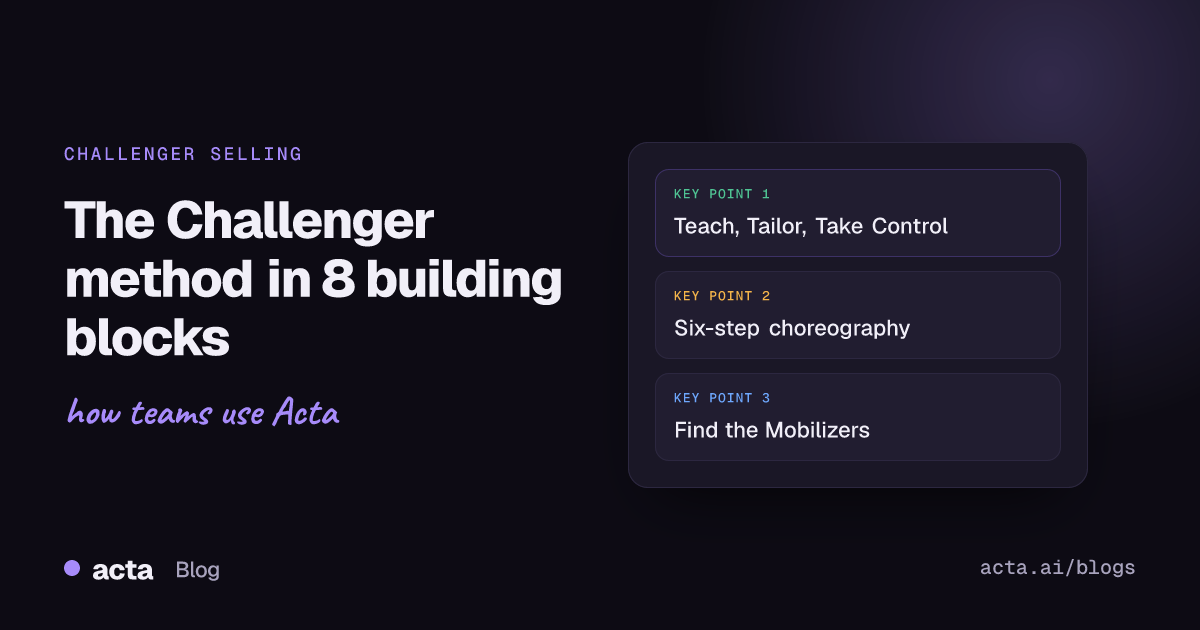
The Challenger sales methodology teaches reps to lead with an insight that reframes how the buyer sees their own problem, tailor it to each stakeholder, and keep control of the deal through constructive tension. In practice it's eight building blocks: the seller profiles, Teach, Tailor, Take Control, three pairs of steps in the commercial teaching choreography, and Mobilizers. Here's each one compared, with a line you can use on a call.
This guide is for sales leaders and reps in complex B2B deals who've heard "be more Challenger" and want to know what that means on Tuesday's call. It won't suit you if you sell a simple, low-price product with a short cycle; there, a reframe often slows the deal down instead of helping.
Key takeaways
- Start with one commercial insight per segment, written as "you think X, but actually Y, and it's costing you Z".
- Tailor that insight to each stakeholder's goals; a CFO and an ops lead should hear different consequences of the same insight.
- Run the six choreography steps in order: Warmer, Reframe, Rational Drowning, Emotional Impact, New Way, Your Solution.
- Spend your time on Mobilizers (Go-Getters, Teachers, Skeptics), not on the friendliest contact.
- Pair Challenger with a qualification framework such as MEDDPICC; Challenger shapes the conversation, not the forecast.
Table of contents
- The Challenger sales methodology rests on eight building blocks
- The seller profiles explain what the method reacts to
- Teach, Tailor and Take Control are the core skills
- The six-step choreography turns insight into a conversation
- Mobilizers decide where you spend your time
- A fictional deal shows the blocks working together
- Challenger fits some deals better than others
- Frequently asked questions
- Put the Challenger sales methodology to work
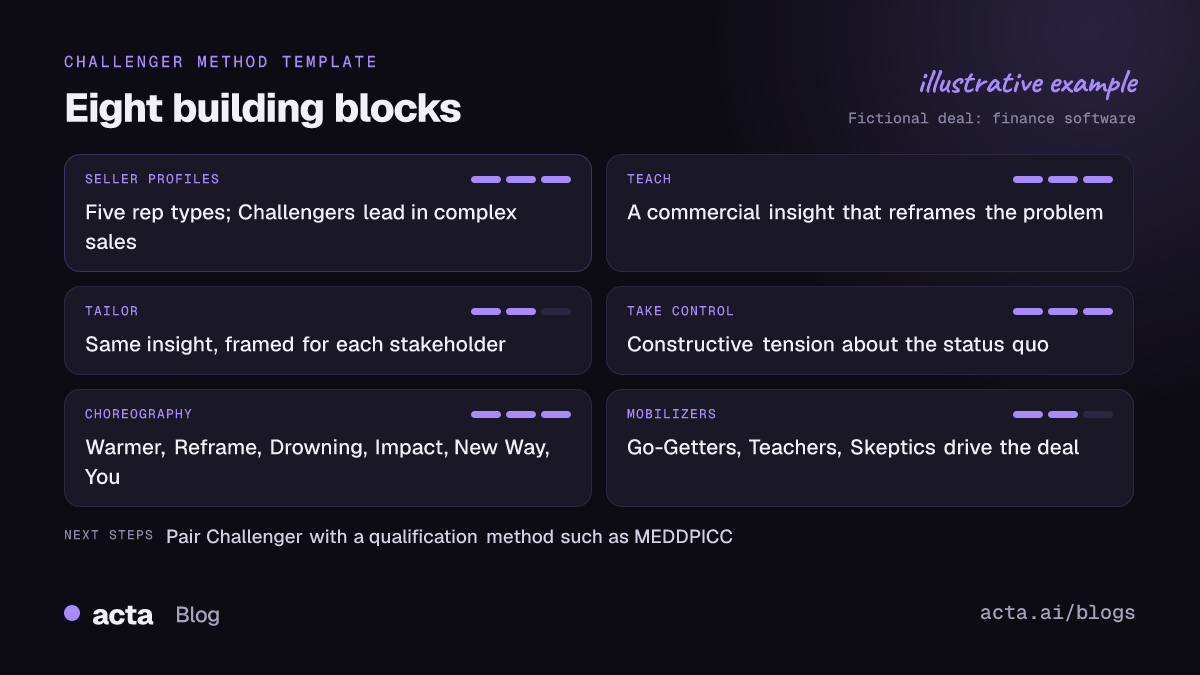
The Challenger sales methodology rests on eight building blocks
The method comes from research by Matthew Dixon and Brent Adamson at CEB, now part of Gartner, published in the 2011 book The Challenger Sale. A follow-up, The Challenger Customer (2015, with Pat Spenner and Nick Toman), turned the lens on the buying group. Today the method is taught by Challenger Inc., whose overview of the Challenger sales methodology is the best primary source online. Secondary summaries disagree on details such as the study's sample size, so treat any precise numbers you see quoted with some caution.
Searchers for this term usually want to know what the parts are and how to use them, so this roundup compares the building blocks rather than training vendors.
| Building block | What it answers | Best used | Effort |
|---|---|---|---|
| 1. Seller profiles | Why change how we sell? | Hiring, coaching | Low |
| 2. Teach | What should the buyer learn? | First meetings | High |
| 3. Tailor | Why does it matter to this person? | Multi-stakeholder deals | Medium |
| 4. Take Control | How do we keep momentum? | Pricing, stalls | Medium |
| 5. Warmer and Reframe | How do we open? | Discovery, pitch | Medium |
| 6. Rational Drowning and Emotional Impact | Why act now? | Business case | High |
| 7. New Way and Your Solution | What should they do instead? | Demo, proposal | Medium |
| 8. Mobilizers | Who can drive the deal inside? | Account planning | Medium |
Effort is my own rough rating of how much prep each block takes for a team new to the method.
The seller profiles explain what the method reacts to
1. The five seller profiles
- Best for: Sales leaders deciding what to coach and hire for.
- Pros: Gives the team shared language. The research grouped reps as Hard Worker, Challenger, Relationship Builder, Lone Wolf and Reactive Problem Solver, and reported Challengers doing best in complex sales.
- Cons: It's one well-publicized study, and summaries vary. Don't use the labels to rank people on your team.
- Effort to adopt: Low. One team session using Challenger Inc.'s page on the Challenger selling profiles.
Coaching prompt: "On that call, were you building rapport or teaching the buyer something new about their business?"
Teach, Tailor and Take Control are the core skills
2. Teach (commercial insight)
- Best for: Reps selling into buyers who've already done their research.
- Pros: Gives the buyer a reason to talk to you instead of reading your website. A strong insight reframes their problem and leads, fairly, to what you do best.
- Cons: Hard to write. Generic "industry trends" decks aren't insights. If the insight doesn't point to your strengths, you've educated the buyer for a competitor.
- Effort to adopt: High. Expect several drafts per segment, tested on real calls.
"Most finance teams think month-end close is slow because of headcount. In the companies we work with, it's usually the approval loops."
3. Tailor
- Best for: Deals with three or more stakeholders.
- Pros: Makes the same insight land with each person, because you tie it to their goals and the metrics they're judged on.
- Cons: Needs real discovery. Guessing at a stakeholder's priorities sounds worse than not tailoring at all.
- Effort to adopt: Medium. One line per role in your account plan.
To the CFO: "That loop costs you two days of cash visibility." To the controller: "That loop is why your team works the last weekend of the month."
4. Take Control (constructive tension)
- Best for: Deals that stall, or where pricing comes up early.
- Pros: Keeps deals moving. Challenger describes constructive tension as tension within the buying group about the status quo, not between seller and buyer, and its post on dialing up constructive tension treats it as a level you calibrate.
- Cons: Easy to overdo. Pushing too hard reads as arrogance, especially with a buyer who's still building trust in you.
- Effort to adopt: Medium. Role-play pricing and "let's wait until Q2" conversations.
"If we wait until Q2, you go through two more closes this way. What would need to be true to start the pilot this month?"
The six-step choreography turns insight into a conversation
Challenger calls the structured way of delivering an insight commercial teaching. The six steps run in a fixed order. I've paired them, because each pair does one job.
5. Warmer and Reframe
- Best for: The opening ten minutes of a first real meeting.
- Pros: The Warmer shows you've done your homework on their business. The Reframe is the "I hadn't thought of it that way" moment.
- Cons: A Warmer that runs long becomes a monologue. A Reframe that insults how they work today ends the meeting.
- Effort to adopt: Medium. Write both for each segment and practise out loud.
Warmer: "Teams like yours usually tell us close takes eight to ten days." Reframe: "What surprised us is where the time goes."
6. Rational Drowning and Emotional Impact
- Best for: Building the business case once the Reframe has landed.
- Pros: Rational Drowning quantifies what the status quo costs, using the buyer's numbers where possible. Emotional Impact makes it personal, often through a story about a team like theirs.
- Cons: Without real data, Rational Drowning sounds made up. Without a story, the numbers don't move anyone.
- Effort to adopt: High. You need credible data and customer stories you're allowed to tell.
"If approvals add two days a month, that's about 24 days a year without a clean cash view. One controller told us she stopped taking holidays at month-end."
7. New Way and Your Solution
- Best for: The demo or proposal stage.
- Pros: New Way describes the better approach without naming your product, so the buyer agrees on the approach first. Your Solution then maps your capabilities to it.
- Cons: Jumping to Your Solution too early undoes everything before it.
- Effort to adopt: Medium. Usually a slide or two per segment.
New Way: "Approvals happen as entries are posted, not in a batch at the end." Your Solution: "Here's how that works in our product."

Mobilizers decide where you spend your time
8. Mobilizers (from The Challenger Customer)
- Best for: Account planning in deals with a buying group.
- Pros: Points you at the stakeholders who can build consensus. Challenger's page on the Challenger Customer profiles describes Mobilizers (Go-Getters, Teachers, Skeptics), Talkers (Guides, Friends, Climbers) and Blockers.
- Cons: The friendliest contact is often a Talker, which feels wrong to reps who were trained to find a champion.
- Effort to adopt: Medium. Tag each contact in your CRM after the second meeting.
To a Skeptic: "What would you need to see before you'd put your name on this?"
A fictional deal shows the blocks working together
Dana sells finance automation software to a mid-sized logistics company. This is an illustrative deal, not a customer story.
- Discovery: Dana learns close takes nine days and the controller, Marco, blames headcount.
- Warmer and Reframe: she shares what she sees across similar firms, then reframes: the delay is approval loops, not people.
- Rational Drowning: using Marco's own numbers, they estimate the days of delayed cash visibility per year.
- Emotional Impact: she tells the (anonymized) story of another controller's month-end weekends.
- Tailor: for the CFO, Priya, the same insight becomes a cash forecasting problem.
- Mobilizers: Priya turns out to be a Skeptic who asks for proof. Dana gives her a pilot plan instead of more slides.
- Take Control: when procurement suggests waiting for next year's budget, Dana proposes a one-month paid pilot inside the current one.
Notice what the deal doesn't show: qualification. Challenger tells Dana how to run the conversation, but it doesn't tell her whether there's budget, a decision process or a paper process. That's why many teams pair it with something like MEDDPICC; see our post on MEDDPICC deal reports from sales calls.
Challenger fits some deals better than others
Compared with other methods, the Challenger sales methodology is about shaping the buyer's view, not just finding needs:
- SPIN Selling uncovers needs through Situation, Problem, Implication and Need-payoff questions. It's gentler and works well when the buyer already knows they have a problem. Our post on SPIN Selling deal reports shows the questions in a call write-up.
- SPICED structures discovery around situation, pain, impact, critical event and decision. Our SPICED sales methodology comparison sets it beside seven other methods.
- MEDDPICC is qualification. It pairs well with Challenger rather than replacing it.
Skip Challenger for short, transactional sales and for buyers in a crisis who need help fast, not a reframe. And if your reps can't yet run a solid discovery call, start with our discovery call template first.
Coaching Challenger works best from real calls, since you can hear whether the Reframe landed. If you review recordings, tell buyers the call is recorded and why; our guide to recording calls with consent covers the basics. On Zoom or Teams calls where a bot would feel awkward, a desktop recorder captures audio from your own computer.
Where Acta fits
Acta records sales calls and writes summaries, action items with owners and follow-up email drafts. Its sales report templates can write a call up against a framework, so a manager can check whether the Reframe and the Mobilizer questions happened without listening to the whole call. It doesn't replace coaching; it gives you the right ten minutes to coach on.
Frequently asked questions
What are the three main elements of the Challenger sales methodology?
Teach, Tailor and Take Control. Teach means offering a commercial insight that reframes the buyer's problem. Tailor means adapting that insight to each stakeholder's goals. Take Control means keeping the deal moving through constructive tension, including being comfortable talking about money and pushing back on a stalled process.
What are the six steps of Challenger commercial teaching?
The Warmer, the Reframe, Rational Drowning, Emotional Impact, a New Way, and Your Solution. The first two earn attention and shift the buyer's view. The middle two build the logical and personal case for change. The last two describe a better approach and then connect it to what you sell.
Is the Challenger sales methodology still relevant in 2026?
For complex B2B deals with buyers who research before talking to sales, the core idea still holds: reps need to bring something the buyer couldn't find alone. It's less useful in short, transactional sales. Most teams now use it alongside a qualification framework rather than as their only method.
What is a Mobilizer in Challenger selling?
A Mobilizer is a stakeholder who can build consensus and drive a purchase inside their organization. The Challenger Customer describes three types: Go-Getters, Teachers and Skeptics. They differ from Talkers, who are helpful and friendly but less able to move a deal, and from Blockers, who prefer the status quo.
Is Challenger selling too aggressive?
It can be if reps confuse constructive tension with pushiness. Challenger describes the tension as being within the buying group, about the cost of the status quo, not between the rep and the buyer. A respectful, well-researched Reframe is assertive without being rude.
Put the Challenger sales methodology to work
You don't need a full rollout to start. Work through these with your team over the next month.
- Write one insight: pick your best segment and draft a Reframe in the "you think X, actually Y" form.
- Tailor by role: add one line per stakeholder type showing why the insight matters to them.
- Script the choreography: one sentence each for Warmer, Reframe, Rational Drowning, Emotional Impact, New Way.
- Map the buying group: tag contacts as Mobilizer, Talker or Blocker after the second meeting.
- Review real calls: listen for whether the Reframe landed, and coach on that moment.
To review those calls without a bot in the meeting, try the Acta desktop app with a 15-day free trial.