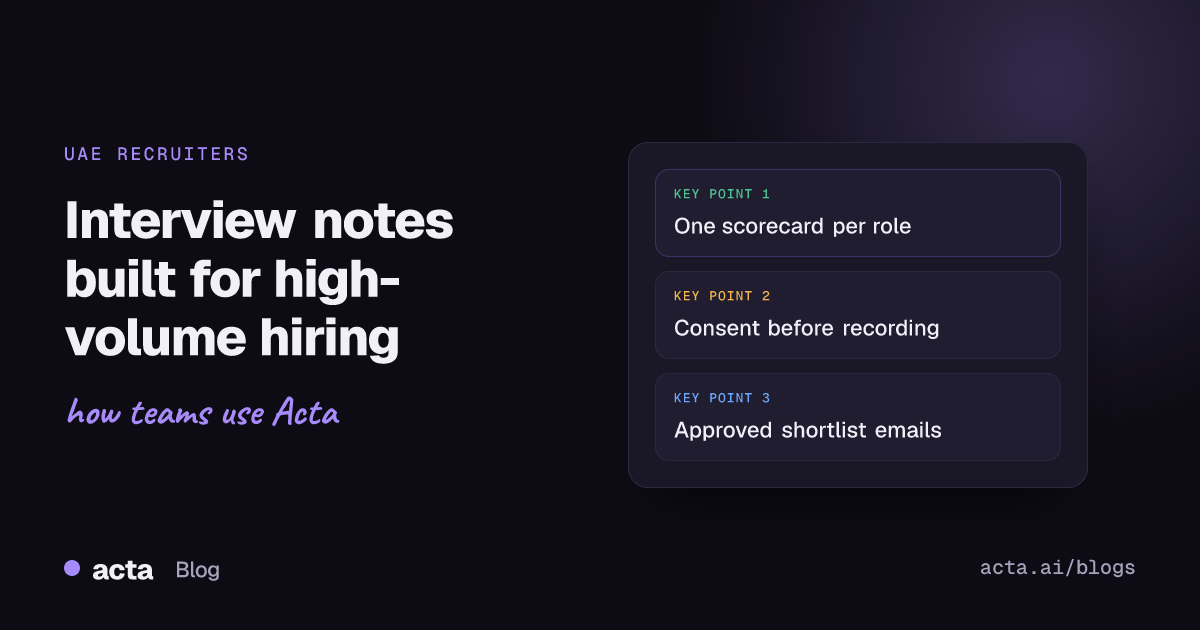
High-volume UAE hiring breaks free-form interview notes
Free-form notes work when one recruiter interviews five people for one role. They fall apart at forty candidates a week across three clients. One consultant writes "strong communicator", another writes "good English", a third writes nothing until the end of the day. When the hiring manager asks why candidate 12 beat candidate 19, nobody can answer from the notes.
UAE hiring adds pressure. Candidate pools are very international, interviews switch between languages, and many first screens happen on WhatsApp calls or Microsoft Teams with candidates still abroad. A note that says "communication 3/4" means little unless it says which language, in what context, and what the candidate actually said.
There's a legal reason to keep notes factual too. As of November 2026, Article 4 of the UAE labour law, Federal Decree-Law No. 33 of 2021, prohibits discrimination on grounds including race, colour, sex, religion, national or social origin and disability, as summarised in this overview of UAE anti-discrimination rules; the government's employment laws page lists the law and its amendments. This article is general information, not legal advice. In practice, notes that record evidence against criteria are easier to defend than notes full of impressions. Our guide on how to reduce bias in interview notes goes deeper on wording.
One scorecard per role, agreed before the first call
The scorecard is the backbone. Agree it with the hiring manager during intake, not after you've seen ten candidates and started favouring a type. If you run agency intake calls, capture the criteria there; our post on recruitment agency client intake call notes shows how to keep that spec current.
Keep it short. Four to six criteria, each with a one-line definition of what a 4 looks like, and the same scale for every candidate. Copy this into your ATS notes field or a shared sheet:
Role: [Title, client, location] | Interview type: [Screen / technical / final]
Candidate: [Name] | Interviewer: [Name] | Date: [ ] | Language used: [ ]
Consent to record: [Asked / answer / not recorded]
Must-haves: [e.g. availability date, notice period, licence or certification the client requires] - Met / Not met / Unclear
Criterion 1 to 5: Score 1-4 | Evidence (what they said or did) | Short quote
Concerns to check: [Gap, inconsistency, reference to verify]
Salary and notice: [As stated by the candidate]
Recommendation: Shortlist / Hold / Decline | Reason in one line: [ ]
Two rules make this work. Every score needs evidence next to it, and the "Reason in one line" must refer to the criteria, not to a feeling. For worked role versions, see our interview scorecard template examples.
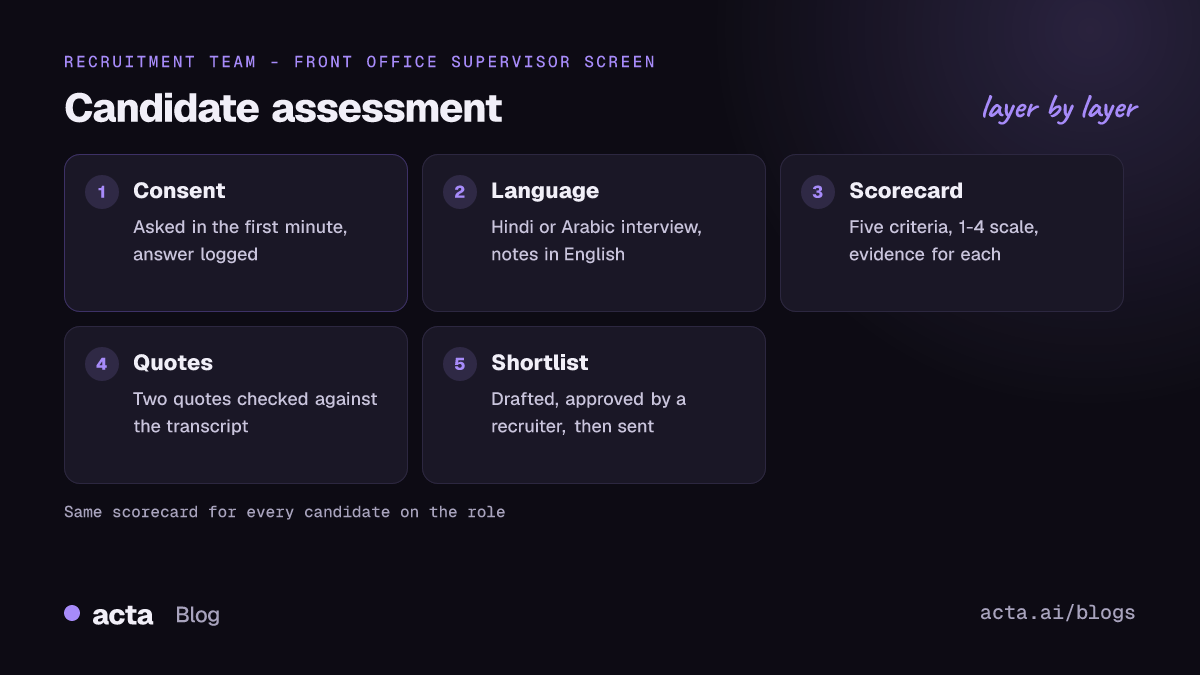
Candidate consent comes before the record button
Recording interviews makes notes better, because you can check a quote instead of reconstructing it. It also means processing personal data. The UAE's federal Personal Data Protection Law, Federal Decree-Law No. 45 of 2021, came into force on 2 January 2022, and the government's data protection page sets out the framework and the UAE Data Office's role. Our UAE PDPL meeting recording explainer covers consent, free zones and notices. Again, general information, not legal advice.
Whatever your legal position, the practical habit is simple: tell the candidate at the start, say why, and accept a no. Something like:
"Before we start, I'd like to record this call so my notes are accurate. The recording is only used for this hiring process and shared with the hiring team. Is that OK with you? If not, I'll just take notes by hand."
Write the answer in the "Consent to record" line. For more detail, read our guides on recording job interviews with consent and what to tell participants when an AI notetaker records. If you use the Acta desktop app, its "Copy notice" button gives you a recording notice to paste into the call chat, which helps on Teams and Zoom screens where people join late.
Hindi and Arabic interviews can still give English notes
Plenty of UAE interviews happen partly or fully in a language other than English, especially for frontline, hospitality and driver roles. With Acta, Hindi (including Hindi-English mixes) is detected automatically. Arabic is supported in beta and has to be chosen in Settings, because Auto won't pick it. Arabic transcripts display right to left, as Arabic should.
The useful setting for recruiters is "Language for my notes". Set it to English and the transcript stays in the language spoken, with quotes kept as the candidate said them, while the summary, action items and report templates come in English for a hiring manager who doesn't speak Hindi or Arabic. Settings apply to new meetings only. The meeting languages guide lists the steps; for setup detail, see our Arabic transcription setup guide and the post on Hindi-speaking teams in the UAE.
Be clear-eyed about the gaps. Urdu, Malayalam and Tagalog are common in UAE workplaces but are not supported yet. For those candidates, run the interview in English if they are comfortable, or take notes by hand with a colleague who speaks the language. Don't record a Tagalog interview on English and hope for the best; the transcript will be wrong. Each meeting also has one language, so a screen that switches between Arabic and English mid-way works best when you pick the language most of the interview uses.
Run each interview in seven steps
This is the routine that keeps interview notes for recruiters UAE-based teams consistent across consultants, even on a 15-interview day.
- Open the scorecard for the role before the call, not after.
- Set the language if the interview won't be in English, and choose English notes.
- Ask for consent in the first minute and note the answer.
- Ask the same core questions in the same order for every candidate on that role. Follow-ups can vary.
- Score within ten minutes of the call, while you remember tone and context the transcript can't show.
- Check two quotes against the transcript or recording before they go to a client.
- Write the one-line reason and move the candidate to Shortlist, Hold or Decline.
On the recording side, many screens happen outside formal meeting tools. The Acta desktop app detects Zoom and Teams desktop meetings on its own, and records other calls, including WhatsApp calls on your computer, when you press Record. It records the call's sound and your microphone, never the screen, and no bot joins.
Common mistakes to avoid: scoring at the end of the day from memory, letting one consultant use a 1-5 scale while another uses 1-4, and writing salary expectations as your guess rather than what the candidate said.
A filled example from a hotel screening day
This example is illustrative; the candidate, client and answers are made up. Neha Kapoor, a consultant at a Dubai agency, is screening front office supervisors for a hotel client. Her hiring manager contact is Omar Farouk, the hotel's front office manager.
Role: Front office supervisor, hotel client, Dubai Marina | Interview type: Screen (Teams)
Candidate: Maria Santos | Interviewer: Neha Kapoor | Language used: English
Consent to record: Asked at start; candidate agreed.
Must-haves: Available within 30 days - Met. Supervisory experience in a hotel - Met. Opera PMS experience - Met.
Guest recovery (3/4): Described handling an overbooking by upgrading two guests and calling each the next morning. Quote: "I'd rather lose a suite night than a review."
Team leadership (4/4): Led a shift of six; built a handover checklist after missed wake-up calls. Gave numbers for the shift size, not for results.
Systems (3/4): Daily use of Opera; no experience with the client's upsell tool.
Concerns to check: Six-month gap in 2024; candidate said family relocation. Verify dates with reference.
Salary and notice: As stated: 30 days' notice; salary expectation recorded in ATS.
Recommendation: Shortlist | Reason: Meets all must-haves; strongest leadership evidence of today's five.
Look at what's missing: nothing about where Maria is from, her accent or her age. Everything Omar needs to compare her with the next candidate is on one screen, and the quote is checked against the transcript.
Hiring managers need evidence, not impressions
The hiring manager doesn't want your transcript. They want a comparable view of the shortlisted candidates and enough evidence to trust your recommendation. How you share depends on whether they are inside or outside your organisation.
| Situation | What to send | Format |
|---|
| In-house team, same workspace | The interview report plus scorecard | Shared meeting in the workspace |
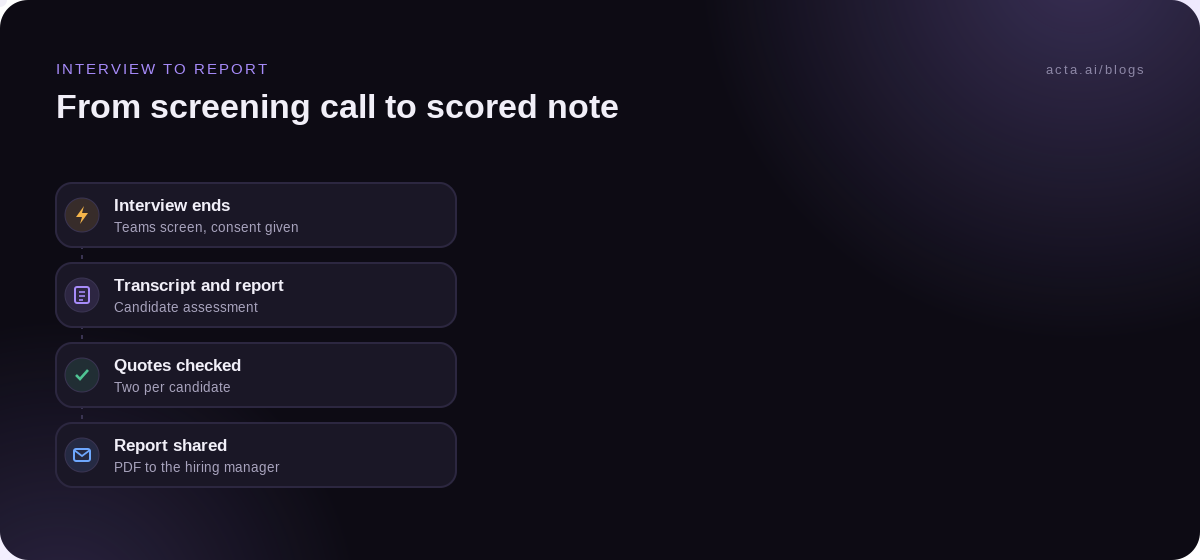
| Agency client | Scorecard summary and two checked quotes per candidate | PDF or Word report by email |
| Panel debrief | All scorecards for the role side by side | Shared sheet or ATS view |
| Rejected after final | Internal reason only, linked to criteria | ATS note, not sent out |
For agency clients, send the summary, not the recording, unless the candidate agreed to that too. Acta's built-in Candidate assessment template writes a structured report from the interview, and you can copy or download it as a PDF, Word file or Markdown. In an Acta workspace, each person's meetings are private by default; you choose to share a meeting with everyone in the workspace. For the meeting where the panel decides, a well-run interview debrief pairs well with these notes.
An Agent Builder recipe for the shortlist email
On a volume day, the slowest step is often writing the shortlist email to the client at 6 pm. Acta's Agent Builder, currently in beta, can draft it for you, and its Human approval step means nothing leaves until a recruiter approves it. Check that Agent Builder appears in your sidebar first, since beta features may not be on for every account.
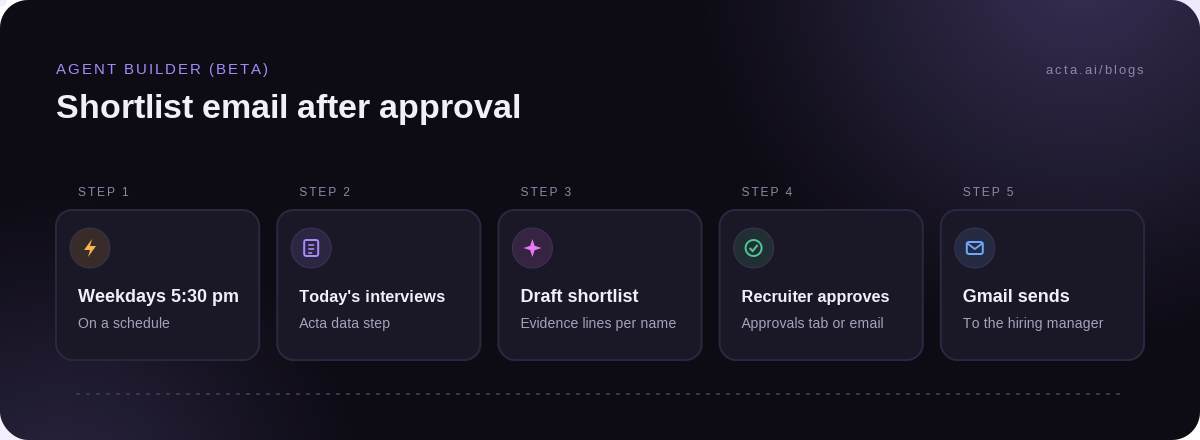
- Start: choose "On a schedule", for example weekdays at 5:30 pm, or "When a meeting ends" with a filter such as the title containing "Interview".
- Acta data step: pull the day's interview meetings and their reports.
- AI step: ask for a shortlist email: candidates marked Shortlist, two lines of evidence each, open concerns, no personal details beyond name and availability.
- Human approval step: the draft waits in the Approvals tab, and you can also get Approve and Reject buttons by email. If nobody answers within 24 hours by default, nothing is sent.
- Action: Gmail sends the approved email to the hiring manager, or saves it as a draft if you prefer to send it yourself.
Use Test and Run test before you turn it on: nothing is sent during a test, and approvals pass by themselves so you can read the output. Agents act as you, so the email comes from your account. The approvals guide explains the approval options in detail.
Where Acta fits for UAE recruiters
Acta records interviews with a meeting bot, the desktop app, the Chrome extension or the mobile app, then writes the transcript with speaker names, a summary and template reports such as Candidate assessment. Acta doesn't use customer data to train AI models. The recruitment agencies page and the UAE page show the setup for local teams, and there's a 15-day free trial.
Frequently asked questions
What should interview notes for recruiters in the UAE include?
Interview notes for recruiters UAE hiring managers will read should include the role, the candidate, the language used, whether consent to record was given, must-have checks, a score with evidence for each agreed criterion, concerns to verify, salary and notice as stated, and a one-line recommendation tied to the criteria. Leave out nationality, accent, age and appearance.
Do I need consent to record a job interview in the UAE?
Asking is the safe, respectful default. The UAE's federal Personal Data Protection Law has applied since 2 January 2022, and some free zones have their own data protection rules. Tell the candidate at the start, explain the purpose, note their answer, and take manual notes if they decline. This is general information, not legal advice.
Can I get English interview notes from a Hindi or Arabic interview?
Yes, with Acta. Hindi, including Hindi-English mixes, is detected automatically, and Arabic is supported in beta once you choose it in Settings. Set "Language for my notes" to English: the transcript stays in the spoken language and the summary and reports come in English. Urdu, Malayalam and Tagalog are not supported yet.
How do I keep interview scorecards consistent across a recruitment team?
Agree one scorecard per role with the hiring manager before interviews start, use the same scale for every candidate, ask the same core questions in the same order, and score within ten minutes of each call. In a UAE recruitment agency with several consultants on one client, review a sample of scorecards weekly to catch drift.
Should I send interview recordings to the client?
Usually not. Send a scorecard summary and checked quotes instead, which is what most UAE hiring managers have time to read. Share a recording only if the candidate agreed to that specific use, and keep it within the hiring process. Check your agency agreement and data protection obligations first.
Choose your interview notes setup
Before your next volume campaign, settle these with your team and your client.
- Agree the scorecard: four to six criteria, one scale, defined with the hiring manager at intake.
- Script the consent line: the same words for every recorded interview, with the answer logged.
- Set languages per campaign: English notes for Hindi or Arabic interviews; English or manual notes for unsupported languages.
- Fix the sharing format: what the client receives, in which format, and what stays internal.
- Keep a human on the send button: shortlists go out only after a recruiter approves them.
To record your next round of screens without a bot joining, try the Acta Chrome extension for browser calls or the desktop app for everything else.