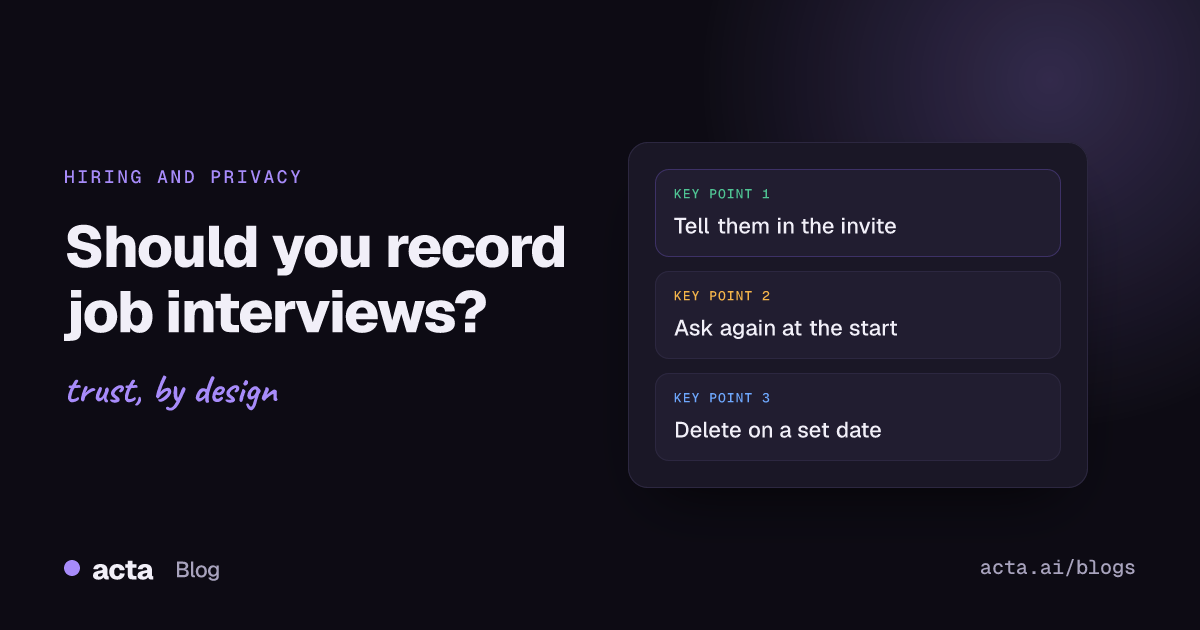
Quick answer: Recording job interviews is usually fine if you tell the candidate beforehand, explain why, ask for consent at the start and accept a no without penalty. Keep the recording for notes and fair scoring, not for AI analysis of faces or voices, limit who can open it and delete it on a set date. Rules vary by country and state, so check yours.
Most hiring managers I know started recording interviews for a dull reason: they were tired of writing while someone talked. When you're typing, you miss the follow-up question you should have asked, and your notes end up as half-sentences you can't decode two days later at the debrief. A recording fixes that. It also raises fair questions from candidates, who are already nervous and now have to wonder where the file goes.
This guide covers whether recording job interviews makes sense for you, what the law tends to care about, how to ask for consent without making it awkward, and the habits that keep a recording from turning into a liability. It's general information, not legal advice. If you hire across borders or use automated scoring, run your process past an employment lawyer.
Is it OK to record job interviews?
In most places, yes, as long as everyone on the call knows and agrees. The bigger risk usually isn't the recording itself. It's a recording made quietly, kept forever and shared with people who had no part in the decision.
The reasons to record are good ones. You get accurate quotes for the scorecard. Two interviewers can compare what the candidate actually said instead of what each remembers. Panel members who couldn't attend can review the relevant part rather than rely on someone's summary. And you can look back at your own questions and spot where you led the witness or went off script.
The reasons for caution are just as real. Candidates have far less power than you in this conversation, so a "would you mind if we record?" can feel like a test. Interviews also pull in personal details people never meant to share: a health condition, a gap year for caring duties, a mention of a partner's job. Once that's in a file, you're responsible for it.
What rules apply when recording job interviews?
Three separate sets of rules tend to overlap, and people often mix them up.
Call-recording consent
These laws are about recording a conversation at all. Some places let one participant record without telling anyone; others want every participant's agreement. In a hiring context, the debate is mostly academic because you should tell the candidate anyway. Our guide on recording meetings with AI, consent and what to tell participants covers the variations, and this piece on when recording a conversation is illegal goes into more depth.
Data protection
A recorded interview is personal data, and often a lot of it. In the UK, the ICO's guidance on recruitment and selection covers shortlisting, interviews and keeping recruitment records. As of November 2026 the ICO says that guidance is under review following the Data (Use and Access) Act 2025, so check the live page. The general principles are familiar: have a clear purpose, tell people what you're doing, keep only what you need and don't hold it longer than you need it.
AI analysis of candidates
This is where the rules get sharper. Illinois' Artificial Intelligence Video Interview Act, in force since January 1, 2020, applies when an employer uses AI to analyze applicants' video interviews. Before the interview the employer has to tell the applicant AI may be used, explain how it works and get the applicant's consent. Applicants can also ask for their videos to be deleted, and the employer has 30 days to do it.
In the EU, the European Commission's AI Act Service Desk explains that AI systems intended for recruiting or selecting people may count as high-risk. Its examples include tools that shortlist candidates and tools that score applicants' written or oral answers. The test is what the system does, not what the vendor calls it.
The practical split: a recording plus a transcript that a human reads is one thing. Software that rates a candidate's tone, face or word choice is another, with heavier obligations. Know which one you're buying.
How do you ask a candidate for consent?
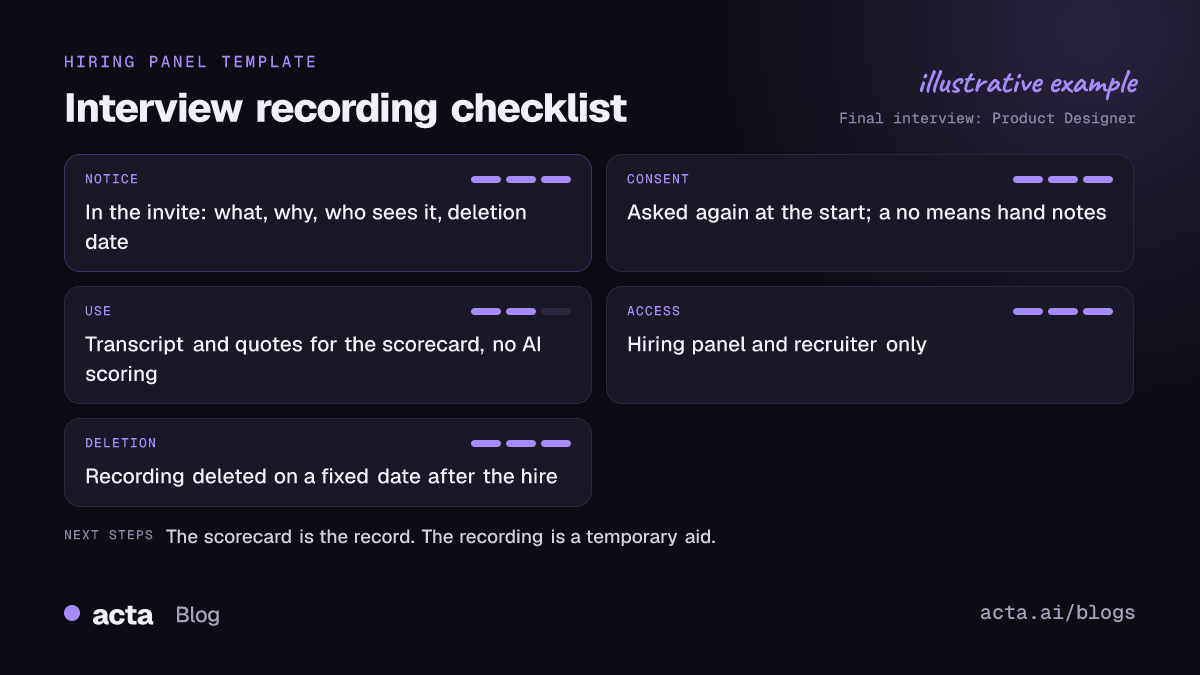
Ask twice: once in writing before the interview, once out loud at the start. The written notice gives people time to think, which matters because some won't feel able to say no on the spot.
- Put it in the invite. One or two plain sentences: what you record, why, who sees it and when you delete it. Add that saying no won't affect their application.
- Ask again when the call starts. Before the first question, check they're still comfortable. Wait for a clear yes.
- Say what happens if they decline. "No problem, I'll take notes by hand" is the right answer, said as if you mean it.
- Repeat the notice in the chat so there's a written trace on the call itself.
- Keep a note of the consent alongside the interview record, with the date.
Here's wording that works in an invite:
With your permission, we'd like to record the interview so we can take accurate notes and focus on the conversation. Only the hiring panel will have access, and we delete recordings 60 days after the role is filled. If you'd rather we didn't record, just tell us. It won't affect your application in any way.
The 60 days is an example; pick a period that fits your own retention rules. If you use a desktop recorder like Acta's desktop app, it has a Copy notice button that puts a recording notice in your clipboard, ready to paste into the meeting chat.
What should you do if the candidate says no?
Turn it off and move on, with zero visible disappointment. This is where interviewers quietly fail. A sigh, a "sure, if you prefer" in a flat voice, or a slower pace while you scribble all tell the candidate they've cost themselves something.
Have a fallback ready. A second interviewer taking notes works well. So does a structured scorecard with space for short quotes under each question, which keeps your notes focused. It also helps you reduce bias in interview notes. If you score candidates differently depending on whether a recording exists, you've created an unfair process, so make sure the panel rates on the same criteria either way.
Don't ask the person to explain why. Some people have had a bad experience, some have privacy concerns, some just don't like being recorded. None of it is relevant to the job.
Where is the line between interview notes and AI scoring?
This is the part worth getting right before you pick tools. A recording that becomes a transcript and a summary of what was said helps humans make a decision. A system that turns that recording into a score or a ranking starts making the decision itself, and that's what regulators are watching.
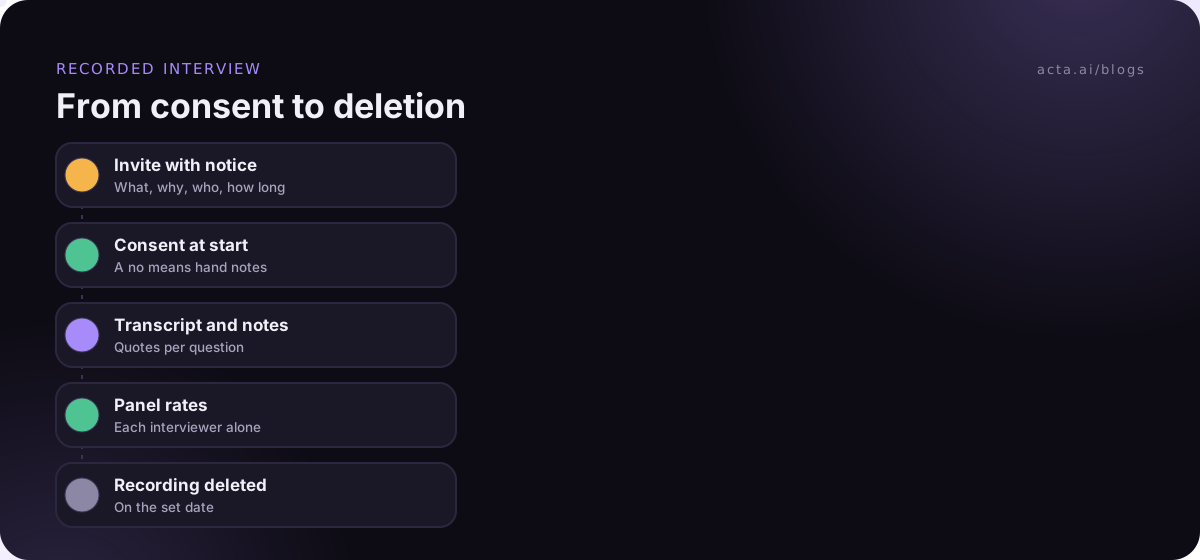
My rule of thumb: let software handle the writing, keep people on the judging. Use the transcript to pull exact quotes into the scorecard, then have each interviewer rate independently before the debrief. We wrote about this approach in interview scorecard automation, where AI drafts the evidence and you rate. If you go further and want AI-generated candidate assessments, read the rules that apply where you hire first, and tell candidates exactly what's happening.
A few things I'd steer clear of entirely: emotion detection, analysis of facial expressions or accent, and anything that produces a "culture fit" number. Even where it's legal, it's hard to defend if a rejected candidate asks how the decision was made.
Who should see interview recordings, and for how long?
Fewer people than you'd think, and for less time than you'd like.
- Access: the hiring panel for that role and the recruiter. Not the whole team, not the candidate's future peers, not a shared drive.
- Sharing: share the specific notes or quotes someone needs rather than forwarding the full file.
- Retention: set a deletion date tied to the hiring decision, and keep only what you need to explain the decision if it's challenged later. Local record-keeping rules may require you to hold some hiring records for a minimum time, so ask HR what applies.
- Candidate requests: have a way to find and delete one person's recording if they ask. In Illinois, for AI-analyzed video interviews, that's a legal duty with a 30-day clock.
A common mistake is treating the recording as the record. It isn't. The record is the scorecard and the decision notes. Once those are written and the role is filled, the raw audio has done its job.
When should you not record a job interview?
There are interviews where the recording costs more than it gives:
- Very senior or confidential searches, where the candidate is still employed and can't risk a leak.
- Informal coffee chats billed as "no pressure." Recording one quietly turns it into an assessment.
- Reference calls and salary negotiations, which often involve third parties or sensitive numbers.
- Anything where the candidate hesitates, even if they eventually say yes. A reluctant yes isn't worth it.
What should an interview recording policy include?
If your company records interviews, write it down in one page. An interview recording policy doesn't need legal flourishes; it needs to answer the questions candidates and interviewers actually ask:
- Which interviews are recorded, and who decides.
- The notice text for invites and the script for the start of the call.
- What happens when a candidate declines.
- Which tools are approved, and whether any of them score or rank candidates.
- Who can access recordings and transcripts.
- When recordings are deleted, and who checks that it happens.
- How a candidate can ask for a copy or deletion.
If you're also deciding how to record (a bot that joins the call, or something on your own computer), our comparison of meeting bots, desktop apps and Chrome extensions lays out the trade-offs. A bot is more visible, which some panels prefer for transparency; a local recorder is less intrusive, but you have to say out loud that you're recording. Our video interview tips for interviewers cover the rest of running the call.
Where Acta fits
Acta can record an interview with a meeting bot, from the desktop app or from the Chrome extension, then write a transcript with speaker names, a summary and notes your panel can use for scorecards. It doesn't use customer data to train AI models. It won't have the consent conversation for you, though, so the steps above still apply. There's more on hiring workflows on our hiring page.
Frequently asked questions
Can I record a job interview without telling the candidate?
In some places the law may technically allow one party to record, but in hiring it's a bad idea. It damages trust, can breach data protection rules and looks terrible if the candidate finds out. Tell them and ask.
Can a candidate record the interview?
Candidates are bound by the same recording laws as you. If one asks, you can agree or decline politely. If you suspect someone is recording without saying so, the same consent rules apply to them.
Do I need written candidate consent?
Not always, but a written notice in the invite plus a verbal yes at the start, noted in your records, is a sensible standard. For AI video interview analysis in Illinois, consent before the interview is required by law.
Should we share the recording with the candidate?
Only if they ask, or if your local data protection rules give them a right to it. Many teams offer a copy of the notes instead. Either way, have a process ready so the request doesn't sit in someone's inbox.
How long should we keep interview recordings?
Set a fixed period tied to the hiring decision and stick to it. Keep the scorecard and decision notes for whatever your record-keeping rules require, and delete the raw recording sooner where you can.
If you want to try recorded interviews with a small panel first, Acta's 15-day free trial is enough to run a few and see whether your notes get better.