Quick answer: To reduce bias in interview notes, write down what the candidate said and did, not your impression of them. Use the same structured template for every candidate, quote or paraphrase specific examples, leave out anything about protected characteristics, score each competency before reading anyone else's feedback, and submit notes within a day while your memory is still accurate.
Interview notes look neutral. They're just notes. But the notes are what the panel reads in the debrief, what HR checks if a decision is challenged, and often the only record of why someone didn't get the job. If bias gets into the notes, it gets into the decision with a paper trail that makes it look objective.
In my experience most bias in interview notes comes from a handful of habits, and habits are fixable. Below is what to watch for and the note-taking method I'd hand a new interviewer.
How does bias get into interview notes?
Mostly through three doors: what you notice, what you remember, and the words you choose when you write it down.
- What you notice. Once you've formed an impression, you start listening for evidence that confirms it. A candidate you liked in the first five minutes gets credit for a vague answer; one you didn't gets marked down for the same answer.
- What you remember. If you write notes hours later, you remember your overall feeling better than the details. The details then get filled in to match the feeling.
- The words you choose. "Confident" for one candidate and "a bit pushy" for another can describe identical behavior. Over a few interviews, those word choices add up to a story.
SHRM, citing Harvard Business School professor Francesca Gino, notes that impressions formed in the first seconds of an interview can affect its outcome, and that unstructured interviews are often unreliable for predicting job success. Your notes are where that first impression either gets checked or gets written into the record.
What types of bias show up most in interview notes?
Halo effect
The halo effect is when one strong impression spills over into everything else. The candidate went to a well-known university, or gave a brilliant answer to the first question, and suddenly every later answer reads as strong too. In the notes it shows up as uniformly high scores with thin evidence behind the later ones. The reverse (sometimes called the horns effect) does the same thing in the other direction.
Affinity bias
Affinity bias is warming to people who are like you: same hometown, same former employer, same sense of humor. Notes often reveal it through extra detail about rapport ("great chat about cycling") and generous readings of weaker answers.
Contrast effect
A decent candidate interviewed straight after an excellent one looks worse than they are. One interviewed after a poor one looks better. Notes written right after each interview, against a fixed scale, are the main defense.
Vibe words and "culture fit"
Words like "polished", "energetic", "not a fit", "too quiet" and "great presence" feel like observations but they're judgments. They also tend to track things like accent, age, gender and background more than job performance. Google's re:Work training guide tells interviewers to avoid judging personality or "fit" and to focus on attributes tied to success in the role.
What should good interview notes look like?
Good notes are evidence-based notes: someone who wasn't in the room can read them and understand what the candidate actually said, then reach their own view. Compare these two notes on the same answer:
Weak: "Strong communicator, handled the conflict question well, good energy."
Better: "Conflict question: described a disagreement with a designer over a launch date. Set up a call the same day, proposed shipping without one feature, agreed a follow-up release. Didn't mention how they kept their manager informed."
The second one takes about 30 seconds longer to write. It also gives the panel something to discuss, makes your score defensible, and leaves much less room for your mood to fill the gaps. Google's guide makes a similar point: feedback should avoid vague statements and shouldn't just summarize the resume.
How do you reduce bias in interview notes, step by step?
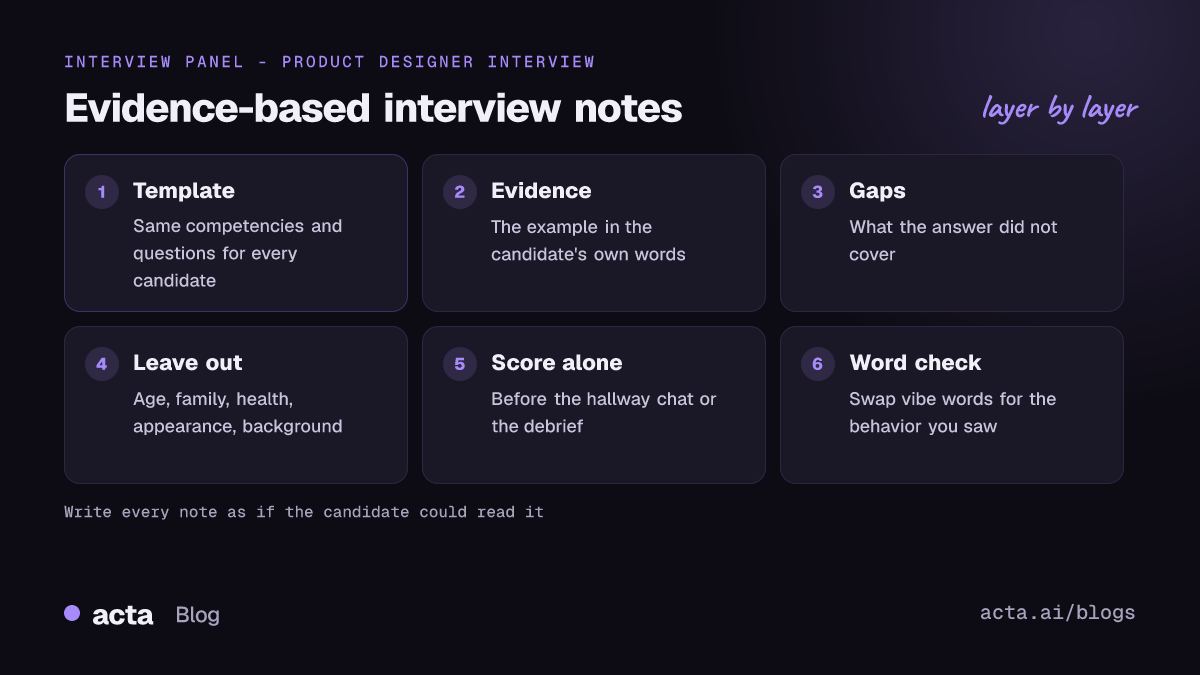
- Use one template per role. Put the competencies and questions in the template, with space under each for notes and a score. Every candidate gets the same page. That consistency is the core of structured interviews too. If you're starting from scratch, our guide to what to capture in notes covers formats that adapt well.
- Write what was said, then what it shows. First the example in the candidate's words, as close to verbatim as you can. Only then a short line on which competency it supports. Keep the two separate.
- Note what's missing too. "No example of working with a difficult stakeholder" is as useful as a positive note, and it's fairer than a vague low score.
- Leave out protected characteristics. Don't write down age, family plans, religion, health, nationality or appearance, even if the candidate volunteers them. The EEOC's guidance on prohibited employment practices covers why these shouldn't feed into hiring decisions in the US, and many other countries have similar rules. This is general information, not legal advice; your HR or legal team can tell you what applies where you hire.
- Score before you talk. Fill in your scores on your own, before the hallway chat or the interview debrief. Once you've heard a senior colleague's view, it's hard to un-hear it.
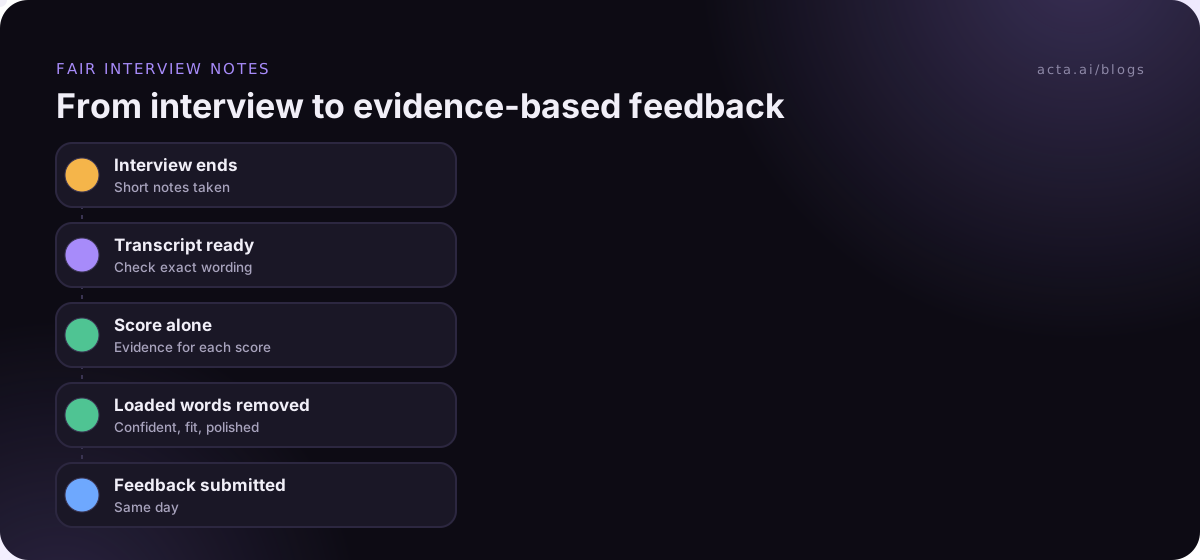
- Finish notes quickly. Google's re:Work guide says its internal research found that feedback submitted within 48 hours was significantly higher in quality than later submissions. I'd aim for the same day.
- Reread for loaded words. Before you submit, scan for vibe words: confident, polished, aggressive, quiet, fit, energy. Replace each one with the behavior that made you think it, or delete it.
Does recording interviews reduce bias in interview notes?
It can help, mainly with the memory problem. When you know the exact wording is available later, you can listen properly during the interview instead of scribbling, then check your notes against the transcript before you score. That catches the classic error where you remember a candidate "didn't really answer" a question they actually answered quite well.
It doesn't fix judgment. A transcript of a biased interviewer's questions is still biased. And candidates need to know the interview is being recorded and why. Read our guide on recording consent and what to tell participants before you start. For video interviews, a bot-free option such as Acta's Chrome extension for Google Meet, Microsoft Teams in the browser and the Zoom web client, or the desktop app for the Zoom and Teams desktop apps, keeps the call free of an extra participant.
One caution: if you use AI to summarize interviews, read the summary against your own notes rather than replacing them. A summary can drop the detail that would change your score. Our post on interview scorecard automation describes an approach where the AI drafts evidence and a person does the rating.
How can hiring managers check the panel's notes for bias?
You don't need a formal audit. A few quick checks after each round of interviews catch most problems:
- Evidence per score. Does every score have a specific example behind it? Scores with no evidence go back to the interviewer.
- Same words, different people. Read notes across candidates. If "assertive" is praise for some candidates and a concern for others, ask why.
- Uniform scores. All 4s or all 2s from one interviewer often point to a halo or horns effect rather than a genuinely even candidate.
- Off-topic content. Anything about personal life, appearance or background gets removed, and you have a quiet word with the interviewer.
Doing this a few times also trains the panel. Once people know their interview feedback will be read closely, the vague notes tend to disappear on their own.
Where Acta fits
Acta can record video interviews with a meeting bot or bot-free from your own computer, and gives you a transcript with speaker names and a summary. That's useful for checking your notes against what the candidate actually said before you score. Acta doesn't use customer data to train AI models. More on hiring use is on our hiring page.
Frequently asked questions
Should I take notes during the interview or after?
During, briefly, then tidy them up right after. Short keyword notes during the conversation, followed by full evidence notes within the hour, gives you the most accurate record with the least distraction for the candidate.
Is it OK to write "not a culture fit" in interview notes?
It's best avoided. It's vague, hard to defend and often hides affinity bias. If a value genuinely matters for the job, write a question and scoring guide for it and note the specific answer.
Can candidates see interview notes?
Often, yes. In the UK, people can make a subject access request for the personal data an organization holds about them, and the ICO's subject access guidance for employers says the reply is usually due within one month. The ICO's own training material uses a job applicant asking for interview notes as an example. Write every note assuming the candidate might read it one day.
How long should interview notes be?
Long enough that a colleague could score the answer from your notes alone. For a one-hour interview that's often one or two short paragraphs per question, not pages of transcript.
What's the single biggest fix for bias in interview notes?
Writing down the example before writing down your opinion. Most of the other problems get smaller once evidence comes first.
If you want a transcript to check your interview notes against, start a 15-day free trial of Acta.