Indian-language teaching is growing, from school to engineering
A lot of India learns in a language other than English. The Cabinet's announcement of the National Education Policy 2020 put it in writing: the mother tongue, local language or regional language as the medium of instruction at least until Grade 5, and preferably until Grade 8 and beyond. At the other end, AICTE permitted B.Tech programmes in 11 regional languages in 2021, so some engineering students now hear their lectures in Hindi, Marathi, Tamil, Telugu, Kannada or Bengali.
And outside the formal system, the coaching economy has always run in the language that gets the point across. A physics teacher in Kota or Patna explains in Hindi. An intermediate maths tutor in Vijayawada explains in Telugu. A UPSC batch in Chennai switches between Tamil and English. The Census of India records 22 scheduled languages in its 2011 language table, and classrooms reflect that variety.
The trouble is that notes rarely keep up. Students copy what's on the board and lose what the teacher said around it: the reason, the shortcut, the warning about a common exam trap. A transcript in the lecture's own language, plus study notes built from it, fills that gap.
Six Indian languages work today, and five common ones don't yet
Acta detects English, Hindi, French, Spanish and German automatically; ten more languages can be chosen in Settings, all marked beta. Five of those ten are Indian languages. Here's the picture for classrooms, with the honest gaps:
| Language of the class | Status in Acta | What to do |
|---|
| Hindi (and Hindi-English mix) | Detected automatically | Choose Hindi or Auto |
| Marathi | Beta | Choose Marathi by name; Auto treats it as Hindi |
| Bengali | Beta | Choose Bengali by name |
| Telugu, Tamil, Kannada | Beta | Choose the exact language by name |
| Malayalam, Gujarati, Punjabi, Odia, Urdu | Not supported yet | Don't rely on Acta for these classes |
Beta means it works, but accuracy is still improving, and the Indian beta languages need clear audio more than anything else. Auto only ever chooses among its five languages, so a Tamil lecture left on Auto will come out wrong. Choose Tamil.
If you teach in Malayalam or Gujarati, I'd rather tell you now than have you find out after recording a term's worth of classes. Those languages aren't available yet.
Record the class in the way that suits the room
Classroom recording is the step most people get wrong. How you capture the lecture depends on where it happens. Every method feeds into the same language settings.
In-person classroom
Use the Acta mobile app on a phone placed near the teacher, or open Acta in a browser on a laptop at the front; the help page on recording an in-person meeting in your browser shows how. For a long batch class, plug the phone in.
Online class on Zoom, Meet or Teams
The Acta notetaker can join the class, or a teacher can record from their own computer with the Chrome extension (Google Meet, Microsoft Teams in the browser and the Zoom web client) without a bot in the participant list.
Recordings you already have
Many institutes record classes for absent students. Those MP3 or M4A files can be uploaded; the guide on uploading an audio recording covers it. Set the language before you upload, since the setting applies to new items.
Whichever you use, tell the class it's being recorded and why, and follow your institution's rules, especially with school-age students. The article on recording consent and what to tell participants covers the general principles.
Set the lecture language and the notes language
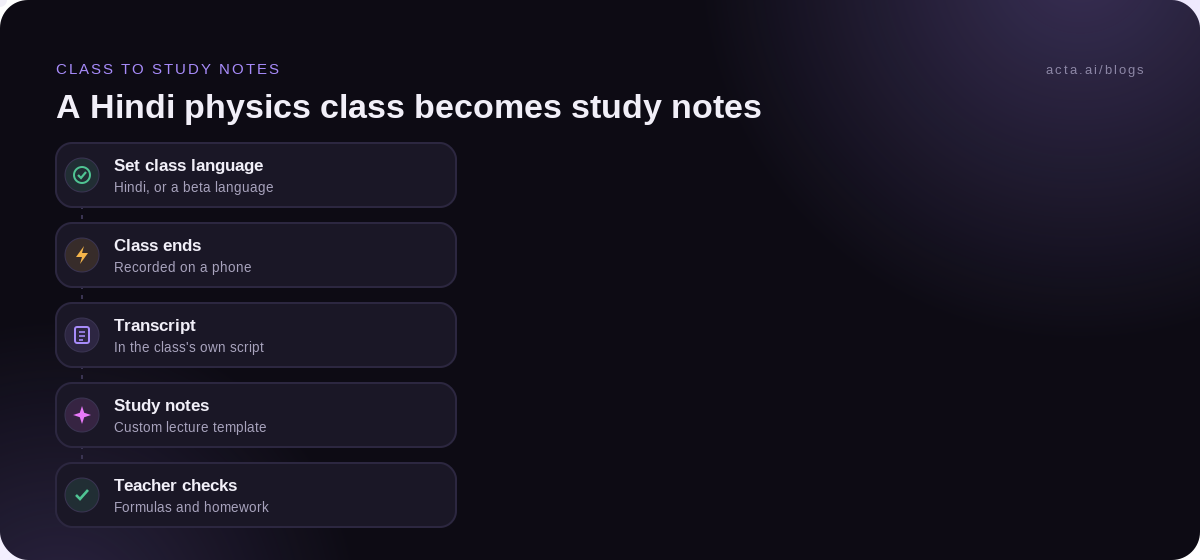
- In the Acta dashboard, open Settings and then Meetings. Lectures use the same settings as meetings.
- Find the Language card below "Add Acta Notetaker to my meeting invites".
- Under Language spoken in meetings, pick the language of teaching: Hindi, or Telugu (beta), Tamil (beta), Kannada (beta), Marathi (beta) or Bengali (beta).
- Under Language for my notes, choose Same as the meeting for notes in the language of the class, or English.
- Record or upload the lecture. On its page, the language chip beside the tabs confirms the setting; Change language fixes it for the next class.
The settings are per account. A teacher recording Telugu classes and a colleague recording Hindi classes each set their own. The meeting languages help article lists every option on the card.
To get study notes rather than a meeting summary, run a report template on the lecture. Acta has 40 built-in templates, and you can write your own with sections like "Key terms", "Formulas", "Worked problems" and "Likely exam questions"; the help guide to building custom report templates explains how. The template's headings stay in English, and the content under them follows your notes language.
Lecture notes in regional languages or English depends on the exam
The transcript is always in the language the teacher spoke. The notes are your choice, and the right answer depends on how students will be tested, not on how they were taught.
Choose notes in the language of the class when students read and write their exam in it: a Marathi-medium Class 10 board batch, a Tamil-medium state-board school, a Hindi-medium competitive exam batch. The notes then use the same words the teacher used and the textbook prints.
Choose English notes when the teaching language and the exam language differ. That's common in engineering and science colleges where a teacher explains in Telugu or Kannada but question papers and textbooks are in English, or in JEE and NEET coaching where students prepare in both. A Tamil-medium biology lecture on ஒளிச்சேர்க்கை (photosynthesis) gives English notes that say photosynthesis, ready to match the English textbook.
Two details help either way. Technical terms and formulas are kept as said, so if the teacher says "resistance" in the middle of a Hindi sentence, it stays resistance. And students can ask questions about a lecture in the language they're comfortable with: Ask Acta answers in the language of the question, so anyone with access to the lecture can ask in English about a Bengali class, or in Bengali.
Notes can only be in the lecture's language or English. A Kannada lecture can't produce Hindi notes, for example.
Worked example: a Hindi physics class in Patna
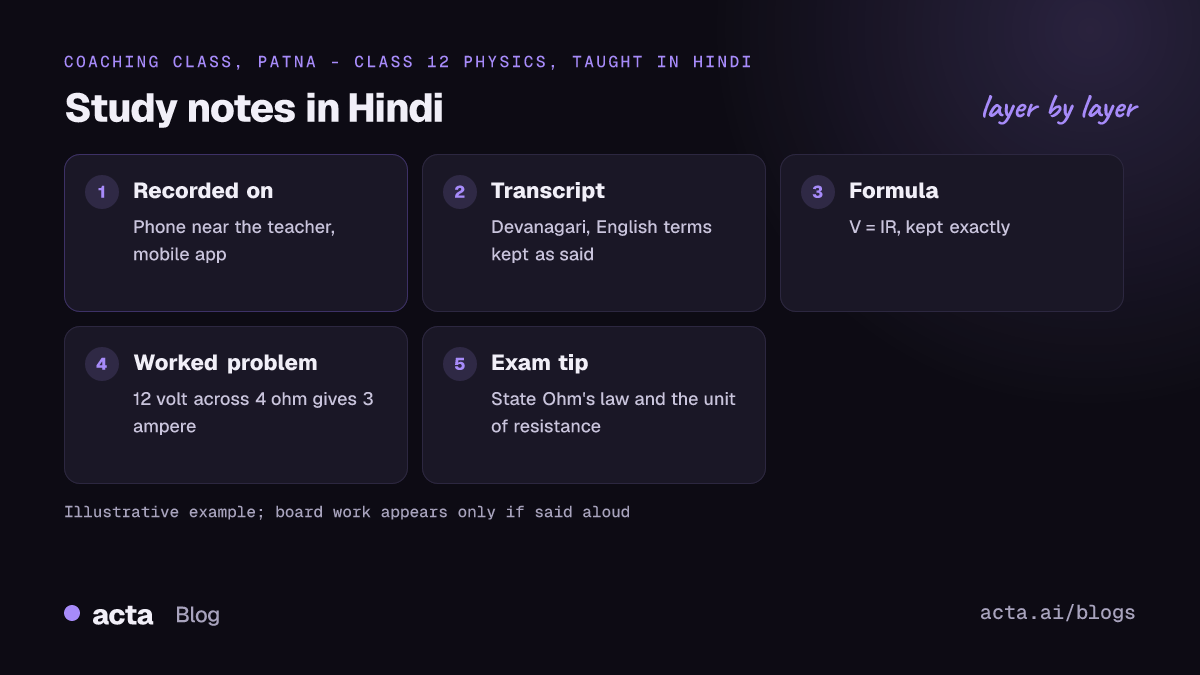
An illustrative example. A coaching institute in Patna runs a 50-minute Class 12 physics batch in Hindi, with English technical words mixed in, as most such classes are. The teacher puts a phone on the desk beside him and records with the mobile app. Spoken language: Hindi. Notes language: Same as the meeting, because the students sit the board exam in Hindi. A custom template asks for key terms, formulas, a worked problem, likely exam questions and homework.
A few lines from the transcript, with English glosses:
ओम का नियम कहता है कि V = IR. (Ohm's law says that V = IR.)
प्रतिरोध की इकाई ओम है। (The unit of resistance is the ohm.)
यह सवाल exam में ज़रूर आता है। (This question definitely comes up in the exam.)
What the study notes would contain, shown here in English for readers of this post (the students' version is in Hindi):
- Key terms: current, voltage, resistance, ohm.
- Formula: V = IR, kept exactly as written and said.
- Worked problem: a 12 volt battery across a 4 ohm resistor gives a current of 3 ampere.
- Likely exam question: state Ohm's law and give the unit of resistance; the teacher flagged it as one that "definitely comes up".
- Homework: the numericals the teacher assigned, as he listed them.
Now the check. Did the formula survive intact? Are the numbers in the worked problem the ones the teacher used? Did the homework list catch all the questions? On Hindi this is usually straightforward. On a beta language, check these three things for the first few classes before you share notes with the whole batch.
Students who missed the class get the notes and can search the transcript for the exact explanation. The post on lecture notes and review questions from class recordings shows how to turn the same material into revision questions.
Classroom audio decides how good the beta is
A classroom is a hard place to record. Ceiling fans, traffic outside, sixty students, a teacher who walks to the board and back. Noise costs words in any language, and for the beta languages audio quality is the biggest thing you control.
- Keep the phone close. Within about two metres of where the teacher usually stands. A phone on a back bench mostly hears students.
- Use a clip-on mic for long batches. A cheap lapel mic plugged into the phone beats any placement trick.
- Repeat student questions. Students at the back are rarely picked up. If the teacher repeats the question, the answer makes sense in the notes.
- Say the board work aloud. Acta hears audio, not the board. "Here I'm writing V equals I R" puts the formula in the notes; silently writing it doesn't.
- Pick the exact language. A Marathi class left on Hindi or Auto will be read as Hindi or English. Choose Marathi.
For more on noise and accents, the guide to improving transcription accuracy with accents, noise and crosstalk applies to classrooms as much as to meetings. For a detailed look at one beta language, the batch guide to Telugu meeting transcription covers Telugu-English mixing in depth.
Where Acta fits in a classroom
Acta records or takes an uploaded class recording, transcribes it in the language of teaching, and writes study notes in that language or English with your own template. It's built for meetings and works for lectures because a lecture is, to it, a long meeting with one main speaker; the education page describes how schools use it. It can't read the board, and the beta languages still need a check.
Frequently asked questions
Can AI make notes from a lecture in Hindi, Tamil or Telugu?
Yes. Acta transcribes Hindi automatically and Tamil, Telugu, Kannada, Marathi and Bengali as beta languages you choose in Settings. The transcript is in the lecture's script, and study notes come in that language or English. Beta accuracy is still improving, so check formulas, numbers and homework lists in the first few classes.
Can I get English notes from a lecture taught in a regional language?
Yes. Set "Language for my notes" to English. The transcript stays in the language the teacher spoke, and the summary or study notes are written in English. Technical terms, formulas, names and numbers are kept as said. This suits students whose textbooks or exams are in English even though the class is taught in Telugu, Kannada or Hindi.
Does it work for Malayalam or Gujarati classes?
Not yet. Acta supports 15 languages, and the Indian ones are Hindi, Telugu, Tamil, Kannada, Marathi and Bengali. Malayalam, Gujarati, Punjabi, Odia and Urdu aren't supported, so lectures in those languages won't transcribe correctly. Choosing a nearby language doesn't help; wait for support rather than relying on wrong output.
How do I record an in-person class for lecture notes?
Use the Acta mobile app on a phone near the teacher, or record in a browser on a laptop at the front of the room. You can also upload MP3 or M4A recordings you already have. Set the lecture language first, keep the phone within about two metres of the teacher, and tell the class it's being recorded.
Will the notes include what the teacher wrote on the board?
Only what was said aloud. Acta works from the audio, so a formula written silently on the board won't appear. Teachers who read out what they write, such as "V equals I R", get far more complete notes. Students can add diagrams and board sketches to the notes themselves afterwards.
Choose a setup for your class or institute
Start small: one batch, one language, two weeks. Then extend it. This checklist covers the decisions:
- Confirm the language: check the class language is one of the six Indian languages Acta handles, and choose it by name.
- Decide the notes language: match the exam, not the classroom; English if papers and textbooks are in English.
- Write one template: key terms, formulas, worked problems, likely exam questions, homework.
- Fix the audio: phone near the teacher, a clip-on mic for long classes, board work said aloud.
- Tell students and parents: explain that classes are recorded for notes, and follow your institution's rules.
For online classes, record from your own computer with the Acta desktop app and send the first set of study notes to your batch this week.