Client review meeting notes should record four things every time: where the client stands against their goals, what has changed in their life or business since the last review, what you both decided, and who does what next. A fixed template with those sections, run on every review, gives you a running record you can read back before the next meeting instead of a pile of free-form notes that never line up.
Use Cases 11 min read
Client Review Meeting Notes: 6 Templates for Advisers and Accounts
Six client review meeting notes templates for advisers and account managers, covering goals, changes in circumstances, decisions and follow-ups, with a worked example.
By Sarma BKP, Founder & CEO, Acta · Updated
This post is for financial advisers, wealth and insurance planners, and B2B account managers who hold periodic reviews with the same clients. It gives six copy-ready templates, a comparison table, the setup as a custom template in Acta and a filled-in example. It is general information about note-taking, not legal, regulatory or compliance advice. What your firm must keep, and in what form, is a question for your compliance team.
Key takeaways
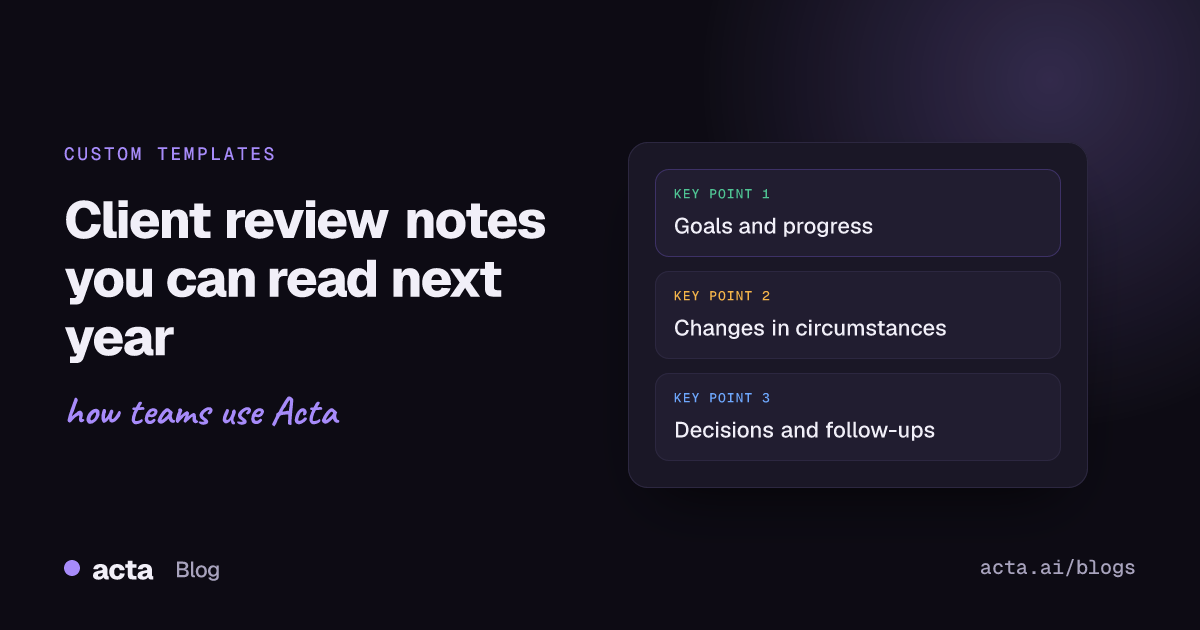
- Every client review template needs the same spine: goals and progress, changes since last time, decisions, follow-ups with owner and date.
- Make "Changes in circumstances" its own section near the top. It is the section most likely to change your advice and the easiest to forget.
- Write decisions as decisions, including "no change". A record that nothing changed and why is still a record.
- Use the client's own words for goals and concerns, and quote numbers exactly as discussed.
- Keep one template per review type (annual, life event, portfolio, account) with 5-7 sections each.
Table of contents
- Client review meeting notes record changes, decisions and follow-ups
- Three client review templates for financial advisers
- Three client review templates for account managers
- Pick the template by meeting type and cadence
- Build a client review template in Acta
- A filled-in client review example
- Keep the notes factual and check your firm's record rules
- Frequently asked questions
- Choose your first client review template
Client review meeting notes record changes, decisions and follow-ups
A client review is a scheduled meeting where you check whether the plan, portfolio or account still fits the client. For an adviser that might be an annual client review; for an account manager it might be a quarterly account review meeting with a customer's operations lead. The format differs, but the notes do the same job: they let the next person who opens the file, including you in twelve months, understand what was said and why things are the way they are.
The CFP Board describes the financial planning process in seven steps, and the last one is monitoring progress and updating; its guidance on the sixth and seventh steps of the financial planning process is worth reading if you hold CFP certification. Reviews are where that monitoring happens in practice, and the notes are how you show it happened.
In my experience the weakest part of most review notes is the middle. Advisers write the goals at the top and the tasks at the bottom, and skip what changed in between: a new job, a divorce, a house sale, a parent moving in, a business losing its biggest customer. That middle section is the reason the review exists. Give it its own heading.
Three client review templates for financial advisers
These are the financial adviser meeting notes layouts I'd give an advisory practice. Section names, then the format in brackets, then what goes in. Each is short on purpose.
1. Annual financial plan review
When to use it: the scheduled yearly review of the whole plan. This is the template most practices run most often.
1. Goals and progress (Table: Goal | Target | Where it stands | Client comment)
2. Changes in circumstances (Bullets): income, family, health, housing, employment, anything the client mentioned
3. Risk tolerance and preferences discussed (Paragraph): in the client's words, including any change from last year
4. Recommendations discussed (Bullets): what you proposed and how the client responded
5. Decisions (Bullets): what was agreed, including "no change" and why
6. Follow-ups (Checklist: task, owner, due date)
2. Change in circumstances meeting
When to use it: an unscheduled meeting triggered by a life event. Shorter, and centred on what changed.
1. What changed (Paragraph): the event, when it happened, in the client's words
2. Effect on goals (Table: Goal | Effect | Needs review?)
3. Immediate questions from the client (Bullets)
4. Decisions and next meeting (Bullets)
5. Follow-ups (Checklist: task, owner, due date)
3. Portfolio review
When to use it: a focused investment review, often quarterly or half-yearly, separate from the full plan review.
1. Performance and allocation discussed (Paragraph): only what was said on the call
2. Client concerns and questions (Bullets)
3. Changes proposed (Table: Change | Reason given | Client response)
4. Decisions (Bullets)
5. Follow-ups (Checklist: task, owner, due date)
Our separate guide to financial adviser client review notes covers the adviser workflow in more depth; this post focuses on the template layouts themselves.
Three client review templates for account managers
B2B account managers run reviews too, just with different words. The spine is identical: goals, changes, decisions, follow-ups.
4. Quarterly account review
When to use it: a regular check-in with a customer's day-to-day owner. Lighter than a full QBR.
1. Customer goals and progress (Table: Goal | Status | Evidence mentioned)
2. Changes on their side (Bullets): new stakeholders, reorganisations, budget changes, new priorities
3. Issues raised (Table: Issue | Raised by | Severity as described)
4. Promises made by us (Checklist: task, owner, due date)
5. Expansion or renewal signals (Bullets)
For the full executive version, see our post on customer QBR reports.
5. Retainer client review
When to use it: a monthly review with an agency or consultancy client on a retainer.
1. Work delivered this period (Bullets)
2. Client feedback (Bullets): in their words
3. Scope changes requested (Table: Request | In scope? | Agreed response)
4. Priorities for next period (Bullets)
5. Follow-ups (Checklist: task, owner, due date)
6. Short check-in call
When to use it: a 15-minute call between formal reviews. Three sections are enough.
1. Anything changed? (Bullets)
2. Questions asked and answers given (Bullets)
3. Follow-ups (Checklist: task, owner, due date)
The "Promises made by us" section in the account review is the one I'd never drop. Promises are what clients remember and account managers forget; our post on tracking customer promises explains how to stop them going overdue.
Pick the template by meeting type and cadence
Here is the set side by side. Most practices need two or three of these, not all six.
| Template | Typical cadence | Lead section | Sections |
|---|---|---|---|
| Annual financial plan review | Yearly | Goals and progress | 6 |
| Change in circumstances | When something happens | What changed | 5 |
| Portfolio review | Quarterly or half-yearly | Performance discussed | 5 |
| Quarterly account review | Quarterly | Customer goals | 5 |
| Retainer client review | Monthly | Work delivered | 5 |
| Short check-in call | As needed | Anything changed? | 3 |
A good client review agenda follows the same order as the template. Send the section headings to the client a few days before the meeting and ask them to think about what has changed. You'll get better answers, and the notes will fill more completely.
Build a client review template in Acta
If you record reviews, a custom template in Acta fills these sections from the conversation. Custom templates are available on paid plans only, not in the 15-day free trial. The custom templates help article has the full reference; here is the annual review as an example.
- Go to Templates in the Acta sidebar, choose My templates and click + Create template.
- Name it "Annual client review".
- Under Start from, choose Describe it. In "What should this report do?" write: "For annual review meetings with existing financial planning clients: goals and progress, any changes in the client's circumstances, risk preferences discussed, recommendations and the client's response, decisions including no change, and follow-ups." Click Draft sections.
- Edit the drafted sections to match the annual template above. Set "Goals and progress" to Table with four named columns and "Follow-ups" to Checklist, which adds task, owner and due date.
- Add extra instructions: "Use the client's own words for goals and concerns. Quote figures exactly as said. Do not add recommendations that were not discussed."
- Under When should Acta use it?, choose Only matching meetings so it runs on annual reviews and not on internal team calls.
- Use Test on a past meeting and Run on this meeting in the preview panel to check the output. Nothing is saved or sent from the preview. Then Save.
- Switch on Share with my team if colleagues run reviews, so every adviser uses the same layout. Only the owner can edit it.
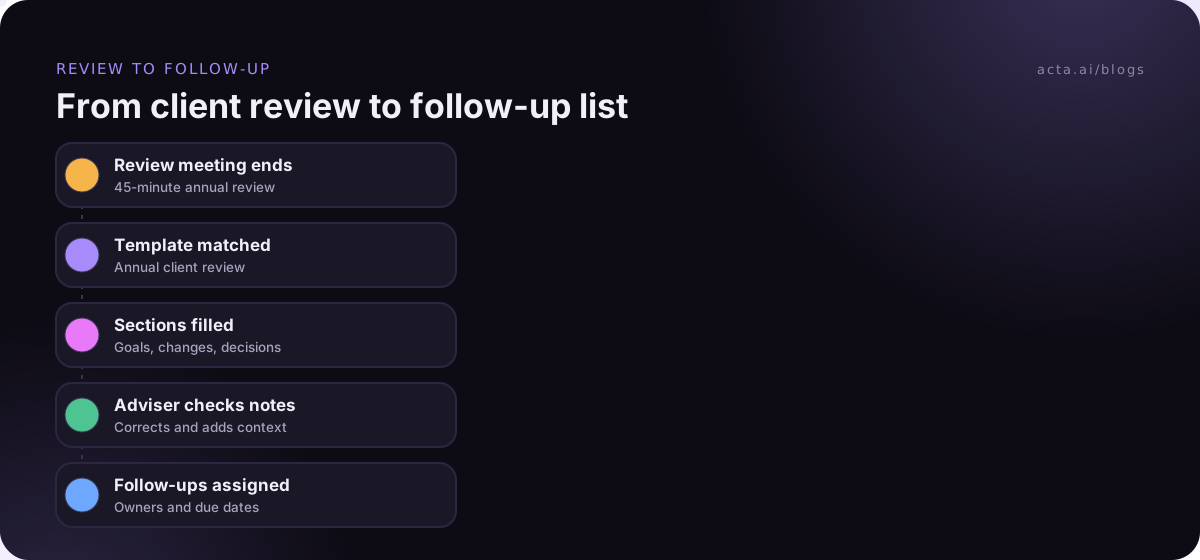
The finished notes appear in the meeting's Templates tab as "Your template" or "Team template", with Copy, Download and Push to CRM, and they're emailed like other template reports. Each report has an "In short" summary, a confidence rating and key quotes. If the client never talked about risk preferences, that section says "Not discussed" rather than guessing, and a follow-up with no owner says "Unassigned". Acta also has built-in templates by role on the templates page, including finance ones you can copy with Customize, and the financial services page shows how firms use them.
Read the notes before they go anywhere. You know the client; the template only knows what was said in the room.
A filled-in client review example
An illustration of the annual review template after a 45-minute meeting. The clients and figures are invented.
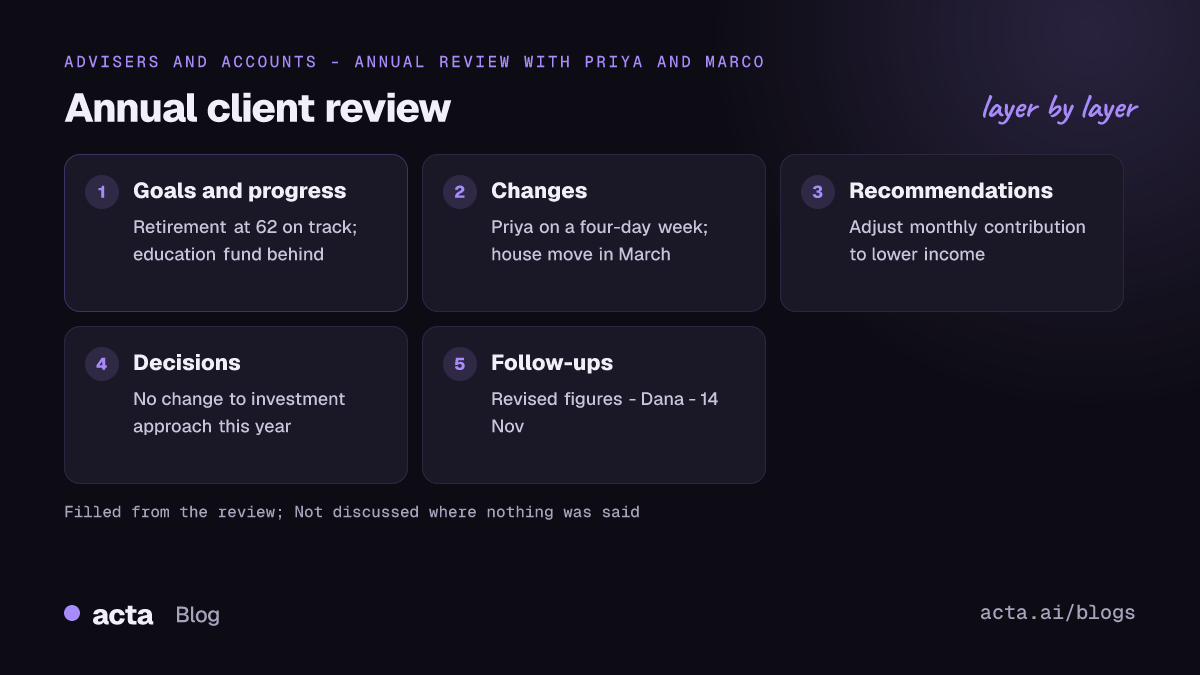
Annual client review: Priya and Marco Shah
In short: Retirement target unchanged at 62 for Marco. Priya has gone part-time, which lowers household savings. Agreed to review the monthly contribution and revisit the education fund next quarter.
Goals and progress: Retirement at 62, on track per the latest projection discussed, "we still want 62". Education fund for two children, behind the target discussed last year, "we paused it during the move". Emergency fund of six months' costs, in place.
Changes in circumstances: Priya moved to a four-day week in June. The family moved house in March. Marco's employer has changed its pension matching (details to be sent).
Risk tolerance and preferences discussed: Both said they are comfortable with the current approach. Marco asked about reducing risk five years before retirement.
Recommendations discussed: Adjust the monthly contribution to reflect lower income. Restart education fund contributions from January.
Decisions: Contribution change agreed in principle, pending figures. No change to investment approach this year.
Follow-ups: Send revised contribution figures (Dana, 14 Nov). Send employer pension matching details (Marco, 20 Nov). Book education fund review (Unassigned).
The "no change to investment approach" line matters. A year from now, nobody will remember whether that was discussed or simply skipped.
Keep the notes factual and check your firm's record rules
Regulated firms have record-keeping obligations, and those rules decide what you keep and for how long, not your template. For broker-dealers, FINRA's Rule 4511 requires member firms to make and preserve books and records and, where no other retention period is specified, to keep them for at least six years. FINRA's books and records page collects the related guidance. Whether review notes or recordings count as required records depends on your firm and your regulator. Our post on FINRA meeting recording rules covers this in more detail. None of this is legal or compliance advice; ask your compliance team.
Recording a client review needs the client's agreement first. Our guide on whether it is legal to record meetings with AI explains what to tell participants. If a meeting bot would feel intrusive to a long-standing client, Acta's desktop app records from your own computer, and its Copy notice button pastes a recording notice into the chat.
The common mistakes with client review notes:
- Opinions written as facts. "Client is risk-averse" is your judgement. "Client said 'I don't want to lose sleep over this'" is a record.
- No "no change" decisions. Write them down. They are decisions too.
- Follow-ups without owners. Every task needs a name and a date, including the client's tasks.
- Templates that grow. If a section has said "Not discussed" for six reviews running, delete it.
Where Acta fits: it records the review, transcribes it with speaker names and fills the template from what was said, so your notes match the conversation. It doesn't decide what your firm keeps; that stays with you. For the supplier-side version of the same review pattern, see our vendor review meeting template.
Frequently asked questions
What should client review meeting notes include?
Goals and progress, changes in the client's circumstances since the last meeting, recommendations discussed and the client's response, decisions made (including no change), and follow-ups with an owner and due date. Use the client's own words for goals and concerns, and quote any figures exactly as they were discussed.
How often should a financial adviser hold a client review?
It depends on the client agreement and the service you offer. Annual reviews are common, with extra meetings when circumstances change. CFP Board guidance treats monitoring as a step in the process and expects you to be clear with the client about how and when it happens. Agree the cadence with the client and record it in the scope of your service.
What is a change in circumstances in a client review?
Any event that might affect the client's goals or the advice you give: a new job, redundancy, marriage, divorce, a birth, illness, inheritance, a house move or retirement. Ask about it explicitly at every review, because clients often don't think to mention changes that seem unrelated to money.
Can I use the same template for account reviews and financial reviews?
The spine is the same: goals, changes, decisions, follow-ups. The detail differs, so keep separate templates. A financial review needs risk preferences and recommendations; an account review needs issues raised, promises made and renewal signals. Mixing them produces sections that say "Not discussed" half the time.
Do AI meeting notes replace my own file notes?
Treat them as a draft. Read every set of notes, correct anything wrong, and add context only you know. Your firm's policies decide what goes into the official client file and how it is kept, so check with compliance before relying on any tool's output as a record.
Choose your first client review template
Start with the review you hold most often, run it on three meetings, and trim before you add.
- Pick one review type: annual review for advisers, quarterly account review for account managers.
- Give changes their own section: put "Changes in circumstances" second, right after goals.
- Record decisions plainly: include "no change" and the reason.
- Check with compliance: confirm what your firm keeps and where before you record.
- Share the final layout: one template for the whole team keeps files comparable.
For client reviews held over Google Meet, Teams or Zoom in the browser, the Acta Chrome extension records without a bot joining the call.
Found this useful? Share it with your team.