Good client intake meeting notes record six things from the first call: who the client is, the problem in their own words, the key facts and dates, what they want to achieve, any deadlines, and every person or company named so you can run a conflict check. Add a checklist of documents you asked for and the open questions. A fixed template makes each intake comparable, so nothing slips between the call and the engagement letter.
Use Cases 13 min read
Client Intake Meeting Notes: A Template for Law, Accounting and Agencies
What to capture on a first client call, in what order, and how to turn intake recordings into consistent notes with a custom template. General information, not legal advice.
By Sarma BKP, Founder & CEO, Acta · Updated
This guide is for small law firms, accounting practices and agencies that take on new clients through a first call. It gives you a section list to copy, a custom template setup and a filled-in example. It's general information about running intake, not legal advice: your bar rules, professional body and engagement terms decide what you must do. If your firm already runs intake through a case management system with a structured form, use this to tighten what goes into that form rather than replacing it.
Key takeaways
- Use 7-8 sections, always in the same order: contacts, the matter in the client's words, facts and dates, goals, deadlines, names for the conflict check, documents requested, open questions.
- Collect names for the conflict check early and keep the detailed story for after the check clears, especially in law.
- Write deadlines only when someone actually said them, with who said them. "Not discussed" is a better note than a guessed date.
- Put documents requested in a checklist with an owner and due date, because that list becomes your first follow-up email.
- Test the template on two or three past intake calls before you rely on it for new ones.
Table of contents
- Client intake meeting notes capture the same eight things every time
- The conflict check comes before the full story
- Law, accounting and agency intakes differ in the details
- Build this as a custom template in Acta
- A filled-in intake report shows what good looks like
- Five mistakes make intake notes useless a month later
- The notes should feed the engagement letter and first tasks
- Frequently asked questions
- Decide what your intake template must catch
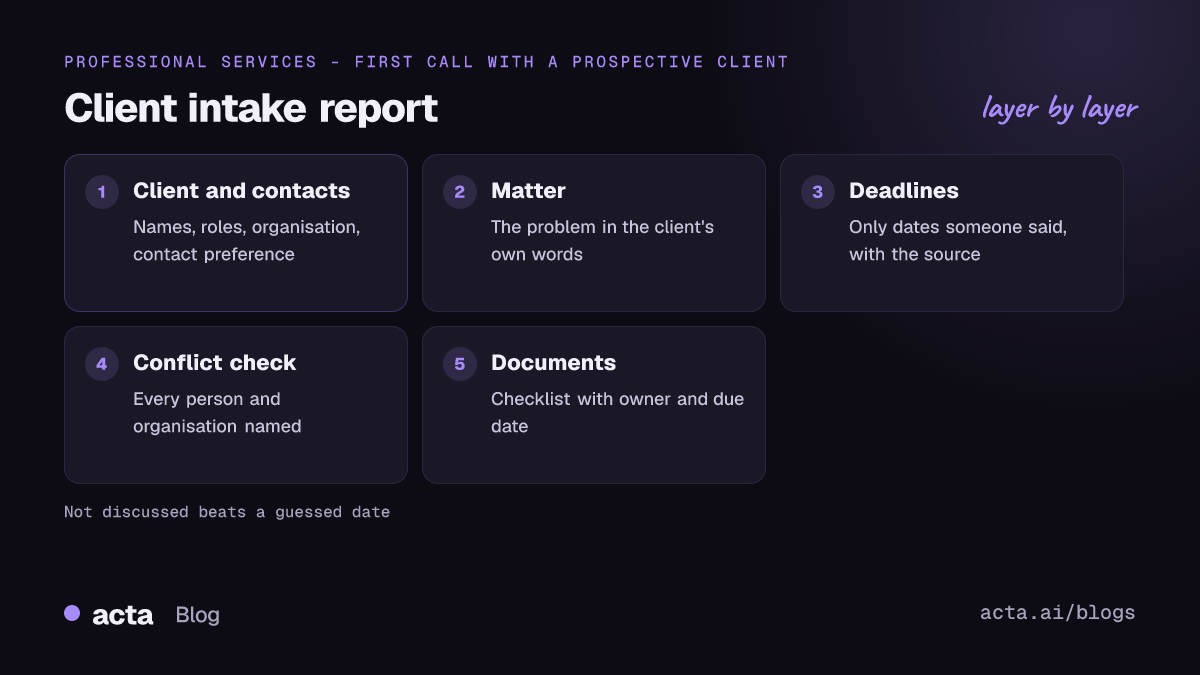
Client intake meeting notes capture the same eight things every time
A first call with a prospective client is messy by nature. People start with what worries them most, jump back three years and then remember a letter from last week. Your notes have to put that back into order. When every partner keeps intake notes their own way, whoever picks up the file a week later ends up calling the client again.
Here's the section list I use. It works for most professional services, with small changes per practice:
- Client and contacts: legal names, roles, the organisation, how they want to be contacted.
- The matter in the client's words: two or three sentences, quoting them where you can.
- Key facts and dates: what happened and when, in order, with who said it.
- Goals: what a good result looks like to them, and what they'd accept.
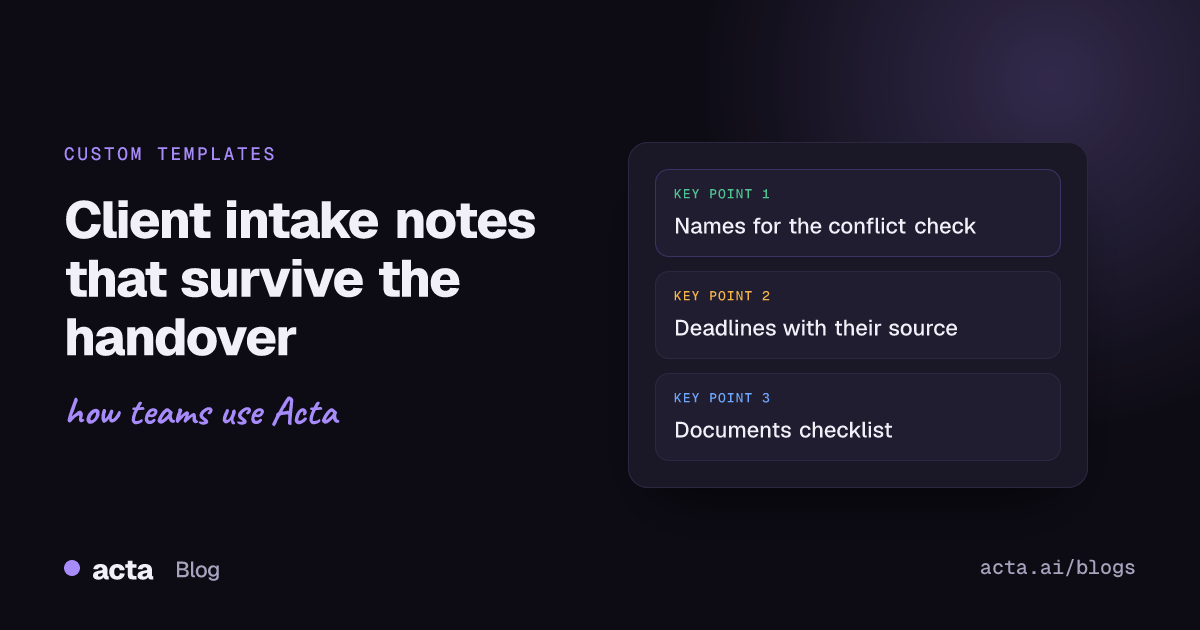
- Deadlines and time limits mentioned: letters, filing dates, launch dates, anything with a date attached.
- Names for the conflict check: every person and organisation mentioned and how they relate to the client.
- Documents requested: what you asked for, who sends it, by when.
- Open questions and next steps: what you still need to know, fees or scope discussed, the agreed next contact.
That's a client intake checklist, not a script. You can ask in any order on the call; the notes come out in this order, so anyone in the firm can read them in two minutes.
The conflict check comes before the full story
In law, the people you talk to before they hire you still get protection. The ABA's Model Rule 1.18 covers someone who consults a lawyer about possibly forming a client relationship. Even if no relationship forms, the lawyer generally can't use or reveal what was learned, and if the lawyer received information that could be significantly harmful to that person, the lawyer may be barred from acting against them in the same or a substantially related matter. You can read a state version, such as Massachusetts Rule 1.18, to see the structure. The ABA has also issued a formal opinion on how far those confidentiality duties reach, which the ABA Journal summarised. States depart from the model text in places, so check your own jurisdiction's rule.
The practical consequence for your new client intake process: get the names first, run the conflict of interest check, and only then take the detailed account. The D.C. Bar's version of the rule is a useful read on how one jurisdiction handles screening differently from the model. Many firms split intake into a short screening call and a longer consultation for exactly this reason.
Accountants and agencies don't work under the same rule, but the habit still pays off. An agency pitching two competitors, or a practice advising the other side of a dispute, wants to know before hearing the client's plans. Make "Names for the conflict check" its own section and treat it as the first thing someone reads after the call.
Law, accounting and agency intakes differ in the details
The eight sections hold across practices. What changes is what goes inside them, and which ones matter most. Use this as a starting point when you adapt the template:
| Section | Law firm | Accounting practice | Agency |
|---|---|---|---|
| Facts and dates | Events in order, who was involved, letters received | Tax years affected, prior accountant, notices received | Current marketing, past agencies, what was tried |
| Deadlines | Any date in a letter or notice the client mentions | Response dates on notices, the client's own year-end | Launch dates, events, budget cycle |
| Conflict names | Opposing parties, related companies, witnesses | Business partners, related entities, the other side of any dispute | Competitors named, parent brand, other agencies |
| Documents | Contracts, correspondence, court papers | Prior returns, bank statements, notices | Brand guidelines, analytics access, past briefs |
| Goals | Outcome they want, outcome they'd accept | Catch up, reduce exposure, change structure | Business result, not just deliverables |
A legal client intake call also needs a line about how the person found you and whether anyone else is already representing them. An accounting intake needs the entity type and which years are open. An agency intake needs the budget range and who signs off. If your agency's intake call doubles as a kickoff, the sibling guide on turning a kickoff call into a creative brief covers the next stage.
Build this as a custom template in Acta
If you record intake calls, a custom template turns the recording into these exact sections. Custom templates are available on Acta's paid plans, not in the 15-day free trial. The full reference is the custom templates help article; here are the steps for this use case.
- In the Acta dashboard, open Templates in the sidebar, choose the My templates filter and click + Create template.
- Name it "Client intake". Under Start from, pick Describe it.
- In What should this report do?, paste the description below and click Draft sections. Acta drafts 3-7 sections; replace or add to them so they match the list here.
- Set each section's format as shown. Use Move up/down to get the order right. You can have up to 12 sections; eight is plenty.
- Add the extra instructions below.
- Under When should Acta use it?, pick Only matching meetings, so it runs on intake calls and not on your internal partner meeting.
- In the preview panel, use Test on a past meeting, choose a real intake call and click Run on this meeting. Nothing is saved or sent. Adjust, then Save.
- Turn on Share with my team if colleagues should use the same format. They can switch it on; only you can edit it.
Description for What should this report do?:
For first calls with a prospective client of our firm: record who the client is, the matter in their own words, key facts and dates, their goals, any deadlines mentioned, every person and organisation named so we can run a conflict check, documents we asked them to send, and open questions and next steps.
Sections and formats:
- Client and contacts - Table: Name | Role | Organisation | Contact preference
- The matter in the client's words - Paragraph
- Key facts and dates - Table: Date | What happened | Who said it
- Goals - Bullets
- Deadlines and time limits mentioned - Table: Date | What it is for | Who mentioned it | Source (letter, contract, client's estimate)
- Names for the conflict check - Table: Name | Person or organisation | Relationship to client
- Documents requested - Checklist (task, owner, due date)
- Open questions and next steps - Bullets
Extra instructions:
Use the client's own words for the matter. Only list a deadline if someone said a date; never work one out. List every person and organisation named, even in passing. Do not give opinions on the merits.
Every report also gets an "In short" summary, a confidence rating and key quotes, and any section the call didn't cover says "Not discussed" instead of a guess. Tasks with no owner show as "Unassigned". If you'd rather start from something existing, browse the built-in report templates and use Customize on the closest one; the original stays unchanged.
A filled-in intake report shows what good looks like
Here's an illustration of what the template produces for a 40-minute call at an accounting practice. The names are invented.
In short: Maya Okafor, owner of Okafor Studio LLC, wants to move her bookkeeping and tax work to us after her previous accountant retired. She received a notice from the state about a late filing and wants help responding and catching up. Confidence: high.
Client and contacts: Maya Okafor | Owner | Okafor Studio LLC | Email, not phone during studio hours. Daniel Reyes | Business partner (30%) | Okafor Studio LLC | Via Maya.
The matter in the client's words: "I'm about a year behind on the books and I got a letter I don't understand. I need someone to sort out last year and then just keep me straight."
Key facts and dates: Previous accountant (Lorna Field) retired in spring | Maya. Notice about a late filing arrived last week | Maya. Studio opened a second location in March | Maya.
Goals: Respond to the notice. Get last year filed. Monthly bookkeeping going forward.
Deadlines and time limits mentioned: 15 December | Response to the state notice | Maya | Letter (she read the date out).
Names for the conflict check: Daniel Reyes | Person | Business partner. Lorna Field | Person | Previous accountant. Field & Co | Organisation | Previous firm. Northside Studios | Organisation | Landlord of the second location, in a deposit dispute.
Documents requested: Send a copy of the state notice | Maya | Friday. Share bank statements for last year | Maya | Not discussed. Request files from Field & Co | Unassigned | Not discussed.
Open questions and next steps: Whether Daniel needs to sign the engagement letter. Fee estimate to follow after we see the notice. Next call booked for Monday.
Key quote: "The landlord thing is separate, I just mention it because it's eating my cash."
Notice the landlord. Maya mentioned the deposit dispute as an aside, and it still went into the conflict list. That's the name free-form notes lose, and the one you'd regret missing if the landlord were an existing client.
Five mistakes make intake notes useless a month later
Most intake notes fail in boring, predictable ways. These are the ones I see most:
- Summarising instead of quoting. "Client is unhappy with prior provider" tells you nothing. "They stopped returning my calls in June" tells you what happened and when.
- Inventing deadlines. Someone works out a limitation date or a filing date in their head and writes it as fact. Note the dates people said and where they came from; calculate the real deadline separately, with the right rules in front of you.
- Losing names mentioned in passing. The aside about a landlord, a co-founder or a competitor is often the name that matters for conflicts.
- No owner on the document list. "Bank statements needed" sits there for three weeks because nobody knew whether the client or the firm was meant to chase it.
- Mixing opinion into the record. "Strong case" or "easy win" in intake notes is a liability. Keep the merits out of the intake record and put your assessment somewhere else.
The template above handles the last four by design. It can't fix the first: if the client speaks in generalities, ask a follow-up question on the call.
The notes should feed the engagement letter and first tasks
Intake notes have three jobs after the call. They go to whoever runs conflicts, usually the same day. They become the basis for the engagement letter or scope of work, since the goals and open questions tell you what to include and exclude. And the documents checklist becomes the first follow-up email to the client.
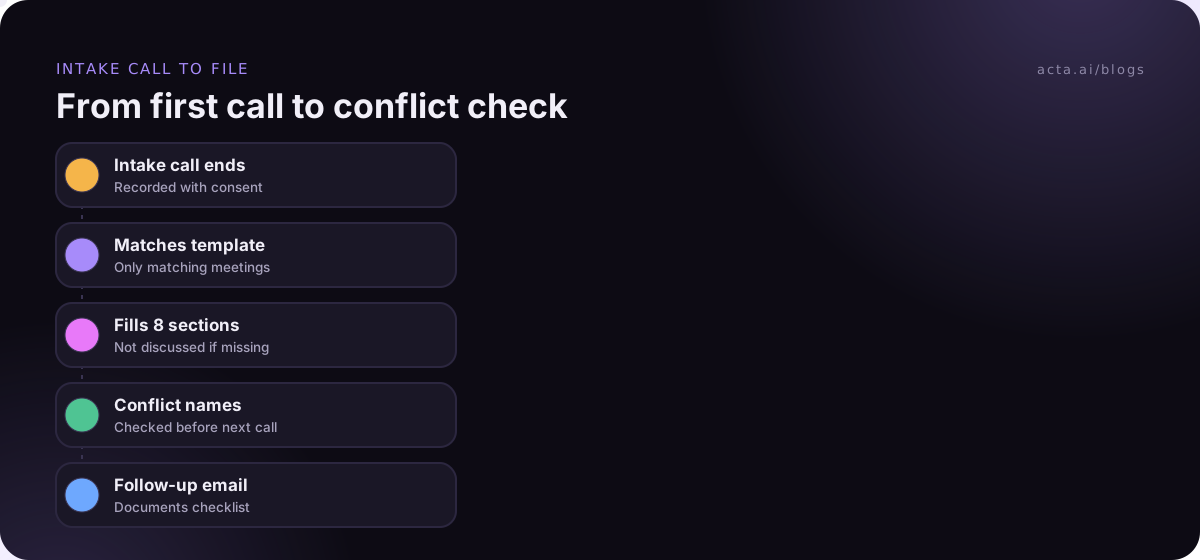
Recording intake calls raises its own questions. Tell the person you're recording and why, and check the consent rules where you and they are; the guide on whether it's legal to record meetings with AI covers the basics, and there are disclosure email templates for clients you can adapt. Lawyers should also read the piece on AI notetakers and confidentiality before switching recording on for prospective clients. If a bot joining the call would feel wrong to a nervous client, a desktop recorder like Acta's desktop app captures it from your own computer, and its Copy notice button pastes a recording notice into the chat.
Where Acta fits: it records the intake call, runs your custom template when the call matches the description, and puts the report in the meeting's Templates tab with Copy, Download and Push to CRM, and in your email. It won't decide anything for you; it gives you a consistent first draft of the record.
Later in the relationship, intake turns into regular reviews. The sibling guide on client review meeting notes picks up from there, and the piece on catching scope creep in client meetings helps when the matter grows past what the intake described.
Frequently asked questions
What should be included in client intake meeting notes?
Include the client's details and contacts, the matter in their own words, key facts and dates, goals, any deadlines mentioned with their source, every person and organisation named for a conflict check, a checklist of documents requested with owners, and open questions. Keep the same order every time so anyone in the firm can read a file quickly.
What questions should I ask on an intake call?
Good intake call questions are: who else is involved, what happened and when, what outcome they want and what they'd accept, whether they've received any letters or notices with dates, who has helped them before, what documents they have, and who makes the final decision. Ask for names early so you can run conflicts before the detailed discussion.
Is it OK to record a client intake call?
It depends on where you and the client are and on your professional rules. Many places require consent from everyone on the call, and some professions add confidentiality duties for prospective clients. Tell the client, explain why, and check your jurisdiction's rules. This is general information, not legal advice.
How is a client intake form different from intake meeting notes?
A client intake form collects fixed fields the client fills in, like name, address and entity type. Intake meeting notes record the conversation: the story, the goals, the asides and what you agreed. Most firms need both. The form gives you clean data; the notes give you context the form never asks for.
Can I use the same intake template for law, accounting and agency work?
You can use the same eight sections, but change what goes in them. Law intakes need opposing parties and any dates from letters; accounting intakes need tax years and notices; agency intakes need budget range, sign-off and competitors. Write a separate description for each so the template runs on the right calls.
Decide what your intake template must catch
Before you build anything, settle the format with whoever reads intake notes after you: the conflicts person, the partner who signs the engagement letter, the account lead. Then check your draft against this list.
- Names first: every person and organisation mentioned goes into one section that the conflicts check reads.
- Dates with sources: deadlines appear only when someone said them, with who said them and where the date came from.
- Owners on documents: the documents list is a checklist with an owner and a due date, ready to paste into the follow-up email.
- Client's own words: the matter is described in a quote or close paraphrase, never in your judgement of the merits.
- Tested on real calls: run the template on two or three past intake recordings and fix anything that reads wrong before going live.
When you're ready to try it on a real call, the Acta Chrome extension records intake calls in Google Meet, Teams in the browser or the Zoom web client without a bot, and the pricing page shows which plans include custom templates.
Found this useful? Share it with your team.