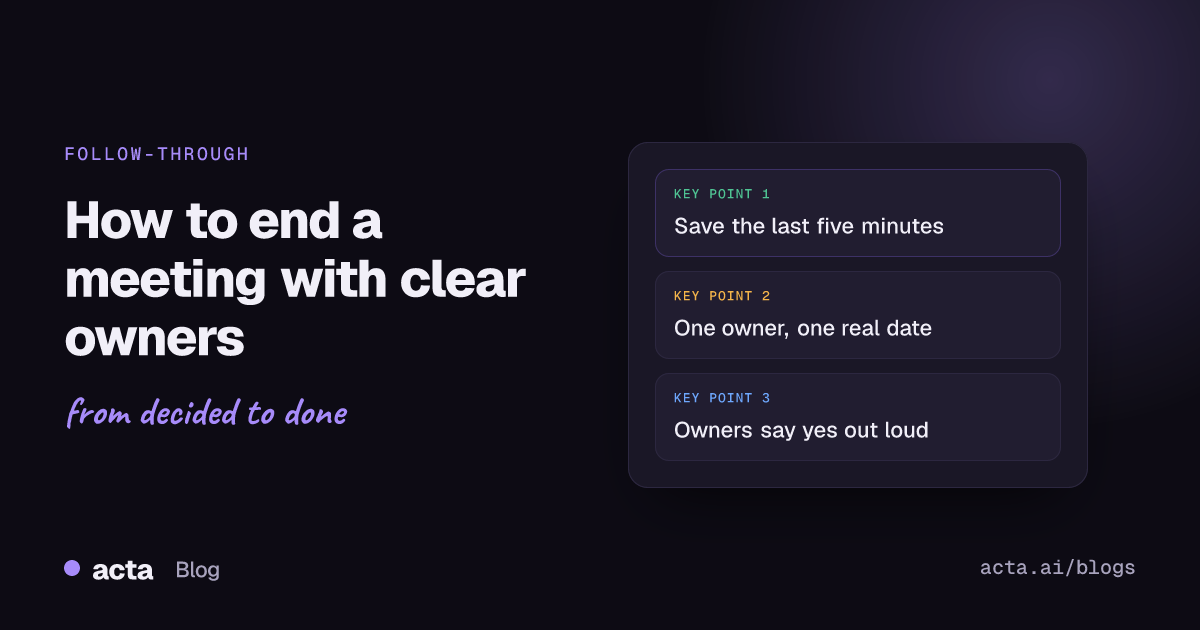
Quick answer: Here's how to end a meeting with clear owners and deadlines: stop the discussion five minutes early, read every action item back as one task, one owner and one date, and get each owner to say yes out loud. Name what's parked and who follows up on it, then send a written recap within the hour. "We" and "soon" never count as an owner or a deadline.
Most meetings don't end, they just stop. Someone notices the time, says "OK, great discussion", and everyone drops off to the next call. Each person leaves with a slightly different idea of what was agreed and who's doing it. Two weeks later, nothing has moved and nobody is sure why.
The fix takes about five minutes and a bit of nerve. Nobody teaches how to end a meeting; we learn how to open one, set an agenda, keep time. The ending is where the work actually gets handed out, though, so it deserves its own routine. Here's the one I use, and the reasons it works.
Why do meetings end without clear owners?
Three reasons come up again and again.
- Time runs out. The discussion fills the whole slot, so the wrap-up gets squeezed into the last 30 seconds or skipped entirely.
- "We" language. "We should update the pricing page" sounds like agreement. It's actually nobody's job.
- Politeness. Asking "who's doing this, and by when?" feels a bit pushy, especially with peers or senior people, so people don't ask.
The second one has a name in psychology. Diffusion of responsibility is the tendency for each person in a group to feel less responsible because others are around who could act; the EBSCO research summary on diffusion of responsibility covers the classic work behind it. Most of that research is about emergencies, not meetings, but anyone who's watched an action item assigned to "the team" will recognise the pattern.
How to end a meeting: the five-minute closing routine
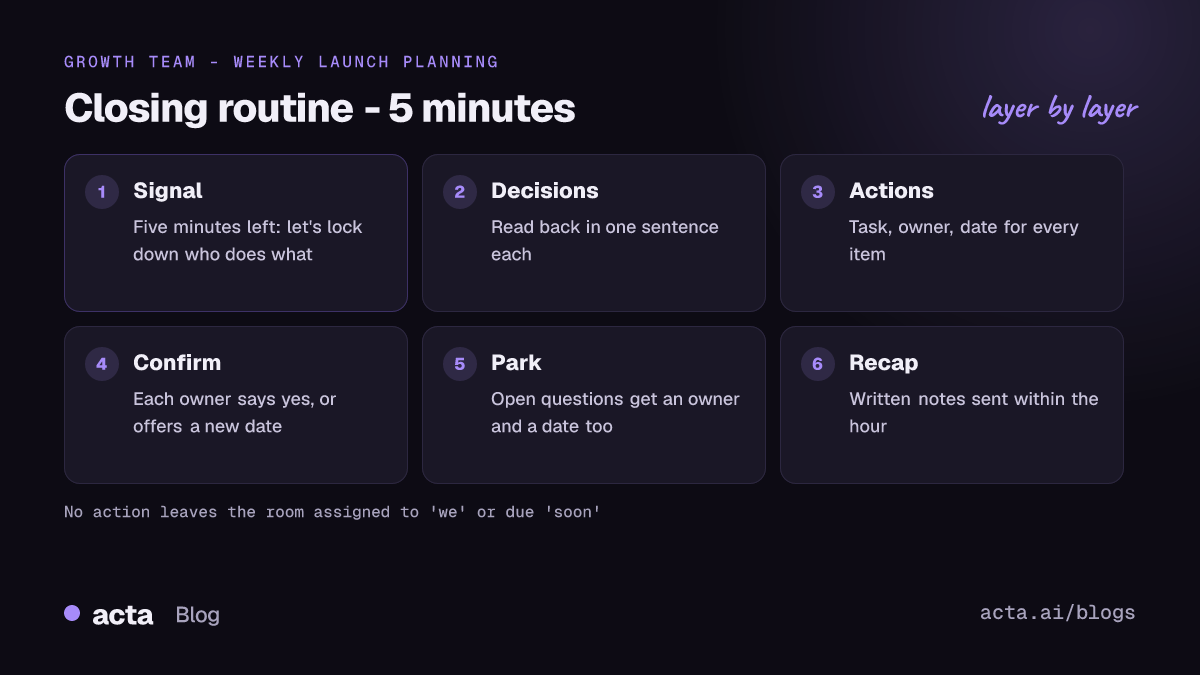
Put "Wrap-up, 5 min" as the last line of every agenda. When you reach it, stop the discussion even if it isn't finished. Then:
- Say you're closing. "We've got five minutes. Let's lock down who's doing what." This one sentence changes the energy in the room.
- Read back the decisions. One sentence each. If someone disagrees with how you've phrased it, better to find out now.
- Read back each action item. Task, owner, date. "Marco updates the pricing page by Thursday."
- Get a yes from each owner. Look at them, or say their name on the call, and wait for "yes" or "that date doesn't work". Silence isn't agreement.
- Park what's open. Anything unresolved gets an owner too: "Priya will find out whether legal needs to review this and tell us by Monday."
- Say when and how the recap goes out. "I'll send notes in the next hour."
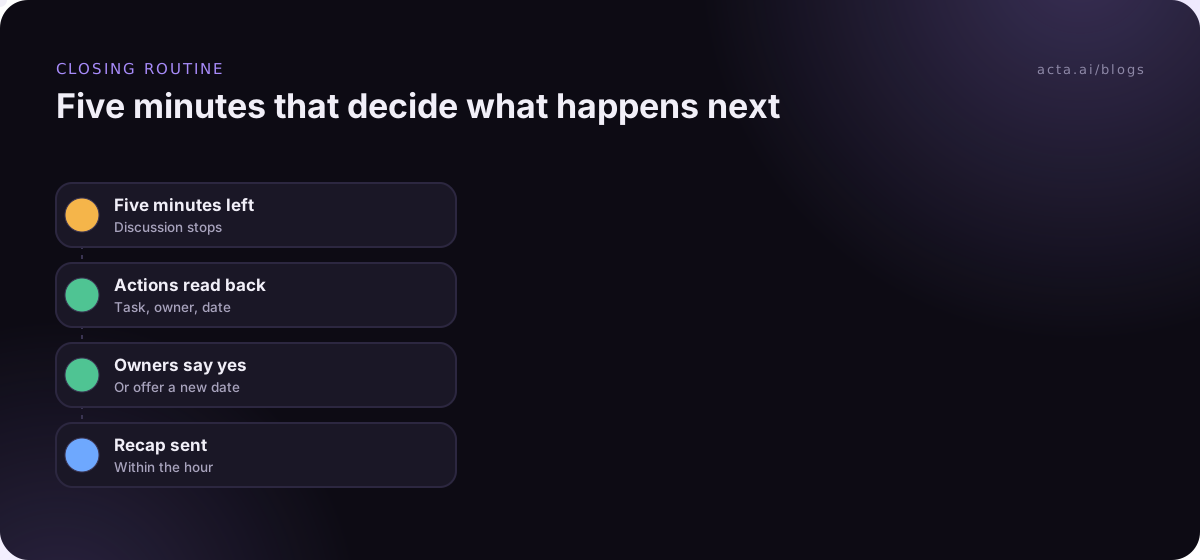
The step people skip is number 4. Writing someone's name next to a task isn't the same as them agreeing to it. A spoken yes in front of colleagues is a small commitment, and small public commitments are the ones people tend to keep.
What makes a good action item?
A good action item is something a person could start on tomorrow morning without asking anyone what it means. Atlassian's guide to meeting action items makes the same point: a clear task, an owner and a target date, and a short list rather than a long one.
One owner, always
If two people are needed, one of them owns it and pulls in the other. "Marco and Dana" means each of them thinks the other is on it.
A verb and a finish line
"Look into the onboarding drop-off" never ends. "Send three hypotheses for the onboarding drop-off to the team channel" does.
A real date
Not "next week", not "ASAP", not "end of quarter" for a two-hour task. A day of the week works. If the owner can't commit to a date yet, the action is "tell us a date by Wednesday".
Fewer than you think
Five clear actions get done. Fifteen fuzzy ones get done selectively, usually the easiest first. If the list is long, ask which ones actually matter before the next meeting and drop or park the rest.
Why does saying it out loud work?
There's decent research behind this. Peter Gollwitzer's work on implementation intentions looks at plans in the form "when X happens, I'll do Y". A 2006 meta-analysis by Gollwitzer and Sheeran pooled 94 independent tests and found that forming such specific plans had a medium-to-large positive effect on reaching goals.
A meeting isn't a psychology lab, so I wouldn't stretch this too far. But the direction is clear: "I'll send the draft on Thursday morning" is far more likely to happen than "I'll get to it". The closing routine is a way to turn vague intentions into specific ones while everyone's still in the room.
What should you say? A closing script
If the routine feels awkward, a script helps. Here's one that works for a 30-minute team meeting:
"OK, five minutes left, so let's wrap up. We decided two things: we're keeping the beta to 50 users, and the launch email goes on the 14th. Actions: Marco, you're updating the pricing page by Thursday, yes? Dana, the email draft to me by Monday? Priya, you're checking with legal and you'll tell us by Monday whether they need to review. The onboarding question we didn't settle; I'll put it first on next week's agenda. I'll send notes within the hour."
Notice what's not in there: no "great discussion everyone", no "let's keep thinking about it", no "does anyone have anything else?" The last one, asked at minute 29, either gets silence or opens a new 15-minute topic.
For clients and external calls, the same structure works, just softer: "Before we go, let me make sure I've got the next steps right..." Then list what you'll do first. Clients relax when they hear the vendor taking the first actions, and it makes it easier to ask for what you need from them in the same breath.
On a video call, type the action items into the chat as you read them out. People can correct a name or a date on the spot, and anyone whose connection dropped for a minute still sees the list.
What goes in the meeting recap?
The recap is the written version of what you just said. Send it the same day, ideally within the hour, while everyone still remembers the details. Keep it short:
- decisions, one line each;
- action items as owner, task, date;
- parked items and who's following up;
- a link to the full notes if there are any.
If you want a format, our meeting minutes template has one. What you do in the first 10 minutes after the meeting decides whether it actually goes out. If you're writing the same kind of recap after every call, it may be worth automating the follow-up email draft and checking it before it goes.
Notes are easier when you aren't writing and facilitating at the same time. One option is to record the call and let a tool draft the summary, after telling people; our guide on recording consent and what to tell participants covers that. If a bot joining the call isn't welcome, a browser extension like Acta's Chrome extension records Google Meet, Microsoft Teams in the browser and the Zoom web client from your own computer instead.
How do you make sure the actions actually happen?
Ending well is half of it. The other half is what happens after, which we cover in detail in why action items don't get done. The short version:
- Put actions where the work is. A task in Jira or the CRM gets seen; a bullet in a notes doc doesn't. Our guide to syncing action items to Jira, HubSpot and Salesforce shows a few ways to do it.
- Open the next meeting with the last list. Two minutes, owner by owner: done, in progress, or blocked. It's the least awkward way to hold people accountable without micromanaging.
- Treat a missed date as information, not a failure. Ask what got in the way. Often the task was too big, or the owner didn't actually have the time.
Common mistakes when ending a meeting
- Assigning tasks to people who aren't there. Fine occasionally, but then someone present owns telling them, and the task isn't real until they accept it.
- Letting the most senior person go silent on their own actions. Owners at every level read back their items.
- Reading back only the actions, not the decisions. Misunderstood decisions cause more rework than forgotten tasks.
- Ending late. If you run over, people leave mentally before the wrap-up. Start it on time, even mid-discussion.
A note on Acta
Acta writes up each call with a summary, decisions and action items with owners, and drafts a follow-up email you can check before sending. Action items can go on to Jira, Salesforce, HubSpot and other tools you already use. It doesn't replace the spoken read-back at the end, but it means the recap is mostly written by the time you've closed the call.
Frequently asked questions
How many minutes should you save to end a meeting?
Five minutes for most meetings up to an hour. For a big planning session with a dozen actions, save ten.
What if nobody volunteers to own an action item?
Then it probably isn't important enough, or it belongs to someone who isn't in the room. Either drop it or have the meeting owner pick a person and ask them directly. Don't leave it with "the team".
Should the facilitator take the action items?
Only the ones that are really theirs. Facilitators who collect every leftover task become the bottleneck, and everyone else learns that saying nothing is the safe option.
How do you end a meeting that's running over?
Stop the discussion, run the wrap-up anyway, and park the unfinished topic with an owner and a date. A meeting that ends five minutes late with clear owners is better than one that ends on time with none.
Is a recap email still needed if the action items were read back?
Yes. Memory fades fast, people who weren't there need it, and a written list is what you'll open the next meeting with.
You can see how Acta pulls owners and dates out of a call on the features page.