Quick answer: To hold people accountable without micromanaging, agree on the outcome and the deadline, not the method. Give every task one named owner, write it down where everyone can see it, and set a check-in rhythm in advance so you aren't chasing people at random. When something slips, ask what got in the way before you tighten control.
Most managers who micromanage don't think of themselves that way. They think they're being thorough. The trouble is that from the other side of the desk, "just checking in" three times a day feels like you don't trust the person to do the job you hired them for. And the opposite failure is just as common: a manager so worried about hovering that nobody ever asks whether the thing got done, until the client asks instead.
There is a middle path, and it's mostly about setting things up well at the start so you don't need to hover later. Here's how I'd do it.
What's the difference between accountability and micromanagement?
The cleanest way to put the accountability vs micromanagement question: accountability is about results, micromanagement is about methods. If you care that the customer onboarding deck is ready and accurate by Thursday, that's accountability. If you care which slide template they open first and want to see each draft, that's micromanagement.
Harvard Business Review has made this point many times. One of its tips suggests you avoid micromanaging by setting clear targets for your direct reports, and a longer piece on how to stop micromanaging recommends talking about the outcome you want rather than every step on the way, and setting regular check-ins so you aren't asking for updates all the time.
A simple test: if the person did it a completely different way from you and got the same result, would you be fine with that? If yes, stop commenting on the method.
How do you hold people accountable without micromanaging?
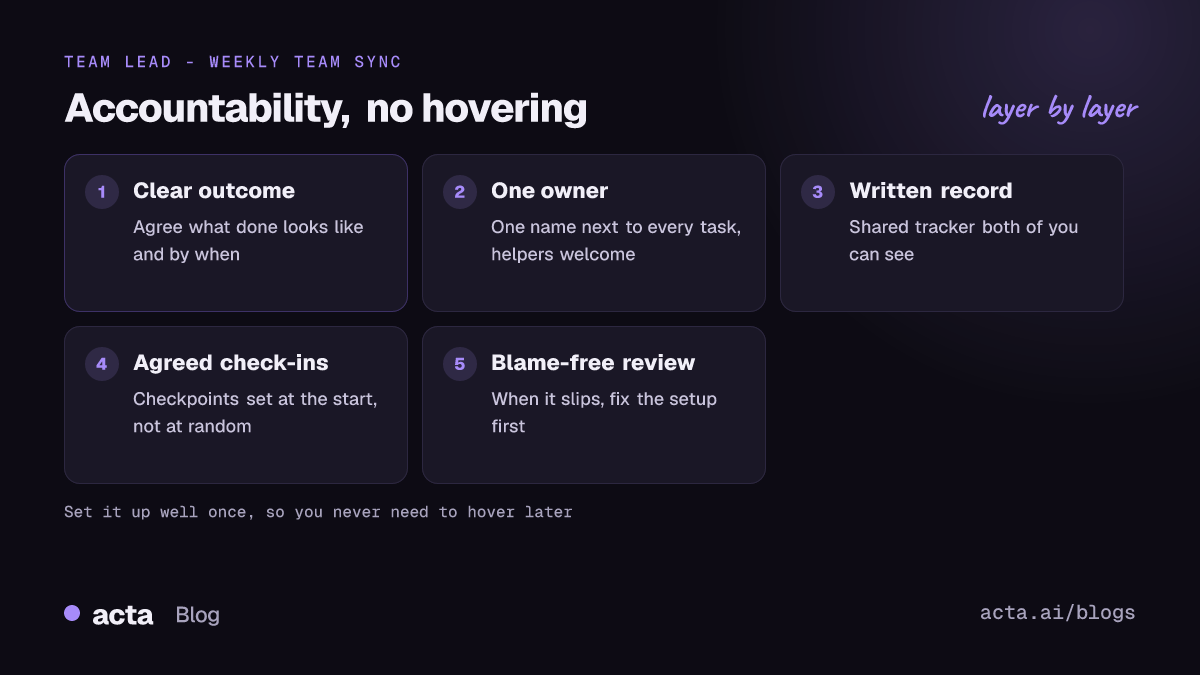
The short version is that you front-load the work. Micromanagement usually fills a vacuum: the task was vague, nobody wrote it down, and now the manager has no way of knowing how it's going except by asking. Remove the vacuum and most of the urge to hover goes with it.
- Agree on what done looks like. "Look into the churn numbers" isn't a task. "A one-page summary of why the 14 accounts we lost in Q3 left, with your top three guesses, by the 20th" is.
- Name one owner. Two owners means zero owners. Other people can help, but one name sits next to the task.
- Let them set the date if you can. People defend deadlines they chose. If their date doesn't work, negotiate it in the open rather than overriding it silently.
- Write it down where both of you can see it. A shared tracker, a ticket, a running doc. Not your memory, and not theirs.
- Decide the check-in points up front. "Let's look at a draft on Tuesday" agreed today feels very different from a surprise "how's it going?" on Monday afternoon.
- Agree what they should flag early. For example: "If you're going to miss the date, tell me as soon as you know, not on the day." That one sentence saves a lot of anxious pinging.
You'll notice none of this tells the person how to do the work. You're agreeing on the what and the when, and leaving the how to them.
Where do commitments actually get made?
Mostly in meetings, and mostly out loud. Someone says "I'll get that over to legal" near the end of a call, everyone nods, and nobody writes it down. A week later there are three versions of what was agreed. I'd guess more accountability arguments start this way than from anyone actually slacking off.
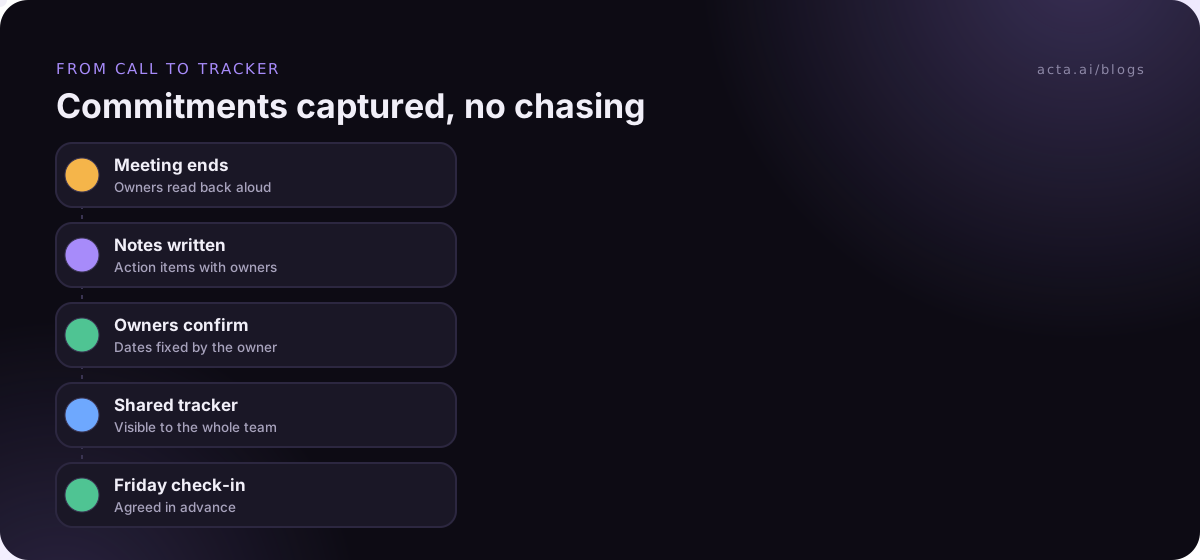
So the habit that matters most is capturing commitments at the moment they're made. Before the call ends, read the list back: "So Dana has the pricing page by Thursday, Marco is checking the contract terms by Friday, and I'm talking to finance." It takes thirty seconds. We go through the whole close in how to end a meeting with owners and deadlines. Then post it somewhere shared within the hour. If you want more on why tasks fall through after the call, our piece on why action items don't get done goes deeper.
If typing notes while running the meeting is what stops you, record it and let the notes come out afterwards. A meeting bot works where bots are welcome; where they aren't, a desktop recorder or a browser extension captures the call from your own computer. Either way, tell people you're recording and check the rules where you are; we cover that in is it legal to record meetings with AI.
What check-in cadence works without feeling like surveillance?
The right check-in cadence depends on the stakes and the person's experience, not on how nervous you feel that week. A rough guide I use:
- Someone new to the task, high stakes: agree two or three checkpoints in advance, say a rough outline, a midway draft and a final review.
- Experienced person, familiar work: the regular weekly 1:1 or team sync is enough. No extra pings.
- Long project: a short written status each week, in the shared doc, that you read instead of asking.
Gallup's guidance for managers points the same way. Its guide to managing hybrid and remote teams recommends one meaningful conversation a week with each direct report, and says these can be fairly short when they happen routinely. A predictable conversation every week beats ten unpredictable ones.
The key word is predictable. People don't mind being asked about their work. They mind being asked at random, because random checking reads as distrust.
How to follow up without nagging
Knowing how to follow up without nagging mostly comes down to three things: timing, channel and tone.
Follow up when you said you would
If you agreed to look at the draft on Tuesday, look at it on Tuesday, not before. Following up at the agreed point is accountability. Following up early is hovering.
Ask about blockers, not status
"Where are we on X?" invites a defensive status report. "Anything in the way on X that I can help with?" invites the useful answer. It also puts you in the position of helping rather than inspecting.
Let the tracker do the asking
If the task list is shared and kept up to date, you can see most of the status without asking anyone. Some teams send a short weekly digest of what's open and what's overdue, like the format in our weekly decision digest email. A list going to the whole team feels far less personal than a direct message from the boss.
What are the signs of micromanagement in your own habits?
It's hard to see in yourself. A few signs of micromanagement worth checking honestly:
- You ask for updates that you could have read in the tracker.
- You redo work that was fine, just not how you'd have done it.
- You want to be copied on emails that don't need you.
- People wait for your sign-off on small decisions they're perfectly able to make.
- Your team stops suggesting ideas and starts asking what you want.
That last one is the expensive one. Once people stop thinking for themselves because you'll override them anyway, you've built a team that genuinely does need micromanaging, and you'll feel justified in doing more of it.
If you spot two or three of these, pick one to drop this month. Usually the easiest is the update request: stop asking and read the shared list instead.
What should you do when someone misses a commitment?
This is where accountability gets real, and where a lot of managers swing straight to control. Don't. Have an accountability conversation first, and keep it about the work.
- Start with the facts. "We agreed the vendor comparison would be ready Friday and it isn't." No adjectives.
- Ask what happened, and actually listen. Often the answer is something you caused: a competing priority you handed them, or a dependency nobody owned. If it keeps happening, it turns into one of the difficult conversations managers tend to put off.
- Agree a new date and what they need. Again, let them propose it.
- Adjust the setup, not the person. Maybe the task was too vague, or the checkpoint was too late. Fix that.
- Write down the new commitment. Same place as before.
One slip is information. A pattern is a conversation. HBR's advice on getting your team to follow through after a meeting makes the same distinction: be understanding about individual misses, but if people keep dropping things, talk openly about how to change the norm. At that point you might agree on more checkpoints for a while, explicitly and for a set period, instead of quietly starting to hover.
How do you make accountability a team habit, not a manager's job?
The best teams I've worked with didn't rely on the manager to chase anyone. They had a shared record and a shared expectation that you update it. A few things that help:
- Review open items at the start of the weekly meeting, five minutes, owner by owner. Peers noticing a stale item does more than any manager reminder.
- Make it normal to renegotiate. "I can't hit Thursday, can it be Monday?" should be a boring sentence, not a confession.
- Hold yourself to the same list. If your own items sit overdue, nobody will take theirs seriously.
- Keep decisions written too. A lot of "you didn't do it" disputes are really "we never agreed on it" disputes. A decision log with a RACI settles who owned what before anyone argues.
A worked example: a five-person marketing team runs a Monday sync. Before the call ends, the lead reads back four items and owners. The list goes into a shared doc. On Friday a short digest goes out showing what's done and what's open. Nobody gets pinged in between unless they flagged a blocker. That's the whole system. It's dull, and it works.
Where Acta fits
Acta records your meetings with a bot, a desktop app or a Chrome extension, then writes the summary, decisions and action items with owners, so the "who said they'd do what" list exists without anyone typing it. It can draft the follow-up email, and you can ask OneChat questions like "what did Marco commit to last week?" and get answers with the meeting it came from. It doesn't replace the conversation about a missed deadline; it just means you're both looking at the same record.
Frequently asked questions
Is checking in on employees micromanaging?
Not by itself. Checking in at agreed points, about outcomes, is normal management. It becomes micromanaging when the check-ins are unscheduled, frequent, and about how the work is being done rather than whether it's on track.
How often should I follow up on a task I delegated?
Agree on it when you delegate. For routine work handled by an experienced person, the weekly 1:1 or team meeting is usually enough. For new or high-stakes work, set two or three checkpoints up front and stick to them.
What do I say when someone keeps missing deadlines?
Name the pattern with specifics, ask what's getting in the way, and agree on a change together, such as smaller tasks, earlier checkpoints, or fewer competing priorities. Keep it about the work and write down what you agreed.
Can I hold people accountable without micromanaging a remote team?
Yes, and remote teams arguably need the written record more. Shared task lists, a weekly meeting with open items reviewed, and recorded or well-documented calls give everyone the same view, so you don't need to ping people to find out where things stand.
Who should write down action items in a meeting?
Anyone, as long as it's agreed beforehand and the list is read back before the call ends. Rotating the job works well. Some teams record the meeting and let an AI notetaker draft the list, then the owner confirms it.
If you'd like action items with owners written up after every call, you can try Acta free for 15 days.