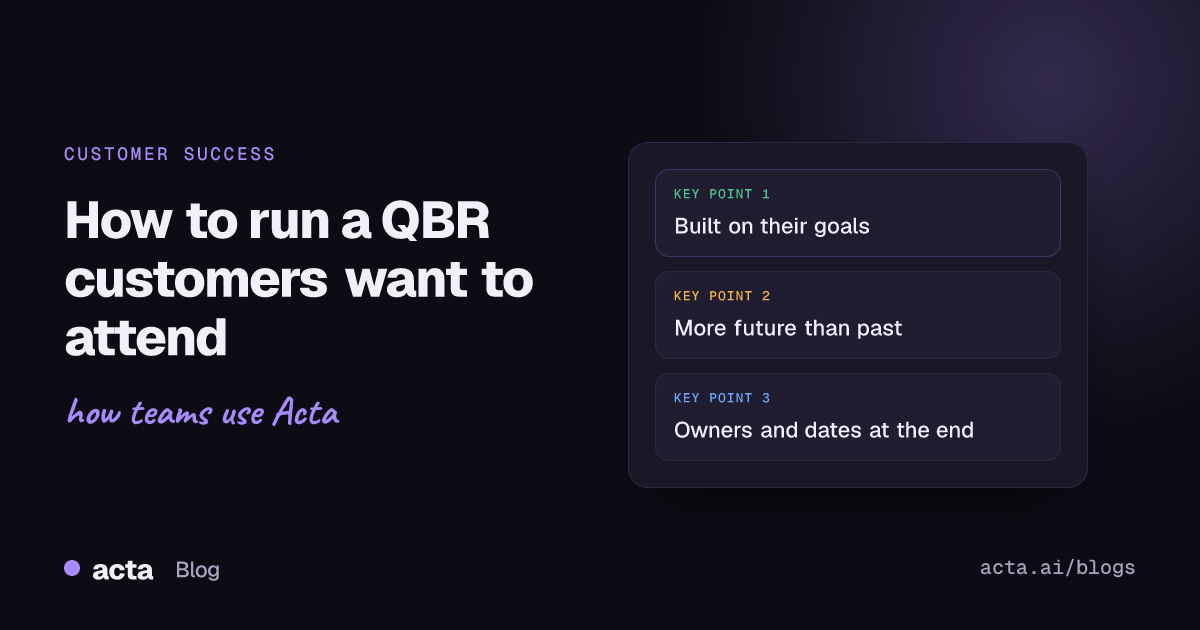
Quick answer: Here's how to run a QBR customers value: build it around their goals, not your product. Agree the goals and attendees a few weeks ahead, open with results measured against those goals, spend most of the time on what's changing in their business and the plan for next quarter, and finish with named owners and dates. Send the written follow-up within a day.
Most customers dread QBRs. They block out an hour, sit through forty slides of usage charts, hear about a roadmap they didn't ask about, and leave with nothing they couldn't have read in an email. Then the account team wonders why the executive sponsor stopped showing up.
A good quarterly business review is one the customer would be annoyed to miss. Here's how to run a QBR that earns that, from prep to follow-up, with a sample agenda and the parts I'd cut.
What is a QBR, and what is it for?
A quarterly business review (QBR) is a meeting, usually every three months, where a vendor and a customer step back from day-to-day support to look at outcomes: what the customer set out to achieve, how far they've got, what's changed, and what happens next quarter.
It's for the customer first. If it helps them make a decision, defend a budget or plan the next quarter, it's worth their hour. The vendor benefits too, of course: you spot risks early, meet the people who decide on renewal and find room to expand. But those come as a result of being useful, not from treating the QBR as a sales call.
Gainsight's guide to effective QBRs makes the same point bluntly: tie results to the customer's own goals and KPIs, because generic product-usage metrics won't make an impression.
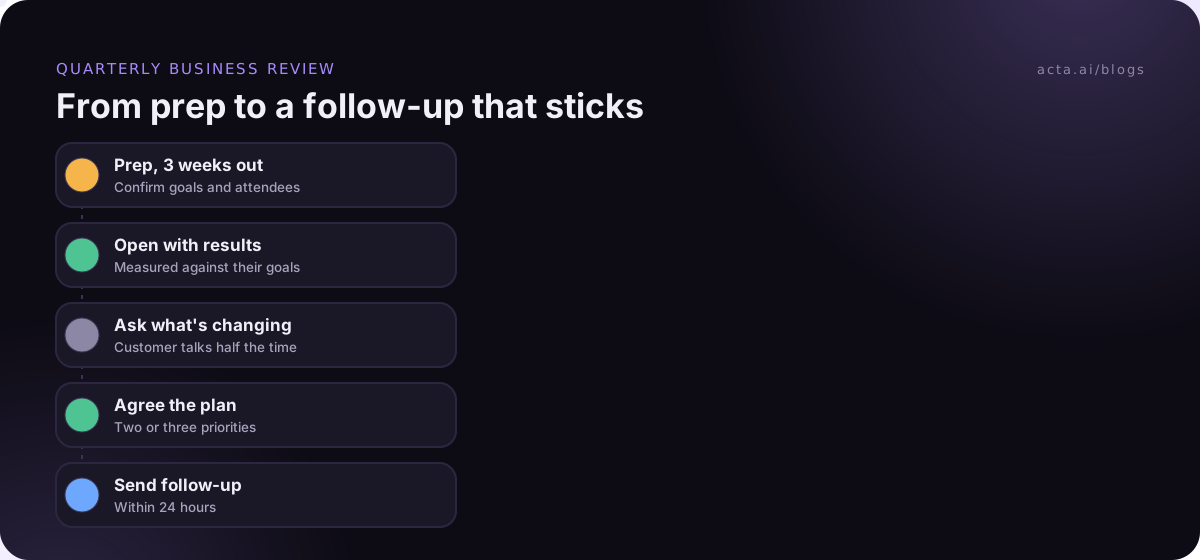
How to run a QBR: preparation (two to three weeks out)
The quality of a QBR is mostly decided before the meeting. If you only change one thing, start prepping earlier.
- Confirm the customer's goals. Pull up what they told you at kickoff or the last QBR. Then email your main contact: "Are these still the three things that matter most this quarter?" Goals change more than you'd think.
- Get the right people invited. On their side: the day-to-day owner, the executive sponsor and anyone whose team uses the product heavily. On yours: the customer success manager, the account executive if renewal or expansion is near, and someone senior if their executive is coming.
- Gather evidence, not data dumps. For each goal, find two or three numbers or examples that show progress. "Ticket backlog down from 400 to 150" beats a chart of daily active users.
- Look back through the quarter's calls. Read the notes from support escalations, check-ins and any complaints. Some CS teams hand this to an agent; see AI agents for customer success teams. What did you promise? What's still open? Our post on tracking customer promises covers how to catch the overdue ones before the customer brings them up.
- Pre-wire the main contact. Walk your champion through the draft a week before. They'll tell you what will land with their boss and what will cause a fight.
What should a QBR agenda include?
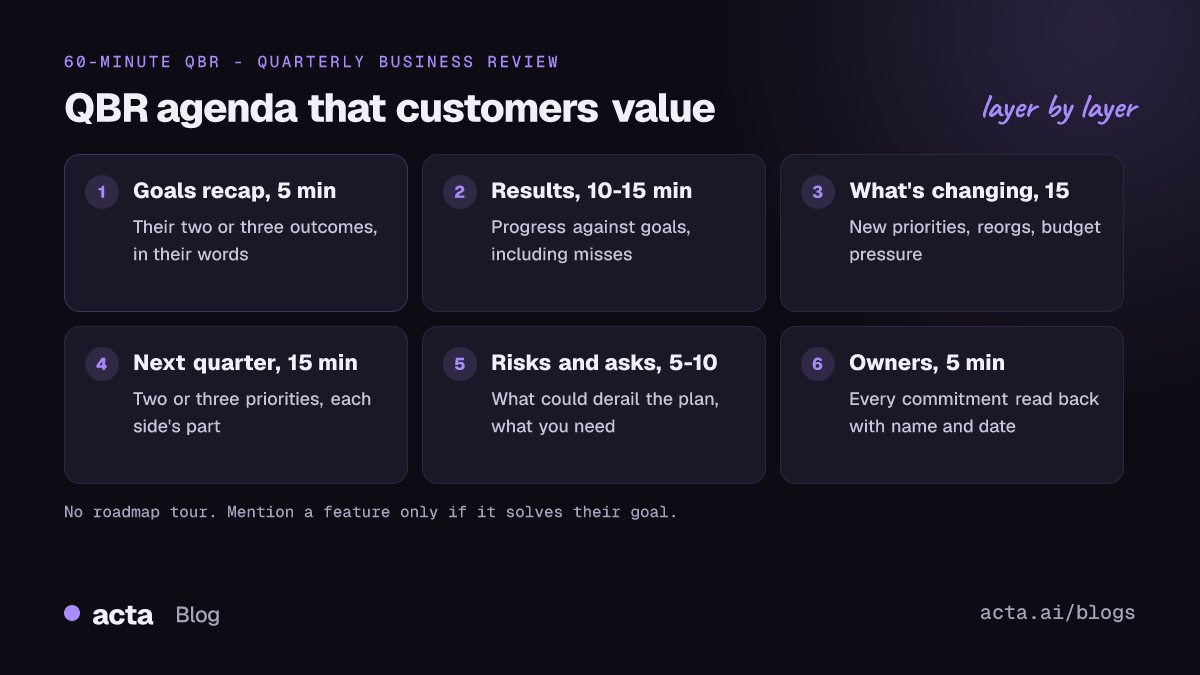
Here's a QBR agenda for a 60-minute meeting that I've seen work across very different customers. Adjust the timings, but keep the balance: more time looking forward than looking back.
- Goals recap (5 minutes). The two or three outcomes they're working towards, in their words.
- Results against those goals (10-15 minutes). Progress, honestly reported, including what didn't go to plan.
- What's changing on their side (15 minutes). New priorities, reorganisations, budget pressure, new teams coming on board. Ask, then listen.
- Plan for next quarter (15 minutes). Agree two or three priorities and what each side will do.
- Risks and asks (5-10 minutes). Anything that could derail the plan, and anything you need from them.
- Owners and dates (5 minutes). Read back every commitment, with a name and a date.
Notice what's not on it: a product roadmap section. If something on your roadmap genuinely solves one of their problems, mention it in the planning block. A ten-slide roadmap tour is the fastest way to lose an executive.
How do you make the QBR presentation useful?
Keep the QBR presentation short. I aim for eight to twelve slides, and I'd rather use six. A few rules that help:
- One slide per goal. Goal at the top, the result in large type, one sentence on what drove it.
- Say the bad news yourself. If onboarding a team took twice as long as planned, put it on a slide with what you're doing about it. Customers trust vendors who don't hide problems.
- Use their language. If they talk about "case deflection", don't call it "self-service adoption".
- Leave white space for discussion. The slides are there to start conversations. If you're reading them aloud, there are too many words.
- Send it ahead. A day before is plenty. It lets the executive skim it and arrive with questions. It's the same logic behind executive meeting notes that speed up decisions.
For the written version that goes round afterwards, our post on customer QBR reports covers what to include on value, account health and next quarter's plan.
How do you get the executive sponsor to show up?
The executive sponsor comes when the meeting is about their problems. They skip it when it's a product update.
- Ask your champion what the executive is being measured on this year, and put that on the first slide.
- Invite them personally, with one sentence on what decision or input you need from them.
- Offer a shorter slot. "Could you join for the first 20 minutes, when we cover results and next quarter's priorities?" is easier to accept than an hour.
- Match seniority. If their VP attends, bring someone equally senior from your side.
If they still don't come, don't take it personally, but do take it as a signal. An executive who won't give 20 minutes a quarter may not be the one defending your renewal.
How do you run the conversation in the room?
The meeting should feel like a working session, not a presentation. The customer should be talking for at least half of it. Gainsight's essential guide to QBRs puts it as inviting open conversation about obstacles and changes in the customer's business, which is where the risks and the opportunities both show up.
Questions that get people talking:
- "What's the one thing your leadership is asking you about most right now?"
- "If we look back in three months, what would make this quarter a success for you?"
- "What's harder than it should be for your team?"
- "Is anything changing in how you're organised or budgeted that we should know about?"
- "What would you tell a peer considering us today?"
Write the answers down, or better, have a colleague do it so you can keep eye contact. The answers to the change question in particular are early warnings. A new CFO, a team merger or a budget freeze shows up here months before it shows up in your health score. Our post on churn risk signals in customer calls lists the phrases worth flagging.
If you record the QBR, ask at the start and explain why: so nobody has to take notes. Our recording consent guide covers what to say. If a meeting bot would feel out of place with an executive in the room, the Acta desktop app or Chrome extension records from your own computer instead.
What should the QBR follow-up look like?
The QBR follow-up is where most of the value is kept or lost. Send it within 24 hours, while everyone still remembers the conversation.
- A short email, readable in two minutes. The agreed priorities for next quarter, each with an owner and a date.
- The slides, updated. Correct anything that turned out to be wrong in the meeting.
- The open questions. Anything you couldn't answer on the spot, with when you'll answer it.
- A date for the next check-in. Not the next QBR, a working session in four to six weeks to check progress on the plan.
Then put the commitments somewhere your team will see them, and look at them at that mid-quarter check-in. A QBR where the same three items get "agreed" every quarter is worse than no QBR at all.
Common QBR mistakes
Most advice on how to run a QBR focuses on the deck. The mistakes that hurt are usually about judgement:
- Running it the same way for every customer. A 20-seat account and a 2,000-seat account need very different meetings. Smaller accounts may only need a twice-a-year review or a 30-minute call.
- Leading with usage charts. Logins and feature clicks matter to you. The customer cares what those logins achieved.
- Turning it into an upsell pitch. If expansion makes sense, it'll come up naturally when you discuss next quarter. Forcing it makes people wary of the next invitation.
- Skipping the hard conversation. If there's an unresolved escalation, raise it first. Customers notice when it's left out.
Where Acta fits
Acta records customer calls, then writes summaries, decisions and action items with owners, so QBR prep starts from what was actually said all quarter rather than from memory. OneChat can answer questions such as "what did we promise Northwind since July?" with the sources it used, and the customer success templates include a QBR report format.
Frequently asked questions
How long should a QBR be?
Sixty minutes is typical for strategic accounts and 30-45 minutes for smaller ones. If the executive sponsor can only give 20 minutes, put results and next quarter's priorities in those 20 minutes and run the detail with the day-to-day team.
Who should run the QBR?
Usually the customer success manager, with the account executive joining when renewal or expansion is close. The person who knows the customer's goals best should lead, whatever their title.
Do all customers need a quarterly business review?
No. Strategic accounts usually benefit from one each quarter. Smaller accounts may be better served by a shorter review twice a year, or by a written report they can read on their own.
What's the difference between a QBR and an EBR?
Definitions vary by company. Often an executive business review (EBR) is a less frequent, more strategic meeting focused on senior stakeholders, while a QBR covers progress and planning each quarter. Agree internally which you mean.
How do I know if my QBRs are working?
Watch whether the executive sponsor keeps attending, whether the customer adds their own agenda items, and whether last quarter's commitments actually got done. Those say more than any survey.
If you want your next QBR prep to start from a quarter's worth of searchable call notes, try Acta with the 15-day free trial.