Quick answer: A good interview debrief meeting starts only after every interviewer has submitted written scores and evidence on their own. The hiring manager runs it: review the scores, discuss the biggest disagreements competency by competency, let the most junior interviewers speak first, and end with a clear hire or no hire decision, the reasons, and who tells the candidate by when.
Most interview debriefs go the same way. Four people pile into a room or a call, someone senior says "I really liked her", two others nod, the fourth quietly changes their mind, and twenty minutes later you have a decision nobody could fully explain. The interviews were structured. The debrief wasn't.
The interview debrief meeting is where all your careful interviewing either pays off or gets overridden by whoever talks first. Here's how to run one that actually uses what the panel heard.
What is an interview debrief meeting for?
It has one job: turn several independent views of a candidate into one decision the team can stand behind. That means three smaller jobs along the way:
- Combine evidence. Each interviewer covered different competencies. The debrief puts the full picture together.
- Surface disagreement. Where interviewers scored the same thing very differently, find out why. That's usually where the useful information is.
- Make and record a decision. Hire, no hire, or a specific next step, with reasons written down.
What it's not for: re-interviewing the candidate from memory, persuading the room, or letting someone who wasn't on the panel weigh in on gut feel.
Why should interviewers submit independent feedback first?
Because once you've heard someone else's opinion, your own shifts toward it, and you usually don't notice. Daniel Kahneman, whose later work focused on what he called "noise" in judgments, made this point about hiring directly. Personnel Today reported him saying that independence was key if you wanted to gauge authentic judgments when several people share a hiring decision, and that a lone decision-maker tends to feel sure because they can't see their own noise.
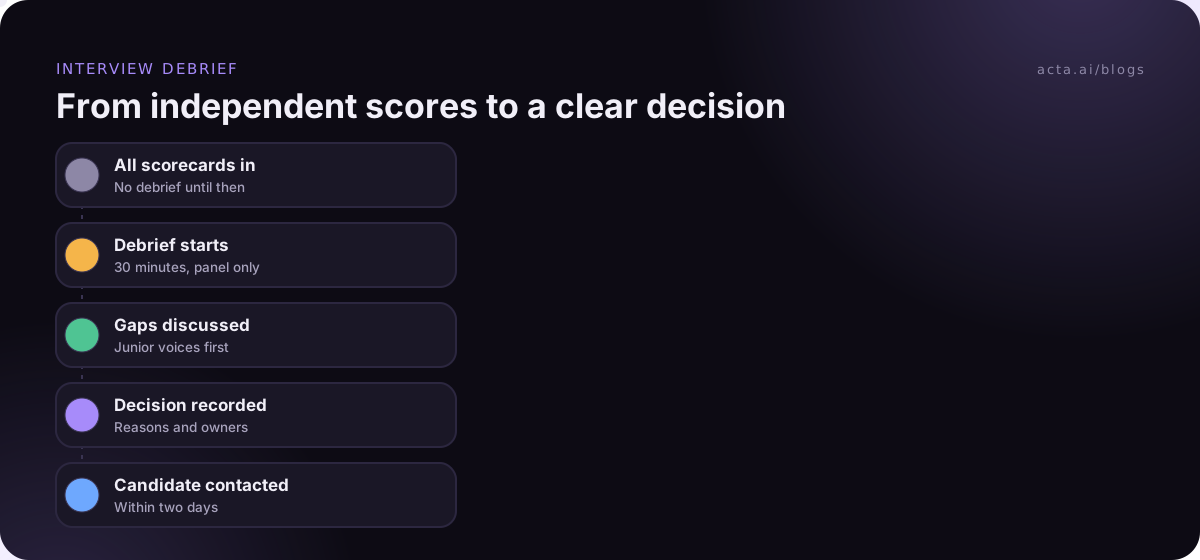
In practice that means one hard rule: no debrief until every scorecard is in. Not "I'll fill it in after". Not "let's just chat quickly first". If someone hasn't submitted, you move the meeting.
Timing matters too. Google's re:Work interviewer training guide says its internal research found feedback submitted within 48 hours was significantly higher in quality than feedback submitted later. So book the debrief for one or two days after the last interview, and ask for written feedback the same day as each interview.
Good independent feedback has a score for each competency the interviewer covered, the specific example behind each score, and an overall lean. It doesn't need to be long. It does need to be written before anyone talks.
Who should be in the interview debrief meeting?
Everyone who interviewed the candidate, the hiring manager, and the recruiter if you have one. That's it. Keep out people who didn't interview, however senior. They don't have evidence, only opinions, and their opinions will carry more weight than they should.
Some companies use a separate hiring committee that reviews written feedback and makes the final call without having interviewed. Google's guides describe this approach. It works well at scale, but for most teams a well-run panel debrief does the job.
What is a good interview debrief agenda?
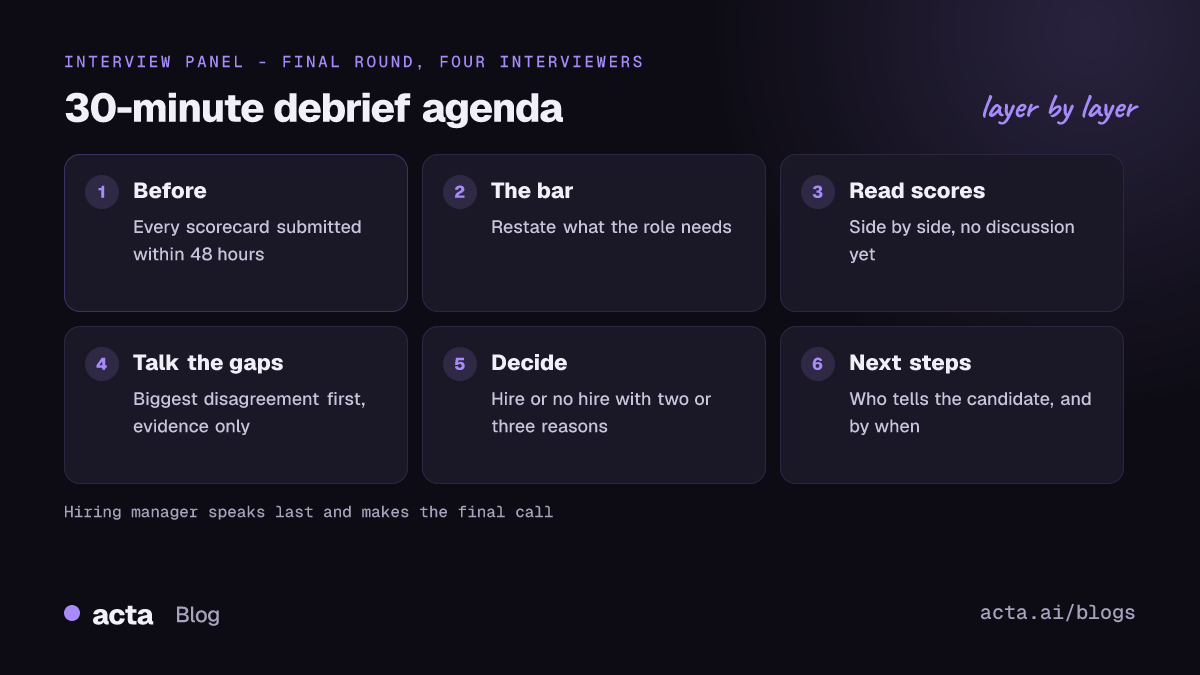
For one candidate, 30 minutes is usually plenty. Here's the debrief agenda I'd use:
- Two minutes: the bar. The hiring manager restates what the role needs and what the scorecard competencies are. This stops the conversation drifting into "would I like working with them".
- Five minutes: read the scores. Put everyone's scores side by side on screen. Don't discuss yet. Just look at where people agree and where they don't.
- Fifteen minutes: talk through the gaps. Go competency by competency, starting with the biggest disagreement. Each interviewer shares the evidence behind their score, not just the score.
- Five minutes: decide. Hire, no hire, or a specific next step such as a reference check on one area. Record the reasons.
- Three minutes: next steps. Who tells the candidate, by when, and what feedback they get.
Who should speak first in the debrief?
The most junior interviewer, and the hiring manager last. If the hiring manager opens with "I loved him", every other comment becomes a reaction to that. If the newest member of the panel opens with what they saw, you hear it unfiltered.
The same applies within each competency. Ask whoever scored lowest to explain first, then whoever scored highest. You'll often find they're describing the same answer and simply read it differently, which is worth knowing. Sometimes one of them heard something the other missed.
Insist on evidence over adjectives. When someone says "she was really strong on stakeholder management", ask "what did she say?". If nobody can answer, that score shouldn't carry much weight. Google's structured interviewing guide recommends standardized rubrics so all reviewers share an understanding of what an outstanding, solid, borderline or poor answer looks like. In the debrief, that shared rubric is your referee.
How do you handle disagreement in an interview panel?
Disagreement in an interview panel is useful. It's a sign that people formed their own views. The aim isn't to remove it; it's to understand it. A few patterns come up a lot:
- Different questions, different evidence. One interviewer saw the candidate struggle with a hard technical problem; another saw them explain a project clearly. Both can be right. The question is which matters more for this role.
- Same answer, different reading. Go back to what was actually said. If you recorded the interviews, check the transcript rather than arguing from memory.
- One strong objection. If one person has a serious, evidence-based concern, don't let the majority vote it away. Ask whether it's something the job can't tolerate, and whether a reference check or a follow-up conversation could settle it.
- Everyone is lukewarm. A panel full of "probably fine" scores is usually a no. Hiring someone nobody is excited about rarely ends well.
How do you make the hire or no hire decision?
Decide who decides before the meeting starts. In most teams the hiring manager makes the final hire or no hire call after hearing the panel. Consensus is nice but not required, and chasing it is how debriefs run to an hour.
Whatever the decision, write down three things: the decision, the two or three main reasons tied to competencies, and any concerns to follow up during the new hire’s first 30 days of onboarding meetings. That record matters. It helps you explain the decision to the candidate, it's useful if the decision is ever questioned, and it gives you something to look back at in six months when you're asking whether your interviews predicted anything. Our guide on tracking decisions made in meetings has a simple format that works here too.
What should happen after the debrief?
Move quickly. Candidates notice silence, and good ones have other offers. The recruiter or hiring manager should contact the candidate within a day or two of the debrief with either an offer conversation or a clear, kind no. Our candidate follow-up email templates cover both.
If you recorded the interviews and the debrief, tell candidates and panel members up front and follow the rules where you hire. Our guide to recording consent and what to tell participants covers the basics; it's general information, not legal advice. For debriefs held on a call, a bot-free recorder such as the Acta desktop app captures the discussion from your own computer, so the decision and its reasons end up written down without anyone acting as note-taker.
Once a quarter, look back at a few hires and their debrief notes. Were the concerns raised in the debrief the ones that came up in the first months? That's how you find out which competencies and questions actually matter.
A short note on Acta
Acta records interviews and debriefs on Zoom, Google Meet and Microsoft Teams, with a bot or bot-free, and turns them into transcripts with speaker names, summaries, decisions and action items with owners. OneChat lets you ask questions across meetings with links to the source, which helps when a debrief turns into "what exactly did he say about the migration project?". Our posts on interview scorecard automation and candidate assessment from interviews go into the interview side in more detail, and the hiring page has the rest.
Frequently asked questions
How long should an interview debrief meeting take?
About 30 minutes per candidate is enough if everyone has submitted written feedback beforehand. If debriefs regularly run longer, the usual cause is that people are forming their views in the room instead of before it.
Should the hiring manager share their opinion in the debrief?
Yes, but last. Hearing the panel first means the hiring manager's view doesn't shape everyone else's, and the manager gets the benefit of the panel's unfiltered evidence before deciding.
Can interviewers change their scores during the debrief?
Keep the original scores as submitted, and note any change of mind separately with the reason. That way you can see later how much the discussion moved people, and whether it moved them toward better decisions.
What if one interviewer strongly disagrees with everyone else?
Hear their evidence fully before anyone responds. If the concern is specific and job-relevant, treat it seriously even if they're outnumbered. A targeted reference check or short follow-up conversation often settles it.
Do we need a debrief for every candidate?
For final-round candidates, yes. For early screens, written scores reviewed by the hiring manager are usually enough, with a quick conversation only when scores conflict.
If you'd like your debriefs and their decisions written down automatically, see what Acta does on the features page.