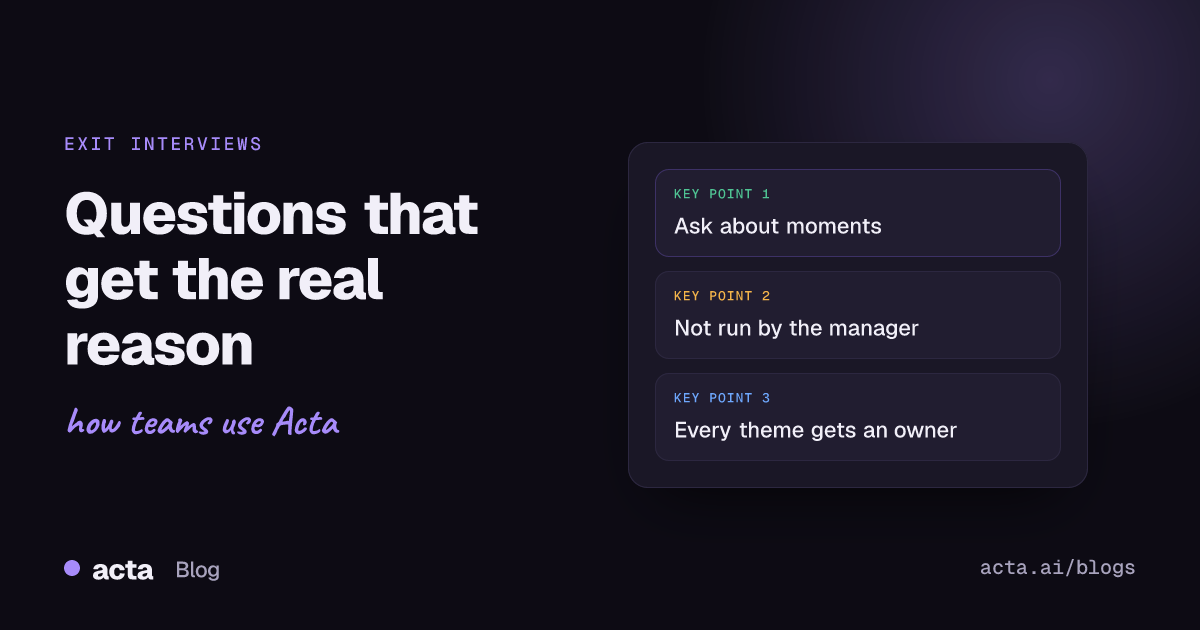
Quick answer: The exit interview questions that reveal real problems are specific and behavioral: when did you first start looking, what happened that week, what would your manager have needed to do differently, and what would have kept you. Have someone other than the direct manager ask them, follow up on vague answers, and review the themes every quarter with an owner for each fix.
Most exit interviews follow the same script. HR books 30 minutes on the person's last afternoon, asks them to rate their experience from one to five, hears "it was a great opportunity, I just wanted something new," and files the form. Everyone is polite. Nobody learns anything.
The person leaving knows exactly why they're going. They've usually known for months. The trick is asking questions they can answer honestly without burning a bridge, and then doing something with what they say. Below are the questions I'd use, what each one tends to surface, and how to stop the answers from disappearing into a spreadsheet.
Why do most exit interviews tell you nothing?
Two reasons: people don't say what they think, and companies don't act on what they hear.
The first is understandable. The person leaving may want a reference, may come back one day, or may simply not want a hard conversation in their last week. "Better opportunity" is safe. "My manager took credit for my work for a year" is not.
The second is the bigger failure. In their Harvard Business Review article "Making Exit Interviews Count", Everett Spain and Boris Groysberg surveyed 188 executives and interviewed 32 senior leaders about how their organizations used exit interviews. Fewer than a third of the executives could name a specific change that came from exit interview feedback. If leavers sense that nothing happens with what they say, they stop saying anything useful.
The frustrating part is that many departures could have been stopped. In a Gallup study of 717 people who had voluntarily left an employer, 42% said their manager or organization could have done something to keep them, and 45% said no manager or leader had talked with them about their job satisfaction, performance or future in the three months before they left. The exit interview is often the first time anyone asks.
Who should run the exit interview, and when?
Not the person's direct manager. If the manager is part of the reason, you've just asked the leaver to criticize someone face to face. HR, a people partner or a skip-level leader works better. If you plan to record it, read our guide to recording sensitive HR, legal and board calls first. The leaver should feel that the person across the table can actually change something.
Timing matters too. The last afternoon is the worst slot: the person is distracted, emotional and already halfway out. Somewhere after the resignation has settled and before the final few days tends to give calmer answers. Offer video or in person, and keep it to 30 to 45 minutes.
Be honest about confidentiality. "This is completely anonymous" is rarely true when you're the only person who left the design team this quarter. Say instead what you'll do: "I'll share themes with leadership, not quotes with your name on them, unless you tell me something about safety or misconduct, which I'd have to act on."
Which exit interview questions reveal real problems?
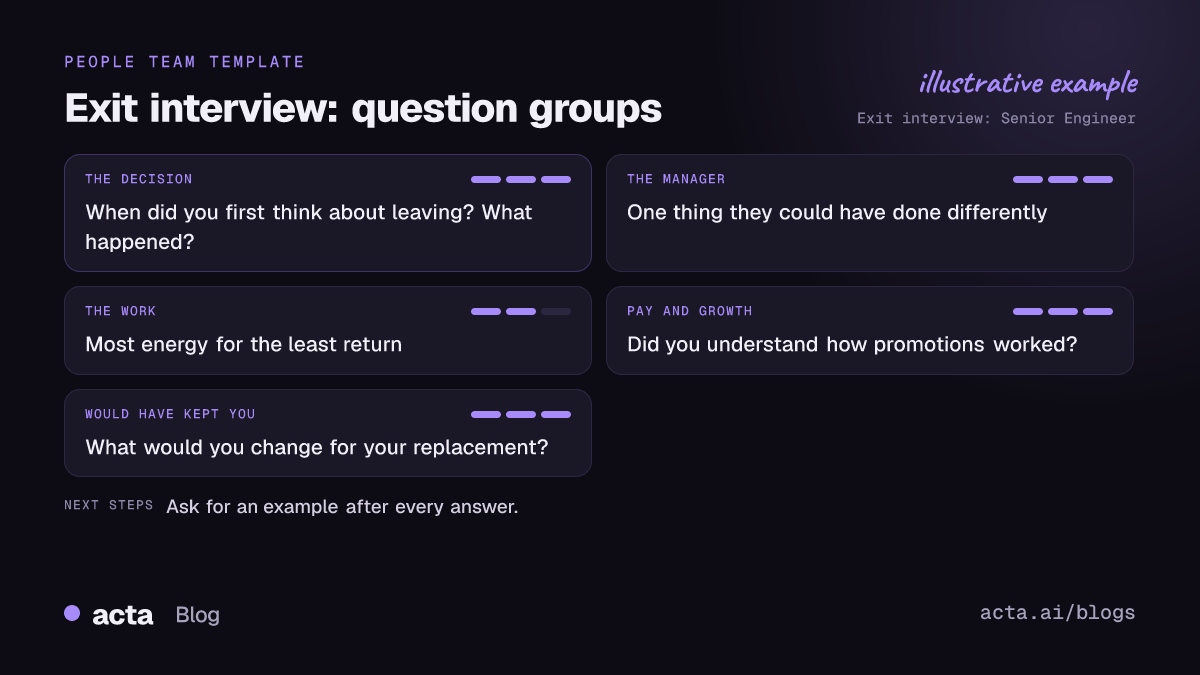
Good exit interview questions ask about moments, not opinions. "How was your manager?" gets a shrug. Specific, open questions work here for the same reason they do in structured interviews. "Tell me about a time your manager helped you, and a time you needed help and didn't get it" gets a story. Here's the set I'd work from, grouped by what you're trying to learn.
The decision itself
- When did you first start thinking about leaving? The date matters more than the answer. If it's "about eight months ago," something happened eight months ago.
- What was going on at work around then? A reorg, a new manager, a missed promotion, a project cancelled. This is often the real reason.
- Was there one moment when you decided? People often remember a specific meeting or email.
- What does the new role have that this one didn't? More useful than "why are you leaving," because it's about the other job, which feels safer to talk about.
The manager
- How often did you and your manager talk about your work and your future? Listen for "we had one-to-ones, but they were status updates."
- What's one thing your manager could have done differently that might have changed your mind? Framing it as "one thing" makes it easier to answer.
- Did you raise any of this before you resigned? What happened? This tells you whether the problem is the issue or the response to the issue.
The work
- What part of the job took the most energy for the least return? Surfaces broken processes, pointless meetings and approval chains.
- Was your workload the same as when you were hired? Quiet scope creep is a common cause that nobody names.
- Did you have what you needed to do the job well? Tools, information, decisions, people.
Pay and growth
- Did you understand how promotions and raises worked here? Confusion is often a bigger problem than the amount.
- Was money part of the decision? Roughly how big was the gap? Ask plainly. People usually answer.
What would have kept you
- If you could change one thing here for the person who takes your job, what would it be? This is my favorite question. It lets people be blunt on someone else's behalf.
- Would you come back? Under what conditions?
- Would you recommend this team to a friend? Why or why not?
SHRM publishes a sample list of exit interview questions you can use as a base. I'd cut it down rather than add to it. Ten good questions with follow-ups beat thirty rushed ones.
Which exit interview questions should you skip?
- Rating scales in a live conversation. "On a scale of one to ten, how would you rate your manager?" gets a polite seven. Save numbers for a written exit survey.
- Leading questions. "You enjoyed working with the team, right?"
- Anything about the new employer's offer details beyond what they volunteer. It reads as a counteroffer attempt.
- Questions you won't act on. If benefits are set for the next three years, don't spend ten minutes asking about them.
How do you get honest answers in an exit interview?
Most of the honesty comes from the follow-up, not the first question. A few habits help:
- Ask for an example every time. "Communication could have been better" means nothing until you hear about the Tuesday the roadmap changed and nobody told the team.
- Get comfortable with silence. After the first answer, wait. People often add the real point a few seconds later.
- Don't defend the company. The moment you explain why the reorg was necessary, the conversation is over.
- Write down their words, not your interpretation. "Felt invisible after the new VP arrived" is more useful in six months than "manager relationship issue." Our guide on how to take meeting notes has more on capturing quotes.
- Close with thanks and what happens next. Tell them when themes go to leadership.
Taking accurate notes while listening properly is hard. If the leaver agrees, recording the conversation lets you focus on them instead of your keyboard; see what to tell participants before recording a meeting with AI. If a bot joining feels too formal for a sensitive goodbye, a desktop recorder like Acta's captures the call from your own computer instead. Ask first either way, and offer to keep notes by hand if they'd prefer.
Exit interview or exit survey: which do you need?
Both, if you can. They do different jobs.
An exit survey is short, written and consistent. It gives you numbers on why employees leave that you can compare across teams and quarters: how many leavers cite pay, how many cite their manager. Some people are also more candid in writing.
An exit interview gives you the story behind the numbers. The survey tells you that a lot of engineering leavers mentioned workload; the interview tells you it started when the on-call rotation shrank from eight people to four. If you only have time for one, run interviews for people you'd have wanted to keep and surveys for everyone else.
What should you do with exit interview answers?
This is where most programs fall over. A pile of notes nobody reads is worse than no exit interviews, because leavers notice.

- Tag each interview by theme within a day: manager, workload, pay, growth, process, culture. Use the same tags every time.
- Review themes quarterly with the leaders who can change things. Show counts and two or three anonymized quotes per theme.
- Name an owner and a date for anything you decide to fix. "Look into workload" is not an action. "Ana proposes a new on-call rotation by March 15" is.
- Check at the next review whether the fix happened and whether the theme is shrinking.
If you already track decisions from other meetings, treat exit themes the same way. Our post on why action items don't get done covers the follow-through habits that apply here too.
Should you ask these questions before people leave?
Yes. A stay interview uses the same questions with people who haven't resigned: what keeps you here, what would make you leave, what's the most frustrating part of your week. Gallup's finding that many leavers had no conversation about their future in the three months before going suggests where to start.
Managers can fold a short version into regular one-to-ones. Ask one question a month, write down the answer and come back to it. Our guide to one-on-one meeting notes shows a format that makes this easy to keep up.
A note on Acta
Acta records calls through a bot, the desktop app or a Chrome extension, then writes a transcript with speaker names, a summary and action items with owners. For exit interviews, that means you keep the leaver's actual words, and OneChat can answer questions like "what did leavers say about on-call this year?" with links back to the source meetings. Use it only with the leaver's agreement.
Frequently asked questions
What are the most important exit interview questions?
When did you first think about leaving, what was happening then, what could your manager have done differently, and what would you change for your replacement. Those four usually get you to the real reason.
Should exit interviews be mandatory?
Offer them to everyone, but don't force anyone. A reluctant interview produces polite answers. A written exit survey is a good fallback for people who decline.
How long should an exit interview take?
Thirty to 45 minutes is enough for ten questions with follow-ups. Longer than an hour usually means you're asking things you won't act on.
Can an employee refuse an exit interview?
Yes, in most workplaces it's voluntary. Respect the choice and thank them anyway. Check your own policies and local rules if you're unsure.
How do you report exit interview findings to leadership?
Group answers into the same themes every quarter, show counts and a few anonymized quotes, and list the fixes already agreed with owners and dates. Leaders respond to trends and named actions, not to individual stories.
To see how exit interview notes and themes come together in practice, look at the features overview.