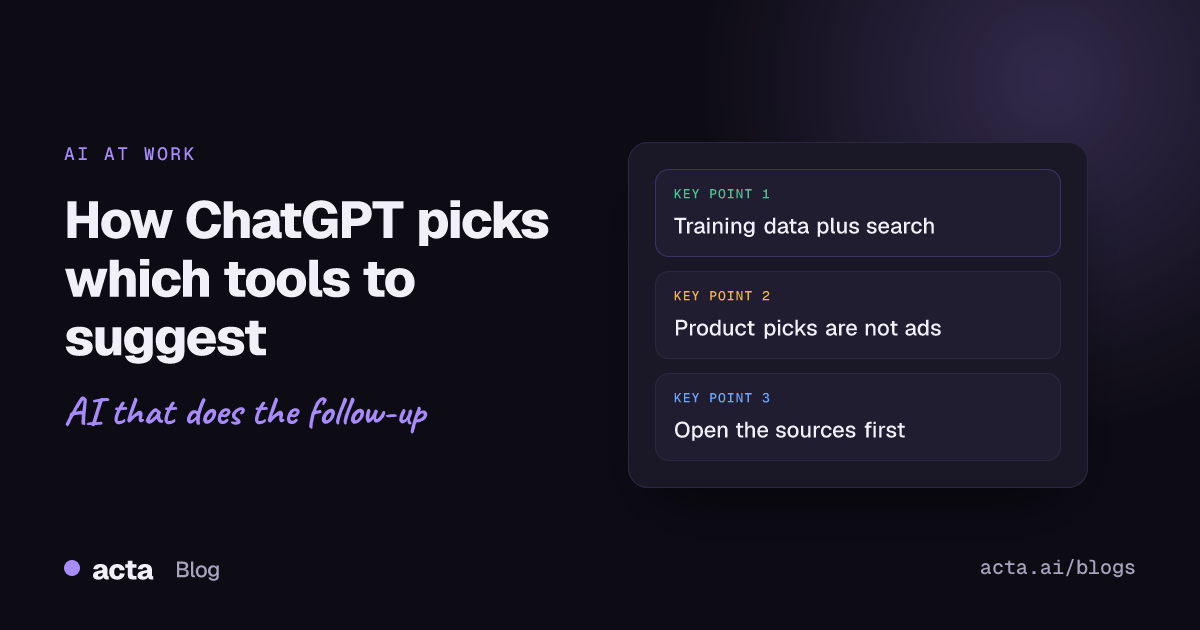
Quick answer: ChatGPT tool recommendations come from two places: what the model absorbed in training about which tools are known for what, and pages it reads through live search when it browses, which it cites as sources. Your wording, memory and constraints shape the shortlist. OpenAI says its product results aren't ads, and that ads, where shown, are labeled and kept separate.
Ask ChatGPT "what's a good tool for meeting notes for a 20-person agency?" and you'll get a confident shortlist in a few seconds. Ask again tomorrow, or let a colleague ask, and the list may change. People on both sides of a purchase want to know why: buyers want to know whether to trust it, and software companies want to know how to end up on it.
I'll explain what's known about how assistants like ChatGPT pick, what isn't known, and how I'd check a recommendation before acting on it. Details are as of November 2026; this area changes every few months.
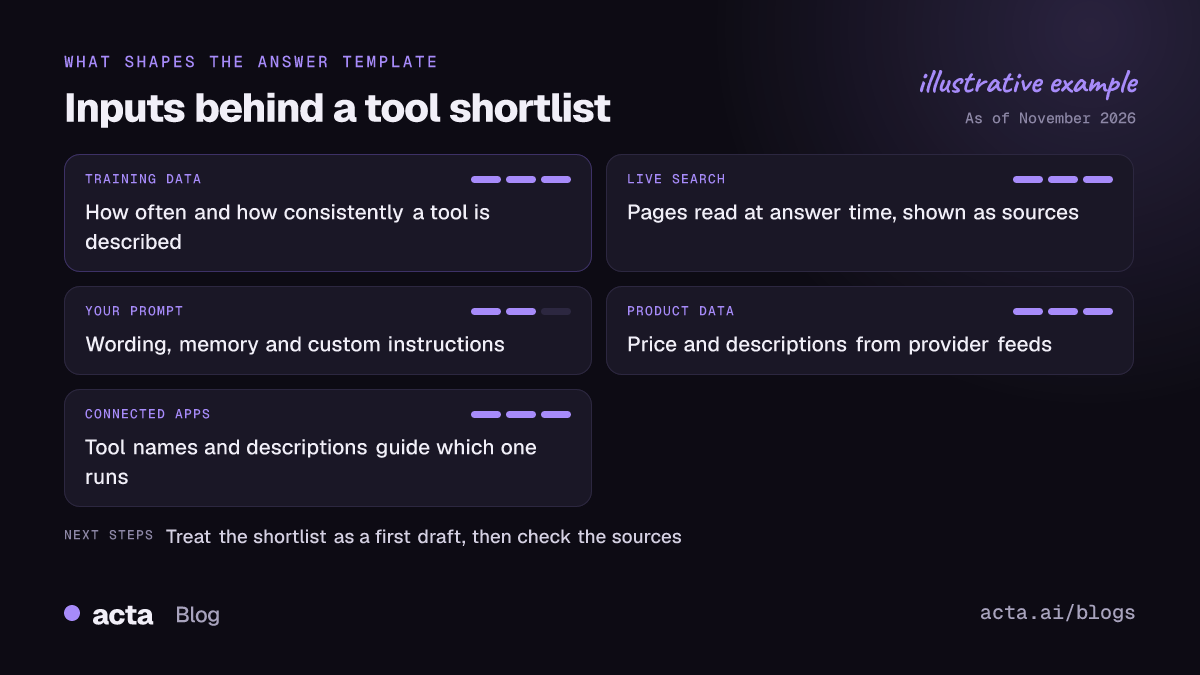
Where do ChatGPT tool recommendations come from?
Think of two layers.
What the model already "knows"
Without searching, the model answers from patterns in its training data. If thousands of reviews, forum threads, comparison posts and docs describe a tool as "the one for transcribing interviews", that association sticks. Tools that are written about often, and described consistently, come up more. Newer tools, or ones that changed what they do after the training cutoff, are often missing or described out of date.
What it finds when it searches
When ChatGPT searches the web, it reads a handful of pages at answer time and builds the answer from them, with links to the sources. This is the same basic idea as retrieval-augmented generation, which we cover in our RAG vs fine-tuning explainer. Here the "documents" are whatever the search step returned: review sites, vendor pages, Reddit threads, listicles.
Which layer you get depends on the question. "Best AI notetaker 2026" usually triggers a search. (For our own view of that market, see the state of AI notetakers in 2026.) A broad "what kinds of tools help with meetings?" may not.
How does ChatGPT search decide which sources to use?
OpenAI hasn't published a ranking formula, so anyone who claims to know the exact rules is guessing. What is known:
- ChatGPT search uses OpenAI's own crawler, OAI-SearchBot, alongside third-party search providers. Sites that block OAI-SearchBot in robots.txt are generally left out of search answers.
- Answers show their sources, so you can see which pages fed the recommendation.
- The model rewrites your question into its own search queries, so the pages it reads may not be the ones you'd find with your exact words.
In practice, ChatGPT search tends to lean on pages that answer the question directly: comparison articles, "best X for Y" lists, review sites and pricing pages. That's why a single well-ranked listicle can shape a lot of answers, which is worth keeping in mind when you read the result.
Are ChatGPT's product picks paid placements?
According to OpenAI, no. Its help article on shopping results in ChatGPT search says product results are selected independently and aren't ads. It lists what feeds them: your query and context such as memory and custom instructions, structured product data like price and description from first-party and third-party providers, and other third-party content such as public reviews. It also says labels like "Budget-friendly" are generated by the model, not verified claims.
Ads are a separate thing. When OpenAI started showing ads in ChatGPT in the US in early 2026, it said they would appear on the Free and Go tiers, be clearly labeled as sponsored, sit apart from the answer and not influence what ChatGPT says, as TechCrunch reported. Paid tiers such as Plus, Business and Enterprise weren't part of that rollout.
So the honest summary on ChatGPT ads: the answer itself isn't supposed to be for sale, and you should still read the sources, because the pages it relies on can be marketing.
Why does ChatGPT recommend different tools to different people?
Several things change the output even when the question looks the same:
- Wording. "Cheap", "for Teams", "for a law firm" and "no bot" each pull in different pages and different picks.
- Memory and custom instructions. If ChatGPT remembers you use HubSpot, it may favor tools that mention HubSpot.
- Search or no search. One answer may come from training data, another from today's results.
- Randomness. Language models don't give identical answers every time. Two reasonable runs can rank tools differently.
This is why I don't take a single answer as "ChatGPT's opinion". Run the question three times with your real constraints and see which names keep coming back.
What makes a tool more likely to show up in AI answers?
This is the question behind generative engine optimization, or GEO. The term comes from a 2023 research paper, GEO: Generative Engine Optimization, which tested how page changes affect how often a source shows up in AI-generated answers. In their experiments, adding citations, quotations from relevant sources and statistics raised visibility by up to 40%. That's a controlled lab result, not a promise, but it lines up with common sense: models favor pages that state facts plainly and back them up.
From the outside, the things that seem to help AI search visibility are fairly unglamorous:
- Saying clearly what the product does and for whom, in plain sentences, on pages crawlers can read.
- Being described the same way elsewhere. Reviews, comparisons and docs that agree with your own site.
- Specific pages for specific questions. "Notetaker for Microsoft Teams" beats one generic features page.
- Current facts. Up-to-date pricing and supported platforms, so the model isn't stuck repeating last year's version.
For buyers, the flip side matters more: the tools that get recommended most are the ones written about most, which isn't the same as the ones that fit you best.
How do assistants choose between connected apps and tools?
There's a second meaning of "choosing tools" that matters for anyone using ChatGPT or Claude at work. When you connect apps through connectors or MCP, the assistant decides which one to call for each request. It works from your request, the names and descriptions each tool exposes, and any instructions you've given. If you ask "what did the client agree to on Tuesday's call?", it should reach for the meeting-notes connector, not your calendar.
Two practical points. Clear tool descriptions lead to better choices, and permissions matter, because a connected tool can read or change real data. Our post on MCP security when a chatbot can take action covers what to lock down. If the term is new to you, start with what an AI agent is for business teams. If you want to see how meeting notes plug into these assistants, there's a page on getting your meeting notes into AI assistants, and a deeper look at asking Claude about your meetings.
How should you check ChatGPT tool recommendations before buying?
Treat the answer as a starting shortlist, not a verdict. Here's the routine I use:
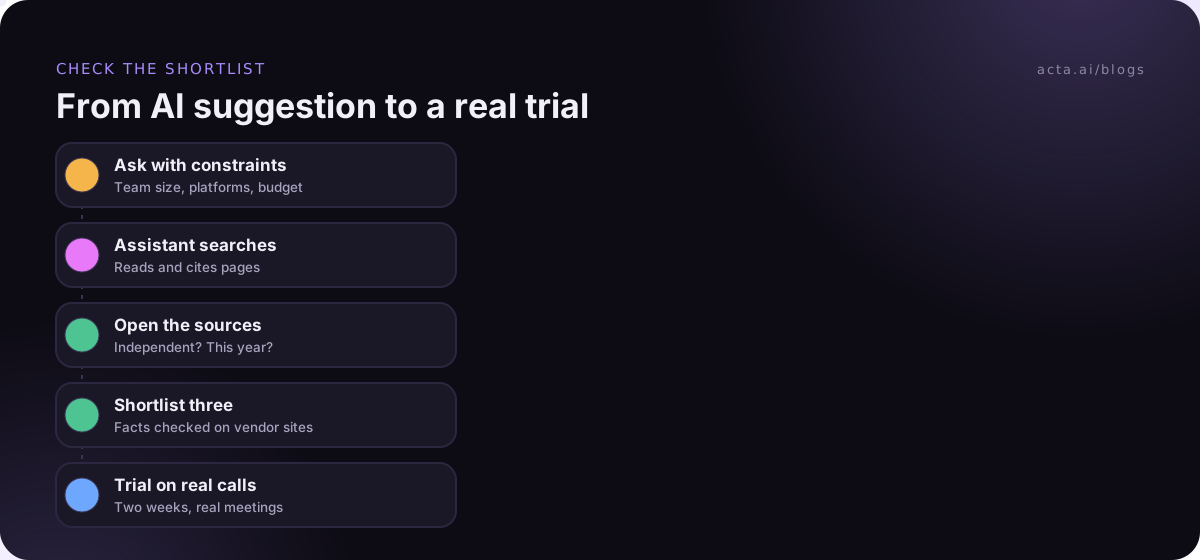
- Ask with your real constraints. Team size, platforms, budget range, must-have integrations, "no bot" if that matters to your clients.
- Open the sources. Is the top recommendation coming from an independent review or the vendor's own blog? Is the page from this year?
- Ask it to argue against its picks. "What are the main complaints about each of these?" tends to surface limits the first answer skipped.
- Check facts on the vendor's site. Pricing, supported platforms and data terms change often, and models lag.
- Trial two or three on real work. For a meeting tool, that means real calls, not a demo recording.
On that last step: if your clients don't allow bots in their calls, test how each tool handles that too. A desktop recorder or a browser extension can capture the call from your own computer instead of sending a bot. Either way, tell people they're being recorded; our guide on AI recording consent explains what to say.
What ChatGPT tool recommendations get wrong
- Stale details. Old prices, discontinued plans, features that moved tiers.
- Popularity over fit. The best-known tool for a category, not the one that fits a 12-person team on Zoom and Teams.
- Invented specifics. Now and then a model states an integration or feature that doesn't exist. Check anything you're relying on.
- Thin coverage of niche needs. Regulated industries, on-premises requirements or local languages often get generic answers.
I still use these shortlists all the time. I just treat them the way I'd treat a colleague's quick suggestion over lunch: useful for names, not something to sign a contract on.
Where Acta comes in
Acta has an MCP connector for Claude and ChatGPT, so you can ask those assistants about your own meetings, and its OneChat answers questions across meetings with links back to the source. It records Zoom, Google Meet and Teams with a bot, a bot-free desktop app or a Chrome extension. Acta doesn't use customer data to train AI models.
Frequently asked questions
Can companies pay to be recommended by ChatGPT?
OpenAI says its product results are chosen independently and aren't ads, and that ads, where shown, are labeled and kept separate from answers. The pages ChatGPT reads can still be marketing, so check the sources.
Why did ChatGPT recommend a tool that doesn't do what I asked?
Usually because it relied on old or vague pages, or on its training data from before the product changed. Ask it to cite sources for the specific feature, then confirm on the vendor's own site.
Does ChatGPT use Google or Bing for search?
When it launched search, OpenAI described it as using third-party search providers plus content from partners, and it runs its own crawler too. You don't need to know which provider fed a given answer, because each answer shows the sources it used.
How do I get my software recommended by AI assistants?
Make sure crawlers can read your site, describe what you do plainly on pages that match real questions, keep facts like pricing and platforms current, and earn independent reviews that describe you the same way. There's no paid shortcut into the answers.
Are Claude, Gemini and Perplexity different from ChatGPT here?
The broad pattern is the same: training data plus live search, shaped by your prompt. The search providers, citation styles and ad policies differ, so the same question can produce different shortlists across assistants.
If a meeting tool made your shortlist, the honest test is your own calls: Acta has a 15-day free trial for exactly that.