Quick answer: Buying signals in a sales conversation are things the prospect says or does that show they're picturing life after the purchase: asking how setup works, who'd be trained, what the contract looks like, or bringing a colleague to the next call. Strong buying signals are specific and come with a next step. Enthusiasm alone, or "send me some info", usually isn't one.
Every rep has had the call that felt like a sure thing. The prospect laughed at your jokes, said "this is exactly what we need" twice, and then vanished. Meanwhile the quiet, slightly prickly buyer who grilled you about data exports for 40 minutes signed in three weeks.
That gap is what this post is about. The prospect who sounds keen isn't always the one who's ready. Below is how I'd tell real buying signals apart from polite noise, how to respond without pouncing, and how to check afterwards what was actually said.
What are buying signals in a sales conversation?
HubSpot defines buying signals as behaviors or statements that indicate a prospect is considering a purchase. That covers a lot. Some are company-level, like a funding round or a new leadership hire, and some are things a person says on a call. Crunchbase's write-up splits them the same way, into verbal and nonverbal cues versus company-level signals.
Company-level signals tell you who to call. HubSpot's own Sales Workspace, for example, surfaces signals such as form submissions to show which companies may be ready to talk. This post is about the other kind: what you hear once you're actually in the conversation.
The common thread in real conversational buying signals is that the buyer has stopped evaluating whether the problem matters and started picturing the solution in their own world. They move from "what does it do?" to "how would that work for us?"
Which verbal buying signals matter most?
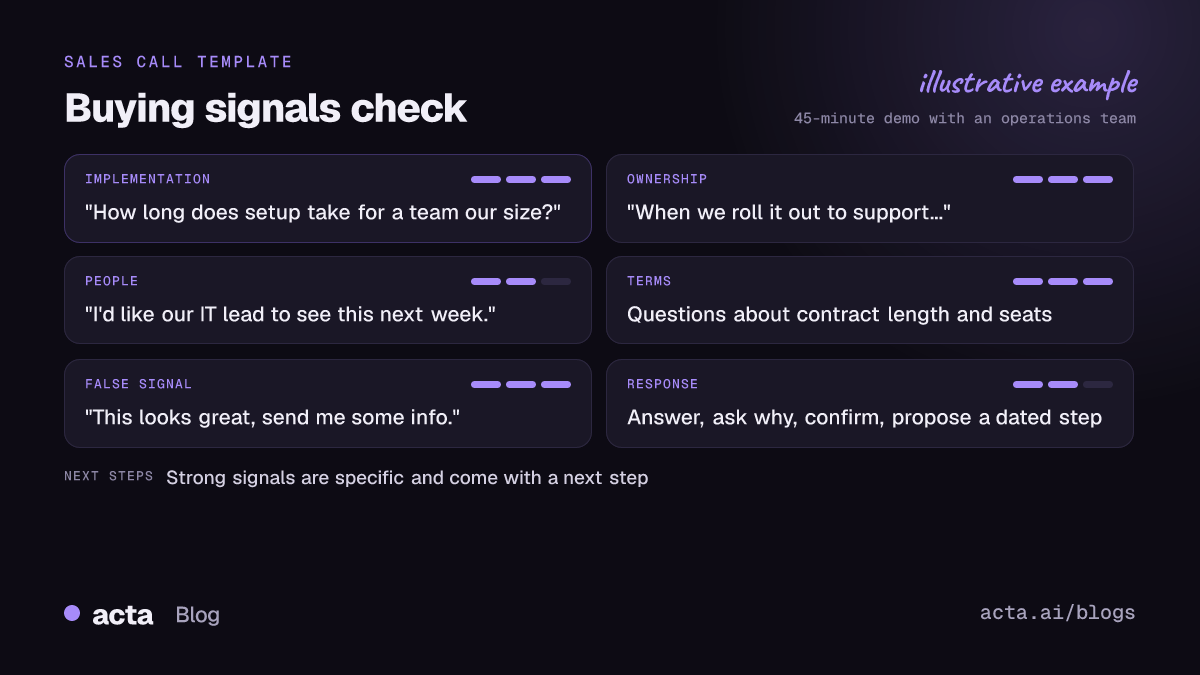
These are the verbal buying signals I'd pay most attention to, roughly in order of strength.
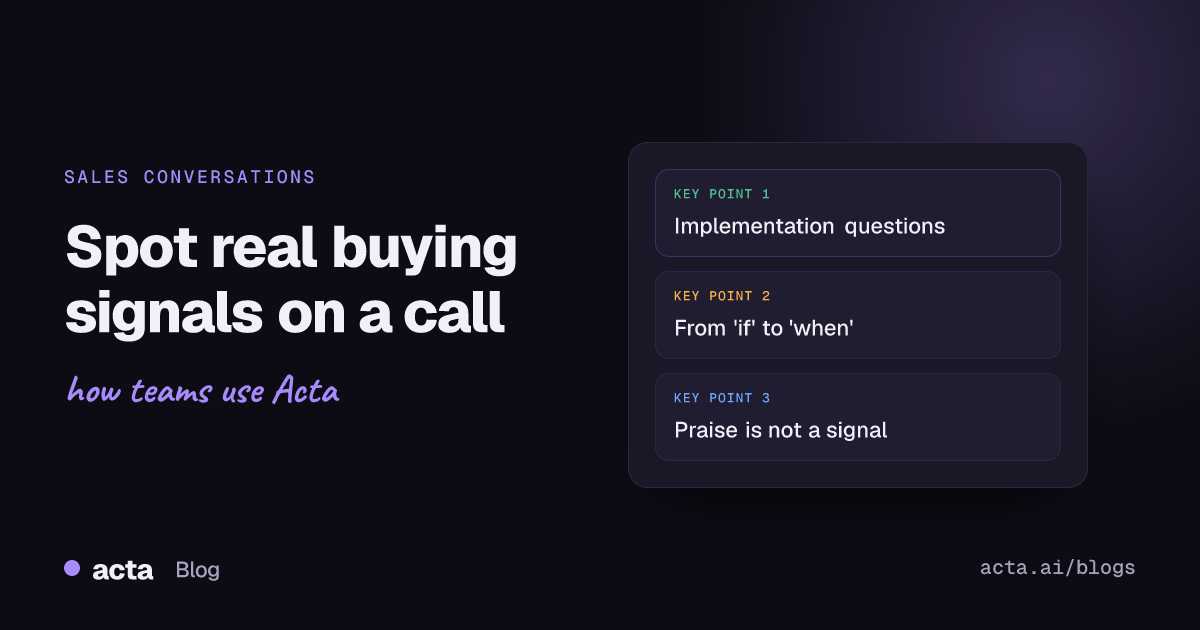
Implementation questions
"How long does setup usually take?" "Who on our side would need to be involved?" "Can it work with our existing CRM?" Implementation questions mean the buyer is mentally past the decision and into the rollout. They're also the questions people only ask when they've been told they'll be the one doing the work.
Ownership language
Listen for the switch from "if" to "when", and from "you" to "we". "If we went ahead, would..." is interest. "When we roll this out to the support team..." is someone who's already sold themselves. It's subtle, and you'll only catch it if you're listening rather than planning your next line.
Bringing people in
"I'd like our IT lead to see this." "Can we do a session with my manager next week?" A buyer who brings colleagues is spending their own credibility on you. That's a stronger signal than anything they say about the product.
Specific objections
This one surprises newer reps. A detailed objection ("our security team will want to know where call data is stored, and who can see it") is often a buying signal, because nobody does that homework for a vendor they've ruled out. Vague objections ("it's just not the right time") are the worrying kind. So is "we're happy with what we have", which needs its own approach to the status quo objection.
Questions about terms
Contract length, notice periods, how seats are added, what happens at renewal. People don't read the small print on things they aren't planning to sign.
Are pricing questions a buying signal?
Sometimes. Pricing questions late in a conversation, after the buyer has described the problem and seen how you'd solve it, are usually a good sign. They're checking whether it fits the budget they already have in mind.
Pricing questions in the first five minutes are less clear. HubSpot's list of phrases that signal a prospect is ready to buy makes the point that when these come up at the start, the prospect may be focused on cost rather than value. In my experience, early price questions often mean they're shopping a list of vendors and want to cut it down fast.
Either way, answer honestly. Then ask what they're comparing against. "Are you weighing this against another tool, or against doing nothing?" tells you which situation you're in.
What are false buying signals?
False buying signals feel good and predict very little. The usual suspects:
- Generic praise. "This looks great." "Really impressive." People are polite on calls. Praise without a question attached is mostly manners.
- "Send me some information." Sometimes genuine, often a way to end the call. Test it: "Sure. What would you want to see in it, and who else would read it?"
- Feature tourism. Lots of questions about what the product can do, none about how it would fit their process. They might be learning the category, not buying in it.
- An excited contact with no influence. A keen junior user is great for a pilot and terrible for a forecast. Ask who else would need to agree.
- A timeline with no reason. "We want to decide by end of quarter" means little if nothing happens at the end of the quarter. Ask what does.
None of these mean the deal is dead. They just aren't evidence that it's alive.
How to respond to buying signals without rushing the close
The classic mistake is hearing a signal and jumping straight to "great, shall I send the contract?". That turns a buyer who was drifting toward yes into one who feels sold to. Here's how to respond to buying signals in a way that moves things forward.
- Answer the question properly. If they asked how long setup takes, tell them, with a realistic range and what it depends on.
- Ask why they're asking. "Is there a date you're working toward?" turns an implementation question into a timeline and often a trigger event.
- Confirm out loud. "It sounds like the support team would be first. Is that right?" Buyers correct you when you're wrong, and commit a little more when you're right.
- Propose a specific next step. Name the person, the topic and the day: "Shall we do 30 minutes with your IT lead on Thursday to go through the integration?"
If they accept the next step, the signal was real. If they hedge, it was weaker than it sounded. Either way you've learned something.
What do nonverbal buying signals look like on video calls?
On video you lose a lot of body language, but not all of it. Things I'd notice: the buyer leaning in or taking notes when you get to the part that matters to them, sharing their own screen to show you their current process, or staying on past the scheduled end without being asked.
The negative ones are just as useful. Camera off when it was on before, long pauses before every answer, someone clearly reading email. I wouldn't build a forecast on any of these alone. Treat them as prompts to ask a direct question: "I want to make sure this is useful. What would you most like to get out of the next ten minutes?"
How do you check for buying signals after the call?
In the moment you'll miss some. You're presenting, answering, watching the clock. That's normal. What helps is a short review right after the call while it's fresh.
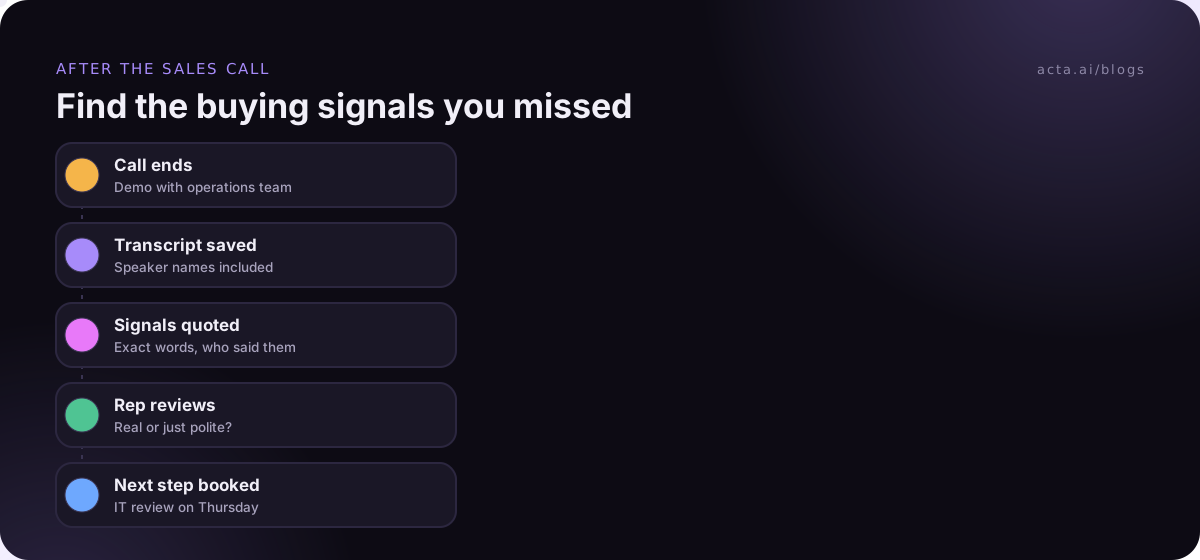
Go through what was said and pull out every buying signal with the buyer's exact words, then do the same for false signals and objections. You'll often find the strongest signal came in a throwaway line near the end ("our renewal with the current tool is in March, actually") that you didn't follow up on.
That's much easier with a transcript than with memory. If you record your calls (do check the consent rules and what to tell participants first), you can search for the phrases that matter. For calls in Google Meet or Teams in the browser where a bot would feel intrusive, a Chrome extension recorder can capture the call from your own machine. Once you have the signals, put them where your team will see them; we covered how to update the CRM after a sales call without retyping everything.
Turn signals into deal notes
A signal on its own is a nice moment. A signal tied to a framework is evidence. If your team uses SPICED, a buyer naming a renewal date is your Critical event; the SPICED deal report post shows how that maps. If you're earlier in the process, the questions in our discovery call template are designed to draw these signals out, and so are these discovery call questions for buying intent.
Where Acta fits
Acta records sales calls on Zoom, Google Meet and Microsoft Teams, with a meeting bot or bot-free, and writes the transcript with speaker names, a summary and action items. You can ask OneChat things like "did anyone mention a renewal date?" across all calls with an account and get the answer with a link to the source. It won't decide for you whether a signal is real, but it gives you the exact words to judge by.
Frequently asked questions
What is the strongest buying signal?
A buyer agreeing to a specific next step that costs them something: bringing a decision maker, booking a technical review, or sharing their internal process. Questions about implementation and terms are close behind.
Is asking about price a buying signal?
Late in the conversation, usually yes. Very early, it may mean the buyer is comparing costs across several vendors. Answer, then ask what they're comparing you against.
What's the difference between buying signals and intent data?
Intent data is usually company-level activity tracked by tools, like website visits or form fills. Buying signals in a sales conversation are what the person says and does on the call. The first helps you decide who to call; the second tells you how the deal is going.
Can objections be buying signals?
Specific objections often are, because they show the buyer is working out how the purchase would get approved. Vague objections, like "not the right time", usually aren't.
How should I note buying signals for my team?
Write the buyer's exact words, who said it and when, plus the next step you agreed. A quote is far more useful to your manager than "prospect seemed keen".
To try it on your own calls, start with the 15-day free trial.