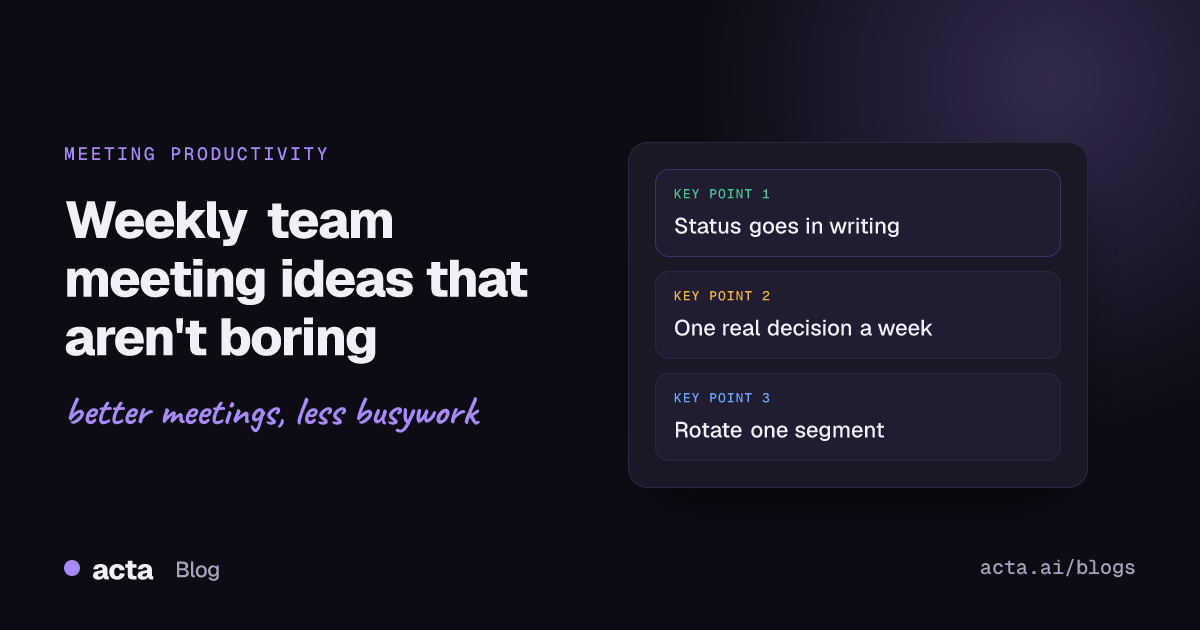
Quick answer: The best team meeting agenda ideas replace the status round-robin with segments that need the whole group: a quick wins round, one real decision, a "where I'm stuck" slot, a short demo, and a check on last week's action items. Post status updates in writing beforehand, phrase agenda items as questions, and rotate one segment a month so the meeting doesn't go stale.
Most weekly team meetings are boring for the same reason: they're status meetings in disguise. Eight people take turns reading out what they did, everyone else checks email, and the one thing that actually needed discussion gets squeezed into the last four minutes. Nobody designed it that way. It's just what happens when the agenda is "updates" every week.
The fix isn't icebreaker games or a fancier slide template. It's giving the meeting a job that only a live group can do, and moving everything else out. Below is a simple skeleton, then a menu of segments you can mix in. Pick three or four; don't use them all at once.
Why do weekly team meetings get boring?
Three patterns show up again and again:
- The agenda is a list of people, not topics. "Priya, then Marco, then Dana" guarantees a round-robin.
- Nothing gets decided. If the meeting never changes anything, people stop treating it as important.
- It's the same every week. Even a good format wears thin after six months.
If your weekly team meeting has all three, people will show up out of duty and leave with nothing. That's fixable, and you don't need to cancel the meeting to fix it.
What should a weekly team meeting agenda look like?
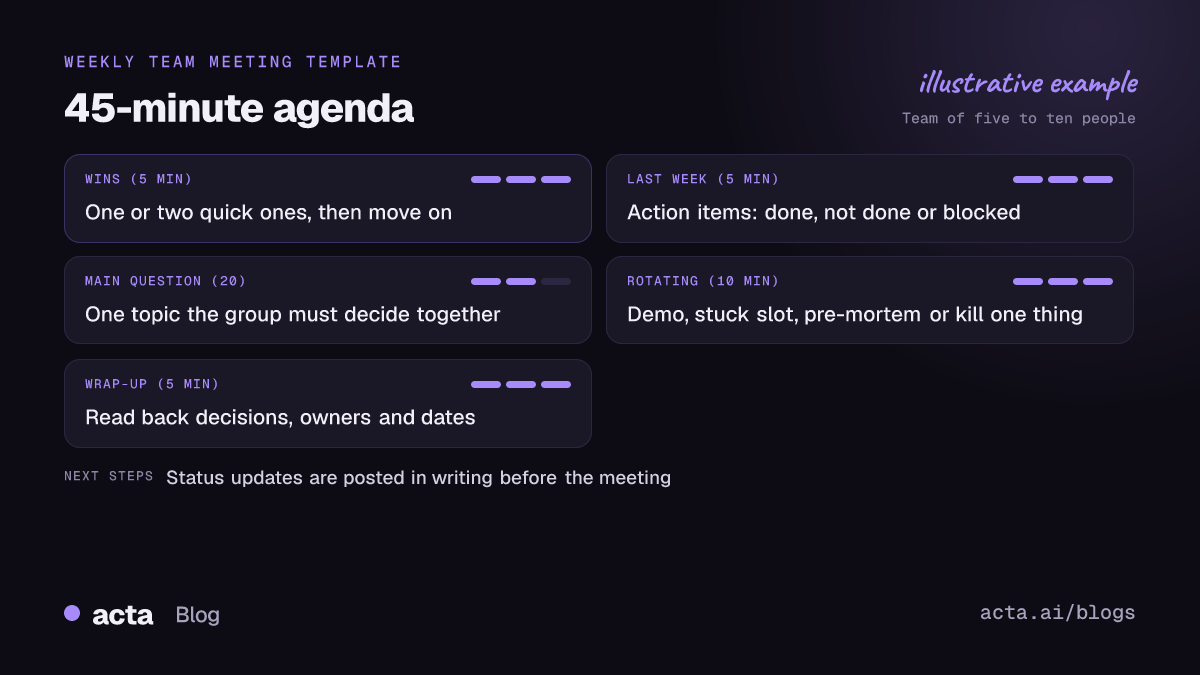
Start with a fixed skeleton so people know what to expect, then leave one slot that changes. For a team of five to ten people, 45 minutes is usually plenty:
- Wins (5 min). One or two quick ones. Keeps the mood up and makes good work visible.
- Last week's action items (5 min). Done, not done, or blocked. No storytelling.
- The main question (20 min). One topic the team needs to decide or work through together.
- Rotating segment (10 min). Pick from the ideas below.
- Wrap-up (5 min). Read back decisions and who owns what.
A tip from HBR's piece on creating the perfect meeting agenda: write agenda items as questions. "Hiring plan" invites a ramble. "Should we hire a second designer or a contractor for Q1?" tells everyone what the discussion is for, and when it's finished. If you can't write any agenda question that week, that's a sign to cancel. Here are other signs a meeting should have been an email.
If you want a plain meeting agenda template to start from, our standup and weekly team meeting template has one. If the daily version is the one dragging, here's how to run a 15-minute standup. The ideas below are for making it worth attending.
Which team meeting agenda ideas actually work?
These are segments I've used or seen work in real teams. Each one fits in the 10-minute rotating slot, or can replace the main question when there isn't one.
"Where I'm stuck"
One or two people each describe a problem they're stuck on, in two minutes, and the group offers ideas for five. It's the single most useful segment I know. People get help, and the team learns what everyone is actually working on far better than from a status update.
Ten-minute demo
Someone shows real work: a feature, a dashboard, a campaign, a tricky spreadsheet. Unpolished is fine, often better. Rotate who presents so it's not always the same few people.
Customer voice
Read out a customer quote, a support ticket, or a short clip from a sales or support call, then ask "what does this tell us?" It reconnects the team to who the work is for. Works especially well for teams that rarely talk to customers directly.
Kill one thing
Each month, ask the team to nominate one report, process, meeting or tool to stop doing. Vote and actually stop it. People love this one, and it saves real time.
Pre-mortem
Before a big launch or deadline, imagine it's already failed. Everyone writes down why, silently, for three minutes. Then share. You'll surface risks people were too polite to raise.
Silent brainstorm
For any open question, give everyone four minutes to write ideas before anyone speaks. HBR makes a good argument for more silence in meetings: writing first stops the first loud idea from anchoring everyone else. It works on video calls too, with a shared doc.
"What I learned this week"
One person shares something useful they learned: a shortcut, an article, a mistake. Keep it to three minutes. Low effort, surprisingly good for team culture.
Metric of the week
Put one number on screen, say how it moved, and ask why. Just one. A whole dashboard turns into a reading exercise. If your team runs a proper metrics review, our post on KPI review meeting reports covers that format.
Rotating facilitator
Let a different team member run the meeting each week. They pick the rotating segment and keep time. It shares the load, and people behave differently in a meeting they might run next week.
A light icebreaker, sometimes
I'm lukewarm on icebreaker questions in a weekly meeting; done every week they feel forced. Once a month, or when new people join, a quick one ("best thing you ate this week") is fine. If you're hunting for fun team meeting ideas, the demo and kill-one-thing segments usually get more laughs than any game.
How do you get quieter people to speak up?
A boring meeting is often one where the same three people talk. A few changes help a lot:
- Share questions in advance. People who like to think before speaking come ready.
- Write first, then talk. The silent brainstorm above is the easiest version.
- Go around for the important ones. For a real decision, ask each person for a view, starting with the most junior.
- Use the chat on calls. Some people will type what they'd never say out loud.
Hybrid teams have an extra problem: people in the room dominate and remote people fade out. Our post on hybrid meetings that don't leave remote people behind has practical fixes.
What should you take out of the weekly meeting?
Making the meeting better is mostly about subtraction.
- Status updates. Ask for them in writing by the morning of the meeting. People read them beforehand, and the meeting only covers questions about them.
- Problems that involve two people. If a topic only concerns Marco and Dana, they should take it offline.
- Pure announcements. Post them. Spend meeting time on reactions, if any.
- Long slide decks. If it needs 15 slides, send it to read first.
Once status moves to writing, many teams find a 60-minute staff meeting fits comfortably in 45, or even 30.
How do you end a team meeting so things actually happen?
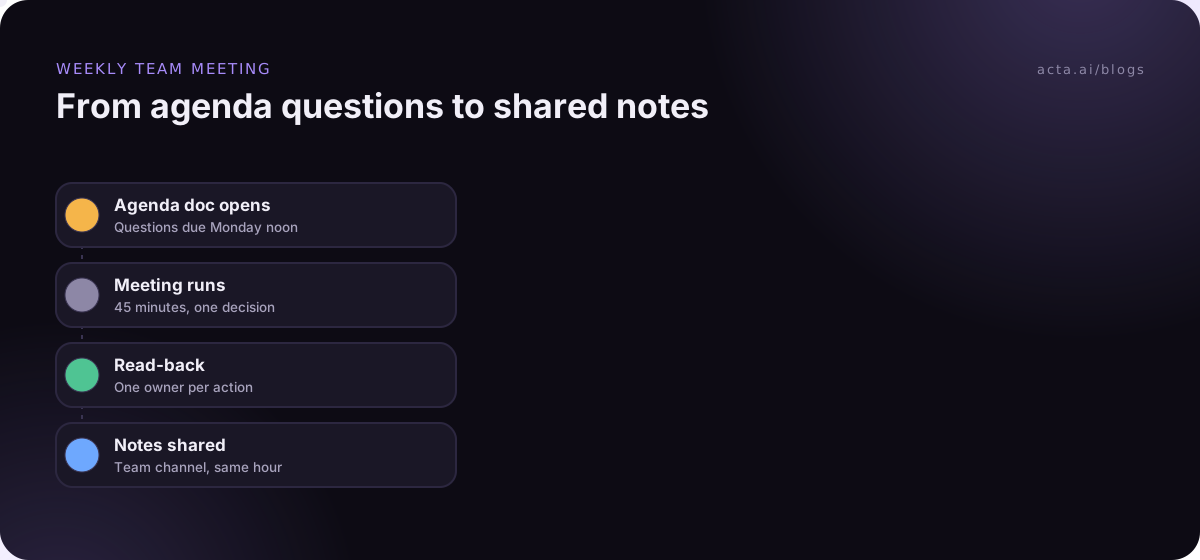
The last five minutes matter more than the first. Read back each decision and each action item with one owner and a date. If an item has two owners, it has none.
Then get the notes out fast, ideally within the hour. HBR's research on meeting hangovers recommends creating action plans rather than just agendas, and following up on accountability. Our guide on how to take meeting notes covers what to capture, and why action items don't get done covers the follow-up.
If nobody wants to be the note-taker every week, recording the meeting is a reasonable option, as long as the team knows and agrees; see our guide on recording meetings with AI and what to tell participants. For a team call in Google Meet, a Chrome extension can record from your own browser without a bot joining. For Zoom or Teams desktop meetings, a desktop app does the same from your computer.
How often should you change the format?
Keep the skeleton steady and change the rotating segment roughly monthly. Every quarter, ask the team two questions in a quick anonymous poll: "Is this meeting worth your time?" and "What would you change?" Take the answers seriously. If people say it isn't worth their time, cut it to every other week before you try to make it more fun.
And if the main question slot is empty for three weeks in a row, the team might not need a weekly meeting. That's a good outcome, not a failure.
Where Acta fits
Acta records your team meeting with a bot or bot-free from your desktop or browser, then writes a summary with decisions and action items with owners. You can pick from 40 report templates for the notes, and OneChat lets the team ask questions across past meetings, like "when did we agree to drop the Q2 survey?" It saves the note-taker job, which tends to fall on the same person every week.
Frequently asked questions
How long should a weekly team meeting be?
For most teams, 30 to 45 minutes. If status updates are moved to writing, you rarely need an hour.
What are some quick team meeting agenda ideas for a small team?
A wins round, a "where I'm stuck" slot, and one decision. Three people can cover that in 20 minutes.
Should the manager always run the weekly meeting?
No. Rotating the facilitator spreads the effort and tends to make people more engaged. The manager can still own the main question.
How do I stop the meeting turning into status updates again?
Ask for written updates before the meeting and don't let anyone read theirs aloud. If someone starts, ask "is there anything in your update you need the group's help with?"
Are icebreakers worth it in a weekly meeting?
Occasionally. Once a month or when someone new joins is plenty. Weekly icebreakers tend to feel like a chore.
See how Acta turns team meetings into notes, decisions and owners on the features page.