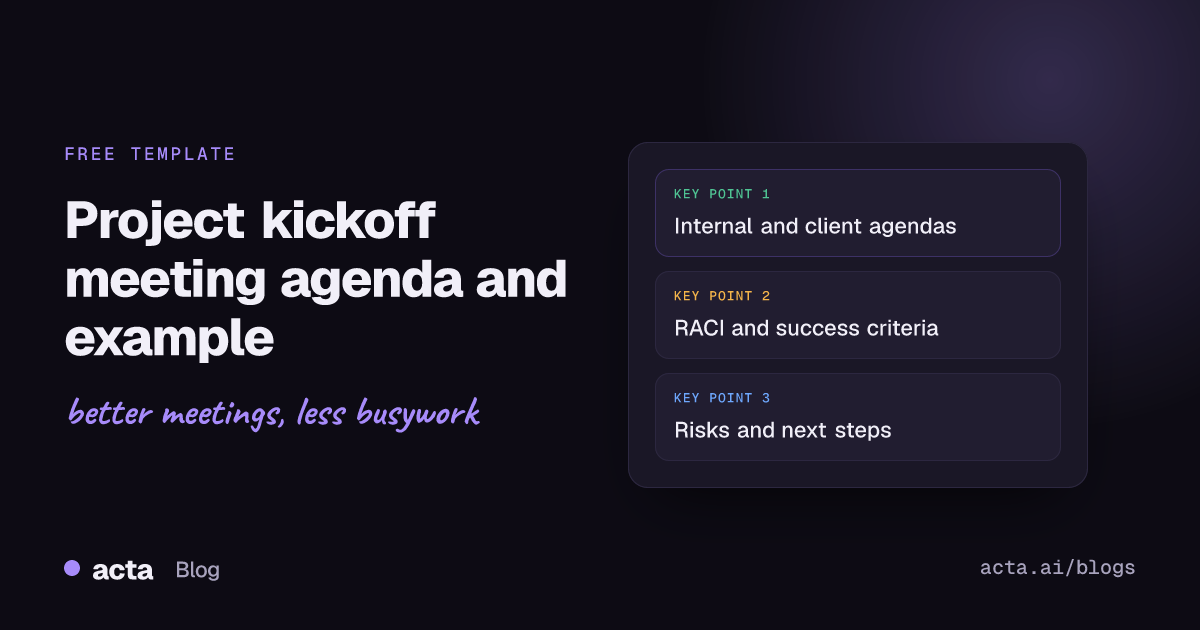
Quick answer: A project kickoff meeting agenda covers, in order: introductions and roles, why the project exists, goals and success criteria, project scope (in and out), timeline and milestones, roles and responsibilities (a RACI), risks and assumptions, how the team will communicate and make decisions, and next steps with owners and dates. Send pre-reads two days before so the meeting is spent agreeing, not reading.
A kickoff is the cheapest moment in a project to fix a misunderstanding. Once people start work, a different idea of scope or a missing approver costs weeks. A good project kickoff meeting agenda forces those differences into the open on day one.
This guide gives you a pre-read checklist, an internal kickoff agenda and a client kickoff agenda you can copy, a RACI format, a filled-in example for two fictional companies, the common mistakes, and how Acta turns the kickoff conversation into decisions, owners, risks and a status report baseline.
What is a project kickoff meeting?
A project kickoff meeting is the first meeting of the whole project team, and often the client or sponsor, after the project is approved. Its job is to make sure everyone leaves with the same understanding of the goal, the scope, who does what, and what happens next.
PMI's PM Network asked practitioners how to use the kickoff to set a project up for success (PMI: Ready to Launch). Their advice lines up with the agenda below: have the sponsor or an executive explain how the project supports the organization's strategy, have the project lead cover objectives, scope and a high-level plan, set out governance and how stakeholders will be kept informed, and let people introduce themselves and their role.
What should you send before the kickoff?
Send pre-reads at least two working days ahead, and ask people to read them. The kickoff should confirm and fill gaps, not present a document for the first time.
- Project charter or brief: the problem, the goal, the sponsor, and the budget if it is shared.
- Draft project scope: what is in, what is out, and what is still open.
- Draft timeline: key milestones and any fixed dates.
- Draft RACI: the main deliverables and who you think is Responsible and Accountable for each.
- Known risks and assumptions: the first five you can think of.
- Agenda: with the decisions you need from the meeting marked clearly.
Internal project kickoff meeting agenda (copy and paste)
Use this kickoff meeting template for a project run inside your own organization. Plan 60 minutes; large projects may need 90.
- Welcome and introductions (5 minutes): name, team, role on the project.
- Why this project (5 minutes): the sponsor explains the problem and how it links to company goals.
- Goals and success criteria (10 minutes): what done looks like, as measurable outcomes with a date.
- Project scope (10 minutes): in scope, out of scope, and open questions with an owner.
- Timeline and milestones (5 minutes): phases, fixed dates and dependencies on other teams.
- Roles and RACI (10 minutes): confirm who is Responsible, Accountable, Consulted and Informed for each deliverable.
- Risks and assumptions (5 minutes): the top risks, their owners, and what we are assuming is true.
- Ways of working (5 minutes): status meeting rhythm, where work is tracked, how decisions get made and escalated.
- Next steps (5 minutes): action items with owners and due dates, and the date of the first status meeting.
Client project kickoff meeting agenda
With a client, the same structure applies, but a few items change. Plan 60 to 90 minutes, and agree the agenda with the client's project lead in advance.
- Introductions on both sides (10 minutes): who is on each team, and the single point of contact on each side.
- Client's goals in their words (10 minutes): ask the client sponsor to describe success. Write it down exactly.
- Project scope against the contract (10 minutes): walk through what was signed. Name what is out of scope and how change requests work.
- Timeline and client dependencies (10 minutes): what you need from the client, by when (access, data, approvals, people).
- Roles and approvals (10 minutes): who on the client side approves deliverables, and how long they need.
- Risks (5 minutes): what could delay or derail the project, on either side.
- Communication (5 minutes): status report format and frequency, meeting rhythm, escalation path.
- Next steps (5 minutes): actions for both sides, with owners and dates.
Keep internal concerns, such as margin or staffing, for your internal kickoff, which you should hold first.
How do you set roles with a RACI?
A RACI chart lists each deliverable or decision and marks who is Responsible (does the work), Accountable (owns the outcome and signs off), Consulted (gives input before) and Informed (told after). The most important rule: one Accountable person per item. As Cornell IT's RACI definitions put it, you can only have one A for an item, so that accountability and decision authority are clear.
A simple format you can copy into a list:
- [Deliverable or decision]: R - [name] / A - [name] / C - [names] / I - [names]
Keep Consulted short: every name there adds a review step. If you want the RACI to stay current as people change roles mid-project, see our guide to a decision log and RACI built from your meetings.
Project kickoff example: Northwind and Contoso
Here is the template filled in for a client kickoff. Northwind and Contoso are fictional companies and everyone named is invented.
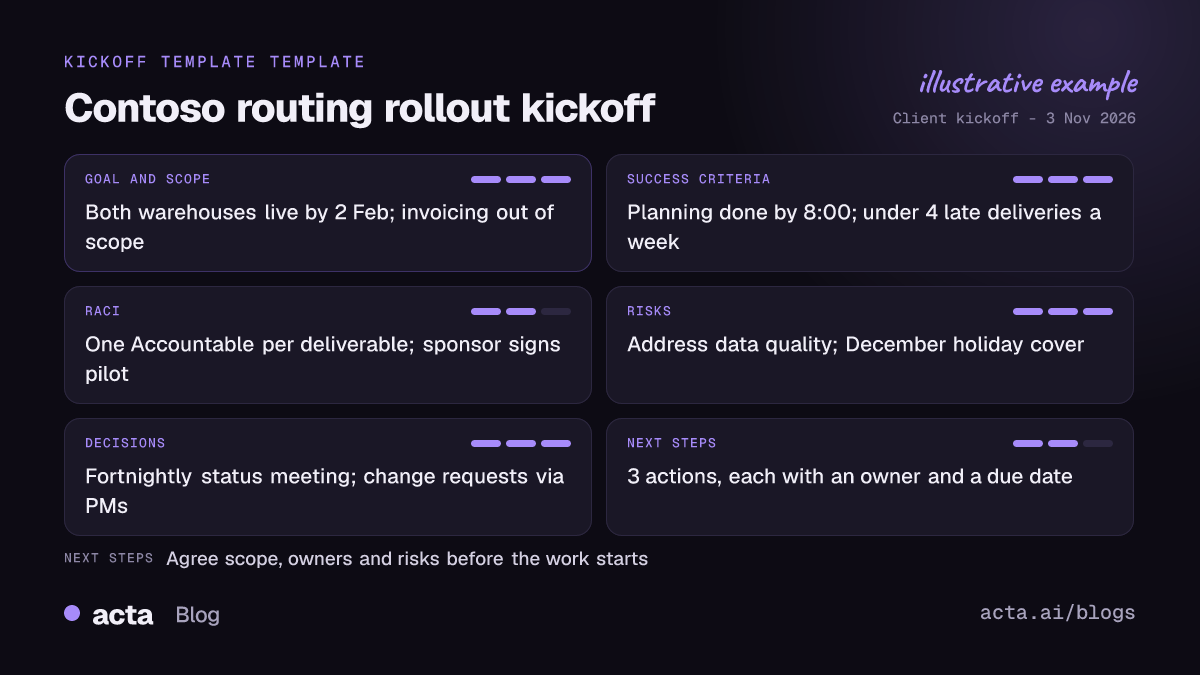
Contoso warehouse routing rollout - client kickoff - 3 November 2026
Attendees: Contoso - Erin Walsh (sponsor), Jordan Patel (project lead), two dispatchers. Northwind - Sofia Lind (project manager), Ravi Nair (engineer), Alex Rivera (account executive).
Goal: Route planning for both warehouses done in Northwind's tool before the second warehouse opens on 2 February.
Success criteria: Morning planning finished by 8:00; late deliveries cut from about 12 a week to under 4 by the end of March.
Project scope: In - route planning, driver mobile app, CSV import of customer addresses. Out - invoicing integration (phase 2). Open - whether the old spreadsheets need archiving (owner: Jordan).
Milestones: data import 21 November; pilot with one warehouse 8 December; second warehouse live 2 February.
RACI:
- Data import: R - Ravi Nair / A - Sofia Lind / C - Jordan Patel / I - Erin Walsh
- Pilot sign-off: R - Jordan Patel / A - Erin Walsh / C - dispatchers / I - Alex Rivera
Risks: address data quality unknown (owner: Ravi, check by 14 November); dispatchers' holiday cover in December (owner: Jordan).
Decisions: fortnightly status meeting on Tuesdays; change requests go through Sofia and Jordan.
Next steps:
- Send address export - Owner: Jordan Patel - Due: 7 November
- Circulate kickoff notes and final RACI - Owner: Sofia Lind - Due: 4 November
- Book first status meeting - Owner: Sofia Lind - Due: 4 November
How do you write success criteria, risks and next steps?
Success criteria
- Use numbers and a date: "planning finished by 8:00 by 31 March", not "faster planning".
- Agree who measures it, and how.
- Limit yourself to three to five criteria the sponsor actually cares about.
Risks
- Write each risk as cause and effect: "If address data is poor, the import slips and the pilot moves."
- Give each one an owner and a next check date.
- Include risks on the client side and the people side, not only technical ones. Our post on project risks hiding in everyday conversations lists the ones teams most often miss.
Next steps
- Every action gets one owner and a due date.
- Send the notes within a day, with the final RACI and the decisions made.
- Book the first status meeting before the kickoff ends.
What are the most common kickoff mistakes?
- No sponsor in the room. Without the sponsor, nobody can confirm why the project matters or settle scope questions.
- Vague scope. Listing only what is in scope invites assumptions. Say what is out, too.
- Two people Accountable. Shared accountability usually means nobody signs off.
- Too many stakeholders. Invite people who will do or approve the work. Keep everyone else informed by email.
- A presentation, not a conversation. If the project manager talks for 50 minutes, nobody has agreed to anything.
- No written record. Three weeks later, people remember different decisions. Write down what was agreed and send it.
How does Acta turn a project kickoff meeting into a baseline?
The kickoff is one of the few meetings where almost everything said matters later. Acta captures it so the project manager can run the meeting instead of typing.
- Capture. Acta records Zoom, Google Meet and Microsoft Teams through a meeting bot that joins from your calendar, or without a bot through the desktop app, the Chrome extension, or the mobile apps for an in-person kickoff. You can also upload a recording. Recording people needs their consent where the law requires it, so tell attendees at the start, especially client stakeholders; see whether it is legal to record meetings with AI.
- Decisions with owners. Acta logs each decision with who decided and the owner. If a decision is later changed or reversed in another meeting, the decision history shows where and when, with the transcript moments. More on the meeting decision log.
- Action items and promises. Next steps become action items with owners and due dates. Promises made to or by the client are tracked as open or delivered, and how late they are.
- Risks. Risks raised in the kickoff are listed with level, impact and a mitigation, either the one agreed in the meeting with an owner and date, or one Acta suggests. Later warning signs, such as overdue promises, are added.
- Status report baseline. The goals, scope, milestones and risks from the kickoff become the starting point for your status reports, so later meetings are compared against what was agreed. See the project status report from status meetings for the format.
- Share and ask. Export the notes to PDF, Word or Markdown, or send them to Confluence, Notion or Google Drive. Ask OneChat, or Claude and ChatGPT through Acta's MCP server, "What did we agree was out of scope at kickoff?"
A person still checks the kickoff notes before they go out, especially the RACI and the success criteria. Browse the Acta agents for project teams to see the templates.
Frequently asked questions
How long should a project kickoff meeting be?
Sixty minutes for most projects, 90 for large or client projects. If you need longer, the pre-reads were probably not read, or the scope is not settled yet.
Who should attend a kickoff meeting?
The sponsor, the project manager, the people doing the work, and anyone who approves deliverables. Other stakeholders can get the notes afterwards.
What is the difference between an internal and a client kickoff?
An internal kickoff covers staffing, budget and internal risks. A client kickoff focuses on the client's goals, the contracted scope, client dependencies and approvals, and how you will communicate.
What is a kickoff meeting template?
A fixed agenda and notes format for the first project meeting: goals, scope, timeline, roles, risks and next steps. Using the same template for every project makes kickoffs faster to plan and easier to compare.
Should the RACI be finished before the kickoff?
Draft it before and confirm it in the meeting. People often spot a missing approver or a wrong owner only when they see their name on the chart.
Want decisions, owners and risks from your next kickoff written down for you? Try Acta free for 15 days.