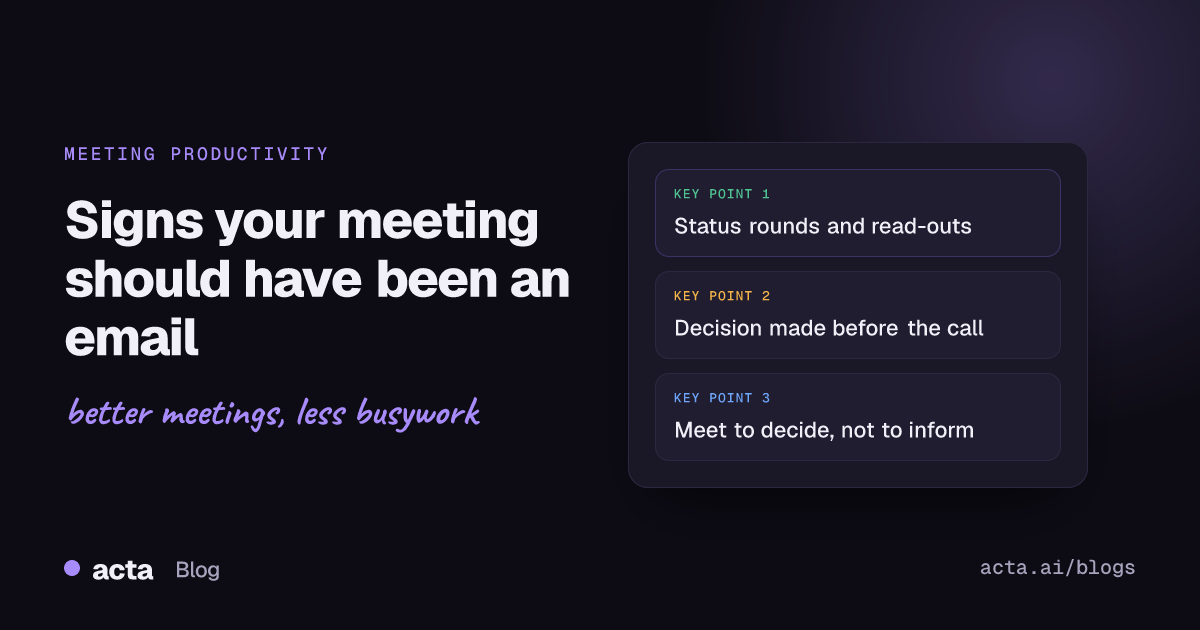
Quick answer: A meeting should have been an email when nobody needed to respond live: the content was a status update, the decision was already made, most attendees only listened, or the same result would have come from a written note and a reply-by date. If people need to argue, decide together or read a room, keep the meeting.
Everyone knows the feeling. You close the laptop after 45 minutes, look at your notes and find three lines, two of which you already knew. The phrase "this meeting could have been an email" became a joke because it's so often true, but the joke doesn't help much when you're the one sending the invite next Tuesday.
So this post is the practical version. Below are the signs I look for before and after a meeting, a quick test you can run on any invite, what to send instead, and the cases where swapping to email makes things worse.
Why do so many meetings end up feeling like a wasted hour?
Mostly because a meeting is the default tool. Booking 30 minutes takes ten seconds; writing a clear update takes twenty minutes of actual thinking. Calendars reward the lazy option, and the cost lands on everyone else. If you want a number, here's how to calculate the cost of a meeting.
It isn't just grumbling. In Microsoft's 2023 Work Trend Index, based on a survey of 31,000 people in 31 countries, inefficient meetings came out as the top thing people said got in the way of their productivity. That matches what most of us see: the problem is rarely meetings as such, it's meetings booked for jobs that writing does better.
Elizabeth Grace Saunders made a similar point years ago in a Harvard Business Review piece, Do You Really Need to Hold That Meeting? One of her observations has stuck with me: when you aren't clear on what you're doing, scheduling a meeting gives you the feeling of progress. Her fix is to do some thinking on your own first, and to use email when you need answers that don't require a two-way conversation.
What are the signs a meeting should have been an email?
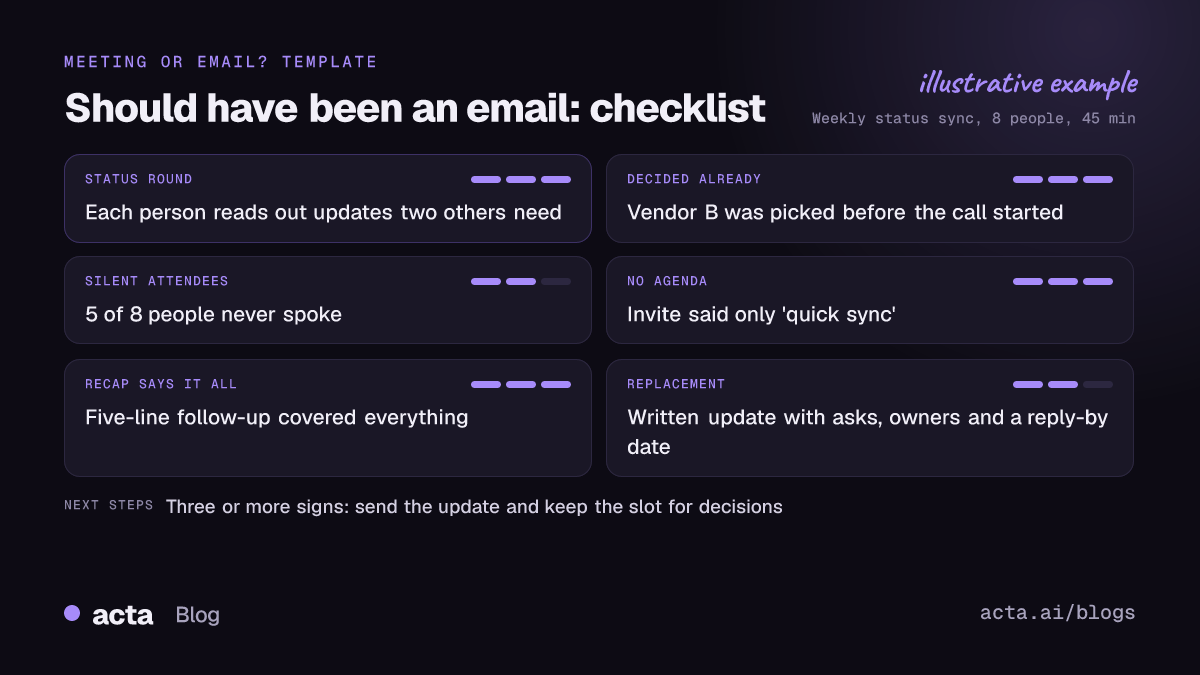
Here are the ones I'd bet on. One sign alone isn't damning. Three or more, and you know the answer.
1. It was a round of status updates
Eight people take turns saying what they did this week. Each person is relevant to maybe two others. That's the classic case: a shared doc or a short email with one paragraph per person does the same job, and people read it in four minutes instead of sitting through thirty.
2. The decision was made before anyone joined
If the organizer opens with "so we've decided to go with vendor B," the meeting is an announcement. Announcements are emails. If you want buy-in, say so in the email and invite objections by a date.
3. Most people never spoke
Count the people who said nothing for the whole call. If it's more than half, most of the room was there to listen, and listening is something people can do at their own pace with a written version.
4. There was no meeting agenda, or the agenda was "sync"
"Quick sync" and "touch base" are warning labels. If the organizer can't write down the question the meeting answers, the meeting probably doesn't have one.
5. Someone shared a slide deck and read it out
Reading slides aloud to people who can read is a strange ritual. Send the deck with three questions you want answered.
6. The follow-up email said everything the meeting did
This is the clearest after-the-fact test. If the recap is five lines and nobody would miss anything by reading only the recap, you have your answer. The meeting was the draft and the email was the real thing.
7. It's a recurring meeting nobody would miss
HBR has a short tip on this, Do You Actually Need That Recurring Meeting?, and its question is a good one to steal: if we cancelled this, who besides me would care? Weekly meetings tend to outlive the project that created them.
How do you decide before you send the invite?
Run this check in your head before booking. It takes under a minute.
- Write the outcome in one sentence. "By the end, we'll have picked a launch date." If you can only write "discuss Q3," stop and think first.
- Ask whether the outcome needs back-and-forth. Choosing between options with trade-offs, untangling a disagreement or brainstorming usually does. Sharing information, collecting approvals or asking yes/no questions usually doesn't.
- Check who has to be there live. If only two people need to talk and six need to know, have a 15-minute call with the two and email the six.
- Check the urgency. If it can wait 24 hours for replies, write it. If something's on fire, call people.
- Decide, then say why. If you do book the meeting, put the one-sentence outcome in the invite so people can judge whether they need to come.
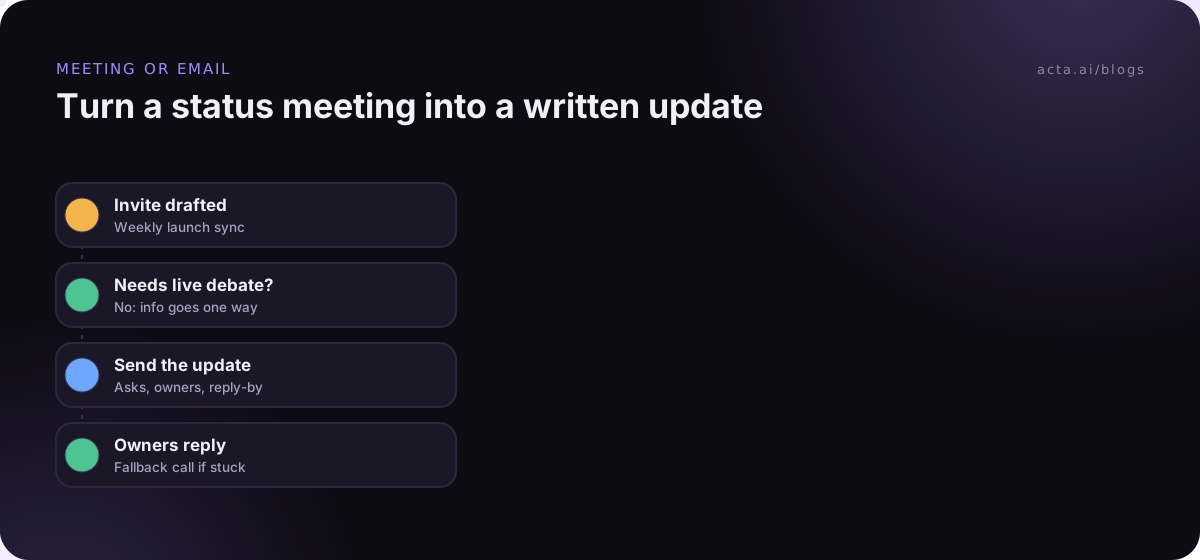
Most of my "should I meet?" cases get settled at step 2. Information goes one way; decisions with friction go both ways.
What should you send instead of the meeting?
A bad email is no better than a bad meeting. The replacement has to be easy to act on, which means the reader should know in ten seconds whether they need to do anything.
A format that works for most teams:
- Subject line with the ask: "Launch date: need your pick by Thursday" beats "Q3 update."
- First line: what you need from whom. "Priya, pick A or B. Marco, flag anything that blocks the 14th. Everyone else, FYI only."
- Then the context, short paragraphs or bullets, with links to anything longer.
- A reply-by date. Without one, async turns into silence. Our async meetings guide has more on making written updates work.
- A fallback. "If we can't agree in the thread, I'll book 20 minutes Friday." This removes the fear that email means losing your chance to object.
For recurring status updates, a shared doc that people fill in by a set time often beats email, because the history stays in one place. If your team already lives in Slack or Teams channels, post it there. The medium matters less than having an ask, an owner and a date.
If your standup has slowly turned into a status meeting, there's a template for a tighter version in our post on daily and weekly standup meetings.
When should it stay a meeting, even if it feels slow?
The "should have been an email" reflex can go too far. Some things are worse in writing:
- Hard feedback and bad news. A layoff, a missed promotion or a tense performance issue deserves a voice and a face. Email strips out tone and invites the worst reading.
- Real disagreements. When two people disagree, a thread of long replies tends to harden positions. Ten minutes on a call usually finds the actual sticking point.
- Brainstorming early ideas. Half-formed ideas build on each other in conversation. Writing makes people polish before they share, which is the opposite of what you want at this stage.
- Kickoffs and relationship building. New team, new client, new project: people need to hear each other before they can work well in writing.
- Anything with a lot of unknowns. If the question keeps changing as you talk, it's not ready for email.
A useful rule: meet to decide, write to inform. When a meeting does decide something, make sure it's captured. Decisions that only live in people's memories get re-argued a month later, which is a whole other way to waste a meeting. Our guide on how to track decisions made in meetings covers that part.
Can a meeting be fixed instead of cancelled?
Often, yes. Before you kill a recurring meeting, try these cheaper fixes:
- Move updates out, keep discussion in. People post their updates in writing before the meeting. The call starts with "anything in the updates you want to talk about?" and covers only that. A 60-minute weekly often drops to 20.
- Cut the attendee list. Make attendance optional for anyone who only needs the outcome, and send them the notes.
- Shorten the default. Book 25 minutes instead of 30, or 15 instead of 25. Work tends to fill the slot.
- End with owners. If a meeting doesn't end with named people and dates, it will probably need a second meeting. Our post on why action items don't get done goes deeper on that.
Making attendance optional only works if the people who skip actually get the content. The simplest way is to record the meeting and share the notes. If bots aren't welcome in the call, a desktop recorder or a Chrome extension can capture it from your own computer instead. Either way, tell people you're recording; our post on recording consent and what to tell participants covers the basics.
How do you push back on a meeting that should have been an email?
Saying "this could be an email" out loud rarely goes well, especially to your manager. A few gentler moves that work:
- Ask for the outcome. "Happy to join. What do you need from me by the end?" Sometimes the organizer realises there isn't anything.
- Offer the written version. "I can send my update in writing beforehand if that saves time." Most organizers say yes.
- Decline with a contribution. "I'll skip this one, here are my two points, and I'll read the notes." You're still participating, just not live.
- Fix your own meetings first. The quickest way to change a team's habits is for people to notice your meetings got shorter and your emails got clearer.
One mistake I see a lot: people cancel a meeting, send nothing, and then wonder why the team drifts. Cancelling only works if the email replacing it actually goes out.
Where Acta fits
For the meetings that do need to happen, Acta records Zoom, Google Meet and Microsoft Teams, either with a meeting bot or bot-free from your computer, and writes the summary, decisions and action items with owners afterwards. It also drafts the follow-up email, so the people you excused from the call still get what they need without sitting through it.
Frequently asked questions
What does "this meeting could have been an email" mean?
It means the meeting delivered information that people could have read on their own time, without needing a live conversation. It's usually said about status updates, announcements and slide read-outs where most attendees just listened.
Is it rude to suggest a meeting should have been an email?
It can be if you say it bluntly. It lands better as an offer: ask what the meeting needs to produce, or offer to send your input in writing. Most organizers are glad to save the time.
How many people is too many for a meeting?
There's no magic number, but if more than half the attendees never speak, the list is too long. Keep the people who need to talk and send everyone else the notes.
Should status updates ever be a meeting?
Rarely as the whole meeting. Collect updates in writing first, then use a short call only for the items that raised questions or need a decision.
What if people don't read the email?
Make the ask impossible to miss: put the request and the deadline in the subject and first line, name who needs to act, and say what happens if nobody replies. If an important email still gets ignored, then book the short meeting.
If you'd like your remaining meetings to come with notes and follow-up drafts already written, you can try Acta with a 15-day free trial.