Steering committee minutes should record what the committee decided, approved, escalated and asked for, with an owner and date on every action, not a summary of the status presentation. Below are eight copy-ready steering committee minutes templates: a standard meeting, a decisions-only page, an exception, a change request, a stage gate, a project closure, a first meeting and a programme board, each with when to use it.
Meeting Productivity 11 min read
Steering Committee Minutes: 8 Templates for Decisions and Escalations
Eight copy-ready steering committee minutes templates that lead with decisions, escalations and actions, for routine reviews, exceptions, stage gates, closure and programme boards.
By Sarma BKP, Founder & CEO, Acta · Updated
This guide is for project managers, PMO leads and the people who end up as secretary to a steering committee (often the PM, sometimes a project coordinator). It covers project and programme steering committees inside organisations. It isn't about the minutes of a company's board of directors, which have their own legal formalities; for those, see our guide on board meeting minutes from the recording.
Key takeaways
- Lead the minutes with decisions. Members read the first five lines; put what was approved, rejected or escalated there.
- Write each decision as one sentence with a subject and a verb: "The committee approved a two-week extension to Stage 2, with go-live moving to 14 March."
- Record the options considered and the reason for the choice whenever the committee handles an exception or a change request.
- Give every action an owner, a due date and the meeting where it will be checked.
- Send draft minutes within two working days and ask the chair to approve them, then confirm them at the next meeting.
Table of contents
- Steering committee minutes record decisions, not discussion
- The standard template covers status, decisions, risks and actions
- Exception and change minutes need options and a reason
- Stage-gate and closure minutes record a go, no-go or sign-off
- First meetings and programme boards need their own versions
- Pick the steering committee minutes template, then write it in five steps
- Where a meeting recorder helps the committee secretary
- Frequently asked questions
- Set up minutes your steering committee will read
Steering committee minutes record decisions, not discussion
A project steering committee is a group of senior people who direct a project or programme: they approve the plan and budget, make decisions the project team can't, and handle issues escalated from below. It's usually chaired by the sponsor or project owner. In PRINCE2 terms, the equivalent is the project board, with an Executive who owns the business case and Senior User and Senior Supplier roles representing the people who'll use and build the result, as this overview of the PRINCE2 project board explains. UK government projects name a single senior responsible owner who is accountable for the project being governed and managed well.
The problem is that many steering committees don't actually steer. McGrath and Whitty's paper Do steering committees really steer? found practitioners confused about the committee's role in several distinct ways. Minutes are where that shows. If the minutes are three pages of "the PM presented the status update" with no decisions, the committee is acting as an audience, not a governing body.
So the rule for the secretary is simple: the minutes exist to record what the committee did. That means:
- Decisions: approved, rejected, deferred, with conditions.
- Escalations: issues raised to the committee and what it did with them.
- Directions: instructions to the project, such as "re-plan Stage 3 within the current budget".
- Actions: who does what by when.
- Exceptions only for status: what's off track, not a copy of the status report.
The standard template covers status, decisions, risks and actions
Most steering committee meetings are routine monthly or fortnightly reviews. These two templates cover them.
Template 1: Standard steering committee minutes template
When to use it: regular steering committee meetings for a single project.
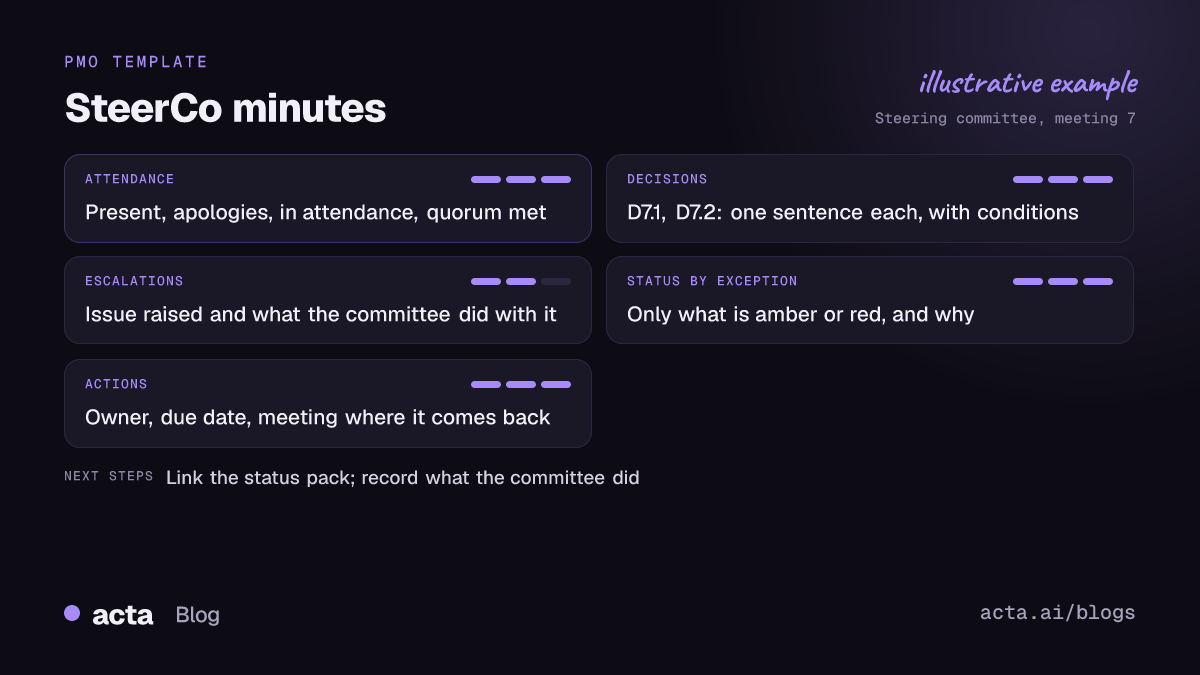
[Project] Steering Committee / Meeting [no.] / [date] / [location or call]
Present: [name, role] / Apologies: [names] / In attendance: [PM, guests]
Quorum: [met / not met]
1. Minutes and actions from last meeting: [approved / amended] / [open actions and status]
2. Decisions: [D-numbered list, one sentence each]
3. Status by exception: [overall RAG] / [what's amber or red and why]
4. Escalated risks and issues: [item] / [committee response]
5. Budget: [spend vs plan, any change requested]
6. Actions: [A-numbered] / [owner] / [due] / [review at meeting no.]
Next meeting: [date]
Filled-in example (fictional): "D7.1 The committee approved moving the data migration dry run from 3 to 10 February, as the vendor's test environment is late. Go-live date unchanged. D7.2 The committee rejected the request for a second test environment; the PM to re-plan within the existing one. Status: overall amber (schedule). Escalated: supplier resourcing on the integration team; Senior Supplier Priya to confirm two named developers by 31 January. A7.1 Priya, named developers, 31 Jan, review at meeting 8."
Number decisions by meeting (D7.1, D7.2). It makes them easy to reference in later minutes and in your decision log.
Template 2: Decisions-only steering committee minutes
When to use it: short meetings, or committees whose members won't read more than a page.
[Project] SteerCo / [date] / Present: [names]
Decided: [D-number] [decision in one sentence]
Escalated to [higher body]: [item and why]
Asked the project to: [direction]
Actions: [owner] / [action] / [due]
Papers: [link to status report and pack]
This is the format I'd default to if attendance is senior and time is short. The status report already exists as a paper; there's no reason to retype it in the minutes. Link it instead.
Exception and change minutes need options and a reason
When a project is forecast to go beyond what the committee agreed (on time, cost or scope), the committee has to choose what happens next. PRINCE2 calls the document behind this an exception report. Whatever your method, the minutes of that discussion matter more than any other, because they're what people look at when the project is reviewed later.
Template 3: Exception or escalation minutes
When to use it: the project has breached, or will breach, its agreed tolerance on time, cost or scope.
Exception raised by: [PM] / [paper reference]
What has changed: [cause, in two lines]
Impact: [time / cost / scope / benefits]
Options considered: [A] / [B] / [C], with impact of each
Decision: [option chosen] / [conditions]
Reason: [why this option over the others]
Dissent or concerns recorded: [member, concern]
Next step: [exception plan due by / escalate to / revised tolerances]
"Reason" and "dissent" are the two lines secretaries leave out. Put them in. If a member said "I'm uncomfortable with this, but I won't block it", that's worth a line.
Template 4: Change request approval minutes
When to use it: requests to change scope, budget, timeline or a key deliverable.
Change request: [CR number] / [title] / [raised by]
Summary: [what changes and why]
Impact: [cost] / [time] / [benefits] / [risks]
Decision: [approved / approved with conditions / rejected / deferred to (date)]
Conditions: [if any]
Change log updated by: [name] / [date]
Stage-gate and closure minutes record a go, no-go or sign-off
Some meetings exist to make one big decision: can the project move to the next stage, and can it close? The minutes should make that decision unmistakable.
Template 5: Stage-gate (go / no-go) minutes
When to use it: end of a stage or phase, before committing the next tranche of budget or people.
Gate: [end of Stage 2 / design approval / go-live readiness]
Criteria reviewed: [criterion] / [met / partly / not met] / [evidence]
Business case still valid: [yes / yes with changes / no]
Decision: [go / go with conditions / no-go / stop]
Conditions and owners: [condition] / [owner] / [by]
Next stage approved: [budget] / [dates] / [tolerances]
Use a criteria line for each readiness item, not a general "all criteria reviewed". A go-live decision that turns out badly gets reviewed line by line, and "partly met, accepted by the committee because the workaround is in place" protects everyone better than silence.
Template 6: Project closure minutes
When to use it: the final steering committee meeting, closing the project.
Deliverables accepted: [item] / [accepted by]
Open items handed over: [item] / [to whom] / [by]
Benefits review: [who measures which benefit, and when]
Lessons recorded: [link]
Decision: the committee [approved / did not approve] project closure
Committee disbanded: [yes / date]
First meetings and programme boards need their own versions
The first meeting sets the rules, and a programme board juggles several projects at once. Both need a slightly different structure.
Template 7: First steering committee meeting minutes
When to use it: the inaugural meeting, ideally just after project kickoff.
Terms of reference: [approved / amended] / [link]
Membership and roles: [chair, sponsor or SRO, members, secretary]
Quorum and decision rule: [e.g. chair plus two members; chair decides if no consensus]
Tolerances agreed: [time / cost / scope the PM can absorb without escalating]
Meeting rhythm: [frequency] / [papers due how many days before]
Initial decisions: [plan, budget, stage 1 approval]
The tolerances line saves more meeting time than anything else. Once the committee has agreed what the PM can absorb, small slips stop appearing on the agenda. If you're planning the kickoff too, our project kickoff meeting agenda pairs with this.
Template 8: Programme steering committee minutes
When to use it: one committee overseeing several related projects.
Programme status: [overall RAG, benefits on track or not]
By project: [project] / [RAG] / [exception, if any] / [decision needed]
Cross-project dependencies: [dependency] / [risk] / [owner]
Resource conflicts: [conflict] / [committee decision]
Decisions: [D-numbered]
Actions: [owner] / [due]
Feed each project's line from its own status report. Our guide to project status reports with RAG ratings covers how to keep those consistent.
Pick the steering committee minutes template, then write it in five steps
| Meeting type | Template | What must be on the page |
|---|---|---|
| Routine review | 1 or 2 | Decisions, exceptions, actions |
| Tolerance breach | 3 | Options, decision, reason, dissent |
| Scope or budget change | 4 | CR number, impact, decision |
| End of stage | 5 | Criteria, go or no-go, conditions |
| Final meeting | 6 | Acceptance, handover, closure decision |
| First meeting | 7 | Terms of reference, tolerances |
| Several projects | 8 | Dependencies, resource conflicts |
Then write the minutes the same way every time:
- Prepare the skeleton before the meeting. Copy the template, fill attendees and agenda items, and list the decisions the papers ask for.
- Capture decisions in the room. When the chair closes an item, read the decision back: "So we're approving option B, with go-live on 14 March?" Write what they confirm.
- Draft within a day. Decisions first, then escalations, exceptions and actions. Cut anything that only repeats the papers.
- Send to the chair for approval, then to members, within two working days.
- Confirm at the next meeting under item 1, and carry open actions forward.

Mistakes that make steering committee minutes useless
- Retyping the status report: link it; record only exceptions and what the committee did about them.
- Vague decisions: "the committee discussed the timeline" isn't a decision. If nothing was decided, write "No decision; deferred to meeting 8 pending the vendor's revised plan."
- No reasons: a year later, nobody remembers why option B won.
- Actions without a review point: add the meeting number where each one comes back.
- Late minutes: after a week, members remember the meeting differently. Our guide to meeting minutes best practices has more on making minutes people read.
Where a meeting recorder helps the committee secretary
The secretary's hardest job is capturing the exact wording of a decision while also following the discussion. If the committee agrees to it being recorded, Acta can record the meeting and draft a summary with decisions and action items with owners, which you then shape into one of the templates above, or match through Acta's report templates. For steering committees on Zoom or Teams where nobody wants a bot in the participant list, the Acta desktop app records from your own computer. Agree on recording at the first meeting and note it in the terms of reference; our guide on recording meetings with AI and consent covers what to tell members.
Frequently asked questions
What should be included in steering committee minutes?
Include the meeting number and date, who was present, apologies and quorum, approval of the last minutes, numbered decisions, escalated risks and issues with the committee's response, status by exception, budget changes, and actions with owners, due dates and a review meeting. For exceptions and change requests, add the options considered and the reason for the decision.
Who takes the minutes in a steering committee meeting?
Usually a named secretary, often the project manager, a PMO analyst or a project coordinator. Ideally it isn't the person presenting, because presenting and minuting at once means decisions get missed. Name the secretary in the terms of reference, and have the chair approve the minutes before they go to members.
What is the difference between steering committee minutes and board minutes?
Steering committee minutes govern a project or programme inside an organisation: decisions on plans, budgets, changes and stage gates. Board minutes record decisions of a company's board of directors and often carry legal and regulatory requirements. Steering committee minutes can be shorter and more operational, but should still record every decision with its reason.
How soon should steering committee minutes be sent?
A common practice is to send draft minutes to the chair within a day or two of the meeting and to all members once the chair has approved them, then confirm them formally at the next meeting. Your terms of reference can set a firm deadline. The sooner they go out, the fewer disagreements about what was decided.
Should steering committee minutes record who disagreed?
Record concerns or dissent when a member asks for it to be noted, or when it matters for a significant decision such as an exception or a go-live. Keep it factual: the member's name or role and their concern in one line. Don't record every back-and-forth; the decision and its reason are what matter.
Set up minutes your steering committee will read
Good steering committee minutes take less time to write than bad ones, because you stop retyping the status report. Use this checklist before your next meeting:
- Pick the format: Template 1 for full minutes, Template 2 if members won't read more than a page.
- Agree tolerances: put them in the terms of reference so small slips stay off the agenda.
- Number decisions: use meeting.decision numbering and copy them into your decision log.
- Read decisions back: confirm the wording with the chair before moving to the next item.
- Send within two days: chair approval first, then members.
If your committee meets on Zoom or Teams, try the Acta desktop app during the 15-day free trial and compare its draft decisions with your own notes.
Found this useful? Share it with your team.