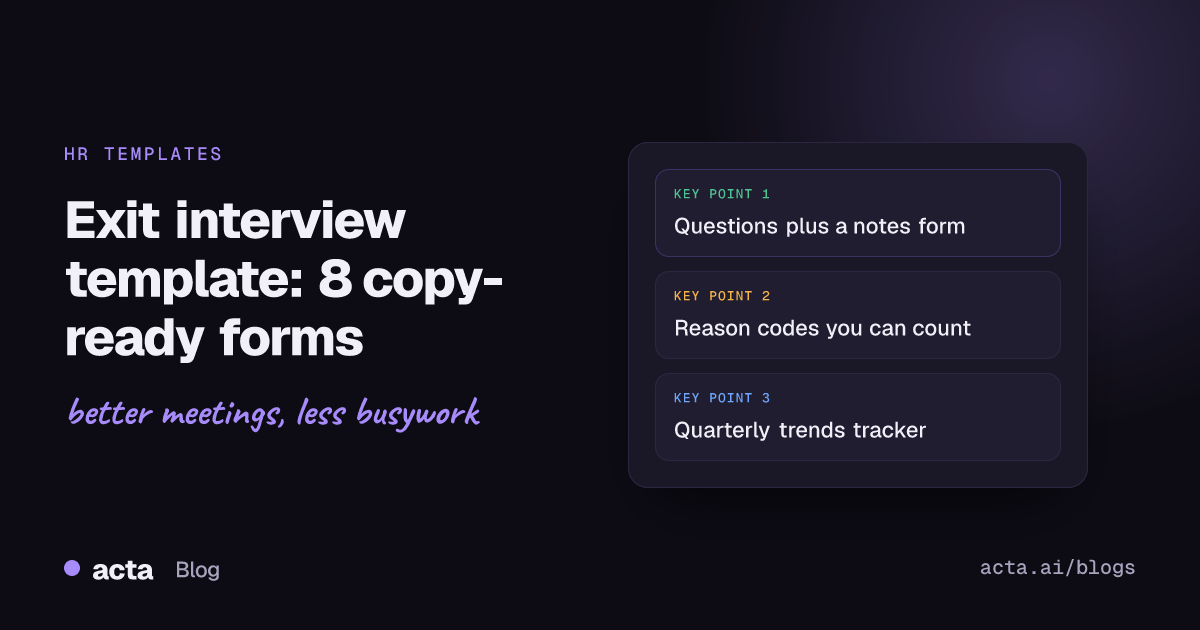
An exit interview template is a fixed set of questions plus a notes form, so every leaver is asked the same core things and every answer is written down the same way. Below are eight copy-ready templates: the standard interview, the interviewer's notes form, a regretted-leaver version, an escalation note, a written survey, a remote interview script, a one-page summary and a quarterly trend tracker.
Meeting Productivity 11 min read
Exit Interview Template: 8 Copy-Ready Forms, Notes and Trackers
Eight copy-ready exit interview templates covering the questions, the interviewer's notes form, regretted leavers, escalations, surveys, remote interviews and quarterly reporting.
By Sarma BKP, Founder & CEO, Acta · Updated
This is for HR teams, people partners and managers at small companies who run exit interviews themselves. If you're after the questions themselves, our guide to exit interview questions that reveal the real reasons people leave goes deeper on wording. This post is about structure: what to capture, how to write it up, and how to turn ten interviews into something leadership will act on. It's general information, not legal advice; check local employment and data rules before you record or store anything.
Key takeaways
- Use a semistructured format: five or six fixed questions you ask everyone, then open follow-ups. HBR's Spain and Groysberg recommend combining standard and open-ended approaches.
- Have someone other than the leaver's direct manager run it, ideally HR or a manager one step removed.
- Write the notes within an hour, with direct quotes in quotation marks and your interpretation kept separate.
- Tag every interview with one primary and one secondary reason code, so you can count patterns each quarter.
- Decide in advance what happens if someone raises harassment, discrimination or a safety issue: that's a separate process, not a line in the summary.
Table of contents
- An exit interview template has two halves: questions and notes
- The standard interview and the notes form come first
- Regretted leavers and serious concerns need their own versions
- Written surveys and remote interviews reach people who won't sit down
- A summary and a tracker turn interviews into decisions
- Run the exit interview so people tell you the real reason
- Where a notetaker fits in exit interviews
- Frequently asked questions
- Choose your exit interview template and set the routine
An exit interview template has two halves: questions and notes
Most free exit interview form downloads are a list of questions. That's half the job. The other half is the notes form: the structure you write the answers into, so that interview number twelve can be compared with interview number three. Without it, you end up with twelve documents in twelve formats and no way to say "four of our last ten leavers mentioned the same manager".
The Harvard Business Review article Making Exit Interviews Count by Everett Spain and Boris Groysberg (April 2016) makes the case for this mix: standard questions let you spot trends, while unstructured ones bring up things you didn't think to ask. It also suggests making exit interviews mandatory for at least some employees. SHRM's list of exit interview questions every HR professional should ask starts where you'd expect: what made the person decide to leave.
A good exit interview template therefore has:
- Fixed questions: the same five or six for every leaver, in the same order.
- Open follow-ups: prompts, not a script, for whatever the person raises.
- A notes form: reason codes, quotes, ratings and flags in fixed fields.
- A reporting layer: a summary and a tracker that roll the notes up.
The standard interview and the notes form come first
If you only set up two templates, make it these. Template 1 is what you ask; Template 2 is what you write.
Template 1: Standard exit interview template (semistructured)
When to use it: every voluntary leaver, as the default. Plan 30 to 45 minutes.
Opening: "Thanks for doing this. The aim is to learn what we should change. I'll take notes; here's who sees them: [who]."
1. What made you start looking, and what made you decide to accept?
2. What's the new role offering that we didn't?
3. How would you describe working with your manager, in one or two examples?
4. Did you have the tools, time and information to do your job well?
5. Was there a moment when staying was still possible? What would have changed your mind?
6. What should we keep doing exactly as it is?
Open follow-ups: "Tell me more about that." "When did that start?" "Who else is affected?"
Close: "Would you consider coming back one day? Is there anything you'd like us to pass on, and anything you'd rather we didn't?"
Question 5 is the most useful one on the list. It turns a general complaint into a specific, fixable moment: "If my promotion case hadn't been pushed to next year, I'd have stayed."
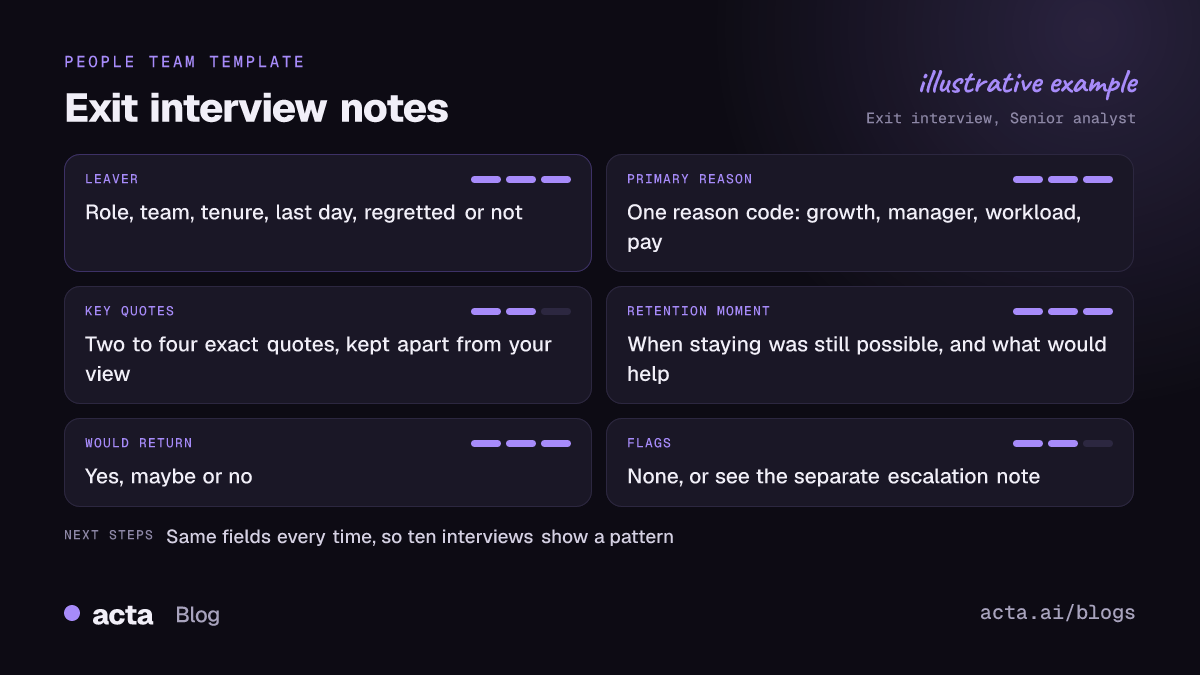
Template 2: Exit interview notes template
When to use it: immediately after every interview, filled by the interviewer.
Leaver: [role] / [team] / [tenure] / [last day] / [regretted or not]
Interviewer and date: [name] / [date] / [in person or video]
Primary reason code: [pay, growth, manager, workload, flexibility, culture, relocation, personal, other]
Secondary reason code: [same list]
Key quotes: "[exact words]" (2 to 4 quotes)
Interviewer interpretation: [your reading, clearly labelled as yours]
Could we have kept them: [yes / maybe / no] and the moment they named
Would return: [yes / maybe / no]
Flags: [none / needs follow-up, see escalation note]
Shared with: [who, at what level of detail]
Keep quotes and interpretation in separate fields. "The workload was impossible after the re-org" is a quote; "manager seems to over-allocate" is your interpretation. Mixing them is how exit notes become unfair to the manager and useless as evidence.
Regretted leavers and serious concerns need their own versions
Two situations break the standard template. One is the person you really didn't want to lose. The other is the interview where someone tells you something that needs action, not just a note.
Template 3: Regretted leaver interview
When to use it: high performers, people in hard-to-fill roles, or anyone whose manager says "we can't lose them". Run it with a senior person, not only HR.
1. When did you first think about leaving? What happened that week?
2. Did you raise it with anyone? What did they say?
3. If you'd been offered [the thing they named], would you have stayed?
4. Who else on the team feels the same way?
5. What would make you consider coming back in a year?
Notes: [retention moment] / [who knew] / [was it raised and when] / [boomerang potential]
Question 4 is delicate, so don't press for names. "A few people on the data team" is enough to act on. The answer to question 2 tells you whether your problem is the cause of leaving or the fact that nobody heard it in time.
Template 4: Escalation note for serious concerns
When to use it: the leaver mentions harassment, discrimination, fraud, a safety issue or anything your policies say must be investigated.
Date and interviewer: [date] / [name]
What was said: [their words, as close to verbatim as possible]
People named: [names or roles, as stated]
What the leaver wants: [investigation / just to put it on record / unsure]
What I told them happens next: [exact words]
Passed to: [HR lead or investigator] / [date and time]
Keep this out of the regular summary and the trend tracker. Don't promise confidentiality you may not be able to keep; say what you will do with it instead. If you need to handle the follow-up conversations, our guide to recording sensitive HR, legal and board meetings covers when a recording helps and when it doesn't.
Written surveys and remote interviews reach people who won't sit down
Some leavers won't do a live interview, and some teams are fully remote. These two templates cover both.
Template 5: Written exit survey
When to use it: people who decline an interview, very large leaver volumes, or as a pre-read before a short live conversation.
Rate 1 to 5: my manager / my growth / my workload / my pay / my team / how decisions are communicated
Choose one main reason: [reason code list, plus "other"]
Open: What's one thing we should change first?
Open: What's one thing we should never change?
Optional: Would you like a follow-up conversation? [yes / no]
Keep it under ten questions. A long exit survey gets "fine" for every answer. Use the same reason codes as Template 2, so survey and interview data land in one tracker.
Template 6: Remote exit interview script
When to use it: video exit interviews on Zoom, Teams or Google Meet.
Before: send the invite with the purpose, who will see the notes, and whether you plan to record. Offer a no-recording option.
Start: cameras optional; confirm consent to record or to take notes only.
Middle: Template 1 questions, with longer pauses than in person.
End: say what happens next and when they'll hear about their equipment return and final paperwork.
Silence feels longer on video, and people often fill it with the real answer. Count to five before your next question. If you record, tell the person first and explain why; our guide on whether it's legal to record meetings with AI walks through consent and what to say.
A summary and a tracker turn interviews into decisions
Exit interviews fail when nobody reads them. HBR's Spain and Groysberg note that many exit programmes go nowhere because the organisation brushes off what it hears. The fix is a reporting format short enough that leadership reads it.
Template 7: One-page exit interview summary
When to use it: sharing a single interview with the leaver's skip-level manager or department head.
Leaver: [role, team, tenure; no name if sharing widely]
Why they left (one sentence): [primary reason in plain words]
What would have kept them: [the moment they named]
What to keep: [what they valued]
Suggested action: [one, with an owner]
Template 8: Quarterly exit trends tracker
When to use it: once a quarter, combining every interview and survey from Templates 2 and 5.
| Reason code | Primary count | Secondary count | Teams | Example quote | Action and owner |
|---|---|---|---|---|---|
| Growth | [n] | [n] | [teams] | "[quote]" | [action / owner] |
| Manager | [n] | [n] | [teams] | "[quote]" | [action / owner] |
| Workload | [n] | [n] | [teams] | "[quote]" | [action / owner] |
| Pay | [n] | [n] | [teams] | "[quote]" | [action / owner] |
With small numbers, don't present percentages. "3 of 7 leavers" is honest; "43%" sounds like a survey. And in small teams, even a role and a quote can identify someone, so strip details before the tracker goes beyond HR.
Run the exit interview so people tell you the real reason
The template only works if the conversation is honest. These steps follow the common advice in SHRM's guidance on conducting exit interviews and HBR's research.
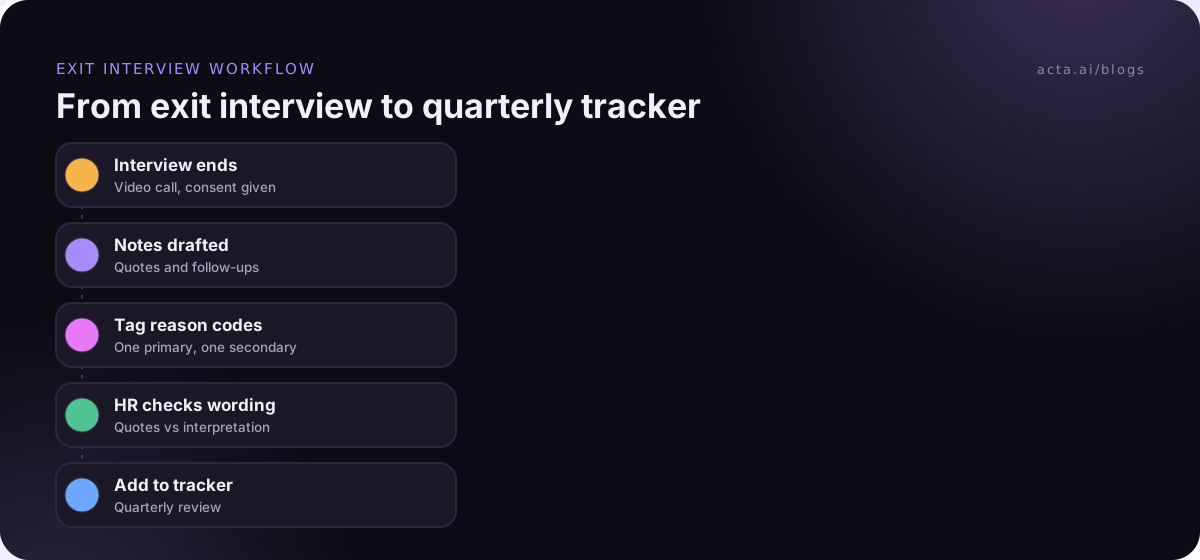
- Pick the interviewer. HR or a manager one step removed. The direct manager is usually the worst choice, because they may be the reason.
- Book it in the last week or two. Late enough that the person feels free to speak, early enough that they're still engaged.
- Say who sees what. Before the first question, explain where notes go and at what level of detail.
- Ask the fixed questions, then follow the energy. When someone hesitates or says "it's complicated", that's where the useful answer is.
- Write the notes within the hour. Fill Template 2 while you still remember the exact words.
- Close the loop. Add the interview to the tracker and put one action with an owner on the quarterly review. The leaver's work handover is a separate document; a job handover notes template covers that.
Mistakes that make exit interviews useless
- Asking only about pay: people often give pay as the polite answer. Ask what made them start looking.
- Arguing with the leaver: you're there to listen, not to correct their version of events.
- Interpretation in the quote field: keep their words and yours apart.
- No reason codes: without them, you can't count patterns.
- No owner for actions: the tracker becomes a list of complaints nobody fixes.
Where a notetaker fits in exit interviews
For video exit interviews where the leaver has agreed to recording, Acta can draft the notes with the decisions and action items, so you can listen instead of typing, then edit the draft into Template 2. A report template can match your own fields, and if a visible bot would feel heavy for this conversation, the Acta Chrome extension records Google Meet, Microsoft Teams in the browser and the Zoom web client from your own browser. Always offer a notes-only option, and check the draft against what you heard before it goes anywhere.
Frequently asked questions
What should an exit interview template include?
It should include five or six fixed questions you ask every leaver, open follow-up prompts, and a notes form with role and tenure, a primary and secondary reason code, direct quotes, your interpretation kept separate, whether they'd return, and any flags. Add a one-page summary and a quarterly tracker so the interviews lead to actions.
Who should conduct an exit interview?
Usually HR, or a manager one step removed from the leaver. The direct manager is often part of why the person is leaving, so they're the least likely to hear a candid answer. For regretted leavers, consider a senior leader alongside HR, so the person can see the feedback is reaching someone who can act on it.
Should exit interviews be anonymous?
A live interview can't be anonymous, but the reporting can be. Strip names and identifying details before results go beyond HR, and report small numbers as counts, not percentages. Don't promise full confidentiality if your policies require you to act on certain concerns, such as harassment or safety issues; say what you'll do with them instead.
What is the difference between an exit interview and an exit survey?
An exit interview is a live conversation, in person or on video, where you can follow up on answers. An exit survey is a written form the leaver fills in alone. Surveys scale better and suit people who'd rather not talk; interviews get the real reason more often. Many teams offer the survey and invite a short follow-up conversation.
Can I record an exit interview?
Only with the person's clear agreement, and after checking your local recording and data rules; requirements vary by country and state. Tell them why you'd like to record, who will have access, and how long you'll keep it. Always offer a notes-only alternative, and respect a no without asking twice.
Choose your exit interview template and set the routine
Start small. One interview template, one notes form and a quarterly look at the tracker will tell you more than a 40-question survey nobody finishes.
- Pick the core pair: copy Templates 1 and 2 and agree your reason codes.
- Name the interviewer: HR or a skip-level manager, never only the direct manager.
- Prepare the escalation path: keep Template 4 ready and agree who receives it.
- Add the survey: send Template 5 to anyone who declines an interview.
- Review quarterly: fill Template 8 and assign one action per top reason.
If you run exit interviews on video, try the Acta Chrome extension during the 15-day free trial and see whether a drafted notes form gives you back the hour after each interview.
Found this useful? Share it with your team.