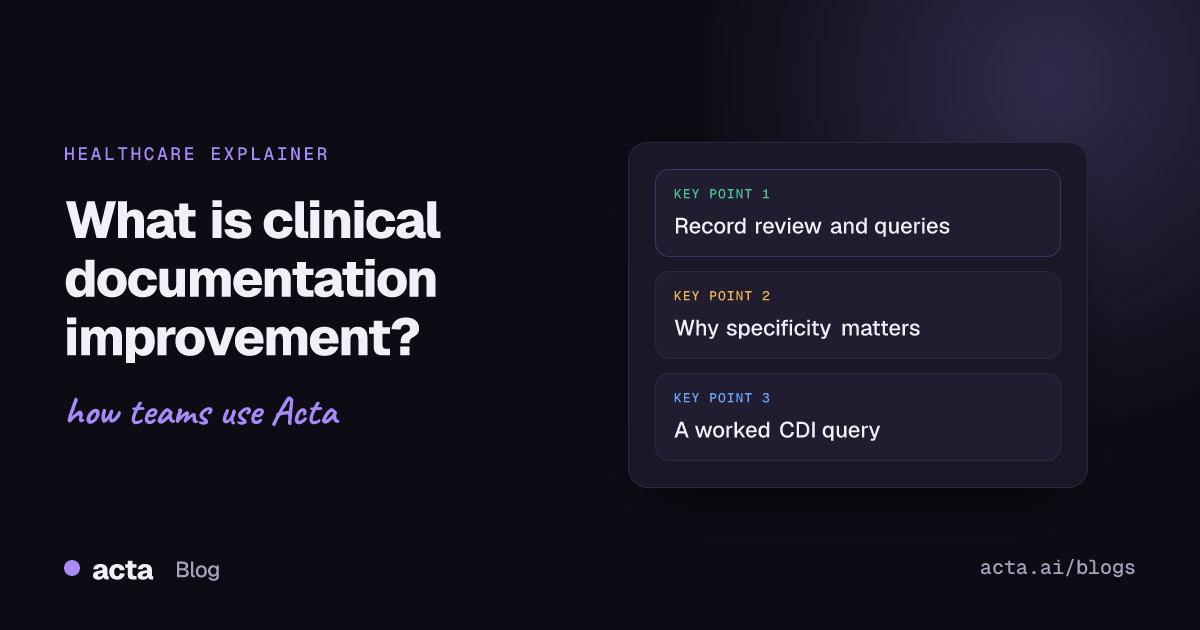
What is clinical documentation improvement? It's a hospital or clinic program that reviews patient records while care is happening and asks clinicians to clarify notes that are vague, incomplete or contradictory, so the record accurately reflects how sick the patient is and what was done. CDI specialists, often nurses or coders, find the gaps and send compliant queries. The clinician decides the answer; CDI never tells them what to write.
This explainer covers how a CDI program works, why specificity changes how a stay is classified, a worked query example, where CDI fits and the mistakes that get programs into trouble. It's written for clinicians, new CDI staff and practice managers. It's general information, not clinical, coding or legal advice; your organisation's policies and the official guidelines take precedence.
Key takeaways
- CDI is also called clinical documentation integrity. Its job is an accurate record, not a higher bill.
- The main tool is the query: a written or verbal question asking the clinician to clarify documentation, following the ACDIS/AHIMA compliant query guidelines (2022 update).
- Under Medicare's MS-DRG system, each secondary diagnosis is classed as an MCC, a CC or a non-CC, so a precise diagnosis can change how a stay is grouped.
- Good queries present the clinical indicators, offer reasonable options including "unable to determine" and never mention payment.
- Review early in the stay. A query answered after discharge is harder for everyone.
Table of contents
- What is clinical documentation improvement: a program, not a product
- CDI works through record review and compliant queries
- Specificity changes how a stay is classified
- A worked example: one vague phrase, one query
- CDI fits some settings far better than others
- Most CDI problems come from leading queries and late reviews
- AI can draft notes, but the clinician owns the record
- Frequently asked questions
- Decide what your CDI program needs next
What is clinical documentation improvement: a program, not a product
Clinical documentation improvement is a set of people and processes, usually inside a hospital's health information or quality team, that checks whether the record says what the clinicians actually saw and did. Many organisations now say "clinical documentation integrity" instead, which is a better name: the point is integrity, not more words.
A typical program has CDI specialists who review charts, physician advisors who back them up on clinical questions, and close ties to coding, quality and compliance. Specialists often come from nursing or coding backgrounds. Two common credentials are ACDIS's CCDS and AHIMA's Certified Documentation Integrity Practitioner (CDIP), whose exam covers record review and clarification, CDI metrics and compliance.
Why bother? Because the record feeds everything downstream: the codes that are billed, the severity and mortality data that quality rankings use, the next clinician's handover, and any audit. If the note says "kidney issues" when the labs show acute kidney injury, every one of those uses is working from a weaker picture.
CDI works through record review and compliant queries
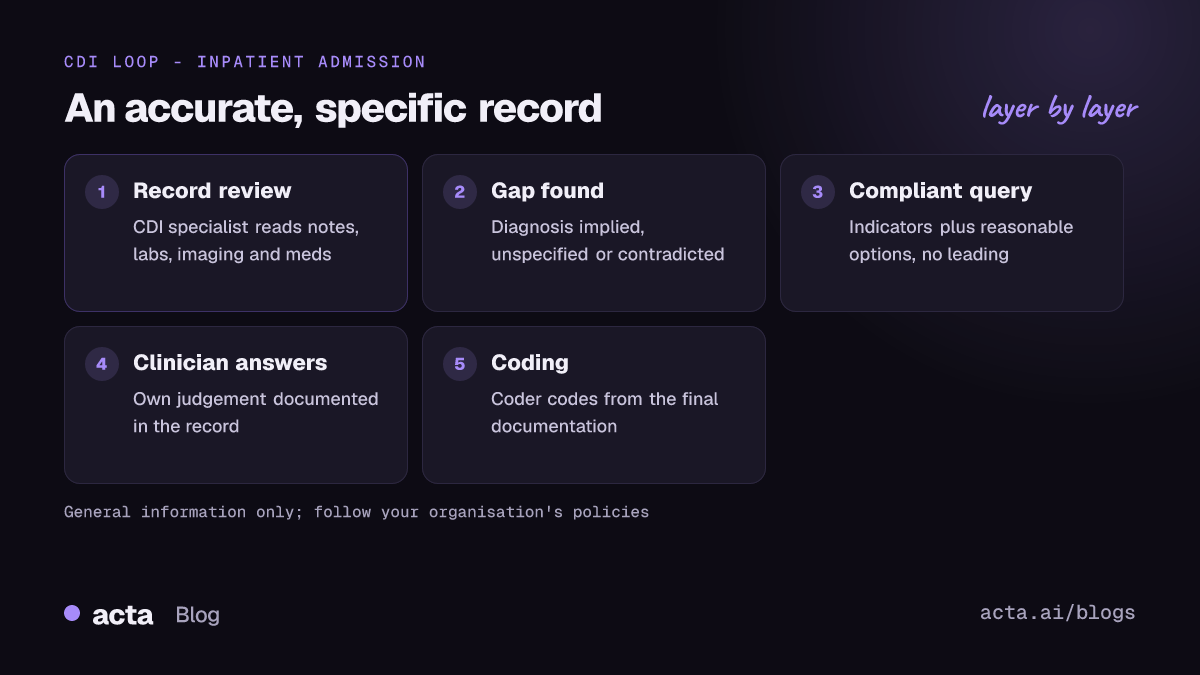
Most inpatient programs follow the same loop. The details vary by hospital, but the shape is this:
- Select records. The CDI specialist reviews new admissions, often prioritised by diagnosis, payer or unit.
- Compare notes with clinical indicators. Labs, imaging, medications and vital signs are checked against what the clinician documented.
- Spot a gap. A diagnosis is implied but not stated, stated without type or acuity, or contradicted elsewhere in the chart.
- Send a query. The specialist asks the clinician to clarify, quoting the indicators and offering reasonable options.
- Clinician answers in the record. The clinician documents their own judgement in a progress note or discharge summary.
- Follow up and code. The specialist re-reviews before discharge; coders code from the final record.
The rules for step four come from the ACDIS/AHIMA Guidelines for Achieving a Compliant Query Practice (2022 update). AHIMA's summary of that update highlights compliant use of query templates, the use of "unable to determine" in multiple-choice queries, and how problem list information is handled. Read the full brief; it's the standard most auditors will hold you to.
Specificity changes how a stay is classified
For Medicare inpatient stays, hospitals are paid by MS-DRG. The CMS MS-DRG definitions manual classes every ICD-10-CM diagnosis code as a major complication or comorbidity (MCC), a complication or comorbidity (CC) or a non-CC. The manual's acute myocardial infarction example shows the effect: a patient discharged alive goes to DRG 280 with an MCC, 281 with a CC and 282 with neither.
So a precise, supported diagnosis can move a stay into a different group, and a vague one can leave real severity out of the data. There are exclusions too. A CC can be ignored when it's closely related to the principal diagnosis, and a hospital-acquired condition that wasn't present on admission doesn't act as a CC or MCC.
Outpatient CDI works on a different system. Medicare Advantage risk adjustment uses hierarchical condition categories (HCCs), and CMS guidance says diagnoses must come from an acceptable face-to-face encounter and be documented in the medical record. Outpatient CDI therefore focuses on chronic conditions being assessed and documented at visits, rather than sitting unaddressed on a problem list.
A worked example: one vague phrase, one query
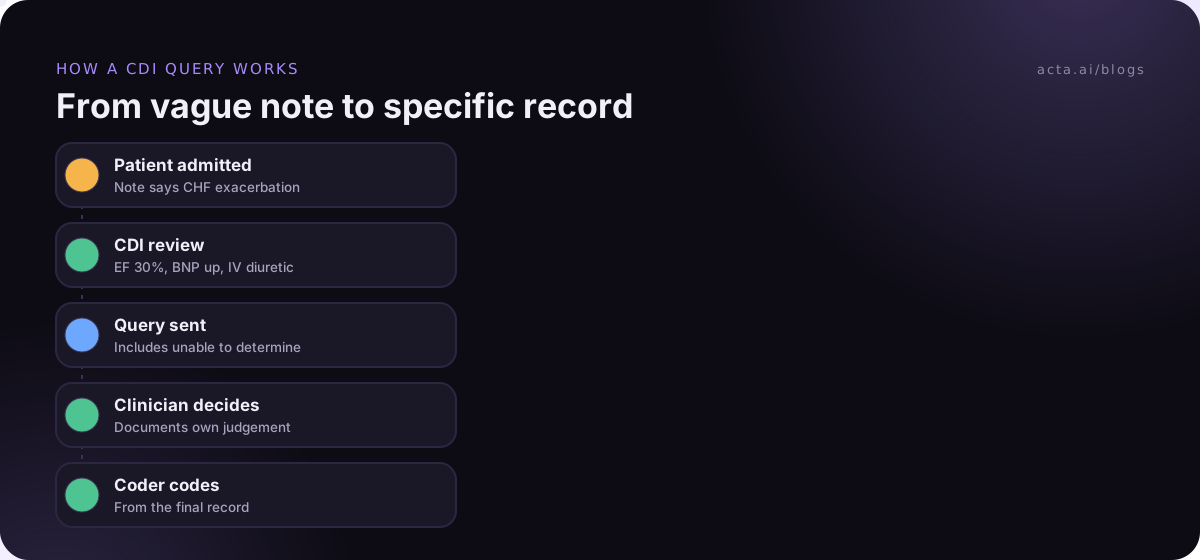
Here's a CDI query example built on a fictional case. Mr. Alvarez, 74, is admitted with shortness of breath. The admitting note says "CHF exacerbation". The chart shows an echocardiogram with an ejection fraction of 30%, a raised BNP, bilateral crackles and IV furosemide twice daily. The note gives no type or acuity of heart failure.
The CDI specialist doesn't write "please document acute systolic heart failure". That would be leading. Instead, a compliant multiple-choice query might read:
Clinical indicators: echo 11/3 shows EF 30%; BNP raised on admission; bilateral crackles on exam; furosemide 40 mg IV twice daily since admission. Documentation states "CHF exacerbation". Based on your clinical judgement, can the type and acuity of heart failure be further specified?
- Acute on chronic systolic (HFrEF) heart failure
- Acute systolic (HFrEF) heart failure
- Other (please specify)
- Unable to determine
The clinician reviews the chart, agrees the patient has known reduced EF with an acute decompensation, and documents "acute on chronic systolic heart failure" in the next progress note. The coder then checks the current CC and MCC lists in the CMS manual for the code assigned. Notice what the query didn't do: it didn't mention payment, DRGs or what answer CDI hoped for, and it offered "unable to determine".
CDI fits some settings far better than others
A formal CDI program makes sense where documentation drives classification and quality data:
- Acute inpatient hospitals paid by DRG, especially with complex medical and surgical patients.
- Outpatient groups in risk-adjusted contracts, where chronic conditions need to be assessed at each relevant visit.
- Organisations with quality reporting at stake, where severity adjustment affects published outcomes.
It's harder to justify for a small fee-for-service practice with short, routine visits. There, a good note template and periodic coding audits often do more than a dedicated specialist. And CDI is the wrong tool if the real goal is "find more revenue". Programs set up that way drift towards leading queries, which is exactly what auditors look for.
Most CDI problems come from leading queries and late reviews
The same mistakes come up again and again:
- Leading queries. Offering only one reasonable answer, or hinting at the "right" one. Always present the indicators and real options.
- Mentioning money. A query should never refer to payment or DRG impact.
- Querying without indicators. If the chart doesn't support a diagnosis, don't ask about it.
- Waiting until discharge. Retrospective queries are slower and the clinician's memory is weaker. Review in the first day or two.
- Too many queries. Clinicians stop reading them. One study at the University of Kansas Health System, published on PubMed Central, found residents raised concerns about query format and interruptions, and the team improved templates and the timing of verbal queries.
- No education loop. If the same query goes to the same service every week, teach the pattern instead.
AI can draft notes, but the clinician owns the record
AI documentation tools can now draft a visit note from a recorded conversation, which can reduce the number of vague notes in the first place. That doesn't change the basics: get the patient's consent before recording, keep the draft as a draft, and have the clinician review and sign every word. An AI draft is never the record until a clinician says it is. Our posts on SOAP note drafts from patient visits and AI notetakers for clinicians go through the review steps, and SOAP notes for nurses covers note structure.
Acta isn't a CDI tool and doesn't send queries or assign codes. It's an AI meeting assistant some healthcare teams use for internal meetings such as CDI huddles, physician education sessions and committee calls, with transcripts, summaries and action items with owners. Acta is working towards HIPAA compliance and doesn't use customer data to train AI models; check your own policies before recording anything that contains patient information. If those meetings run on Teams or Zoom, the desktop app records them without a bot joining, and our guide to recording consent covers what to tell participants.
Frequently asked questions
What is clinical documentation improvement in nursing?
Many CDI specialists are registered nurses, because the work depends on reading clinical indicators like labs, imaging and medications and spotting where the documentation doesn't match. Nurses in CDI review charts and send queries to physicians and other providers. They don't change the diagnosis themselves; the treating clinician documents the answer in the record.
What does a CDI specialist do day to day?
A CDI specialist reviews new and ongoing admissions, compares documentation with clinical indicators, sends compliant queries when something is unclear or missing, follows up before discharge and works with coders on the final record. Many also run short education sessions for services that get the same queries repeatedly, and track metrics like query response rates.
What makes a query compliant?
A compliant query includes the relevant clinical indicators from the record, offers reasonable options including "other" and, where appropriate, "unable to determine", and doesn't lead the clinician to a particular answer or mention payment. The ACDIS/AHIMA Guidelines for Achieving a Compliant Query Practice (2022 update) are the main reference for both written and verbal queries.
Is CDI the same as medical coding?
No. Coders translate the final record into ICD-10 and procedure codes; they can only code what's documented. CDI works earlier, during the stay, to make sure the documentation is complete and specific enough to code accurately. The two teams work closely, and some CDI specialists come from coding backgrounds.
Does CDI apply to outpatient care?
Yes, increasingly. Outpatient CDI often focuses on risk-adjusted contracts, where chronic conditions need to be assessed and documented at a face-to-face encounter rather than just listed. Reviews happen before or after visits, and queries go to the treating clinician in the same way as inpatient CDI.
Decide what your CDI program needs next
Whether you're starting a program or tightening one, check these five things first.
- Define the goal: write down that the program exists for an accurate record, and share it with clinicians.
- Adopt the query standard: base templates on the ACDIS/AHIMA 2022 compliant query guidelines and review them yearly.
- Review early: aim to query in the first day or two of a stay, not after discharge.
- Track the patterns: count repeat queries by service and turn the top three into education.
- Set AI rules: require patient consent for any recording and clinician sign-off on every AI draft.
If your CDI huddles and education sessions keep producing action items nobody follows up, record the next one with the Acta desktop app during the 15-day free trial on the pricing page.