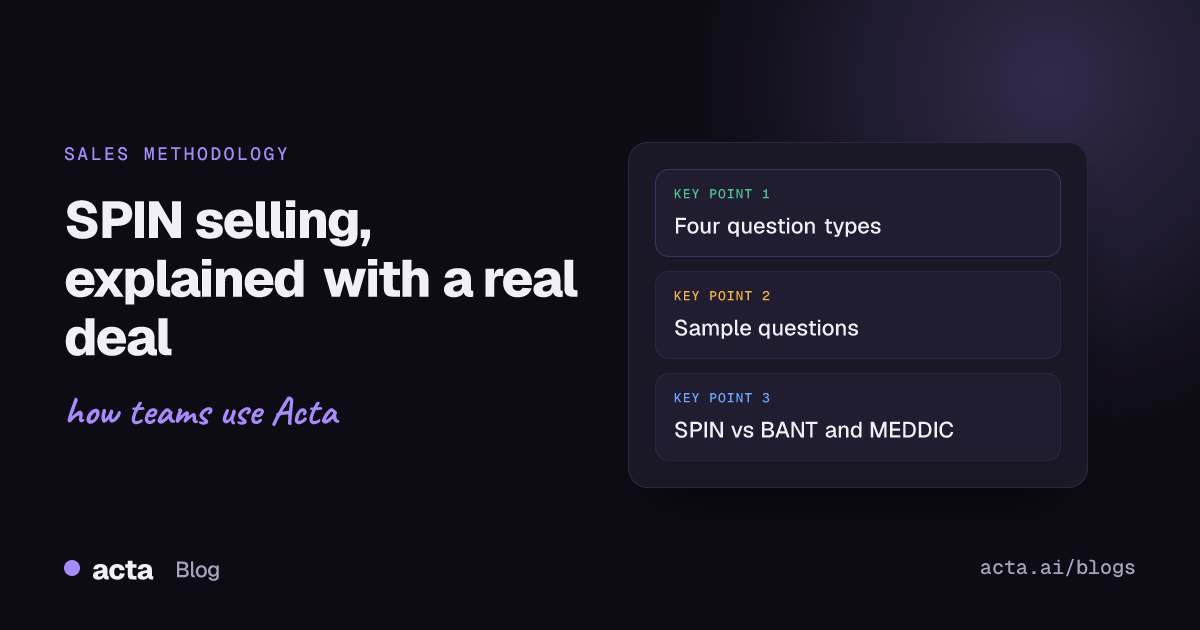
SPIN selling is a questioning method for complex B2B sales: you ask Situation, Problem, Implication and Need-payoff questions, roughly in that order, so the buyer works out for themselves why a problem is worth fixing. It comes from Neil Rackham's research at Huthwaite and his 1988 book. The core idea is that big deals are won in the investigation, not the close.
This guide covers the method itself: where it came from, what each question type does, sample questions, a worked deal, and how it stacks up against BANT, MEDDIC and Challenger. It's built for longer, multi-stakeholder sales. If you sell a $30 product on a single short call, SPIN is more process than you need.
Key takeaways
- Keep Situation questions to two or three; research the rest before the call.
- Spend most of your talk time on Implication questions, where a small admitted problem becomes a cost worth acting on.
- Let the buyer state the payoff in their own words; a benefit they say out loud carries more weight than one you pitch.
- Write four to six Implication questions per likely problem before the call, because they're the hardest to improvise.
- Use SPIN to run the conversation and a framework like MEDDIC or BANT to judge whether the deal is real.
Table of contents
- SPIN selling grew out of research on large sales
- The four question types do different jobs
- Sample questions you can adapt
- A worked example shows the sequence in a real deal
- SPIN fits alongside BANT, MEDDIC and Challenger
- Running SPIN on a live call takes preparation
- Most SPIN mistakes come from rushing to the pitch
- Call notes make SPIN easier to coach
- Frequently asked questions
- Decide whether SPIN fits your next deal
SPIN selling grew out of research on large sales
Neil Rackham founded Huthwaite as a research firm in the 1970s, and the method came from watching salespeople at work rather than from a theory. Huthwaite's own SPIN Selling page says the research involved observing 35,000 business-to-business sales interactions. The book's publisher describes a 12-year study of more than 35,000 calls made by 10,000 salespeople in 23 countries. Accounts of the exact numbers and dates vary, and the research was done by the firm that sells the training, so treat the figures as Huthwaite's own.
The headline finding, as the book's description puts it, is that many methods built for selling low-value goods don't work for major sales. Classic closing techniques and scripted objection handling mattered less in big deals than the quality of the questions asked earlier. That's still the useful part, decades later.
The four question types do different jobs
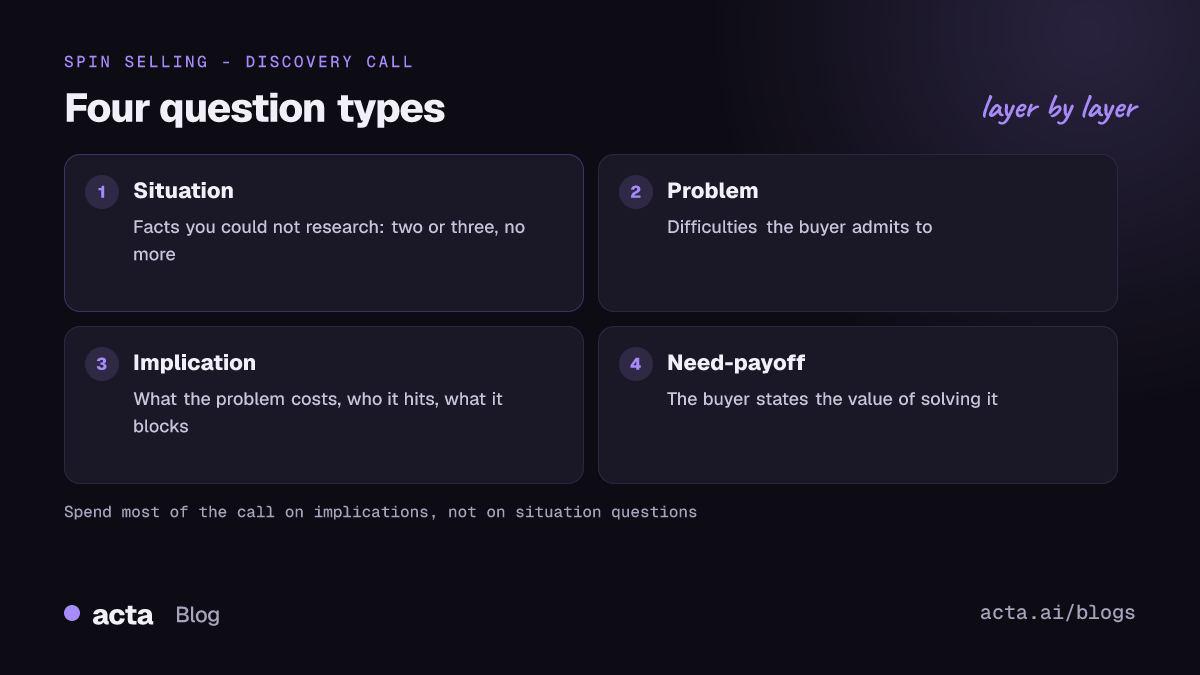
Each letter is a type of question with one job. You don't have to march through them in strict order, but the logic flows from facts to pain to cost to value.
- Situation: background facts about how the buyer works today. Necessary, but buyers get bored fast, and every fact you could have found on LinkedIn wastes their time.
- Problem: difficulties, dissatisfactions and friction with the current way. This is where you find the pain the buyer admits to.
- Implication: the consequences of that problem. Who else it hits, what it costs, what it blocks. This is the step that separates strong sellers from average ones, because it turns a minor irritation into something with a price tag.
- Need-payoff: questions that get the buyer to say what solving the problem would be worth. "If you could…, what would that change?"
Rackham's distinction between implied needs (a buyer grumbling about a problem) and explicit needs (a buyer stating a clear want) sits under all of this. Problem questions surface implied needs. Implication and Need-payoff questions turn them into explicit ones.
Sample questions you can adapt
These are starting points. Rewrite them in your buyer's vocabulary; a SPIN question that sounds like it came from a training binder gets a training-binder answer.
| Type | Sample questions |
|---|---|
| Situation | How do jobs get assigned to technicians today? Who owns the schedule? |
| Problem | Where does the schedule break down? How often do jobs get rebooked? |
| Implication | What happens to the customer when a visit slips? How does that show up in renewals? Who has to fix it? |
| Need-payoff | If rebookings dropped by half, what would your dispatchers do with that time? Why does that matter this quarter? |
Notice that the Implication questions branch out. One problem (rebooked jobs) can touch customer churn, overtime, dispatcher burnout and SLA penalties. Your job is to find which of those the buyer actually cares about.
A worked example shows the sequence in a real deal
Here's a fictional deal. Dana, an account executive at a scheduling software company, is on a discovery call with Marco, operations director at a heating repair firm with 60 technicians.
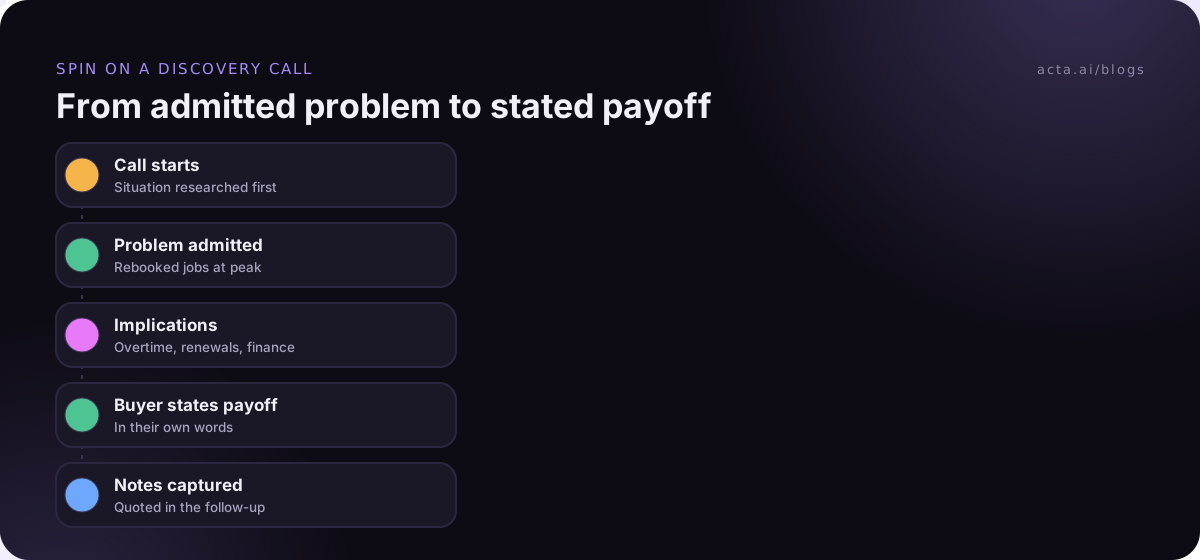
Situation. Dana: "I saw you run three depots. Do they share one dispatch team or schedule separately?" Marco: "Separately. Each depot has its own spreadsheet."
Problem. Dana: "Where does that get messy?" Marco: "Emergency calls. Depot A might be slammed while B has two technicians sitting idle, and nobody sees it."
Implication. Dana: "When A is slammed, what happens to the jobs that were already booked?" Marco: "They slide to the next day. We pay overtime to catch up, and some customers cancel their service contract at renewal." Dana: "Do you track how many of those cancellations follow a missed slot?" Marco: "Not formally. Our finance lead keeps asking, actually."
Need-payoff. Dana: "If dispatch could see all three depots at once, what would change for you?" Marco: "Fewer slipped jobs, less overtime, and I'd have a real answer for finance on renewals."
Dana never pitched. By the end, Marco had described three costs (overtime, churn, a finance question he can't answer) and named the value himself. Her follow-up email can now quote his words, and she knows there's a finance stakeholder to bring in. That last bit is where a qualification framework takes over.
SPIN fits alongside BANT, MEDDIC and Challenger
People often ask which method to pick, but they answer different questions. SPIN is about how you run the conversation. Qualification frameworks are about whether the deal is worth your time.
| Method | What it answers | Best for |
|---|---|---|
| SPIN selling | How do I help the buyer see the cost of the problem? | Discovery in complex B2B deals |
| BANT | Is there budget, authority, need and timing? | Fast early qualification |
| MEDDIC | Do I know the metrics, buyer, criteria, process, pain and champion? | Forecasting large enterprise deals |
| Challenger | What insight can I teach that reframes the buyer's thinking? | Buyers who think they know what they need |
In practice, many teams run SPIN-style discovery and record the answers against MEDDIC or BANT fields. The two fit together well: Implication answers feed the Metrics and Identify Pain parts of MEDDIC almost directly. For more on the qualification side, see BANT explained and the MEDDIC sales methodology.
Running SPIN on a live call takes preparation
SPIN looks simple on paper and feels hard live, mainly because good Implication questions are hard to invent mid-conversation. Prepare them.
- Research the situation first. Pull what you can from the CRM, the website and earlier calls so you only ask the two or three situation questions you can't answer yourself.
- List likely problems. Write the three problems your product solves best, phrased in the buyer's terms.
- Prepare implications for each. Four to six per problem: who else it affects, what it costs, what it delays, what risk it creates.
- Listen for the admitted problem. On the call, wait for the buyer to name a problem before you go deeper. Don't push implications onto a problem they haven't owned.
- Let them state the payoff. Ask a Need-payoff question and stop talking. Write down their exact words.
- Review afterwards. Read back the call and mark each question S, P, I or N. Most people are surprised how few implications they asked.
That review step is where most reps improve. If you use a report template or a discovery call template, add a line for "implications the buyer confirmed" so it doesn't get skipped.
Most SPIN mistakes come from rushing to the pitch
- Too many Situation questions. Ten questions about headcount and tools in a row feels like an audit. Do the homework.
- Pitching at the first problem. The buyer mentions a pain and you jump to the demo. You've skipped the step that gives the problem weight.
- Leading implications. "Wouldn't you agree that costs you a fortune?" isn't a question, it's pressure. Ask open questions and let the number come from them.
- Using SPIN on small, simple deals. For a quick transactional sale, a long chain of implication questions just slows things down.
- Not writing the answers down. If the buyer's own description of the cost isn't in your notes, it won't be in your proposal either.
Call notes make SPIN easier to coach
SPIN is easiest to improve when you can reread what was actually said. Acta can write a SPIN deal report from each sales call, laying out situation, problems, implications and payoff in the buyer's words; the SPIN deal report post shows what it looks like. If you'd rather not add a bot to customer calls, the Chrome extension or desktop app captures the call from your own computer. Tell the buyer and check the rules on recording consent first.
Frequently asked questions
What does SPIN stand for in sales?
SPIN stands for Situation, Problem, Implication and Need-payoff, the four types of question in Neil Rackham's method. Situation questions gather facts, Problem questions find difficulties, Implication questions explore their consequences, and Need-payoff questions get the buyer to describe the value of solving them. Together they move a buyer from an implied need to an explicit one.
Is SPIN selling still relevant?
Yes, for complex B2B sales. A buyer who has already read your website has even less patience for Situation questions, but the core advice still holds: understand the cost of a problem before you pitch. Most modern discovery frameworks borrow the implication idea, even when they don't use the SPIN name.
What are SPIN selling questions examples?
Situation: "Who owns scheduling today?" Problem: "Where does it break down?" Implication: "When a visit slips, what happens at renewal?" Need-payoff: "If that stopped happening, what would it be worth to you?" Adapt the wording to your buyer's industry, and prepare several implication questions per problem before the call.
How is SPIN selling different from Challenger?
SPIN draws the problem out of the buyer through questions. Challenger has the seller bring an insight that reframes how the buyer sees their situation, then tailor and take control of the sale. SPIN suits buyers who know they have a problem but haven't sized it; Challenger suits buyers who are confident in the wrong approach.
Can I use SPIN with MEDDIC?
Yes, and it's a common pairing. Use SPIN questions to run discovery, then file what you learn under MEDDIC: implications feed Metrics and Identify Pain, and the people mentioned point to the Economic Buyer and Champion. SPIN tells you how to ask; MEDDIC tells you what you still don't know.
Decide whether SPIN fits your next deal
SPIN is worth the preparation when the deal is large and the buyer hasn't yet put a cost on the problem. Check these before your next discovery call.
- Size the deal: use SPIN for multi-stakeholder deals with a real sales cycle, not one-call transactions.
- Do the research: answer every situation question you can before the call, so you ask three at most.
- Prepare implications: write four to six for each problem you expect to hear.
- Capture their words: note the buyer's own description of cost and payoff, and reuse it in the follow-up.
- Pair it with qualification: file the answers under BANT or MEDDIC so the forecast reflects what you learned.
To review your next discovery call question by question, capture it with the Acta desktop app and start the 15-day free trial.