Quick answer: AI notetakers in healthcare, often called ambient AI scribes, listen to a visit or meeting and draft the note. Published studies link them to less documentation time and lower burnout, but they also make errors, especially omissions. Clinicians should tell patients, get consent, read every draft before signing, and remember the note is still their responsibility.
If your organisation has just rolled out an ambient scribe, or you're being asked whether you'd like one, you've probably heard two versions of the story. One says it gives you your evenings back. The other says it invents medications. Both have some truth in them. This piece is for the clinician who has to use the thing on Monday: what the evidence says so far, where the drafts go wrong, how to talk to patients about it, and what to check before you sign.
What are AI notetakers in healthcare, exactly?
The term covers a few different tools, and it helps to know which one you're dealing with.
- Ambient AI scribes. A phone, tablet or computer in the room records the consultation. The software transcribes it and drafts a clinical note, often in a set structure such as SOAP, for you to edit and sign in the record.
- General meeting notetakers. Tools that record video calls or in-person meetings and produce a transcript, summary and action items. In healthcare these turn up in multidisciplinary team meetings, operations huddles, research calls and training.
- Dictation with AI clean-up. You still dictate, and the software tidies the text. Less ambitious, and fewer surprises.
The questions below apply most to ambient scribes in patient visits, because that's where the stakes are highest. Most of it applies to the others too.
What does the research say about ambient AI scribes?
The early evidence is encouraging, with caveats about study design.
- A quality improvement study published in JAMA Network Open in 2025 followed 263 physicians and other clinicians across six health systems. After 30 days with an ambient scribe, burnout among those in ambulatory clinics fell from 51.9% to 38.8%, and the authors also reported lower note-related cognitive load. The abstract is on PubMed.
- Mass General Brigham and Emory surveyed more than 1,400 physicians and advanced practice providers. At Mass General Brigham, using ambient documentation was linked to a 21.2% absolute drop in burnout after 84 days, according to the health system's summary of the study. Some users said it added time to their note-writing or helped less in certain specialties.
Two things to keep in mind. Most of these studies are short and not randomised, and many rely on clinicians' own survey answers. And the benefit depends on how you work. If you already finish notes during the visit, you'll see less gain than a colleague who charts at 10pm.
What kinds of errors do AI scribes make?
This is the part clinicians should take most seriously. A pilot at UC Davis, "Quality of Clinical Notes Created by Ambient Listening Generative AI", had physicians review a sample of 356 AI-drafted notes. The most common problem was accidental omission (18% of notes), followed by hallucinations (11.5%) and accidental inclusions (9.3%). Most errors were low to moderate in severity, and 19 notes (5.3%) had errors rated as posing serious risk. The authors' conclusion was blunt: clinician review is still needed.
In practice, the errors you're likely to meet look like this:
Omissions
The patient mentioned the chest tightness on the stairs, almost as an aside, and it isn't in the note. Omissions are the hardest to catch, because nothing on the page looks wrong. You have to remember what's missing.
Hallucinations
A dose, a side, a duration or a family history that nobody actually said. These usually sound plausible, which is exactly why they slip through.
Attribution mistakes
Something the patient's daughter said gets recorded as the patient's own report. Or a possibility you raised ("we could consider a referral") becomes a plan ("referred to cardiology").
Negation errors
"No history of" becomes "history of". Short words, big difference.
None of this means the tools are useless. It means the draft is a draft.
Do you need patient consent to use an AI notetaker?
Legally, it depends on where you practise and how your organisation has set the tool up. Recording rules differ between countries and between US states, and your employer's policy may go further than the law. Our overview of meeting recording laws by country is a starting point. Our guide to recording consent and what to tell participants covers the general picture. This is general information, not legal advice; your compliance or legal team has the final word.
Ethically, the case for telling patients is strong. An AMA Journal of Ethics case commentary argues that a physician's ethical duty to disclose ambient AI use likely goes beyond any legal duty that exists.
A short script works better than a form nobody reads:
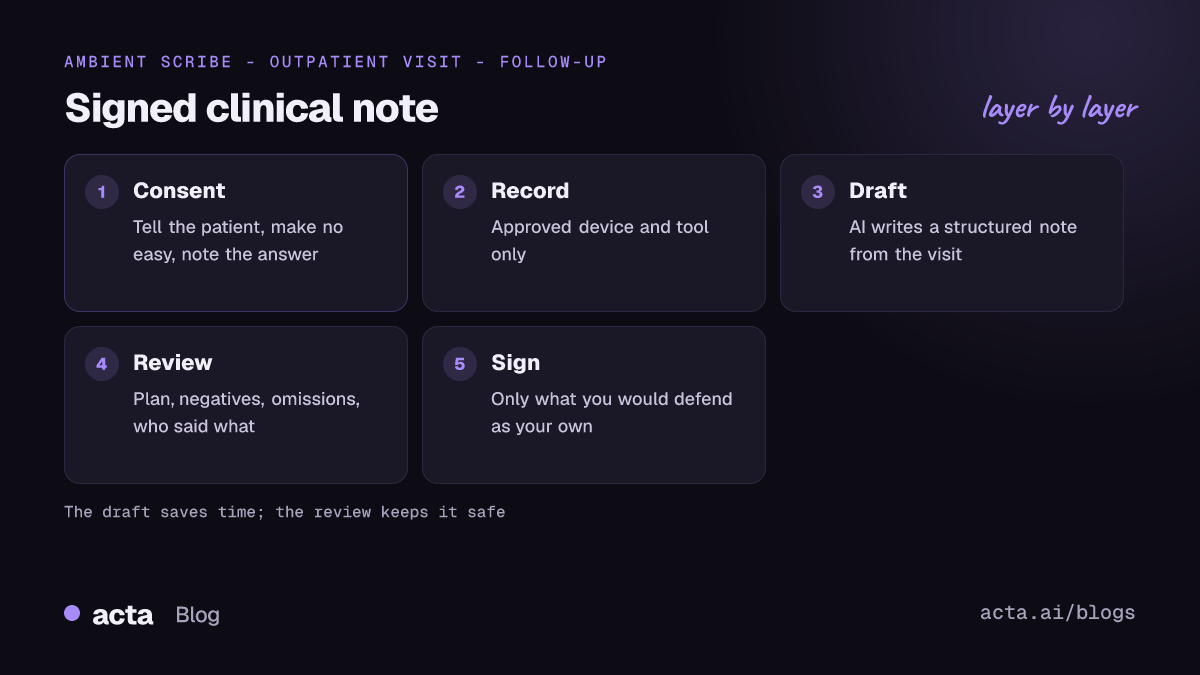
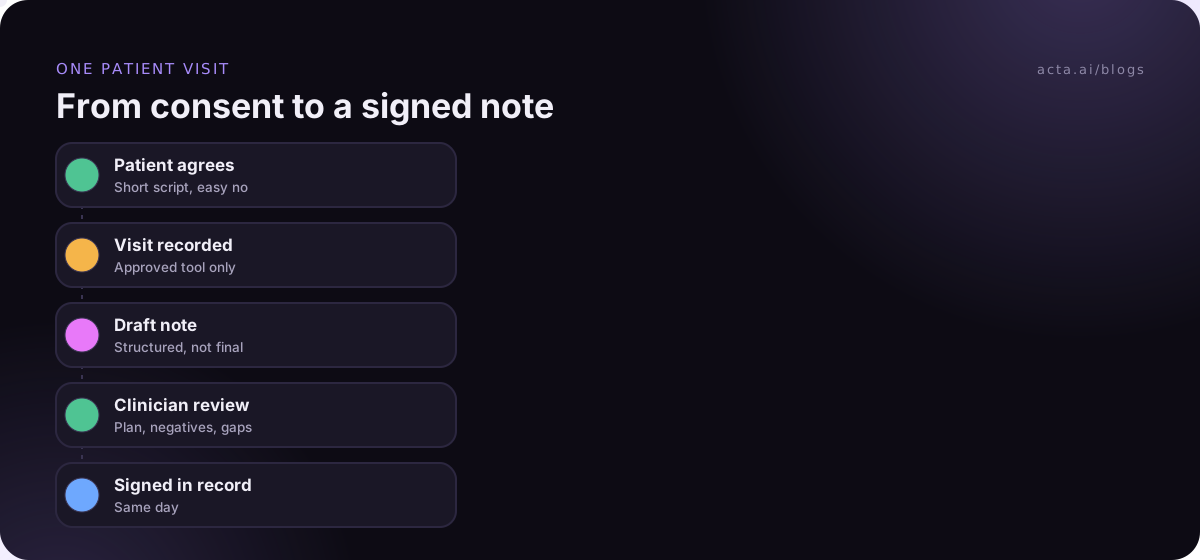
"I use a tool that listens to our conversation and drafts my notes, so I can look at you instead of the screen. I check everything before it goes in your record. Is that okay with you today? You can say no, and it won't change your care."
Then make "no" easy. Know how to switch it off in two seconds, and don't sigh when someone asks you to. Patients discussing mental health, sexual health, abuse or immigration status may decline, and that's reasonable. Note the consent, or the refusal, wherever your organisation asks you to.
How should clinicians review an AI-drafted note?
A quick skim isn't a review. A routine that takes two or three minutes per note:
- Read the plan first. Medications, doses, referrals, tests and follow-up. This is where a wrong word does the most harm.
- Check the negatives. Allergies, "denies", "no history of". Look for flipped meanings.
- Ask what's missing. Run through the two or three things the patient said that mattered most. Are they there?
- Check who said what. Patient, carer, interpreter, you.
- Remove what doesn't belong. Small talk, a third party's private details, anything the patient asked you to keep out of the record.
- Sign only when you'd defend it. Your name on the note means you stand behind it, whoever typed the first draft.
Review the same day, ideally within the hour. The whole point of the tool is that you don't rely on memory at 9pm, and the review depends on memory too.
Which AI notetakers in healthcare should you be careful with?
Before you use any tool with patient information, your organisation should have checked who processes the data, where it's stored, how long recordings are kept, whether the vendor trains its models on your data, and which agreements are in place (in the US, a business associate agreement under HIPAA). Our checklist for choosing an AI scribe goes through those questions in detail. For where meeting data goes once it's inside a tool, see meeting data privacy inside AI tools.
As an individual clinician, the risky move is the one that skips that process: a consumer recording app on your personal phone, or a free notetaker joining telehealth calls on its own. If it hasn't been approved, don't put patient conversations through it, however good the notes look.
Where else do AI notetakers help in healthcare?
Patient visits get the attention, but a lot of clinical time goes into meetings that are lower-risk places to start:
- Multidisciplinary team meetings, where decisions and owners get lost between specialties.
- Operations and bed-management huddles, where the same actions are re-discussed every morning.
- Research and trial calls, which need a reliable record of what was agreed. We wrote about clinical trial site meeting notes separately.
- Teaching and supervision, where a trainee can go back over the discussion later.
Even here, patient details come up, so the same approval and consent rules apply. For video calls where your organisation doesn't allow meeting bots, a desktop recorder can capture the call from your own computer instead, and patient-facing drafts such as plain-language visit summaries still need your review before anything is sent.
When is an AI scribe a poor fit?
Some visits are better without one. Very short visits where the note takes a minute anyway. Consultations through an interpreter, where attribution errors multiply. Rooms with several family members talking over each other. Conversations about safeguarding or domestic abuse, where a recording itself could be a risk to the patient. It's fine to use the tool for most of your list and switch it off for these. Nobody should judge your adoption by the percentage of visits it covers.
About Acta in clinical settings
We build Acta, which records meetings with a bot, from your desktop, through mobile apps for in-person conversations, or from uploaded recordings, and drafts transcripts, summaries and notes from report templates. Acta doesn't use customer data to train AI models. If you use it with patients, get their consent and make sure your data-processing agreements cover patient data; our healthcare page has more detail.
Frequently asked questions
Are AI scribes accurate enough to use without checking?
No. Published reviews have found omissions, hallucinations and misattributions in a meaningful share of drafts. The time savings come from editing a draft instead of writing from scratch, not from skipping the read-through.
Who is responsible if an AI-drafted note is wrong?
The clinician who signs it, in most settings. Treat the draft the way you'd treat a note written by a new junior colleague: useful, often good, and never signed unread.
What if a patient says no to the AI notetaker?
Switch it off and write the note the usual way. Make sure refusing has no effect on their care or how long they get with you.
Do AI notetakers in healthcare reduce burnout?
Early studies, including multi-site surveys published in 2025, link ambient scribes to lower reported burnout and less after-hours charting. The studies are mostly short and non-randomised, so treat the findings as promising rather than settled.
Should the recording be kept after the note is signed?
That's an organisational policy decision. Many teams keep recordings only as long as needed to finish and check the note. Ask your information governance team what your setup does.
If you'd like to see how meeting notes and action items work for your clinical team's internal meetings, look through Acta's features.