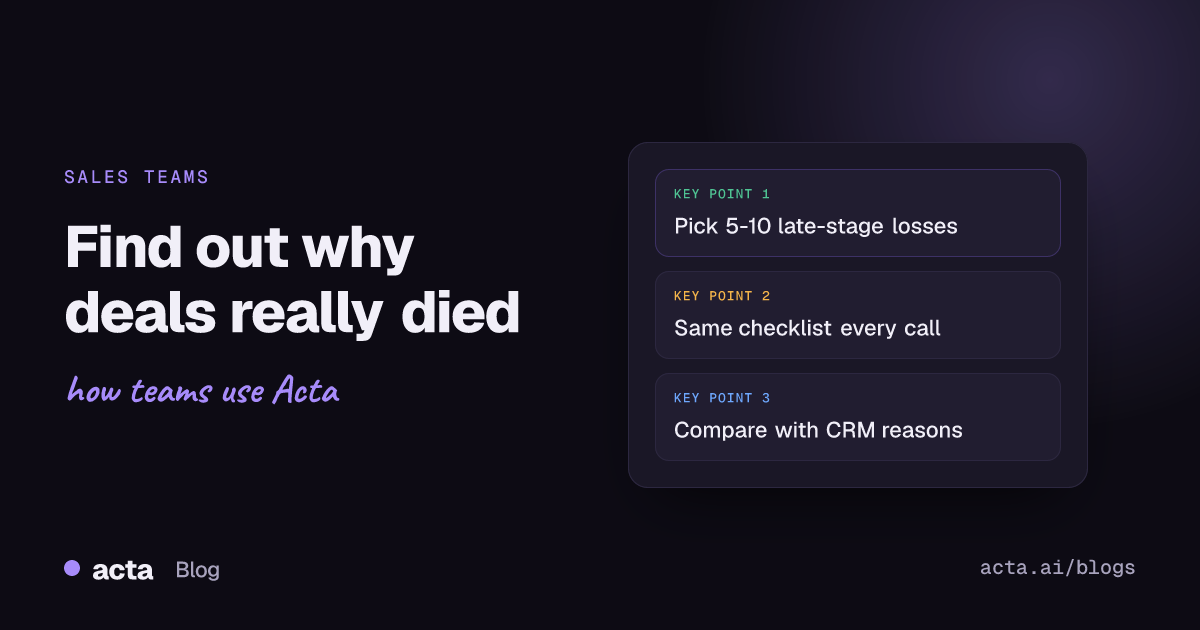
Quick answer: A lost deal analysis from old calls means re-listening to the recorded calls of five to ten lost deals and checking, call by call, where the buyer's energy dropped. Look for the first unanswered objection, missing stakeholders, vague next steps, pricing that arrived late and signs of "no decision". Log each pattern once, then compare it with the CRM loss reason.
Most CRMs have a closed-lost dropdown with five options, and "Price" wins every quarter. Reps pick it because it's quick, it's not their fault, and nobody checks. So the sales team ends up with a year of loss data that mostly says "we were too expensive", which is rarely the whole story and sometimes not the story at all.
The calls are a better record. If your team records sales calls, you already have the evidence for a proper lost deal analysis sitting in a folder. You just have to listen to it with the right questions. This post is the checklist I'd use, plus the mistakes that make these reviews useless.
What is a lost deal analysis, and how is it different from win-loss analysis?
A full win-loss analysis usually means interviewing buyers after the decision, for wins and losses, often through a neutral third party. It's the gold standard, and if you can afford it, do it. But buyer interviews are slow, a lot of lost buyers won't take the call, and you get answers months after the fact.
A lost deal analysis from old calls is the cheaper sibling. You don't ask the buyer anything new. You go back to what they already said, in their own words, while the deal was alive. It won't tell you what happened in the buyer's internal meetings, but it shows exactly what your team heard, what it missed and what it said back.
That gap matters. Gartner's commercial strategy research says B2B buyers spend only 24% of their buying time meeting with all potential suppliers combined. Your calls are a small window into a much bigger decision. That's a reason to listen carefully to the window you do have, and to be honest about what it can't show you.
Why are closed-lost reasons in the CRM so unreliable?
Closed-lost reasons are written by the person with the most reason to soften them, at the moment they least want to think about the deal. Nobody's lying. A rep who lost a deal after a weak discovery call genuinely remembers the pricing conversation more clearly than the discovery questions they didn't ask.
A few things go wrong in nearly every CRM I've seen:
- The dropdown is too coarse. "Price" can mean "we couldn't show the value", "their budget got cut" or "a competitor discounted 30%". Those need three different fixes.
- "No decision" gets hidden. Deals that just went quiet often get marked as lost to price or timing, because "they never decided" feels like a failure to admit.
- Nobody reads the notes field. Even when a rep writes something useful, it's a single line that never gets aggregated.
The "no decision" point is bigger than most teams think. In a study of more than 2.5 million recorded sales conversations, Matthew Dixon and Ted McKenna wrote in HBR that 40% to 60% of deals end up lost to customers who intended to buy but didn't act. If your loss reasons barely mention indecision, your loss reasons are probably wrong.
Which lost deals should you review first?
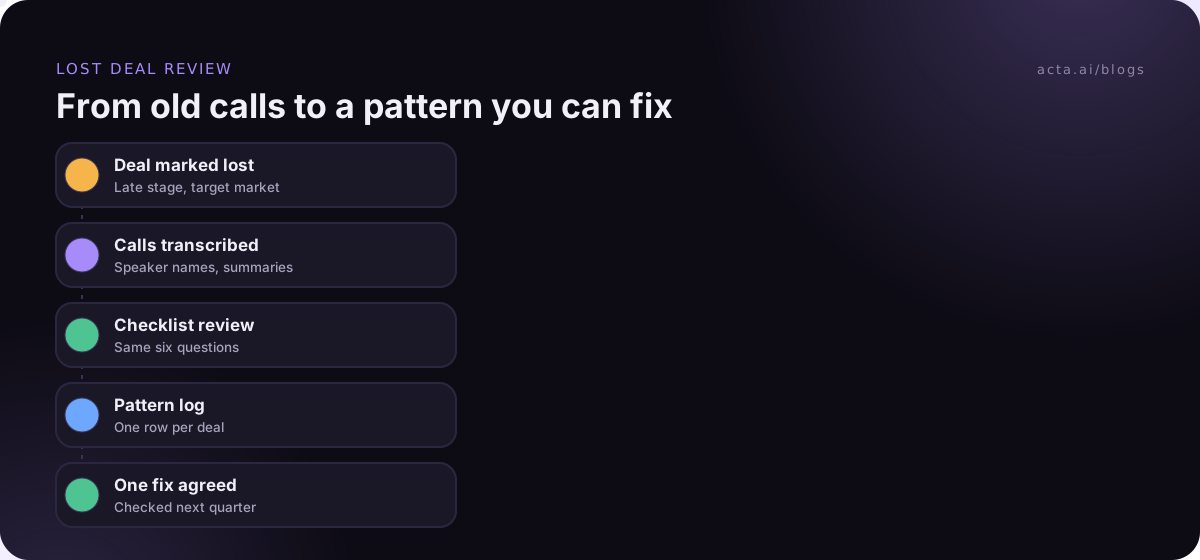
Don't start with every lost deal from last year. You'll burn out by deal four. Pick a small, deliberate sample:
- Late-stage losses. Deals that reached proposal or negotiation and then died. These cost the most time and usually have the most calls to listen to.
- Your ideal customer profile. A loss to a company you should be winning teaches more than a loss to a poor-fit lead who was never going to buy.
- A mix of reps. If all ten deals come from one rep, you're doing a performance review, not a lost deal analysis.
- Two or three wins for contrast. Without wins, you can't tell whether a pattern is a loss pattern or just how your calls always sound.
Five to ten lost deals is plenty for a first pass. A typical late-stage deal might have four to six recorded calls, so you're looking at a few hours of material. With transcripts and summaries you can skim most of it and only listen properly to the moments that matter.
What should you look for in old sales calls?
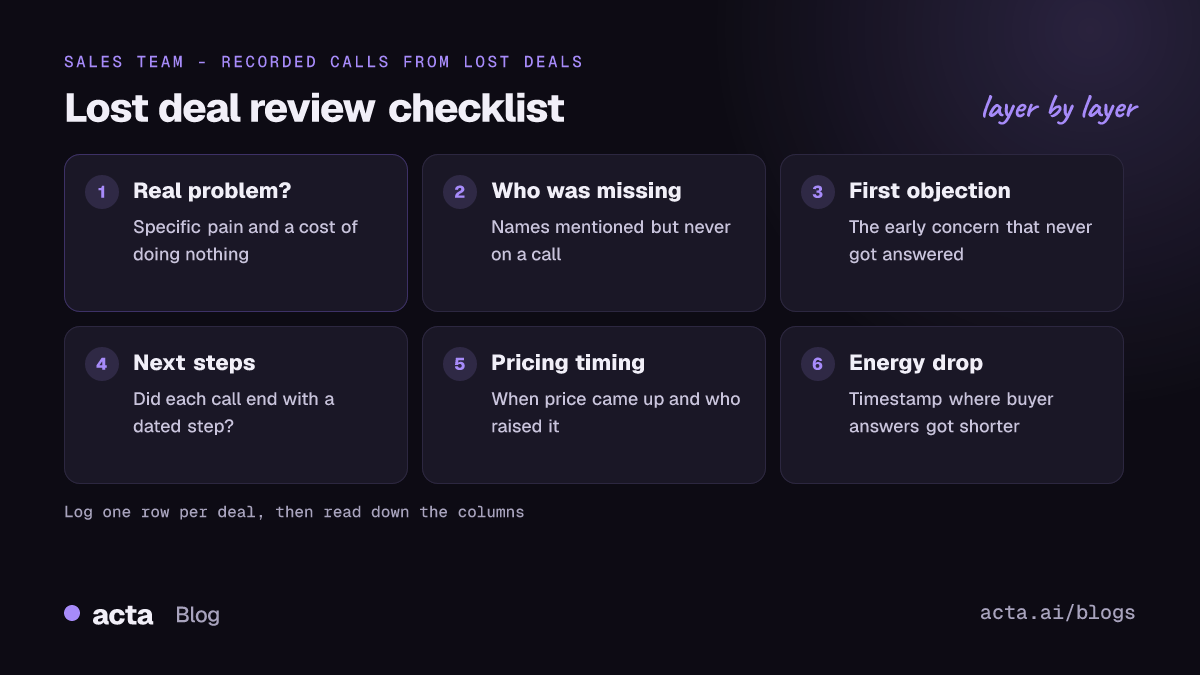
Go through each deal's calls in order and answer the same questions every time. Writing them down as a fixed checklist is the whole trick; it stops you hearing only what confirms your theory.
1. Was the problem real and urgent?
Find the moment in discovery where the buyer described their problem. Was it specific ("our reps spend Friday afternoons updating Salesforce") or vague ("we're looking at ways to be more efficient")? Did anyone ask what happens if they do nothing? Vague pain on call one is the most common thing I find when I review lost deals, and it's often invisible in the CRM.
2. Who was on the calls, and who wasn't?
List every name that spoke. Then list every name that was mentioned but never showed up: "I'll need to run this past our CFO", "IT will want a look". If the economic buyer never joined a call, that's a finding. Our MEDDPICC deal report post covers how to track this while the deal is still alive.
3. What was the first objection that didn't get answered?
Search the transcript for hesitation words: "concern", "not sure", "worried", "we tried", "the problem is". Then check whether the rep answered the concern or moved on. Deals rarely die from the last objection. They die from an early one that got a quick reply and then came back bigger in a meeting you weren't in.
4. Did each call end with a dated next step?
Read the last two minutes of every call. "I'll send something over" and "let's reconnect in a couple of weeks" are warning signs. A calendar invite agreed on the call is a much better sign. Count how many calls in the deal ended without one.
5. When did pricing come up, and who raised it?
If price arrived for the first time in the proposal call, the loss may not be about price at all. It may be about value that was never quantified. If the buyer kept asking about price early and the rep deflected, that's a different problem.
6. Where did the buyer's energy drop?
This one is less scientific but often the most useful. Notice where the buyer's answers got shorter, where they stopped asking questions, or where a new person joined and the tone changed. Write down the timestamp. Then look at what happened just before it.
How do you spot "no decision" in a lost deal?
Dixon and McKenna split no-decision losses into two kinds: buyers who prefer the status quo and buyers who simply can't make up their minds. The first kind is the one our post on handling the status quo objection deals with. In their data, indecision accounted for 56% of no-decision losses. They name three drivers: valuation problems (too many options to compare), lack of information, and fear of the outcome going wrong.
You can hear each of these in old calls once you know what to listen for:
- Valuation problems: the buyer keeps asking for one more comparison, one more option, one more tier.
- Lack of information: lots of "we need to understand more about..." late in the deal, from people who joined late.
- Outcome uncertainty: questions about what happens if it doesn't work, what rollout looks like, who else like them uses it.
When a lost deal shows these signals, mark it "no decision" in your log even if the CRM says "price" or "competitor". It changes the fix. You don't solve indecision with a discount; you solve it with a smaller first step and a clearer recommendation.
How do you turn individual reviews into patterns?
One deal is an anecdote. You want a pattern log: a simple sheet with one row per lost deal and one column per checklist question. Fill each cell with a short answer and a timestamp, like "Economic buyer never joined; mentioned 3x (call 2, 12:40)".
After eight or ten deals, read down the columns instead of across the rows. That's where the useful stuff shows up. You might find that seven of ten lost deals had no dated next step after the demo, or that IT security came up on call three and nobody followed up until the proposal.
Then put two columns side by side: the CRM loss reason and your reviewed loss reason. Where they disagree, you've found something to fix in how reps log losses, and probably something in how they sell.
If you have a tool that can search across many meetings at once, this gets much faster. Asking "in which lost deals did the buyer mention a competitor by name?" across fifty calls beats scrubbing through each recording. We wrote more about asking questions across all your past meetings if you want the general approach.
What mistakes ruin a lost deal analysis?
- Turning it into blame. If reps think lost deal reviews are about catching them out, they'll stop recording calls or start logging every loss as "timing". Review the process, not the person, and share findings by pattern, not by name.
- Only reviewing the last call. The last call is where the deal was announced dead. It's rarely where it died. Start with discovery.
- Hindsight bias. Once you know the deal was lost, every hesitation sounds fatal. That's why you review a couple of wins too.
- No follow-through. A findings deck that nobody acts on is worse than nothing, because it teaches the team that reviews don't matter. Pick one or two changes, such as a required next-step question at the end of every demo, and check whether they happen.
How often should you run a lost deal analysis?
Quarterly works for most B2B teams. It's often enough that the calls are still fresh and the people on them still remember context, and rare enough that you have a decent sample. A small team closing a handful of deals a month could do it twice a year instead.
Keep a light weekly habit as well. When a late-stage deal is lost, the account owner and their manager spend 20 minutes on its discovery call and its last call while the details are fresh. That feeds the quarterly review instead of replacing it. For the live-deal side of this, our posts on what demo calls reveal and a discovery call template help reps catch the same problems before the deal is gone.
Do you need permission to review recorded sales calls?
You need to have recorded them properly in the first place. Recording rules differ by country and, in the US, by state, and buyers should know a call is recorded and why. Reviewing those recordings internally for coaching from sales call recordings and analysis is usually covered by the same notice, but check your own policy. Our guide to recording consent and what to tell participants covers the basics. It's general information, not legal advice.
If your team doesn't record yet and the buyers prefer no bot in the call, a desktop recorder like Acta's desktop app captures the call audio from the rep's own computer, so future lost deals have something to review.
Where Acta fits
Acta records sales calls on Zoom, Google Meet and Microsoft Teams, with a meeting bot or without one, and gives you transcripts with speaker names, summaries and action items. OneChat answers questions across all your meetings with links to the source, which is handy for a question like "which lost deals never had the CFO on a call?". It also connects to Salesforce, HubSpot and Zoho if you want call notes next to the deal record.
Frequently asked questions
How many lost deals do I need for a useful lost deal analysis?
Five to ten is enough for a first pass if they're late-stage losses in your target market. Add two or three wins for comparison. You're looking for patterns that repeat, not statistical proof.
Should reps review their own lost deals?
Yes, as a first step. Ask the rep to listen to the discovery call and name one moment they'd handle differently. Then a manager or peer reviews the full deal with the checklist. Self-review first makes the conversation far less defensive.
Is lost deal analysis the same as win-loss analysis?
Not quite. Win-loss analysis usually includes interviews with buyers after the decision. A lost deal analysis from old calls uses what was already said during the deal. The two work well together: calls show what your team heard, and buyer interviews show what happened after you hung up.
What if most of our closed-lost reasons say "price"?
Check the calls before you change pricing. Look at when price was first discussed, whether value was quantified, and whether the deal actually stalled into no decision. "Price" is often the label for a deal that was never urgent.
What is the most common pattern in lost deals?
It varies by team, which is why the review is worth doing. In my experience, vague pain in discovery and calls ending without a dated next step show up far more often than anyone expects.
If you want to try this on your own calls, start a 15-day free trial and run your next lost deal review from the transcripts.