Quick answer: A good sales follow up email goes out the same day, restates the buyer's problem in their own words, confirms what was agreed, and ends with one clear next step that has a date. Keep it short, around 50 to 125 words for most replies, skip the generic "great chatting" opener, and attach only what they asked for.
Most follow-ups after a sales call look the same: "Thanks for your time today! As discussed, please find attached our deck. Let me know if you have any questions." The buyer has received that email from every vendor they've spoken to this month. It says nothing about them, asks nothing specific, and makes no decision easier.
A strong follow-up does real work. It's the written record of the call, the thing your champion forwards to their boss, and the moment you lock in the next step before momentum fades. Below is how I'd write one, with six examples for the situations that come up most.
What should a sales follow up email include?
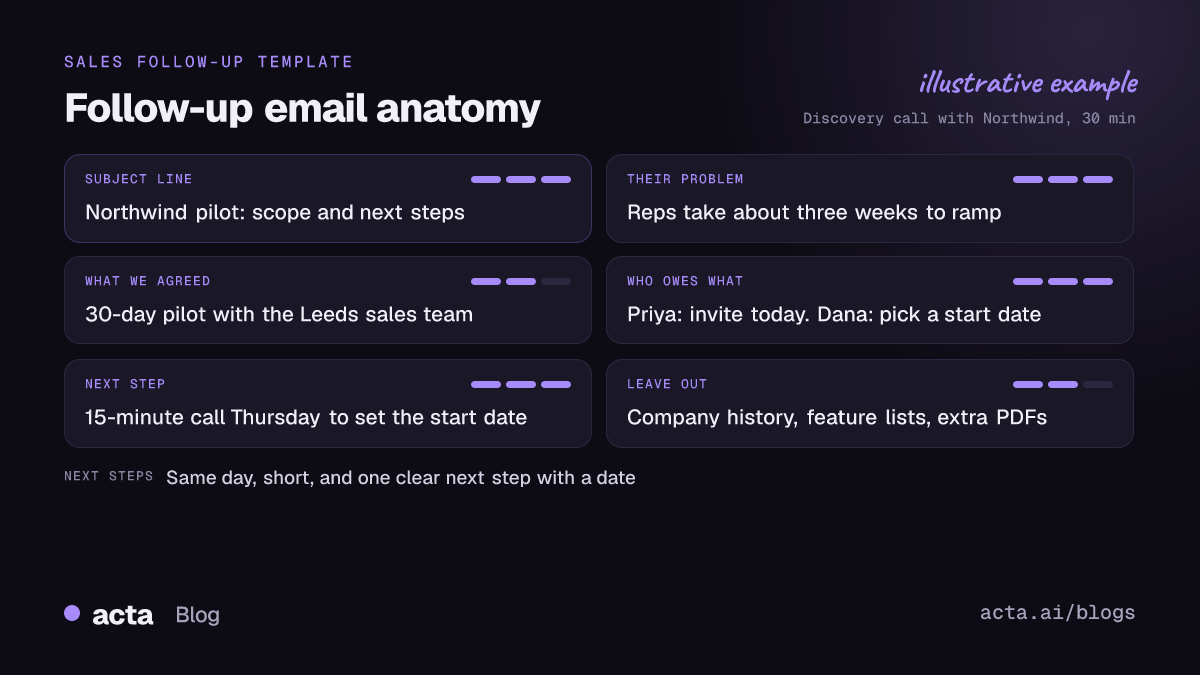
Five parts, in this order. Not every email needs all five, but most good ones have them.
- A specific subject line. "Northwind pilot: scope and next steps" beats "Following up" or "Great call!" The buyer should be able to find this email in two months by searching their company name.
- Their problem, in their words. One or two lines quoting or closely paraphrasing what they told you. "You mentioned onboarding new reps takes about three weeks and managers can't see what's said on calls." This shows you listened, and it's the line a champion copies into an internal email.
- What was agreed. Decisions, not a recap of your pitch. "We agreed a 30-day pilot with the two sales teams in Leeds."
- Who owes what. Your actions and theirs, with dates. Put your own first, which makes it easier to ask for theirs.
- One next step. A date, a meeting, a decision. Not "let me know your thoughts."
What to leave out: your company history, a feature list they didn't ask about, and a pile of attachments. If they asked for the security document, attach the security document. If they didn't, don't send six PDFs to look thorough.
How soon should you send the follow-up after a sales call?
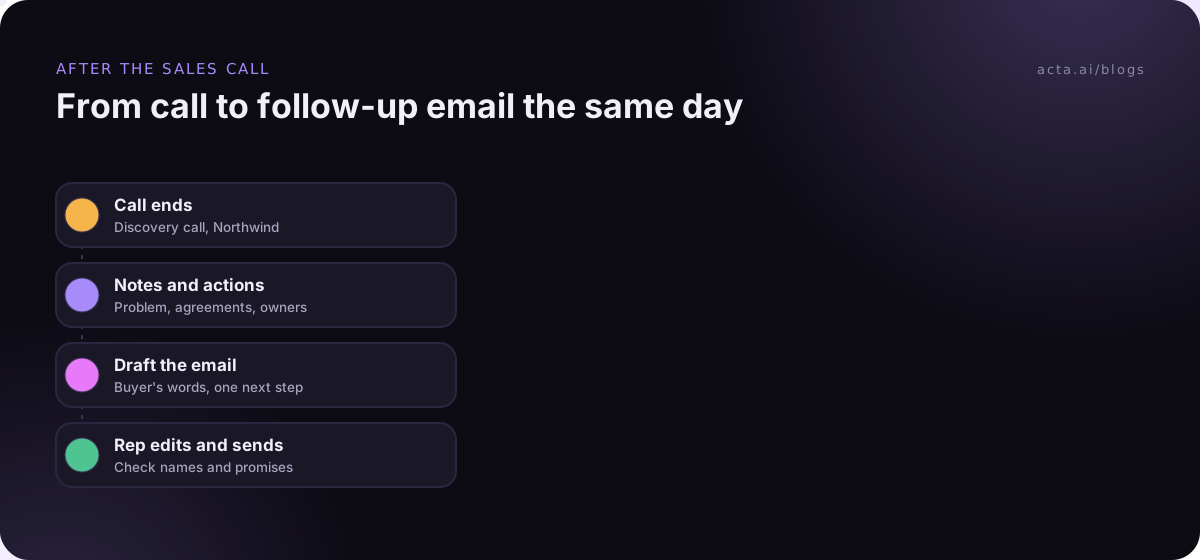
The same day, ideally within an hour or two of hanging up. You remember the details best right after the call, and the buyer does too.
There's research on speed from the lead side of selling. In The Short Life of Online Sales Leads, published in Harvard Business Review in 2011, the authors found that firms contacting a web lead within an hour were nearly seven times as likely to qualify it as firms that waited even one more hour. That study was about first contact with inbound leads, not follow-ups after a call, so don't read too much into the exact number. But the direction is the same as what most reps see: interest cools fast, and the vendor who writes back first, clearly, sets the frame. Note the buying signals from the call while they're fresh, so the email can speak to them.
The practical problem is that you often have back-to-back calls. That's why a lot of reps record the call and draft from the notes. If you're on Google Meet, Teams in the browser or the Zoom web client, a Chrome extension can record from your own tab without a bot joining. Tell the buyer at the start; our guide on recording consent and what to tell participants covers the wording.
How long should a sales follow up email be?
Short. Boomerang analysed a large set of emails back in 2016 and found that messages of 50 to 125 words had response rates above 50%, with replies dropping off for much shorter and much longer emails. It's an old, observational dataset from one company, not a sales-specific study, but it fits the common sense: long enough to be specific, short enough to read on a phone.
For a recap after a complex call with several stakeholders, you'll sometimes need more. In that case, keep the body short and put the detail in a clearly labelled section underneath ("Notes from the call, for Dana and the team") so the busy reader can stop after the first paragraph.
Sales follow-up email examples for common situations
These are illustrative examples with made-up names. Swap in the buyer's own words; that's the part that makes them work.
1. After a discovery call
Subject: Northwind: what we heard and next step
Hi Dana,
Thanks for walking me through how the team works today. What stuck with me: new reps take about three weeks to ramp, and you have no way to see what's said on calls unless you sit in.
Next step we agreed: a 30-minute demo on Tuesday at 10 with you and Marco, focused only on onboarding and call review. I'll send the invite today.
If I've got any of that wrong, tell me before Tuesday and I'll adjust the demo.
Priya
2. After a demo
Subject: Demo follow-up: answers to Marco's two questions
Hi Dana, Marco,
Thanks for today. Marco asked two things I promised to confirm: (1) whether it works with your CRM, and (2) who on your side would need admin access. Answers are below.
You mentioned you'd like to try it with one team first. I can set up a 30-day pilot for the Leeds team. Could we pick a start date on a 15-minute call Thursday?
Priya
Answering the questions they actually asked is the best follow-up email after a demo you can send. The demo call structure matters too: a demo built around their problems gives you a much easier email to write. If you didn't know an answer on the call, this is where you prove you'll come back with it.
3. After a pricing or proposal call
Subject: Northwind proposal: the two options we discussed
Hi Dana,
As promised, the proposal is attached with the two options: the full rollout and the smaller start with one team. You said budget sign-off sits with your CFO and the next review is on the 28th.
Would it help if I joined a 20-minute call with you before then to pressure-test the numbers? I can do Monday or Wednesday.
Priya
4. For a champion to forward internally
Subject: Summary for your team: why Northwind is looking at this
Hi Dana,
You mentioned you'd need to explain this to your VP. Here's a short summary you're welcome to forward or edit:
"Problem: reps take three weeks to ramp and managers can't review calls. Proposed: a 30-day pilot with the Leeds team. Cost to us during the pilot: setup time for two people. Decision needed: go or no-go on the pilot by the 15th."
Priya
This one is underrated. Your champion is busy too, and writing the internal pitch for them removes a real obstacle.
5. When they've gone quiet
Subject: Re: Northwind proposal
Hi Dana,
I haven't heard back since we sent the proposal, which usually means priorities shifted. Is the pilot still on your list for this quarter, or should I check back in the new year?
Either answer is fine; I'd just rather not keep filling your inbox.
Priya
Short, easy to answer, and it gives them permission to say no. You get more honest replies this way than with "just bumping this to the top of your inbox."
6. After a "not right now" call
Subject: Checking back after your Q1 planning
Hi Dana,
Thanks for being straight with me today: the team is focused on the new territory launch until March, and onboarding tools will come up again in Q1 planning.
I'll check back in the first week of February. If anything changes before then, you know where I am.
Priya
Then actually put a reminder in your calendar or CRM for February. Promising to check back and forgetting is worse than not promising.
What subject line works for a follow-up after a sales call?
The best subject line is specific and searchable. A few patterns:
- Company name plus topic: "Northwind pilot: scope and next steps."
- The thing they asked for: "Security answers you asked for."
- The decision pending: "Pilot go/no-go by the 15th."
Avoid "Following up," "Touching base," "Quick question" and anything with three exclamation marks. They look like every other vendor email and don't help anyone find the thread later.
What are the most common follow-up mistakes?
- Recapping your pitch instead of their problem. The buyer doesn't need your talking points back; they need proof you understood theirs.
- Vague next steps. "Let me know your thoughts" hands the buyer a task with no deadline. Suggest a specific time instead.
- Too many attachments. Send what was asked for. Offer the rest.
- Getting a fact wrong. Misquoting their team size or timeline in writing is worse than not mentioning it. Check your notes or the recording.
- Not logging it. The email is a record of the deal. If it lives only in your inbox, your manager and anyone who takes over the account can't see it. Our post on updating the CRM after a sales call covers that side.
- Forgetting your own promises. If you said you'd send pricing by Thursday, the follow-up should say so, and then you should. Small missed promises add up; see our guide to tracking customer promises.
Should you write follow-ups by hand or with AI?
Both work if you're careful. Writing by hand from good notes is fine when you do three calls a day. When you do eight, the follow-up for the last call of the day tends to be thin and late.
AI drafting from the call recording can get the structure and details down quickly, but read every draft before sending. Check names, numbers and especially anything that sounds like a commitment. A draft that promises a discount you never offered is a real problem. If you want to set this up so a draft is waiting after every call, our post on automating meeting follow-up emails walks through it, and for good discovery notes to draft from, see our discovery call template.
Where Acta fits
Acta records sales calls on Zoom, Google Meet and Microsoft Teams, with a bot or bot-free, and drafts a follow-up email from the transcript, with the decisions and action items and their owners. You edit and send it yourself, and the notes can go to Salesforce, HubSpot or Zoho. There's more on how sales teams use it on the sales page.
Frequently asked questions
How do you start a follow-up email after a sales call?
Skip "I hope this email finds you well" and open with something specific from the call, ideally the buyer's main problem in their words. It shows you listened and gets to the point.
How many times should you follow up if there's no reply?
There's no single right number. A sensible pattern is two or three short follow-ups spaced a few days to a week apart, each adding something useful, then a polite "is this still a priority?" email that makes it easy to say no.
Should you attach the slide deck to the follow-up?
Only if the buyer asked for it or it helps them sell internally. Otherwise offer it in one line. A short email with one relevant attachment gets read; a long one with five gets saved for later.
What's the difference between a recap email and a follow-up email?
A recap email summarises what happened; a follow-up also pushes the deal forward with owners, dates and a next step. The best sales follow up email does both in a few lines.
Can I send the same follow-up template to every prospect?
Use a template for the structure, not the content. The lines that quote the buyer's problem and the agreed next step have to be written for that call, or the email reads like everyone else's.
If you want a follow-up draft waiting after each call, you can try Acta with a 15-day free trial.