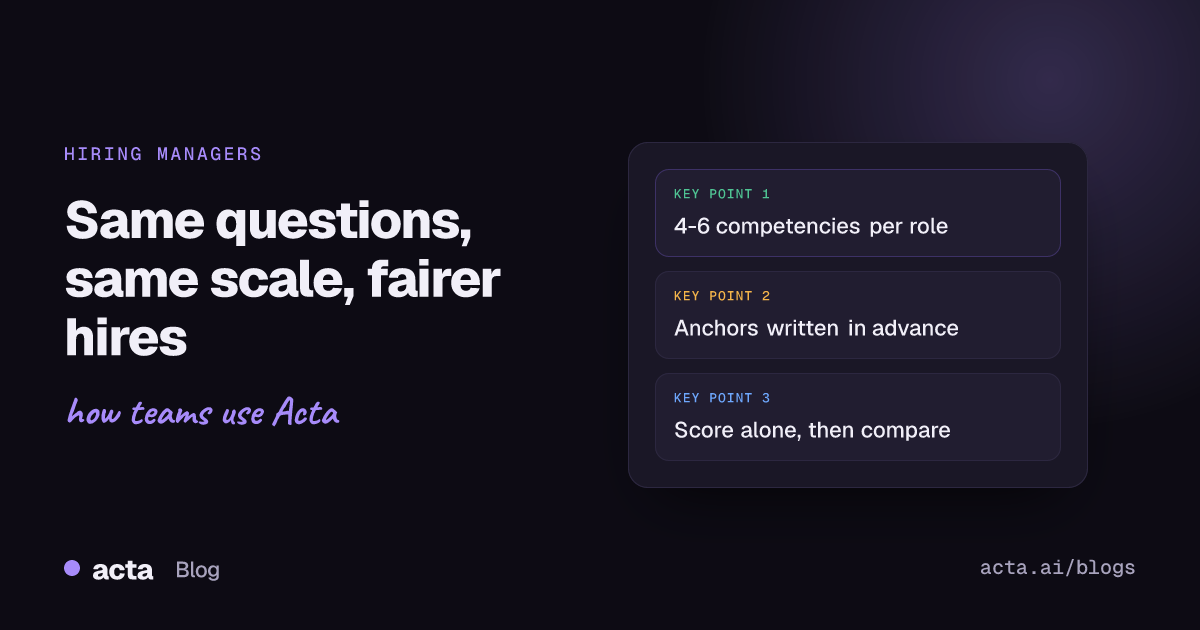
Quick answer: Structured interviews ask every candidate for the same role the same job-related questions, in the same order, and score each answer against a rating scale written before the interviews start. As a hiring manager you define four to six competencies, write behavioral and situational questions for each, agree what a weak, solid and strong answer sounds like, and have interviewers score independently.
Most hiring managers think they run structured interviews because they have a list of questions. Then candidate two gets a different follow-up, candidate three gets a friendly chat about a shared old employer, and the final decision comes down to who "felt right". That's an unstructured interview with a question list attached.
This guide walks through the whole thing, from working out what the job needs to the day you compare scores. It's written for a hiring manager with a real job to fill and limited time, not for an assessment specialist.
What are structured interviews, exactly?
Google's re:Work guide describes structured interviewing simply as using the same interviewing methods to assess candidates applying for the same job. In practice that means three things are fixed in advance:
- The questions. Every candidate gets the same core questions. Follow-up probes are allowed, but they're planned too.
- The scoring. Each answer is rated against a scale with written examples of what each level looks like.
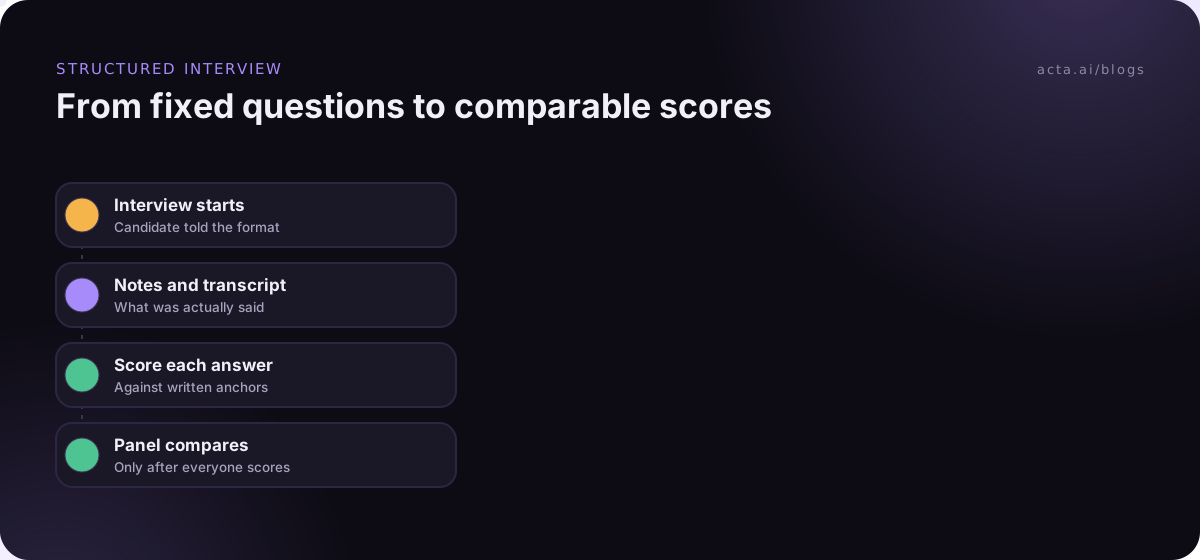
- The process. Interviewers take notes, score on their own, and only then compare in an interview debrief meeting.
It doesn't mean reading questions like a robot. You can still be warm, explain the process, and let the candidate ask their own questions at the end. The structure is in what you assess and how you judge it.
Why do structured interviews work better than unstructured ones?
Because they compare candidates on the same thing. In an unstructured interview, each candidate gets a different test, so you end up comparing how well the conversations went rather than how well the people would do the job.
The research backs this up. A widely discussed 2022 meta-analysis by Paul Sackett and colleagues revisited decades of selection research and found structured interviews came out as the top-ranked selection procedure once the authors corrected what they saw as overstated earlier estimates. The U.S. Office of Personnel Management also encourages federal agencies to use structured interviews and publishes guidance on building them.
There's a fairness argument as well. If everyone answers the same questions against the same scale, it's much harder for a hunch about someone's accent, school or hobbies to drive the decision. It doesn't remove bias, but it gives it fewer places to hide.
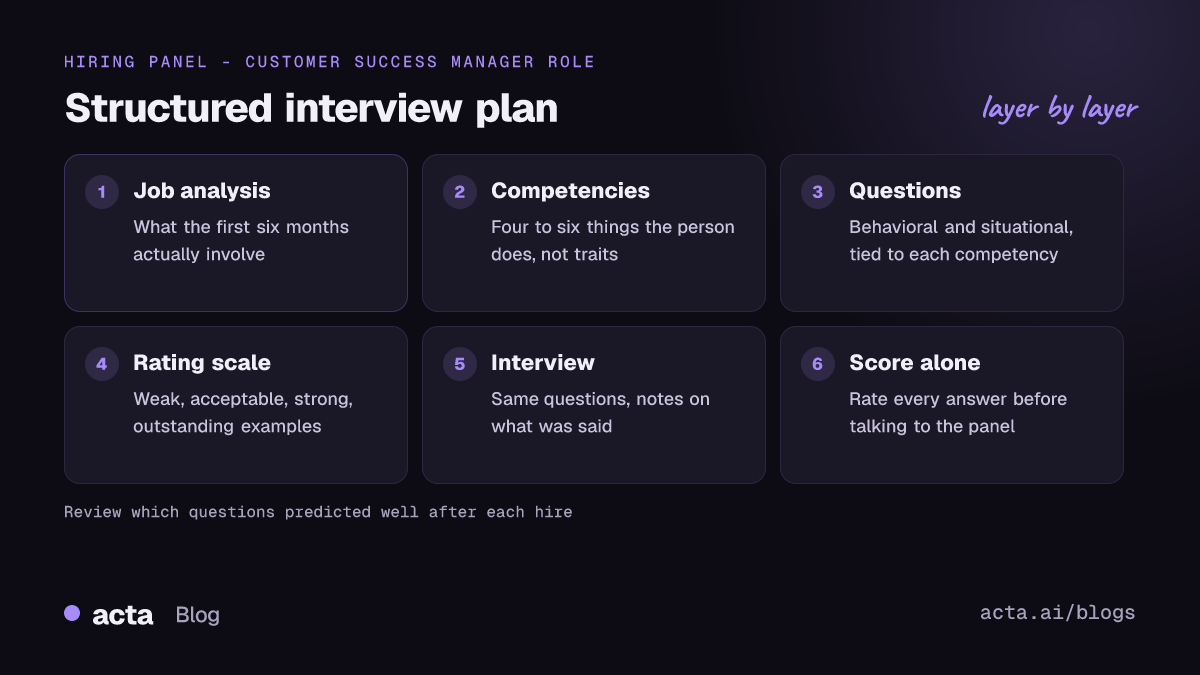
Step 1: What does the job actually need? (job analysis)
Every good structured interview starts with a job analysis. That sounds formal, but for most roles it's an hour with a whiteboard. Ask yourself and one or two people who do the job well:
- What will this person be doing in their first six months, week to week?
- What separates someone who's great at that from someone who's just fine?
- Which of those things can they learn on the job, and which do they need on day one?
Turn the answers into four to six competencies. For a customer success manager that might be: handling an angry customer, spotting churn risk early, running a renewal conversation, organizing a book of 40 accounts, and writing clearly. Notice these are things the person does, not traits like "passionate" or "a self-starter". If you can't describe what a competency looks like in a real week, cut it.
Skills like Excel or a specific programming language are often better tested with a short work sample than with interview questions. Keep the interview for what's hard to test any other way.
Step 2: How do you write structured interview questions?
There are two main question types, and most good interviews mix them.
Behavioral interview questions
These ask about the past. SHRM describes behavioral interviews as focusing on actions candidates have taken in previous jobs. They usually start with "Tell me about a time when...". For the customer success role: "Tell me about a time a customer threatened to cancel. What did you do, and what happened?"
Good behavioral interview questions ask for one specific example, not a general approach. Your planned probes push for detail: "What did you say to them?", "What was the outcome?", "What would you do differently?". A candidate who can only answer in generalities ("I always try to listen first") hasn't given you evidence yet.
Situational questions
Situational questions ask what the candidate would do in a realistic scenario from the job. "A customer you've never spoken to emails the CEO saying they're leaving. You have a call with them in an hour. How do you prepare?" These work well for people early in their careers who may not have a past example, and for testing judgment on problems specific to your company.
Two rules for both types. Keep every question tied to a competency from Step 1, and drop anything you can't score. "What's your biggest weakness?" and brainteasers fail that test. Google's guide is blunt about it: no brainteasers.
Step 3: How do you build a rating scale?
This is the step most teams skip, and it's the one that makes the rest work. For every question, write down what a weak, an acceptable, a strong and an outstanding answer sound like before you interview anyone.
A rating scale for "a customer threatened to cancel" might look like this:
- 1, weak: No specific example, or the example ends with "I escalated it to my manager" and nothing else.
- 2, acceptable: A real example. They responded quickly and offered a fix, but didn't dig into why the customer was unhappy.
- 3, strong: Found the underlying cause, agreed a plan with the customer, and followed up until it was fixed.
- 4, outstanding: All of that, plus they changed something so other customers didn't hit the same problem.
Writing these anchors forces the panel to agree on what "good" means for this job. It also makes your interview scorecard meaningful. A score of 3 means the same thing from every interviewer. If you want to see how a scorecard can be pre-filled with evidence from the transcript, our post on interview scorecard automation goes into it.
Step 4: How should you run structured interviews on the day?
- Brief the panel. Each interviewer covers specific competencies, so you don't get four people asking about teamwork and nobody asking about prioritizing.
- Tell the candidate how it works. "I'll ask some set questions and take notes; there'll be time for your questions at the end." People relax when they know the format.
- Ask the questions as written. Rephrasing is fine if someone doesn't understand, but don't add hints or soften harder questions for candidates you like.
- Take notes on what was said. Write what the candidate actually did and said, not your verdict. Our guide to reducing bias in interview notes has examples. "Called the customer the same day, offered a credit, didn't ask why" is useful. "Seemed strong" is not.
- Score right after, alone. Rate each answer against the scale before you talk to anyone else on the panel.
Note-taking is where a lot of interviewers struggle, because it's hard to listen, probe and write at the same time. Some teams record interviews so the interviewer can focus on the conversation and check the exact wording later. If you do, tell candidates up front and follow the rules where you hire; our guide to recording consent and what to tell participants is a good starting point. It's general information, not legal advice. For video interviews where a bot joining would feel odd, a recorder on your own computer like the Acta desktop app keeps things low-key.
What are the most common mistakes with structured interviews?
- Too many questions. Eight competencies with three questions each won't fit in an hour. Fewer questions with proper follow-up beat a rushed list.
- Scales that only describe the top. If you only write what "excellent" looks like, every middling answer gets a 3 by default.
- The "culture fit" round. An unstructured chat at the end often overrides all the careful scoring before it. If values matter, write questions and anchors for them like any other competency.
- Talking before scoring. A quick hallway "what did you think?" can anchor everyone's ratings. Score first.
- Never updating the questions. After a few hires, check which questions actually separated good candidates from weak ones and replace the ones that didn't.
Are structured interviews worth it for small teams?
Yes. Google's guide notes they work for organizations of any size, and in a small team each hire matters more. You don't need a big process. A one-page interview guide with five questions, a four-point scale for each and a rule that everyone scores before discussion gets you most of the benefit. The first role takes an afternoon to set up. After that, you reuse and tweak.
The bigger risk for small teams is that the founder or hiring manager skips the structure because "I'll know it when I see it". That's exactly the situation where structure helps most.
A short note on how Acta helps
Acta can record your video interviews on Zoom, Google Meet or Microsoft Teams, with a bot or bot-free from the desktop app or Chrome extension, and produce a transcript with speaker names and a summary. That makes it easier to check what a candidate actually said before you score, and its 40 report templates give you a consistent write-up for each interview. It doesn't score candidates for you; that stays with the panel. More on the hiring side is on our hiring page, and our post on candidate assessment from interviews shows what a write-up can look like.
Frequently asked questions
How many questions should a structured interview have?
For a 45 to 60 minute interview, five to eight core questions is usually right. That leaves time for probing follow-ups and the candidate's own questions. More questions usually means shallower answers.
Can I ask follow-up questions in a structured interview?
Yes, as long as they're planned probes that every candidate could get, like "What was the result?" or "What did you say?". Avoid follow-ups that lead the candidate toward the answer you want.
What is the difference between behavioral and situational questions?
Behavioral interview questions ask what someone did in a past situation. Situational questions ask what they would do in a realistic future one. Both work in structured interviews; situational questions are useful when candidates have little relevant experience.
Do structured interviews remove bias completely?
No. They reduce the room for it by making everyone answer the same questions against the same scale, but interviewers still bring their own judgments. Independent scoring, written evidence and a well-run debrief all help.
Should every interviewer on the panel ask the same questions?
Usually not. It's better to split competencies across the panel so each interviewer goes deep on two or three. What matters is that each candidate gets the same questions from the same panel member.
If you'd like your interview transcripts and summaries in one place for the next hire, you can try Acta with a 15-day free trial.