Technology 10 min read
7 Project Risks Hiding in Everyday Conversations

Most project risks don't begin in a risk register.
They begin in a meeting.
A vague commitment. A blocker that keeps coming back. A "small" feature request. A decision that nobody explicitly agrees to. A stakeholder who wasn't in the room.
Individually, these moments may seem harmless. Together, they can become early warning signs of missed deadlines, scope creep, delivery delays, rework, and project failure.
To understand how often these signals appear, we analyzed 1,000 project-related meetings including standups, sprint planning sessions, client calls, project reviews, and cross-functional meetings.
Our goal was simple:
Identify the conversational patterns that signal project risk before those risks appear on a status report.
We found seven recurring signals.
Here's what project managers should be listening for.

The important thing is that none of these statements necessarily represents a problem by itself.
The risk comes from the pattern behind the conversation.
Let's look at each one.
1. The Vague Commitment
"I'll try to get to that this week."
It sounds like agreement.
It isn't necessarily one.
A vague commitment is one of the easiest ways for work to fall through the cracks. There is no clear owner, no firm deadline, and often no explicit confirmation that the person actually accepted responsibility.
In our analysis, vague commitments appeared in roughly one out of every three meetings.
The danger isn't necessarily that someone is deliberately avoiding the task. More often, everyone simply leaves the meeting with a different understanding of what was agreed.
The task feels acknowledged, so nobody follows up.
Until the next meeting.
What to listen for
Pay attention to conditional language such as:
"I'll try."
"Probably."
"I should be able to."
"If I get some time."
"We'll see."
"Hopefully."
When these phrases are attached to a deliverable, dependency, or deadline, they deserve a second look.
A commitment without a clear owner and timeframe isn't really a commitment. It's an assumption.
2. The Repeated Blocker
A blocker mentioned once is normal.
A blocker mentioned in three consecutive standups is a project risk.
One of the clearest signals we found was repetition.
A dependency is raised on Monday.
It comes up again on Wednesday.
By Friday, the team is still waiting.
Yet nothing has changed.
Our analysis found that blockers repeated across two or more meetings were resolved 40% slower than blockers that were raised and assigned an owner when first identified.
The important signal isn't simply that a blocker exists.
It's that the conversation about the blocker isn't progressing.
What to listen for
Look for the same:
Dependency
Unresolved question
External approval
"Waiting on" person or team
Technical issue
Customer response
appearing repeatedly without a clear change in status.
A healthy project conversation moves a blocker forward:
Identified → Owned → Action taken → Resolved
A risky conversation looks like:
Identified → Discussed → Repeated → Repeated again
That's when a blocker becomes a project risk.
3. The Scope Creep Question
"While we're at it, could we also..."
Scope creep rarely arrives with a warning label.
It usually sounds completely reasonable.
"Can we add one more field?"
"Could we make this work for one more use case?"
"Since we're already changing this, can we also update that?"
Each request may be small.
The problem is what happens when ten small requests accumulate without anyone formally recognizing that the project scope has changed.
In the meetings we analyzed, phrases such as "while we're at it," "just a small addition," and "shouldn't take long" frequently appeared around conversations that expanded the original scope.
What to listen for
Be especially attentive when new requests are introduced using minimizing language:
"Just one small change."
"It should be easy."
"Shouldn't take long."
"While we're doing this..."
"Can we also..."
"It's basically the same thing."
The key question isn't:
"Is this change small?"
It's:
"Was this change part of the original commitment?"
If the answer is no, it deserves to be treated as a scope decision—not an informal addition.
4. The Silent Disagreement
Some of the most important signals in a meeting aren't things people say.
They're things they don't say.
A decision is proposed.
Nobody objects.
The conversation moves on.
The meeting ends.
Everyone assumes the team agreed.
But silence isn't always agreement.
Our analysis found that decisions met primarily with silence, rather than explicit confirmation, were more likely to be revisited or reversed later.
This is particularly common in cross-functional meetings where participants may hesitate to challenge a decision publicly.
What to listen for
Watch for decisions that end with:
"Okay, moving on..."
without anyone explicitly confirming:
Who agreed
Who owns the action
Whether affected teams are aligned
What exactly was decided
There is a big difference between:
"So we're agreed that we'll launch on Friday?"
"Yes, agreed."
and:
"Okay, let's move on."
The second one may feel like consensus.
It isn't necessarily consensus.
Silence closes a conversation. It doesn't always close a decision.
5. The Timeline Optimism Gap
"It's a quick change."
Those four words can create a surprisingly large problem.
Teams routinely estimate work during meetings based on how simple the task sounds, rather than how long similar work has actually taken.
When we compared verbal estimates against historical delivery data for comparable tasks, we saw a consistent pattern: estimates made during meetings tended to be more optimistic than actual delivery times.
The gap was particularly noticeable when work was described as:
"Quick"
"Simple"
"Easy"
These words aren't inherently problematic.
But they can be useful signals that the team may be underestimating complexity.
What to listen for
Don't just capture the estimate.
Capture the language surrounding the estimate.
Compare:
"We can probably finish this in two days."
with:
"This is similar to the previous integration, which took five days. We estimate four to five days."
The second estimate is grounded in evidence.
The first may be grounded in optimism.
For project managers, this distinction matters because optimistic estimates compound.
A two-day underestimate repeated across ten tasks doesn't create a small delay. It creates a project schedule that may have been unrealistic from the beginning.
6. The Missing Stakeholder
Some risks don't originate from a bad decision.
They originate from making a reasonable decision without the person who needs to live with it.
A project team agrees on an approach.
Two weeks later, the customer rejects it.
A development team changes a workflow.
Operations discovers that it breaks an existing process.
A product decision is made.
Compliance learns about it afterward.
The meeting itself may have gone perfectly.
The problem happens later.
What to listen for
Listen for statements such as:
"We'll need sign-off from X."
"Let's check with the client."
"We should confirm with legal."
"Operations will need to review this."
"We'll let the product team know."
These statements identify a stakeholder who is relevant to the decision—but may not have been part of the conversation.
That creates a simple risk:
Decision made → Stakeholder informed later → Stakeholder disagrees → Decision reopened
The easiest way to prevent that cycle is to identify the missing stakeholder before the decision becomes final.
7. The Deferred Decision That Never Returns
"Let's revisit this next week."
It's one of the most common phrases in project meetings.
And often one of the least reliable.
Deferring a decision can be perfectly reasonable. Sometimes the team genuinely needs more information.
The problem is what happens afterward.
Who brings it back?
When?
In which meeting?
What information needs to be available before the decision can be made?
Without an answer to those questions, "let's revisit it" can quietly become "let's forget about it."
What to listen for
Watch for:
"Let's park this."
"We'll come back to it."
"Let's discuss this next week."
"We need more information first."
"We'll decide later."
These aren't necessarily risks by themselves.
They become risks when there is no owner and no follow-up point.
A stronger version sounds like:
"Let's park the pricing decision. Priya will collect the customer feedback, and we'll make the decision in Thursday's project review."
Now the decision has:
An owner + an action + a deadline + a forum for resolution
That's very different from simply saying:
"Let's revisit it."
Why Project Risks Are So Easy to Miss
None of these seven signals is particularly difficult for a human to understand.
The challenge is scale.
A project manager might attend six or eight meetings in a day.
A program manager may be tracking multiple teams.
An engineering manager may move from a standup to a customer call, then a design review, then sprint planning.
Across those conversations, hundreds of small signals appear:
Commitments
Blockers
Decisions
Dependencies
Assumptions
Scope changes
Unresolved questions
Stakeholder concerns
Humans are good at understanding a conversation.
We're much less reliable at remembering patterns across hundreds of conversations over several weeks.
That's where AI meeting intelligence can become useful.
From Meeting Notes to Project Intelligence
Traditional meeting tools answer:
"What happened in this meeting?"
Modern project teams increasingly need a different question:
"What is happening across all our meetings?"
That's a much harder problem.
A single meeting might contain a harmless blocker.
But when the same blocker appears in four meetings across two weeks, it becomes a pattern.
A single scope request might be reasonable.
But when similar requests keep appearing across customer calls, the project may be experiencing systematic scope expansion.
A single deferred decision might be appropriate.
But when ten decisions are repeatedly postponed, the project may have an ownership or governance problem.
The value of AI isn't simply transcribing these conversations.
It's connecting them.
How AI Can Help Identify Project Risks Early
AI meeting intelligence can analyze project conversations continuously rather than treating every meeting as an isolated event.
For example, AI can help identify:
Commitments without clear owners
Someone agrees to complete something, but ownership or timing isn't explicitly established.
Repeated blockers
The same dependency, issue, or unresolved question keeps appearing across meetings.
Potential scope changes
New requirements are introduced without an explicit discussion of scope, effort, or impact.
Unconfirmed decisions
A decision appears to have been made, but there is no clear confirmation or ownership.
Timeline risks
Delivery estimates appear optimistic compared with previous commitments or similar work.
Missing stakeholders
A decision affects a person or team that wasn't part of the conversation.
Deferred decisions
An important decision is postponed without a clear owner or follow-up date.
This is where AI moves beyond simple meeting transcription.
It begins to provide a continuous view of project health.
What AI Can Detect Across Project Meetings
The real opportunity isn't analyzing one meeting.
It's analyzing the conversation history of the project.
Imagine an AI project assistant that can answer questions such as:
Which blockers have appeared repeatedly this month?
Which commitments are overdue?
Which project decisions are still unresolved?
What risks were raised but never assigned an owner?
Which customer requests could expand project scope?
Which decisions were made without key stakeholders?
Which deadlines have been mentioned repeatedly but not met?
What issues are becoming more frequent across meetings?
Instead of manually reconstructing this information from meeting notes, project managers can use AI to surface the patterns that matter.
That's the shift from meeting notes to project intelligence.
The Future of Project Risk Management Is Already in Your Meetings
Project managers don't need another dashboard filled with information.
They need earlier signals.
The best project risk management system shouldn't only tell you:
"The project is at risk."
It should help answer:
"What changed in the conversations that makes you think the project is at risk?"
That answer often exists long before the status turns red.
It exists in the language people use.
The commitment that wasn't quite a commitment.
The blocker that keeps coming back.
The "small" request that changes the scope.
The decision nobody explicitly agreed to.
The stakeholder who wasn't in the room.
The decision that was postponed and forgotten.
These are not just meeting details.
They are early indicators of project health.
How Acta Helps Track Project Risks Across Meetings
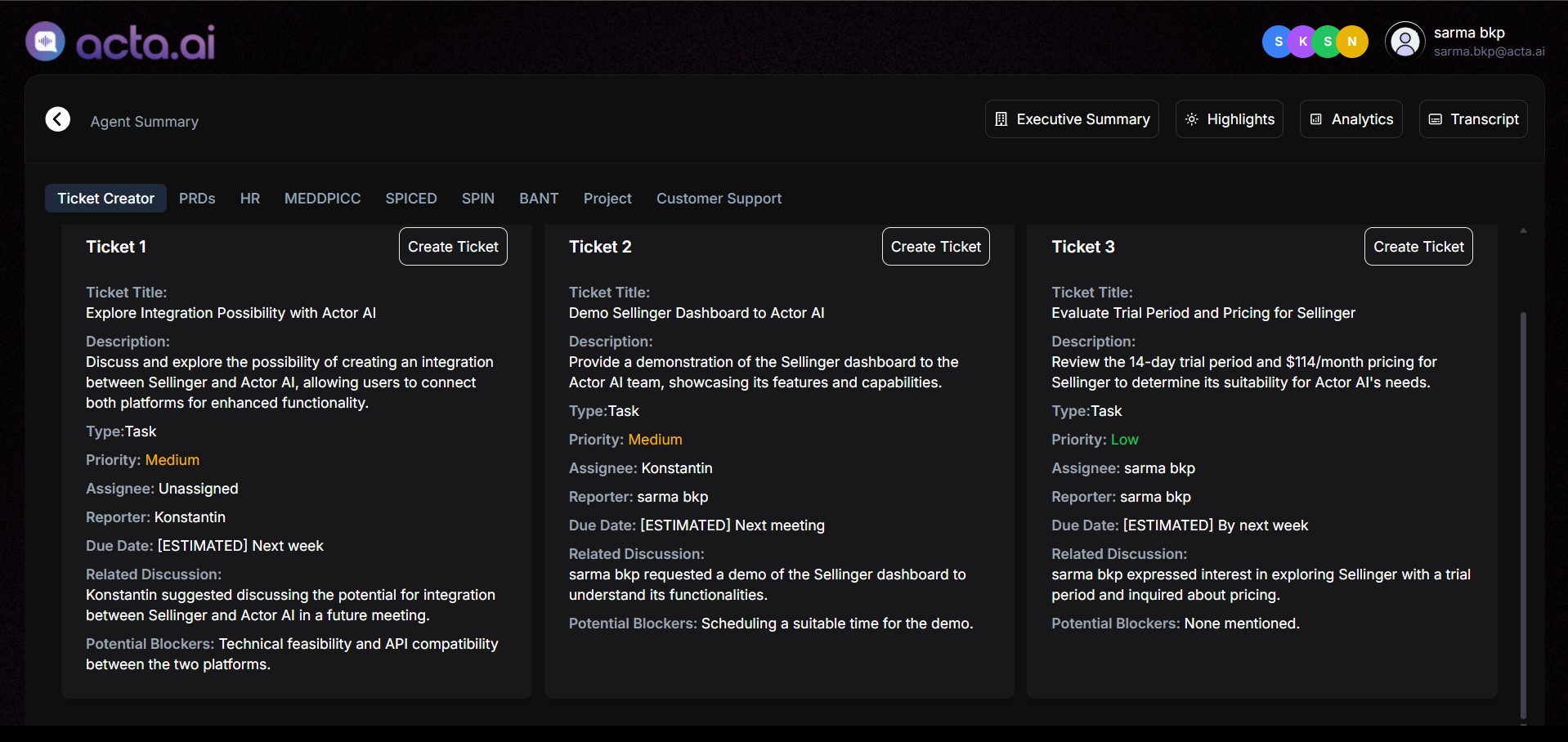
Acta brings AI meeting intelligence into the project management workflow by analyzing conversations across meetings—not just summarizing individual calls.
Instead of looking at every meeting in isolation, Acta can help project teams connect:
Meetings → Decisions → Commitments → Blockers → Risks → Actions
This gives project managers a more continuous view of what's happening across the project lifecycle.
Whether it's a repeated blocker in weekly standups, a new requirement raised during a customer call, or a decision that keeps getting postponed, the goal is to surface important signals while there's still time to act.
Start a free trial with Acta and see what your next project conversation reveals.
You can also explore Acta's Project Management Assistant to see how AI can help track risks, commitments, decisions, blockers, and dependencies across your project lifecycle.