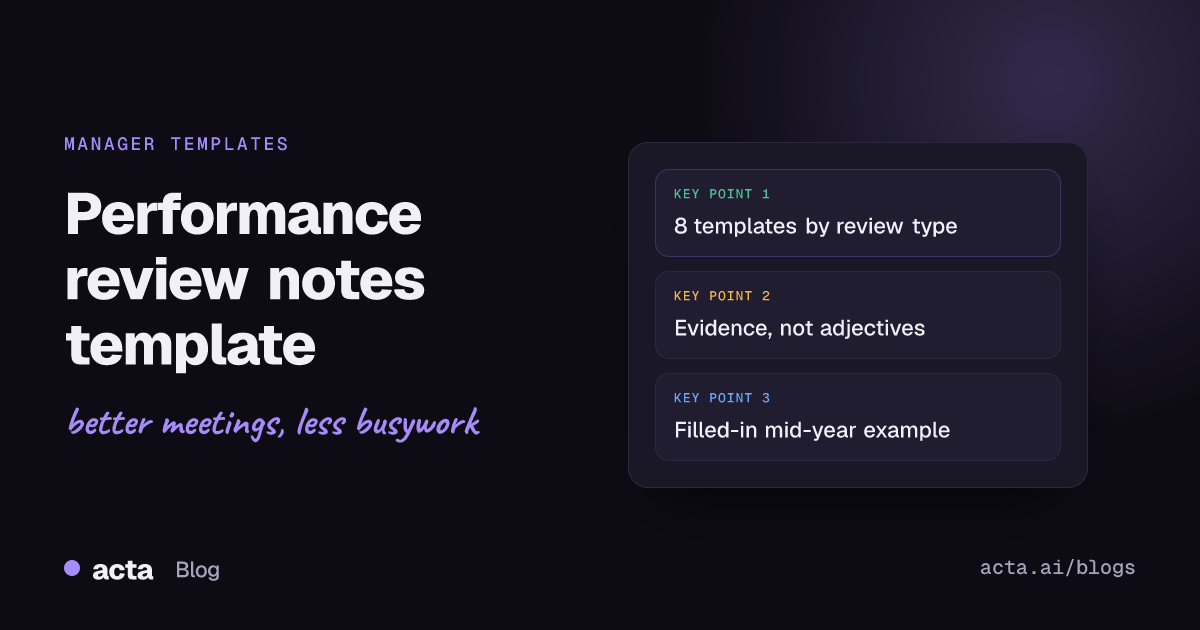
A performance review notes template gives you a fixed place for what was discussed, the evidence behind each point, what the employee said in response, agreed goals and follow-up dates. Below are eight copy-ready templates for annual reviews, mid-year check-ins, probation reviews, improvement plans and 360 debriefs, plus a filled-in example and the rules that keep notes fair and usable.
Meeting Productivity 10 min read
Performance Review Notes Template: 8 Examples for Every Review
Eight copy-ready templates for writing up review conversations, from annual reviews to improvement plans, with a filled-in example and rules for fair, evidence-based notes.
By Sarma BKP, Founder & CEO, Acta · Updated
This guide is for managers and HR partners who need to write up the review conversation itself, during or straight after it. If you're still preparing for the meeting, start with our performance review preparation checklist and come back here. It's general guidance, not legal or HR advice; when a review could lead to formal action, follow your company's policy and talk to HR first.
Key takeaways
- Write the notes within 24 hours, and share them with the employee so they can add comments or corrections.
- Back every rating or judgement with at least one specific example: date, situation, what happened, effect.
- Record the employee's own view in their words, in a separate section from yours.
- End every set of notes with two to four goals, each with a measure and a date, and the date of the next check-in.
- Use a stricter template for probation and performance improvement plan meetings, with expectations, support offered and the consequence spelled out.
Table of contents
- Performance review notes are a shared record, not a private diary
- Good notes follow five rules
- Eight performance review notes templates you can copy
- A filled-in example shows the level of detail
- Evidence beats adjectives in every section
- Six mistakes make review notes useless or unfair
- Recording a review needs care and consent
- Where Acta fits in review conversations
- Frequently asked questions
- Write your next set of review notes with this checklist
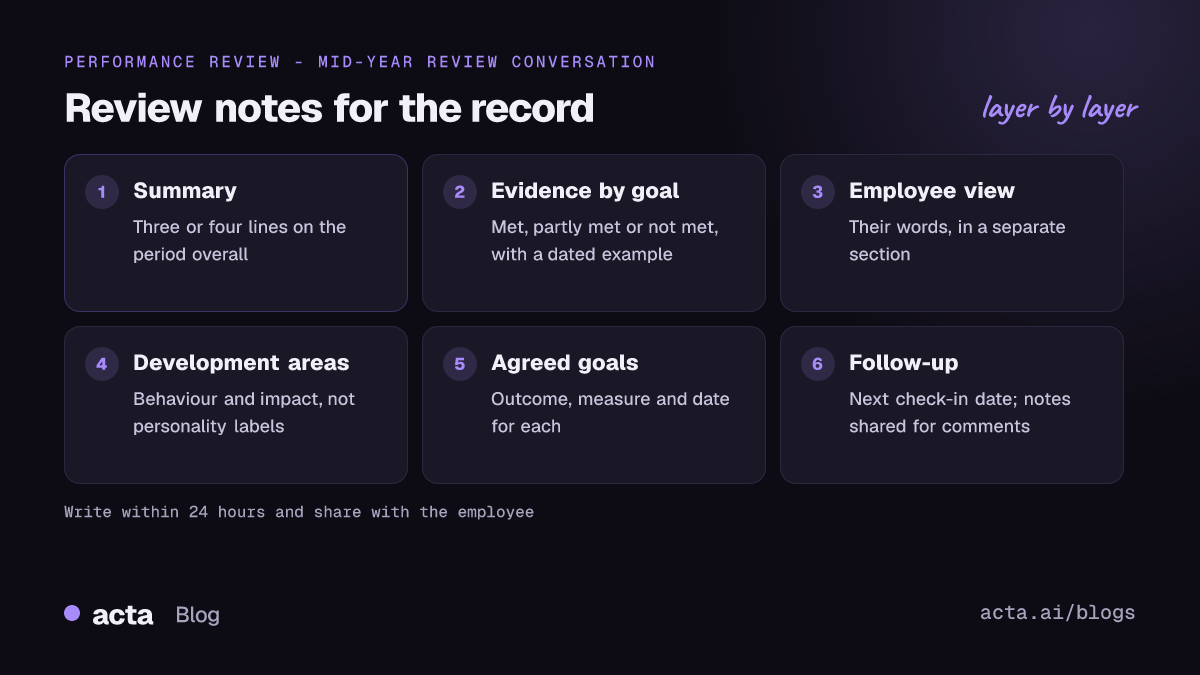
Performance review notes are a shared record, not a private diary
Performance review notes are the written record of a review conversation: what was discussed, the evidence behind each point, how the employee responded, and what both people agreed to do next. They serve three readers. The employee, who needs a clear statement of where they stand. You, at the next review, when you've forgotten the details. And, sometimes, HR or a later manager, who needs to understand a rating or a decision without having been in the room.
The UK's workplace adviser Acas says in its guidance on reviews and appraisals that it's important to keep a written record of what is discussed and to share it with the employee afterwards. In the US, the Office of Personnel Management's performance management roadmap for supervisors advises keeping records of accomplishments, feedback and coaching throughout the review period. Different systems, same message: write it down, keep it factual, and share it.
That changes how you write. Private shorthand like "attitude issues again" doesn't belong in appraisal meeting notes the employee will read. If you wouldn't say it to their face in those words, rewrite it.
Good notes follow five rules
- Write them fast. Fill the template during the meeting if you can, and finish within 24 hours. Memory of tone and wording fades quickly.
- Separate fact from judgement. "Missed the 3 March and 17 March client deadlines" is a fact. "Struggles with time management" is a judgement, and it needs the fact next to it.
- Record both voices. Give the employee's view its own section, quoting them where it matters.
- Make goals measurable. Each goal gets an outcome, a measure and a date.
- Share and sign off. Send the notes, invite comments and keep the final version where your company keeps review records.
Eight performance review notes templates you can copy
Pick the template that matches the conversation. Each performance review notes template is short on purpose; add sections only if your company's review form asks for them.
1. Annual performance review notes
Use it for the main yearly review, where ratings or overall assessments are given.
Employee / role / manager / date / review period:
Overall summary (3-4 lines):
Goals for the period: for each, met / partly met / not met, with one example
Strengths shown, with examples:
Development areas, with examples:
Employee's view (in their words):
Rating (if used) and reason:
Goals for next period: outcome, measure, date
Support agreed (training, mentoring, resources):
Next check-in date:
2. Mid-year check-in notes
Use it halfway through the cycle to adjust goals before the annual review.
Progress on each goal (on track / at risk / off track) and why:
Goals to change or drop, and why:
What's getting in the way:
Feedback both ways:
Actions before year-end, with owners:
3. Quarterly or continuous check-in notes
Use it if your company has moved to frequent, lighter reviews. Keep it to one screen.
Wins this quarter:
Misses and lessons:
Priorities for next quarter (max 3):
One thing the manager will do differently:
4. Probation review notes
Use it at the end of a probation period, or at a midpoint review during one.
Probation start and end dates:
Expectations set at the start (list):
Evidence against each expectation:
Support given so far:
Employee's view:
Outcome: confirmed / extended to [date] / not confirmed (follow company policy)
If extended: what must improve, by when, and how it will be measured
5. Performance improvement plan meeting notes
Use it for formal performance improvement plan meetings. These notes may be read closely later, so be precise and check your process with HR before the meeting.
Attendees and roles (including any HR representative or companion):
The performance gap: the expected standard, the actual performance, specific dated examples
Employee's explanation and any factors raised (workload, health, tools):
Improvement targets: measurable, with dates
Support the company will provide:
Review meeting dates:
What happens if targets are or aren't met (as stated in the meeting):
Notes shared with employee on (date); employee comments:
6. Self-evaluation discussion notes
Use it when the employee has written a self-evaluation and the meeting compares their view with yours.
Where we agree:
Where we see it differently, and why:
Achievements the employee raised that I hadn't weighted enough:
Agreed final assessment:
7. 360 feedback debrief notes
Use it when you're walking someone through feedback from peers and reports. Summarise themes; never attribute anonymous comments.
Top three themes (strengths):
Top three themes (development):
Employee's reaction and questions:
One or two things they'll act on, and how:
8. Employee's own notes
Use it if you're the one being reviewed. Take these notes during the meeting and compare them with your manager's write-up.
Rating or overall view given, and the reasons stated:
Examples my manager mentioned:
Points I raised and the response:
Goals and support agreed:
Anything to clarify in writing:
| Template | When | Length | Key section |
|---|---|---|---|
| Annual review | Once a year | 1-2 pages | Goals with evidence |
| Mid-year | Halfway | Half a page | Goals to change |
| Quarterly check-in | Every quarter | One screen | Next priorities |
| Probation | End of probation | 1 page | Outcome and reasons |
| Improvement plan | Formal PIP meetings | 1-2 pages | Targets, support, dates |
| Self-evaluation | With self-review | Half a page | Where views differ |
| 360 debrief | After 360 survey | Half a page | Themes, not names |
| Employee's own | Any review | Half a page | Points to clarify |
A filled-in example shows the level of detail
An illustrative mid-year write-up. The people and numbers are made up.
Employee: Marco, account manager. Manager: Priya. Date: 9 July. Period: January-June.
Goal 1, renewals (on track): 11 of 12 renewals closed on time. The one late renewal (Harbor Foods, April) slipped because the contract owner changed; Marco re-engaged the new contact within a week.
Goal 2, expansion revenue (at risk): Two of the five planned expansion conversations have happened. Marco said quarterly planning took more of his time than expected.
Feedback: Priya: account plans are clear and clients mention Marco's follow-up by name. Marco: wants earlier warning when product changes affect his clients.
Employee's view: "I'd rather drop one expansion target than rush the conversations."
Agreed: Goal 2 reduced from five to four conversations by 30 September. Priya to add Marco to the product release review from August. Marco to book the remaining conversations by 31 July.
Next check-in: 10 September. Notes shared with Marco on 10 July for comments.
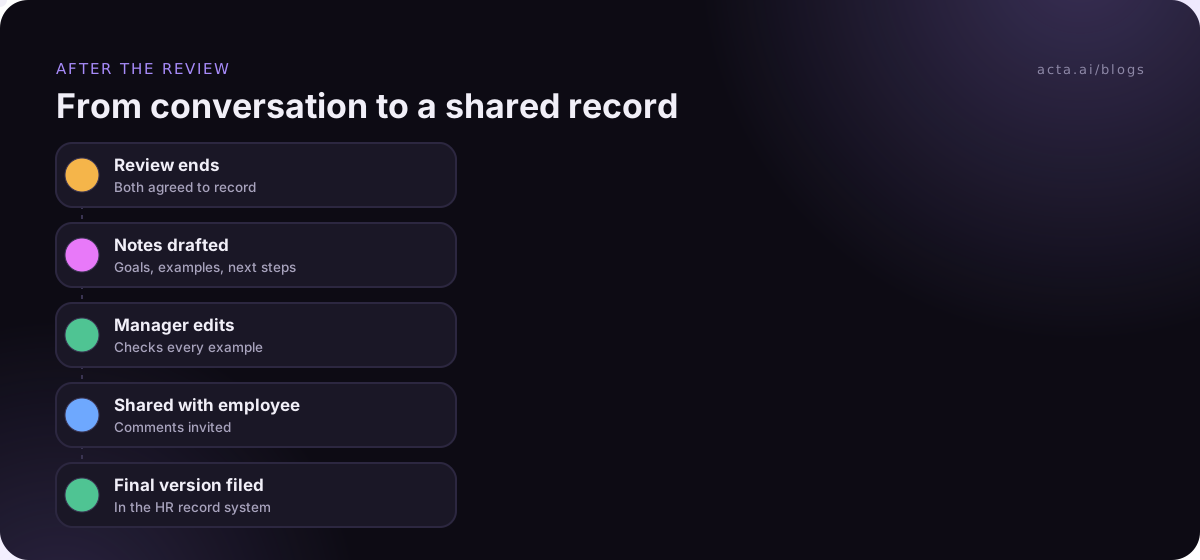
Evidence beats adjectives in every section
The fastest way to improve manager notes for performance review write-ups is to replace adjectives with examples. A widely used structure is Situation-Behaviour-Impact, a feedback model from the Center for Creative Leadership: describe when and where, what the person did, and what effect it had.
- Instead of "great communicator," write "At the March steering meeting (situation), Dana summarised the delay and the two options in five minutes (behaviour), and the client chose an option on the spot (impact)."
- Instead of "needs to be more proactive," write "In May, two supplier issues reached me through the client before Sam raised them (situation and behaviour), which meant we apologised twice (impact)."
- Instead of "strong year," write the three outcomes that made it strong.
Evidence comes from the whole period, not the last month. Recency bias is the classic review error: the project that went wrong in November outweighs ten months of good work. Keep a running file of examples through the year; our guides to one-on-one meeting notes and 1:1 follow-up show how to build that habit. The same discipline that helps you reduce bias in interview notes applies here: write what you observed before you write what you concluded.
Six mistakes make review notes useless or unfair
- Surprises. If the notes contain a problem the employee hears about for the first time, the problem is the feedback process, not the notes.
- Personality labels. "Abrasive" or "not a team player" describes a person. Describe the behaviour instead.
- Missing employee voice. Notes that only show the manager's view look one-sided to anyone reading later.
- Goals without dates. "Improve stakeholder management" can never be met or missed.
- Different notes from what was said. Don't add criticism to the write-up that you didn't raise in the meeting.
- Notes kept in personal files. Store them where your company keeps review records, with the right access controls.
Recording a review needs care and consent
Some managers record reviews so they can listen fully and get the wording right. That can help, but performance conversations are sensitive, and some people speak less openly when they know they're being recorded. Ask first, explain why and who'll see the recording, and accept a no. Check your company's policy, too: many have rules on recording HR conversations, and formal meetings such as improvement plan reviews may have their own process. Our posts on recording sensitive HR, legal and board calls and on recording consent and what to tell participants cover the general rules; neither is legal advice.
Where Acta fits in review conversations
Where both people agree to it, Acta can record the review, produce a transcript with speaker names, and fill a structured report from one of its report templates so you start from a draft rather than a blank page. For a video call where you'd rather not have a bot, the desktop app records from your own computer, and the mobile app covers reviews held in person. Acta doesn't use customer data to train AI models; you still review and edit every word before the notes are shared.
Frequently asked questions
What should be included in performance review notes?
Include the date, attendees and review period; progress on each goal with specific examples; strengths and development areas with evidence; the employee's view in their own words; any rating and the reason; new goals with measures and dates; support agreed; and the next check-in date. Share the notes with the employee for comments.
Should employees see their performance review notes?
Generally yes. Acas recommends sharing the written record with the employee after the meeting, and doing so lets them correct misunderstandings and add their comments. Write every set of notes assuming the employee will read it. Your company's policy decides how comments and sign-off are handled and where the final version is stored.
How do I write notes for a performance improvement plan meeting?
Be precise and factual. Record attendees, the expected standard, the actual performance with dated examples, the employee's explanation, measurable targets with dates, the support offered, review dates and what was said about outcomes. Share the notes promptly. Because these meetings can lead to formal action, follow your company's process and involve HR.
Is it OK to take notes on a laptop during a review?
Yes, if you say so at the start and keep eye contact for the important parts. Some managers prefer a quick paper outline during the meeting and a typed write-up within the hour. If a notetaker or recorder is used instead, get agreement first and still edit the draft yourself.
How long should I keep performance review notes?
That depends on your company's retention policy and local law, so check with HR. Store notes in the system your company uses for review records rather than in personal folders or email, and make sure only people with a legitimate need can see them.
Write your next set of review notes with this checklist
Before you hit send on the write-up:
- Pick the template: annual, mid-year, probation, improvement plan or 360, and use only the sections you need.
- Add the evidence: one dated example behind every judgement or rating.
- Include their voice: the employee's view in their words, in its own section.
- Set the goals: two to four, each with a measure and a date, plus the next check-in.
- Share it: send within 24 hours, invite comments and file the final version.
If you and your report agree to record, try the Acta Chrome extension or the desktop app on your next check-in during the 15-day free trial.
Found this useful? Share it with your team.