Quick answer: Good one on one follow up means writing down every commitment from the 1:1, yours and theirs, in a shared running doc before you hang up, sending a three-line recap the same day, and opening the next 1:1 by reviewing what got done. Treat your own promises as the ones that matter most: they're what your report remembers.
"Let me look into that." "I'll talk to Sarah about the budget." "Yes, let's get you on the conference list." Managers say these things in 1:1s all the time, mean every word, and then the week happens. Two weeks later the report has quietly concluded that raising things with you doesn't lead anywhere.
That's the real cost of weak follow-up on 1:1 commitments. It isn't the missed task. It's that people stop bringing you the real stuff. This guide is about the small, boring system that stops that from happening.
Why do 1:1 commitments slip so easily?
Commitments made in a team meeting have witnesses. Someone usually writes them down, and if they slip, someone else notices. 1:1s have none of that. A few specific reasons they slip:
- They're spoken, not written. 1:1s feel like conversations, so nobody takes notes the way they would in a project meeting.
- Nobody else sees them. There's no team tracker and no peer who'll ask "did that happen?"
- The manager's items are the vaguest. "I'll see what I can do about your title" has no date and no clear finish line.
- Urgent work wins. Development items, like a course or a stretch project, never feel urgent, so they're always next month.
Steven Rogelberg, an organizational psychologist at UNC Charlotte who researches one-on-one meetings, has found that managers tend to rate their own 1:1 skills higher than their direct reports rate them. Follow-through is one of the easiest places for that gap to show up, because the manager forgets the promise and the report doesn't.
What counts as a 1:1 commitment?
Anything either of you said you'd do, plus anything you agreed to come back to. In practice, 1:1 action items fall into three groups:
- Their work items: "I'll have the migration plan ready for review by the 20th."
- Your manager commitments: "I'll find out whether we can backfill the role," "I'll introduce you to the data team lead," "I'll raise the on-call load with Priya."
- Shared development goals: "Let's get you presenting at the next all-hands," "We'll look at the leadership course in Q1."
The middle group is the one managers drop most, and it's the one reports watch most closely. If you only fix one thing after reading this, make it that.
How to do one on one follow up: a simple system
None of this needs software. It needs about five minutes per 1:1 and some consistency.
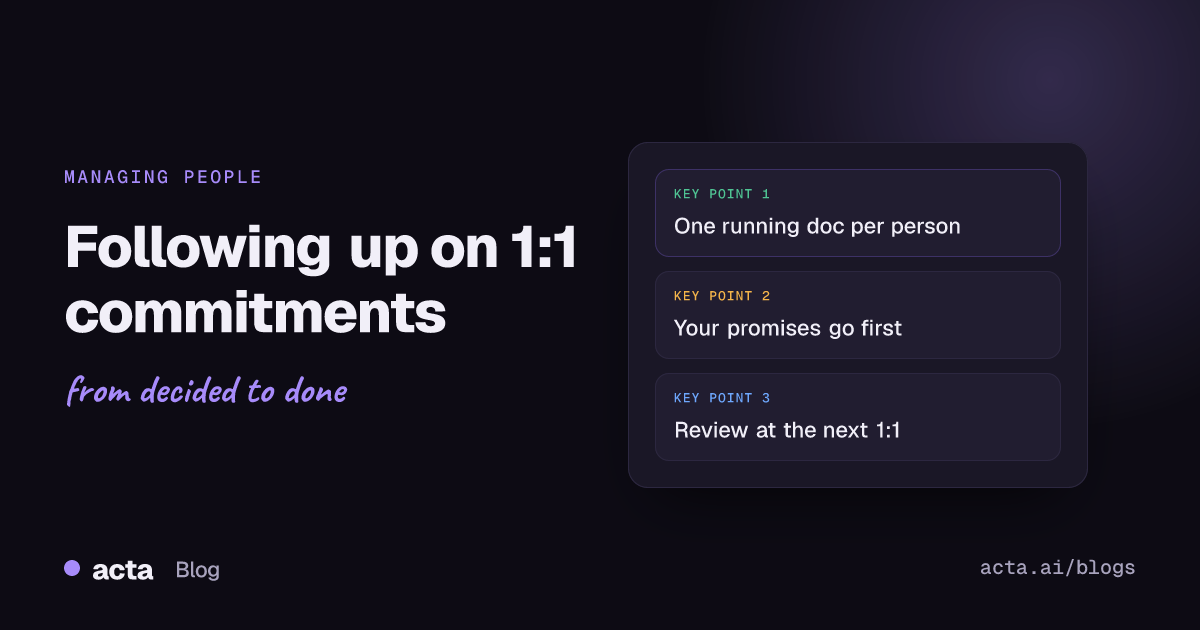
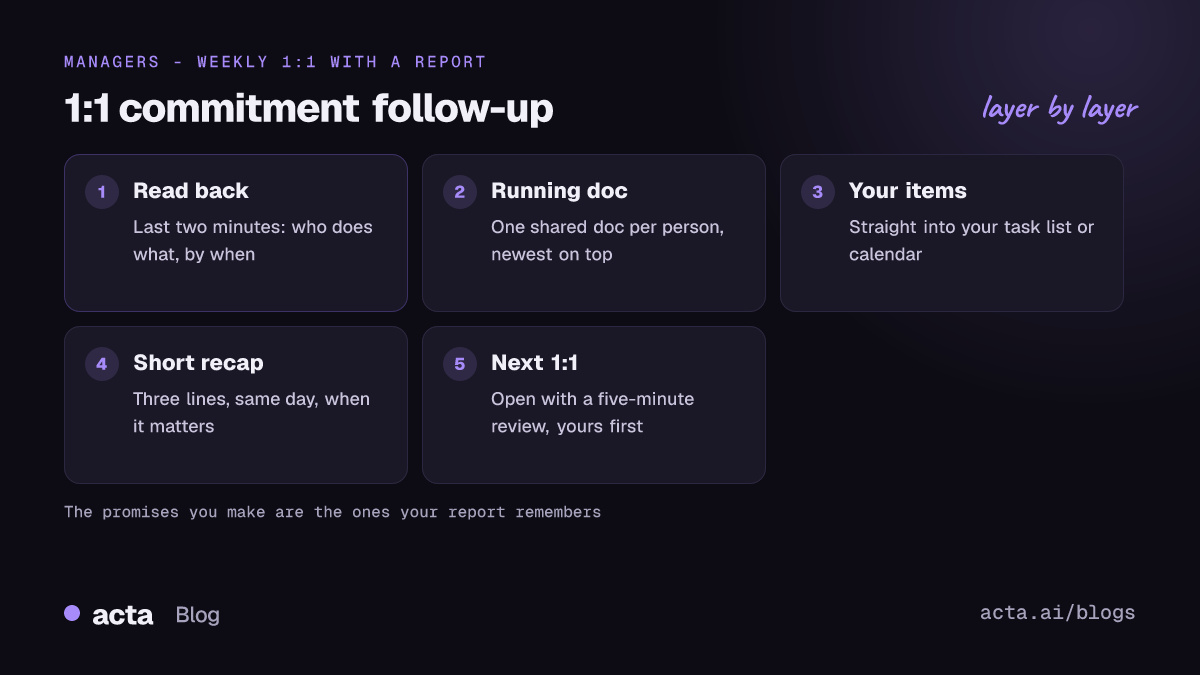
- Keep one running doc per person, shared with them. Newest meeting at the top.
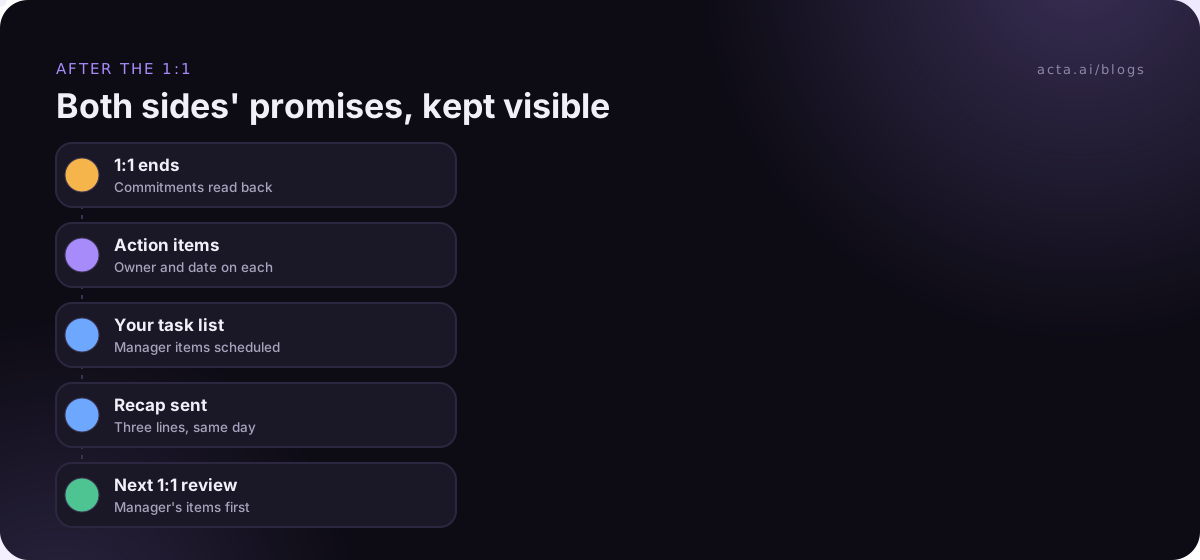
- Read back commitments in the last two minutes. "So you're sending the plan by the 20th, and I'm finding out about the backfill by Friday. Anything else?"
- Write each one with an owner and a date into the running doc before you hang up.
- Put your own items into your task list or calendar right away, not "later today."
- Send a short recap the same day if anything important was agreed.
- Open the next 1:1 by reviewing the list, yours first.
Gallup's guidance on managing teams recommends one meaningful conversation a week with each person, and says those can be fairly short once they're a habit. A weekly rhythm also gives your follow-up a natural home: commitments never go more than a week without being looked at.
What goes in a running 1:1 doc?
Keep the running 1:1 doc plain. A heading per meeting date, and under it:
Their topics
What they wanted to talk about. Put these first, because the 1:1 is their meeting more than yours.
Commitments
Each one as "who, what, by when." Mark them done, moved, or dropped at the next meeting rather than deleting them. Seeing a moved item move three times is useful information.
Things to come back to
Career questions, feedback you want to revisit, anything that needs more than one conversation. When review season comes, those notes make a performance review preparation checklist much quicker to work through.
Our one-on-one meeting notes template has a ready-made version of this layout, and the guide to one-on-one meeting notes covers what to capture during the conversation itself.
What should a follow-up email after a one-on-one say?
Not every 1:1 needs one. If nothing much was agreed, the running doc is enough. When something was, a follow-up email after a one-on-one takes two minutes and removes any doubt about what you both heard. Harvard Business Review's guide on how to lead your first one-on-one meeting suggests sending a follow-up after the session, and it's a good habit well past the first one.
Keep it to three lines:
Thanks for today. You: migration plan to me by the 20th. Me: I'll find out about the backfill by Friday and let you know either way, and I'll introduce you to Dana on the data team this week. Let me know if I've missed anything.
Notice "either way." If the answer on the backfill is no, they still hear back. A no delivered on time builds more trust than a yes that never comes.
How do you review commitments at the next 1:1 without it feeling like an audit?
Go first. Start with your own list: "Last week I said I'd find out about the backfill. Here's what I learned." Then ask about theirs. When the manager opens with their own homework, the review reads as mutual, not as an inspection.
A few other habits that keep it light:
- Ask about blockers, not status. "Anything in the way on the migration plan?" gets a better answer than "is it done?"
- Keep it to five minutes. Then move on to their topics.
- Make renegotiating normal. "I need another week" should be a fine answer, as long as it comes before the date, not after.
Why your own manager commitments matter most
Your report has maybe one manager. You may have eight reports. So the thing you promised in passing is one of eight small items on your list, and the single most important thing on theirs. They will remember it longer than you will.
A useful rule: don't promise in a 1:1 what you can't put a date on. "I'll look into it" is fine if you add "and I'll get back to you by Thursday." If you genuinely can't commit, say that instead: "I don't know if I can change this. I'll ask, and I'll tell you what I hear by end of month." That's honest, and it's trackable.
Also watch for the commitments that fade because they're uncomfortable. Pay discussions, a promotion case, a conflict with another team. Those are exactly the ones your report is waiting on, and silence on them is read as an answer.
What if 1:1 commitments keep slipping?
If it's their items, look at the pattern before the person. Are you agreeing to dates in the 1:1 that don't account for their actual workload? Are the items too big to start? Splitting "write the migration plan" into "outline by Tuesday" and "draft by the 20th" fixes a surprising number of slips. For more on the general version of this problem, see why action items don't get done.
If it's your items, be honest about it. Say so at the start of the next 1:1, give a new date, and keep it. Then make fewer promises. Two kept commitments a week beat five half-kept ones.
Should you record your 1:1s?
Sometimes, and only with clear agreement. 1:1s often cover personal and sensitive topics, and a recorder in the room changes what people are willing to say. My view: ask once, make "no" a perfectly fine answer, and offer to pause for anything personal.
Where it does work, it means you can pay attention to the person instead of typing, and the commitments come out written up afterwards. For video 1:1s, a desktop recorder captures the call from your computer without a bot joining, and it has a "Copy notice" button so you can paste a recording notice into the chat. For in-person 1:1s, a phone app can record the conversation; Acta's mobile apps do that. Whatever you use, check the consent rules that apply to you: our guide on whether it's legal to record meetings with AI covers the basics. This is general information, not legal advice.
Where Acta fits
Acta can record your 1:1s, if both of you are happy with that, and turn them into a summary and action items with owners, including the ones you took on. OneChat lets you ask things like "what did I promise Lena in the last month?" and shows the meetings the answer came from. It's a backup for the running doc, not a replacement for actually doing what you said.
Frequently asked questions
How do I keep track of 1:1 commitments with many direct reports?
Keep one running doc per person, and copy your own commitments from all of them into a single task list you check daily. The per-person doc is for the conversation; your task list is for actually doing things.
Should the manager or the employee take notes in a 1:1?
Either can, as long as the doc is shared and both can edit it. Many teams have the employee own the agenda and the manager own the commitments list. What matters is reading commitments back before you finish.
How soon should I follow up after a one-on-one?
Write commitments down before you hang up, and send a short recap the same day if anything significant was agreed. Your own items should go into your calendar or task list immediately.
What's a good one on one follow up when I can't deliver what I promised?
Tell them before the date passes, explain what happened, and give a new date or a clear no. Being late with an update is much worse than delivering bad news on time.
How long should the commitment review take in each 1:1?
About five minutes at the start. Go through your items first, then theirs, then move on to the topics they brought.
If you'd like your 1:1 commitments written up automatically, see what's on the Acta features page.