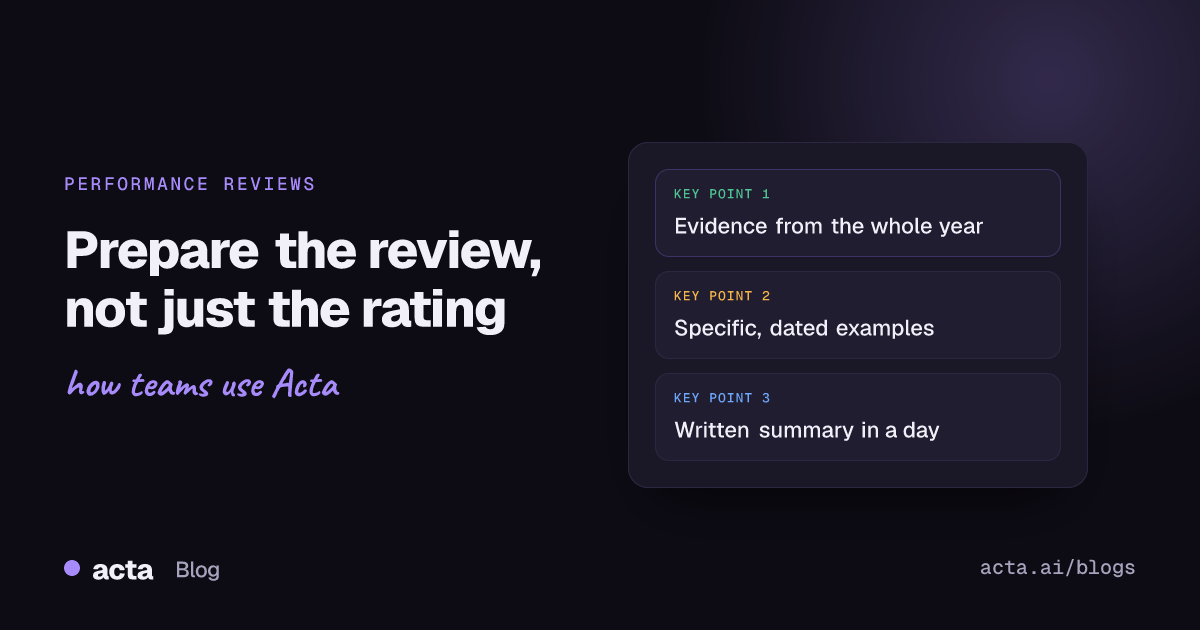
Quick answer: Good performance review preparation starts two weeks out. Gather evidence from the whole period, not the last month; write down three to five specific examples with dates; draft the rating and the one message you most want to land; share the self-assessment ahead of time; and plan the next goals. Afterwards, send a written summary within a day.
The performance review conversation itself is usually 45 minutes. The damage from a badly prepared one lasts much longer. An employee who hears "you need to communicate better" with no example walks out confused and a bit resentful. A manager who can't remember what happened in March ends up rating the last six weeks and calling it a year.
This checklist is for both sides of the table. Managers get most of it, because they run the meeting, but the employee's half matters just as much, and the best reviews I've been in were ones where both people did the homework.
Why does performance review preparation matter so much?
Because most people don't find reviews useful, and poor preparation is a big part of why. Gallup has reported that only 14% of employees strongly agree their performance reviews inspire them to improve, and in a separate piece, only 29% strongly agree their reviews are fair. A conversation built on vague impressions feels unfair even when the rating is right.
Preparation fixes the two most common problems. The first is recency bias: the manager remembers the last few weeks clearly and everything before that as a blur. The second is surprise: the employee hears criticism for the first time in the review. Both are avoidable if you start early.
Performance review checklist for managers: two weeks before
Two weeks gives you time to find evidence without rushing.
- Re-read the goals you set last time. What did you both agree success looked like? If the goals changed mid-year, note when and why.
- Go back through the whole period. Your one-to-one notes, project updates, shipped work, customer feedback, incident reports. If something in there needs a hard conversation, our guide to difficult conversations as a manager helps you prepare. Go month by month so March gets the same attention as November.
- Ask two or three peers for input. Ask specific questions: "What's one thing Sam did this half that made your work easier? One thing you'd want Sam to do differently?" Generic "any feedback?" emails get generic replies.
- Ask the employee for their self-assessment with a due date at least three days before the meeting, so you can read it properly.
If your one-to-ones are written up, this step takes an hour instead of a day. Our guide to one-on-one meeting notes shows a simple format, and if you record those meetings with the other person's agreement (see what to tell people before recording with AI), you can search the transcripts for specific moments instead of relying on memory. A Chrome extension or a desktop recorder handles that without a bot joining a private conversation.
What should you prepare one week before the review?
Pick three to five specific examples
Each one needs a date, what happened and why it mattered. The Situation-Behavior-Impact model from the Center for Creative Leadership is a good structure here, and Mind Tools has a clear explanation of SBI feedback. Describe the situation, the behavior you actually saw, and its impact on the team or the work.
"In the September pricing review, you walked the finance team through the churn data before anyone asked. That meant we made the call in one meeting instead of three."
That lands. "You're good at stakeholder management" doesn't.
Balance the examples across the period
Line them up by month. If four of your five are from the last six weeks, you've found your recency bias. Go back and look for earlier ones.
Draft the rating and the headline
Decide what the one thing is you most want the person to remember. If they forget everything else, what should stick? Write it in a sentence. It might be "you're ready to lead the next project on your own," or "the deadlines need to become reliable before anything else changes."
Check for surprises
Is anything in your review something the employee will hear for the first time? If so, that's a problem with the past year, not the review. You still need to say it, but acknowledge that you should have raised it sooner.
How should employees prepare for a performance review?
If you're the one being reviewed, the self-assessment is your best chance to make sure the full year counts.
- Keep a running list of wins, problems you solved and feedback you received. If you didn't do this all year, go through your sent mail, calendar and project tools now.
- Tie your work to outcomes. "Rebuilt the onboarding flow" is fine. "Rebuilt the onboarding flow; support tickets from new customers dropped noticeably over the next quarter" is better, as long as you can back it up.
- Name one or two things that didn't go well and what you learned. It reads as self-aware, and it takes the sting out if your manager raises them.
- Write down what you want next: a skill, a project, a promotion timeline. Reviews are often the only formal moment to ask.
- Submit it early so your manager has time to read it before they finish their own draft.
What does a good review conversation look like?
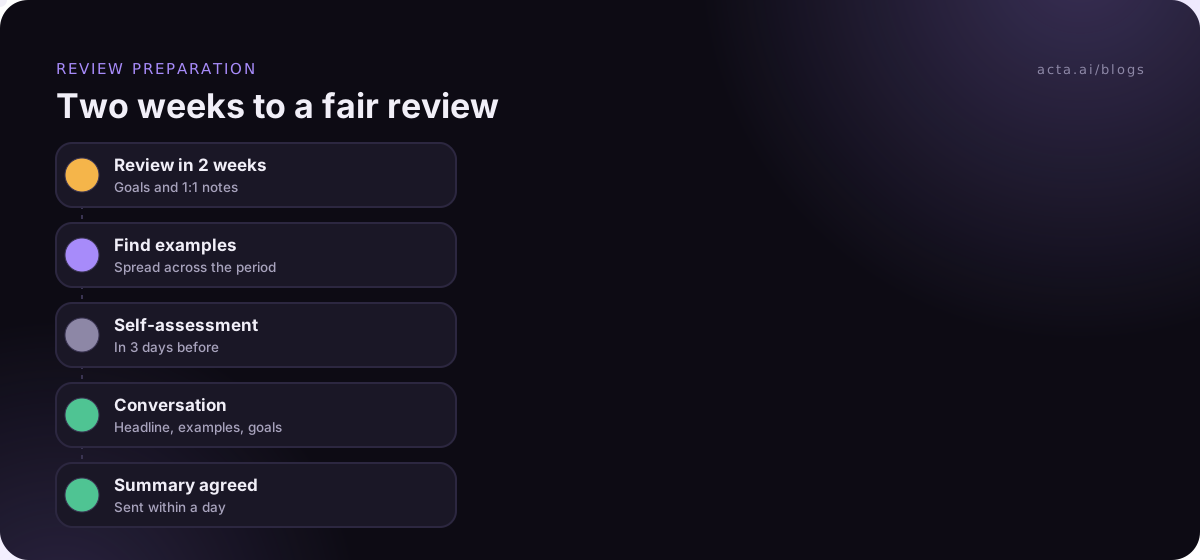
Here's a structure that works for most 45 to 60 minute reviews:
- Open with their view (10 minutes). "You've read your self-assessment more recently than I have. What stands out to you?" People take feedback better after they've been heard.
- Share the headline (5 minutes). Say the one sentence you prepared, then the rating if your company uses one. Don't make them wait to the end.
- Walk through the examples (15 minutes). Strengths first, then the areas to work on. Pause after each and ask what they think.
- Agree on development goals (15 minutes). Two or three, each with a way to tell whether it happened.
- Close with what happens next (5 minutes). When the written summary will arrive and when you'll check in on the goals.
Don't type during the conversation if you can help it. It signals you're half-listening, and in a performance review that's noticed.
What should you avoid in a performance review?
- The compliment sandwich. People see it coming and stop hearing the praise.
- Comparing them to a colleague by name. It creates a rivalry and tells them you'd do the same about them.
- Words like "always" and "never." They invite the person to find the one exception, and the conversation turns into an argument about it.
- Personality labels. "You're not a team player" is a judgment. "In the last two launches, you shipped without telling QA" is a behavior they can change.
- Negotiating pay on the spot if you don't have the authority. Say when you'll come back with an answer, and do it.
What should happen after the performance review?
Within a day, send a short written summary: the headline, the main examples, the rating if there is one, and the agreed development goals with dates. Ask the employee to reply if anything doesn't match their understanding. That reply is the most useful part, because misunderstandings surface while they're still small.
Then put the goals somewhere you'll both see them. A recurring item in your one-to-one agenda works. Check one goal a month rather than all of them at the six-month mark. Our post on why action items don't get done covers why "we'll revisit this" so often turns into nothing.
If you'd rather start from a written format than a blank page, browse Acta's report templates for one that fits your summary.
The full performance review checklist
For quick reference, here's everything above in one list:
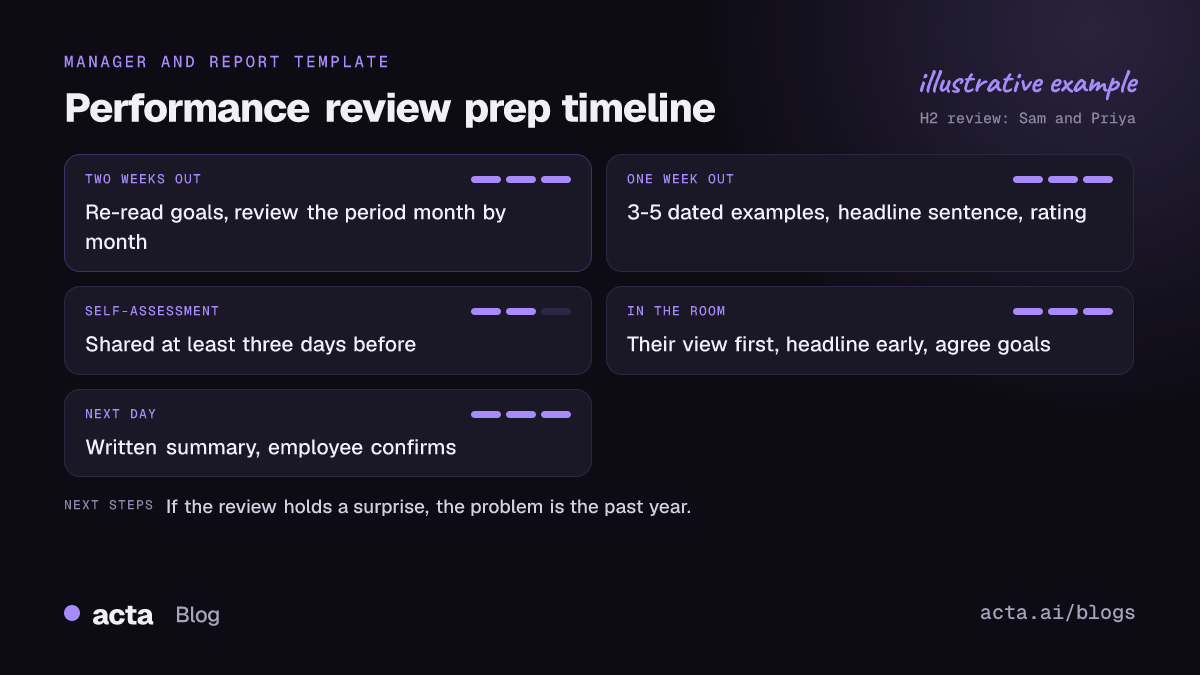
- Two weeks out: re-read goals, review the whole period month by month, ask peers specific questions, request the self-assessment.
- One week out: pick three to five dated examples, balance them across the period, draft the headline and rating, check for surprises.
- Employee: running list of wins, outcomes not tasks, one or two honest misses, what you want next, submit early.
- In the room: their view first, headline early, examples with pauses, two or three goals, next steps.
- After: written summary within a day, employee confirms, goals into the one-to-one agenda.
Where Acta can help
Most of the hard part of performance review preparation is finding evidence from months ago. Good one-on-one follow-up through the year makes that much easier. If your one-to-ones run through Acta, each has a transcript, summary and action items with owners, and OneChat can answer questions like "what did Sam and I agree about the pricing project in March?" with links to the meeting. It won't write the review for you, and it shouldn't.
Frequently asked questions
How far in advance should you prepare for a performance review?
Two weeks for a manager is comfortable: one week to gather evidence and one to draft. Employees should start their self-assessment at least a week ahead.
What should I write in a self-assessment?
Your main results tied to outcomes, one or two things that didn't go well and what you learned, and what you want to work on next. Keep it specific and short.
How do you avoid recency bias in a performance review?
Review the period month by month, aim for examples spread across the whole time, and use written notes from one-to-ones rather than memory.
Should performance reviews be recorded?
Usually not by default. Reviews are personal and people speak more freely without a recording. If you do record, get clear agreement first and keep access tight.
What if the employee disagrees with the review?
Listen, ask for their examples and note the disagreement in the written summary. If they bring evidence you missed, be willing to change your view.
If your one-to-ones aren't written up yet, a 15-day free trial of Acta covers enough meetings to have real notes ready before the next review cycle.