A good handover notes template gives the outgoing shift a fixed order to report in: what is running now, what changed, what is still open, what could go wrong, and who to call. Below are seven copy-ready templates for general shifts, job or leave handovers, nursing (SBAR and I-PASS), plant operations, IT on-call and support desks, with when to use each one.
Meeting Productivity 13 min read
Handover Notes Template: 7 Shift Handover Examples You Can Copy
Seven copy-ready handover notes templates for general shifts, leave cover, SBAR and I-PASS nursing, plant operations, IT on-call and support desks, with when to use each.
By Sarma BKP, Founder & CEO, Acta · Updated
This guide is for team leads, charge nurses, shift supervisors and on-call engineers who want handovers that don't depend on one person's memory at 6 a.m. It won't replace a regulated form your organisation already mandates. If your hospital, plant or control room has an approved handover sheet, use that and borrow only the habits from here.
Key takeaways
- Every handover note should answer five questions in the same order: status now, changes this shift, open items, risks and watch-outs, contacts.
- Write open items as "task, owner, deadline". "Check pump 3" is a reminder; "Ravi checks pump 3 seal by 10:00" is a handover.
- Do the handover face to face or on a call, then send the written note. The Joint Commission recommends face-to-face handoffs free from interruptions.
- Make the receiver read back the top risks before the outgoing person leaves. That's the "synthesis by receiver" step in I-PASS, and it works outside hospitals too.
- Keep the note to one screen. If it runs longer, the risks get buried under routine status.
Table of contents
- Every handover note answers the same five questions
- General shift and job handover notes templates
- Healthcare handover notes use SBAR or I-PASS
- Operations, on-call and support handovers put risk first
- Pick the handover notes template by what can go wrong
- Run the handover as a conversation, then write it down
- Where a meeting recorder helps with verbal handovers
- Frequently asked questions
- Set up your handover routine this week
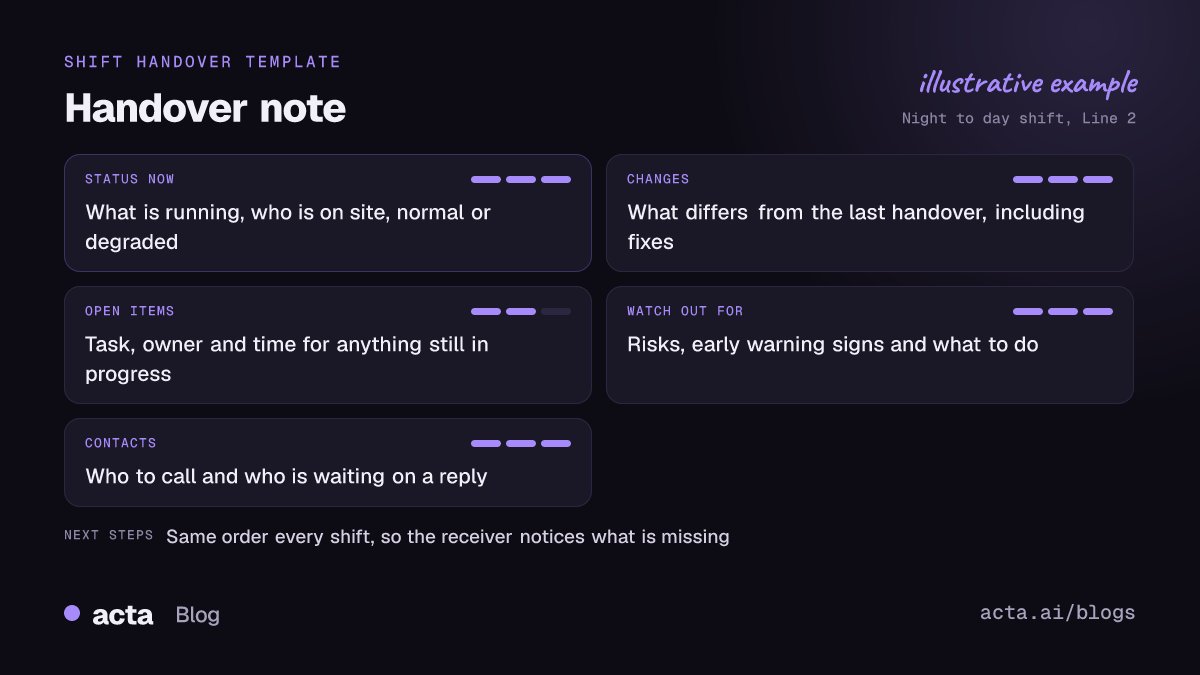
Every handover note answers the same five questions
Handover failures are rarely about missing data. The information usually exists somewhere: in a log, a ticket, someone's head. What fails is the transfer. The UK Health and Safety Executive's shift handover guidance points out that the Cullen Report into the Piper Alpha disaster identified a failure to pass on information at shift handover as one of the contributing factors. In healthcare, the Joint Commission's alert on inadequate hand-off communication links poor handoffs to events such as delays in treatment, falls and medication errors.
So the template's job is to force the transfer of the five things the next shift can't easily rediscover:
- Status now: what is running, who is on site, what state the system or ward is in.
- Changes this shift: anything that differs from the last handover, including things you fixed.
- Open items: tasks still in progress, each with an owner and a time.
- Risks and watch-outs: what could go wrong next and what the warning signs look like.
- Contacts: who to call, who is waiting on a reply, who promised what.
Every template below is a variation on this order. The order matters more than the exact headings: when people always report in the same sequence, the receiver notices when something is missing. I'd put risks above open items for any safety-critical shift, and below them for an office handover where a missed follow-up is the bigger danger.
General shift and job handover notes templates
Start with these two if you don't work in healthcare or a control room. They cover most office, retail, warehouse and agency shifts, plus the handover you write before going on leave.
Template 1: General shift handover template
When to use it: any team that hands over at a fixed time each day, such as a warehouse, front desk, operations centre or social media team.
Shift handover: [Team] / [Date] / [Outgoing] to [Incoming]
Status now: [one or two lines: normal, degraded, short-staffed]
What changed this shift: [3 bullets max]
Open items: [task] / [owner] / [due time] / [where the details are]
Watch out for: [risk, early warning sign, what to do]
Waiting on: [person or vendor] / [what] / [chased at what time]
Contacts tonight: [name, role, number]
Filled-in example for a warehouse: "Status: normal, one picker short until 14:00. Changed: dock 3 door repaired at 09:40. Open: Priya re-counts aisle 12 stock by 16:00. Watch out: courier pickup moved to 17:30, so pack the priority orders first. Waiting on: forklift service, chased at 11:00, promised a call back."
Template 2: Job or leave handover document
When to use it: you're going on holiday, parental leave or moving to another role, and someone covers your work for days or weeks. This is the job handover document people search for, and it needs more context than a shift note because the receiver can't ask you tomorrow.
Handover: [Your role] / [Cover period] / covered by [Name]
What I own: [projects, accounts, recurring reports]
In flight: [item] / [status] / [next step] / [deadline] / [link]
Recurring tasks: [task] / [how often] / [how-to link]
People to know: [name] / [why they'll contact you] / [what they usually need]
Decisions you can make: [scope of authority, spending limit, who to escalate to]
Do not touch: [things that look broken but aren't, or that need my sign-off]
Access: [shared drives, tools, how to request access]
The "Decisions you can make" line is the one people skip, and it's why covers end up emailing you on the beach. Spell it out. If you've had a handover meeting with the cover, paste the decisions and promises from it here, and link the notes. Our guide on sharing meeting notes with people who weren't there covers how to make those notes readable to someone joining cold.
Healthcare handover notes use SBAR or I-PASS
Clinical teams already have two well-known structures. SBAR is a framework the Institute for Healthcare Improvement describes for communicating about a patient's condition between members of the care team, credited to Kaiser Permanente (IHI SBAR toolkit). I-PASS was designed for patient handoffs between shifts. AHRQ's PSNet primer on handoffs describes the I-PASS study intervention as a bundle of the mnemonic, communication training and faculty development, and reports that it markedly reduced preventable adverse events linked to handoffs in teaching hospitals. Use your unit's approved sheet first; these templates show the structure.
Template 3: SBAR nursing handover sheet
When to use it: handing over one patient, escalating a concern to a doctor, or a bedside nurse-to-nurse handover.
S, Situation: [patient, bed, the problem in one sentence, when it started, how severe]
B, Background: [admitting diagnosis and date, relevant history, medications, allergies, lines, recent results]
A, Assessment: [what you found, what you think is going on]
R, Recommendation: [what needs doing, by whom, by when, what to escalate]
Example (fictional): "S: Bed 7, Mr K, 68, new confusion since 03:00. B: Day 2 after hip repair, on regular opioid analgesia, no known allergies. A: Obs stable, possible delirium or opioid effect. R: Review analgesia on the 08:00 round, repeat neuro obs hourly, call the registrar if it gets worse." Keep the SBAR handover to what the next nurse must act on; the full history lives in the record.
Template 4: I-PASS handover for shift change
When to use it: structured shift-to-shift handover for a whole patient list, especially in teams that have been trained on I-PASS.
I, Illness severity: [stable / watcher / unstable]
P, Patient summary: [diagnosis, key events, current plan]
A, Action list: [task / owner / time]
S, Situation awareness and contingency: [if X happens, do Y]
S, Synthesis by receiver: [receiver repeats the key points and asks questions]
The last S is what most home-made templates leave out. The receiver says back, in their own words, what they're worried about. It catches the "I thought you meant tomorrow" errors. For huddles that cover a whole team rather than single patients, see our guide to care team huddle notes.
Operations, on-call and support handovers put risk first
In a plant, a data centre or a support queue, the expensive failure is a risk the next shift didn't know about. These three templates lead with it. The Energy Institute's human factors briefing note on communications recommends clear procedures or written guidance for shift handover, and lists little or no monitoring of handovers as a common failing. A written template is the simplest version of that procedure.
Template 5: Plant or production shift log handover
When to use it: manufacturing lines, process plants, utilities, facilities maintenance.
Safety first: [incidents, near misses, open permits to work, isolations in place]
Equipment status: [running / down / degraded, with reason]
Production: [output vs plan, quality holds, batch numbers]
Maintenance: [work in progress, parts awaited, who is on it]
Abnormal conditions: [alarms overridden, temporary bypasses, readings to watch]
Next shift must: [task / owner / time]
Example: "Safety: permit 117 hot work open in Bay C until 12:00. Equipment: press 4 down, guard sensor faulty, Marco on it. Quality: batch 2231 on QA hold, Dana to release or scrap. Abnormal: line 2 vibration alarm acknowledged twice, check bearing temperature hourly." Overridden alarms and temporary bypasses are the items most worth writing down, because they look normal on the panel.
Template 6: IT on-call handover
When to use it: on-call rotations, NOC shifts, follow-the-sun support between time zones.
Open incidents: [ID / severity / current state / next action / owner]
Noisy alerts: [alert / why it fires / safe to ignore until]
Changes in the window: [planned changes, freezes, rollbacks done]
Customer impact: [who is affected, status page state, last update sent]
Escalation: [secondary on-call, vendor contacts, ticket refs]
If your team already writes incident and change-board minutes, the formats in our IT meeting minutes template examples slot in as attachments to this handover.
Template 7: Support desk handover
When to use it: customer support, contact centres and help desks that run more than one shift.
Queue: [backlog size, oldest ticket, any SLA close to breach]
Escalations: [ticket / customer / what they were promised / by when]
Known issues: [bug or outage / workaround / macro to use]
Callbacks owed: [customer / time / who promised it]
"What they were promised" is the column that prevents the worst support moments: the customer who was told "we'll call you at 9" and nobody did.
Pick the handover notes template by what can go wrong
Choose the handover notes template by the failure you most want to avoid, not by job title. A hospital admin team might do better with Template 1 than with SBAR.
| Template | Best for | Leads with |
|---|---|---|
| 1. General shift | Office, retail, warehouse | Status and open items |
| 2. Job or leave | Cover for days or weeks | Ownership and authority |
| 3. SBAR | One patient or one escalation | The problem now |
| 4. I-PASS | Whole patient list at shift change | Illness severity |
| 5. Plant log | Production, utilities | Safety and permits |
| 6. IT on-call | Rotations, NOC | Open incidents |
| 7. Support desk | Help desks, contact centres | Promises to customers |
One rule of thumb: if a missed item could hurt someone, lead with risk. If it would only annoy someone, lead with open items.
Run the handover as a conversation, then write it down
A template on its own isn't a handover. The written note is the record; the conversation is where the receiver asks "wait, which pump?" The Joint Commission alert summarised by PSNet recommends face-to-face handoffs in places free from interruptions and training for both the sender and the receiver. Here's a routine that works on a ward, a plant floor or a video call.
- Fill the template before the handover, not during it. Ten minutes before the end of the shift, update the note while it's fresh.
- Meet at a fixed time and place. Same room, same call link, every day. A standing time stops handovers being squeezed into the car park.
- Walk the note top to bottom. Risks first if it's a safety-critical shift. Don't skip "nothing to report" lines; say them out loud.
- Receiver reads back the top three items. Owner, time and the warning sign for each.
- Agree changes and send the final note. Anything added in the conversation goes into the note before the outgoing person leaves.
- Store it where the next shift will look. A shared log, the ticket system or a team channel. Not in someone's personal email.
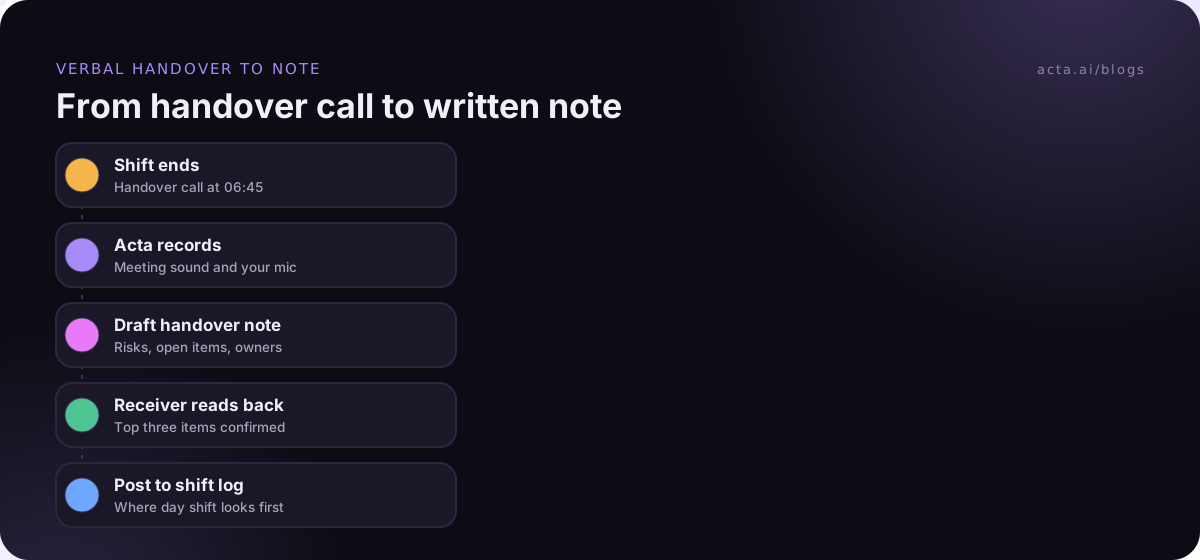
Remote teams that hand over on a video call can record that call and turn it into the written note afterwards. If you do, tell everyone it's being recorded and why; our guide on recording meetings with AI and what to tell participants covers consent. In clinical settings, follow your organisation's rules on patient information before recording anything.
Common handover mistakes
- Everything is "fine": the note lists routine status and hides the one abnormal reading. Fix it with a mandatory "watch out for" line that can't be blank; write "none" if there's truly nothing.
- Tasks without owners: "chase the supplier" gets done by nobody. Every open item needs a name and a time.
- Copy-paste drift: yesterday's note gets copied forward, and stale items survive for a week. Clear the open-items section each shift and re-add only what's still true.
- Handover by chat message only: fine for a quiet night, risky for a busy one. If anything is unstable, talk.
- No read-back: the outgoing person leaves believing the risk was understood. Ask the receiver to repeat it.
Troubleshooting a handover that keeps failing
If the same kind of item keeps getting dropped, add a dedicated line for it rather than a reminder to "be careful". If handovers keep running long, the note is too detailed: move routine readings into the log and keep the note to exceptions. If nobody reads the note, store it where people already look at the start of the shift.
Where a meeting recorder helps with verbal handovers
For handovers that happen on Zoom, Teams or Meet, Acta can record the call and draft the note with decisions and action items with owners, and you can shape the output with one of its report templates. If a bot in the call would be odd, the Acta desktop app records the meeting's sound and your microphone from your own computer, and has a Copy notice button to tell others you're recording. For a handover at the nurses' station or on the shop floor, the mobile app records in-person conversations. You still own the final note: check every owner and time before you send it.
Frequently asked questions
What should be included in handover notes?
Include the current status, what changed during the shift, open tasks with an owner and a deadline, risks and early warning signs, and who to contact. For clinical handovers, use SBAR or I-PASS headings. For a job or leave handover, add what you own, the decisions your cover can make, and where to find access and how-to guides.
What is the difference between SBAR and I-PASS?
SBAR (Situation, Background, Assessment, Recommendation) is a general structure for communicating about one patient or escalating a concern. I-PASS (Illness severity, Patient summary, Action list, Situation awareness, Synthesis by receiver) was built for shift-to-shift handoffs and adds an explicit read-back by the receiver. Many units use SBAR for escalation and I-PASS for shift change.
How long should a shift handover take?
There's no universal number; it depends on how many patients, systems or open items you hand over. Aim for a handover where every risk and open item gets discussed and the routine status gets one line. If it regularly overruns, move routine readings into the log and keep the handover to exceptions and actions.
Is a written handover enough, or do we need to talk?
For a quiet shift with nothing unstable, a written note may be enough. When something is at risk, talk it through as well. The Joint Commission recommends face-to-face handoffs free from interruptions, and a spoken handover lets the receiver ask questions and read back the key items before the outgoing person leaves.
How do I write a handover document before going on leave?
List what you own, everything in flight with its next step and deadline, recurring tasks with how-to links, the people likely to contact your cover, the decisions your cover may make, and anything they shouldn't touch. Walk through it in a short meeting, then share the final document and the meeting notes in one place.
Set up your handover routine this week
You don't need new software to fix handovers. You need one template, one time and one rule about read-backs. Use this handover checklist to get started:
- Pick one template: choose from the seven above based on what can go wrong in your shift, and copy it into your shared log.
- Fix the time and place: same room or call link every shift, with ten minutes protected for it.
- Make risks mandatory: the "watch out for" line is never blank.
- Add the read-back: the receiver repeats the top three items before the outgoing person leaves.
- Review after a month: look at what got dropped and add a line for it.
If your handovers happen on calls, try the Acta desktop app during the 15-day free trial and see whether the drafted notes save your team the retyping.
Found this useful? Share it with your team.